
Glossary
Media buying
Definition
Media buying is paying for ad space, time or impressions on sites, apps, social platforms, search, TV or billboards so an ad reaches the right people at a price that pays off. Agencies buy with client money for a fee; affiliates buy with their own and keep the margin.
Also called: media buy, ad buying, paid media buying, affiliate media buying.
Media buying is purchasing ad space, time or impressions from the places where people see ads: websites, apps, social platforms, search, TV, radio and billboards. The goal is to put an ad in front of the right audience at a price that pays off. A media buy is one such purchase: the placement, the dates, the volume and the price, either agreed in an insertion order or won in an auction.
The same purchase is judged in 2 ways. A brand's buyer is judged on delivery and price: did the ads run where agreed, to whom and at what CPM. An affiliate buyer is judged on profit: did the traffic earn back more than it cost. The auctions and platforms are often the same. The question at the end of the month isn't.
Media buying vs media planning
Planning comes first, buying second. In Amazon Ads' guide, "Media planning is the precursor to media buying", the research that decides where, when and to whom to advertise, and "Media buying is putting the media plan into action". At large agencies these are 2 jobs held by different people. At small agencies and in affiliate teams, one media buyer does both.
How a media buy works
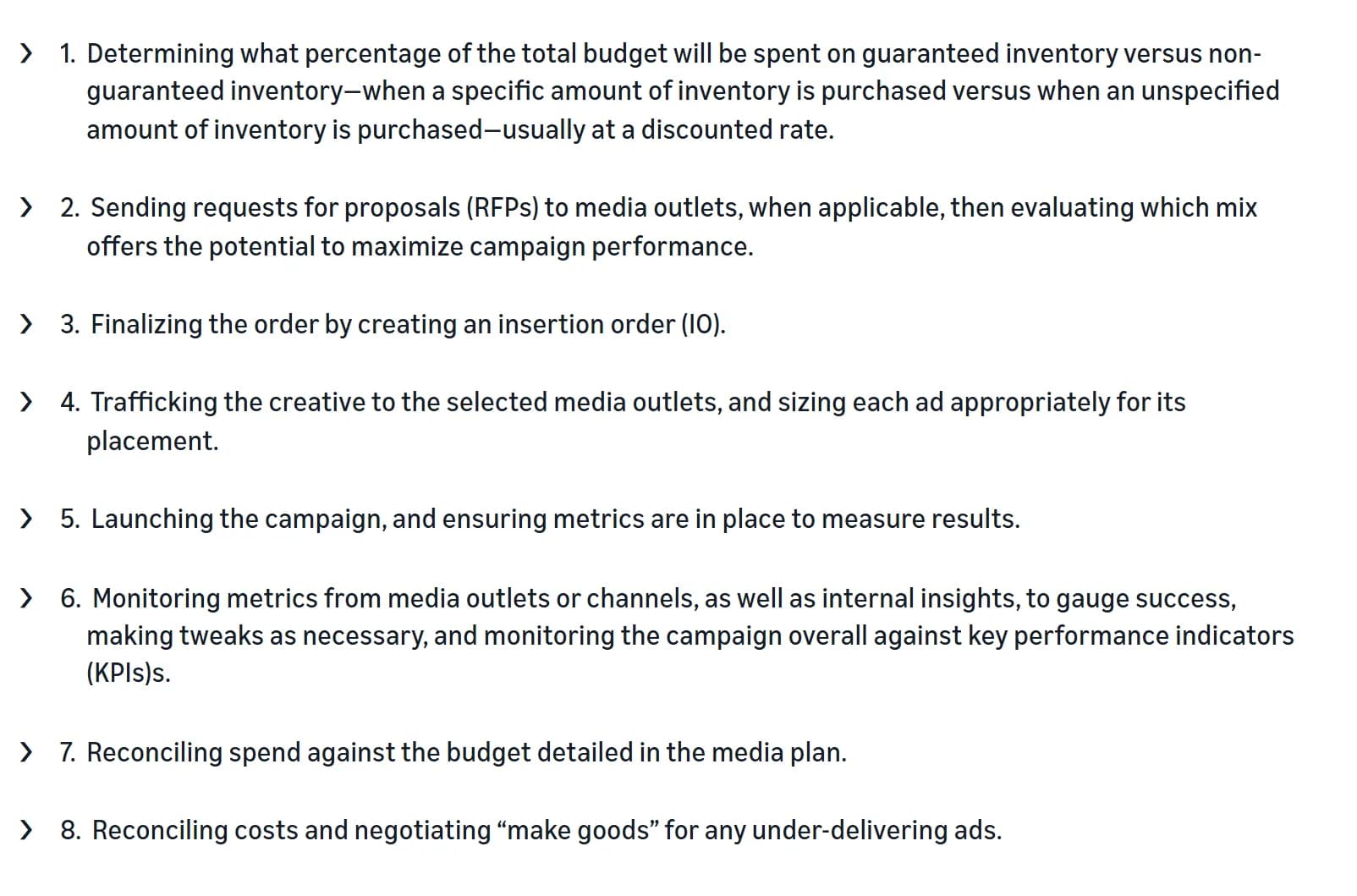
The classic agency buy has 8 steps. Amazon Ads lists them, from splitting the budget between guaranteed and non-guaranteed inventory, through requests for proposals and the insertion order, to reconciling spend and negotiating "make goods" for ads that didn't deliver:
An affiliate buy is shorter, and it loops. There's no proposal and no order to sign:
- Pick an offer and a GEO.
- Open an account with a traffic source and top it up.
- Connect a tracker to the affiliate network by postback.
- Launch on a test budget.
- Read the results by placement and creative, cut what loses and scale what pays.
- Reconcile the network's payouts against the spend, then start again with the next offer, GEO or angle.
The other differences follow from whose money it is. An agency spends the client's approved budget and is judged on delivery against the plan; an affiliate spends their own or the team's money and is judged on revenue minus spend.
3 ways to buy: direct, programmatic and self-serve
Direct means a deal with 1 publisher. Amazon Ads defines it as "Purchasing ads directly with a specific channel or publisher": a sponsorship, a homepage takeover, a TV spot, a newsletter slot. The price is negotiated, the volume is guaranteed and the paperwork is an insertion order.
Programmatic means software does the buying. In Amazon's words, "Using technology to buy and sell digital ads". Google Ad Manager's help center names 4 programmatic transaction types, from the most committed to the least:
- Programmatic Guaranteed: "fixed-price transactions with a pre-committed set of inventory that is negotiated with a single buyer".
- Preferred Deal: "fixed-price, pre-auction transactions that the publisher negotiates with specific buyer(s)".
- Private Auction: "auction-based transactions with specific buyer(s) that are allowlisted by company".
- Open Auction: "auction-based transactions for inventory available to all buyers", the real-time bidding most people picture.
Programmatic is already most of the market. Dentsu's forecast of December 3, 2025 puts digital at 68.7% of global ad investment in 2026 and expects programmatic to take more than 80% of that digital spend.
Self-serve is where most affiliates buy. Meta, Google Ads, TikTok and ad networks sell impressions and clicks through their own auctions to anyone with an account and a card. These auctions don't simply sell to the highest bid. Meta's description: "Unlike traditional auctions that pick a winner based on the highest bid, Meta's auction system looks at a number of factors equally to determine which ad is displayed". Besides the bid, it weighs how likely a person is to act and the ad's quality, so a cheaper ad that people respond to can beat a bigger bid.
What you pay for: CPM, CPC and CPA
The pricing model decides who carries the risk.
- CPM, per 1,000 impressions. The buyer carries the risk that nobody clicks. Display, video, social, popunder and push are sold this way.
- CPC, per click. The buyer still pays for clicks that don't convert. Search, native and social.
- CPA, CPL or CPI, per sale, lead or install. The seller carries the risk. Affiliate offers and some app and lead campaigns.
- Flat fee, per placement and period. Sponsorships, takeovers, TV.
Affiliates sit in the middle of that list. They usually buy traffic on CPM or CPC and get paid by the advertiser on CPA, RevShare or a hybrid of the 2. Their profit is the gap between those 2 prices.
A worked example. These are round numbers for illustration, not a real campaign. $5,000 at a $2.50 CPM buys 2,000,000 impressions. At a 0.5% click-through rate that's 10,000 clicks, $0.50 each. If 2% of the people who click convert, you get 200 conversions at $25 each. If the offer pays $30 per conversion, revenue is $6,000 and profit $1,000, a 20% ROI. If it pays $20, the same buy loses $1,000. A media buy is a bet on conversion rates, paid for at the price of impressions, and you learn the answer after the money is spent.
Where to start buying traffic
HilltopAdsRecommended


See the full ranking: 15 Best Popunder & Popup Ad Networks to Buy Traffic (2026)
Where media is bought: the platforms
Media buying platforms fall into 4 groups:
- Self-serve social and search: Meta Ads Manager, Google Ads, TikTok Ads Manager, Microsoft Advertising. Anyone with an account can buy; Microsoft Advertising states "No minimum fee".
- Demand-side platforms (DSPs): The Trade Desk, Google Display & Video 360, Amazon DSP, StackAdapt. Mostly agencies, trading desks and large advertisers. In Display & Video 360, "Multiple Display & Video 360 advertisers generally exist underneath a single partner", an agency or trading desk. StackAdapt has no minimum spend, but self-serve access is "subject to an application and approval process".
- Native networks: Taboola, MGID. Self-serve; MGID asks for a $100 minimum deposit and recommends at least $650.
- Popunder, push and in-page networks: PropellerAds, Adsterra, HilltopAds, Galaksion. Self-serve, with $50 to $200 minimum deposits by card in our October 2026 check.
The last 2 groups are where most small affiliate tests start, because the entry ticket is a deposit, not a contract. Our catalog of traffic sources lists each network's formats, models and minimums, and we ranked the best push ad networks and best popunder networks separately.
Most of the money goes through 3 sellers. WPP Media's midyear 2026 forecast expects global advertising revenue, excluding US political ads, to grow 8.9% in 2026 and reach $1.3 trillion, with "the top three sellers outside China (Alphabet, Meta, and Amazon)" controlling 57.6% of the market.

The 2 forecasts don't add up to one market size: WPP Media counts advertising revenue without US political ads, while Dentsu counts ad investment and puts 2026 just above $1 trillion.
Who buys media: agencies, brands and affiliate teams
Agencies buy with client money. The largest sit inside 5 holding companies: WPP, Publicis Groupe, Omnicom, Dentsu and Havas. Older lists name a "big 6", but on November 26, 2025 Omnicom completed its acquisition of Interpublic, with a pro forma combined revenue "in excess of $25 billion".
Agencies used to take 15% of what they bought. Research summarized by UCLA Anderson Review describes agencies being paid a 15% commission on the media they bought from the 1880s to the 1980s: "the 15% media commissions nevertheless persisted until the 1980s". Today, according to the ANA's Trends in Agency Compensation survey, "fees, particularly labor-based fees, are the most dominant method of compensation today".
Brands also buy for themselves. Self-serve platforms let a brand run its own campaigns without an agency, and many in-house teams do exactly that, especially in e-commerce.
Affiliate teams buy with their own money. A media buying team pays for traffic up front and earns the advertiser's payout for each conversion, so every unprofitable day comes out of its own pocket. Our catalog of media buying agencies and teams lists 62 of them as of November 11, 2026: 51 run traffic from Meta, 27 from Google Ads or other PPC and 12 from TikTok; 37 work in gambling, 21 in nutra, 14 in finance and 13 in e-commerce. Of the 43 that publish their headcount, the median is 50 people, and 15 have 100 or more.
Media buying examples with real numbers
Here are 3 buys from cases we've fact-checked, at 3 very different scales.
1. A $120 popunder test. Alukard_X, a long-time forum member, bought 4 days of popunder traffic on PropellerAds, shown only to Windows desktops with gaming graphics cards, and sent it to a free-to-play football game paying around €1.80 per active player. He spent $120.04 on 270,854 impressions, a $0.443 CPM. On the last day of traffic the campaign was 57% down. 2 weeks later it had 156 players, $311.54 of revenue, $191.50 of profit and a 160% ROI: 130 of the 156 conversions arrived after he stopped paying for traffic. Our fact-check of the case has the tracker data by day.

2. A solo buyer's month on Facebook. Robb, a solo buyer who publishes a monthly income diary, ran 2 gambling offers in 1 tier-3 GEO on Facebook in May 2026, through agency accounts that charge 7% of every top-up. $5,364.44 of ad spend brought $9,245 of revenue from players' first deposits, a 72% ROI on spend. Then came $1,006.34 of other costs: $394.80 in agency fees, $399 for the progressive web app he sent traffic to and $212.54 for tools. Profit earned in May: $2,874.22, about 45% on everything he paid out. Costs outside the ad account took a quarter of gross profit. Our fact-check reconciles every line.
3. A team's month. In September 2026, DEVILS, a media buying holding that also invests in other teams, published the numbers of a Facebook iGaming team it had funded. Its starting month: $585,000 of ad spend, $720,000 of revenue and $135,000 of gross profit, a 23% ROI. Then about $31,000 of operating costs and about $67,000 of bonuses to buyers and team leads, half of gross profit. Net profit: $36,000, 5% of revenue. We looked at what that means for growth in why most affiliates never scale past $10K a month.
Side by side, ROI on ad spend falls from 160% to 72% to 23% as the buy grows from $120 to $5,364 to $585,000, and more of what's left goes to things that aren't ads: nothing reported in the test, a quarter of gross profit in fees and tools for the solo buyer, half of gross profit in bonuses for the team. My advice: whichever side you're on, start with the last line, not the first.
Media buying on Meta ads
On Meta, the auction is the media buy. There's no order to negotiate. You pick an objective, an audience, a budget, placements and creatives, and the auction prices every impression. Meta now automates much of that: Advantage+ promises to "Increase efficiency by automatically applying AI across your campaign's audience, placement and budget." What's left for the buyer is the offer, the creative, the account structure and the tracking that tells the algorithm what a good result is.
Some verticals need permission before the first impression. Meta allows online gambling ads only from ad accounts that have obtained authorization, with evidence that the gambling is licensed or lawful in the target country, and authorization is required for affiliate and aggregator sites too. That's one reason gambling affiliates often run traffic through agency accounts rather than their own.
Sources
- Amazon Ads: A complete guide to media buying (definition, planning vs buying, the 8 steps, direct vs programmatic)
- Google Ad Manager Help: transaction types (programmatic guaranteed, preferred deal, private auction, open auction)
- Meta for Business: about the ad auction
- Meta for Business: Meta Advantage+
- Meta advertising standards: online gambling and games (authorization required)
- Dentsu: Global ad spend set to surpass $1 trillion for the first time in 2026 (December 3, 2025)
- WPP Media: This Year Next Year 2026 Global Midyear forecast
- Omnicom completes acquisition of Interpublic (November 26, 2025)
- UCLA Anderson Review: The long history of middlemen earning a lucrative fixed commission (September 15, 2021)
- ANA: Trends in Agency Compensation, 18th edition
- Microsoft Advertising: no minimum fee
- Display & Video 360 Help: partners and advertisers
- StackAdapt: plans and packages (no minimum spend, self-serve access by application)
- MGID: pricing and billing model ($100 minimum deposit)
- PropellerAds: Our Community Shares: How Alukard_X Hit 160% ROI With Zero Optimization (October 19, 2026, updated October 20)
- Alukard_X: Case Study UFL F2P football game, his own post (October 7, 2026)
- Robb: How much I earned in traffic arbitrage in May? (Record), the case video (July 2, 2026)
- DEVILS: $100K offer case result, with the case document (September 4, 2026)
- DEVILS: full text of the case with comments (September 4, 2026)
Related terms
Articles that mention Media buying
- GuideTikTok Ads for Affiliate Marketing in 2027: What TikTok Allows, What It Costs to Start and the 3 Programs People Confuse
- ReviewShopify Affiliate Program Review 2026: $150 or $25 per Store and the Terms Behind It
- Case fact-check$2,837 in 34 Days, 85% on 2 Exam-Result Days: Adsterra's Pakistan Publisher Case, Fact-Checked
- Top list12 Top Affiliate Media Buying Teams in 2026: Who They Are and What They Show
- GuideThe Media Buying Stack in 2026: Every Layer, What It Does and What It Costs
- Case fact-checkA Media Buying Team Lost $29K on TikTok in 2 Months: The Owner's Post-Mortem, Fact-Checked
Show more (20)
- Case fact-checkWhy a Media Buying Team Closed Its Nutra Department After 21 Months: The Write-Up, Fact-Checked
- Case fact-check$100K Into a Media Buying Team, Net Profit Up 181%: Fact-Checking the DEVILS Case
- AnalysisWomen in Affiliate Marketing 2026: 45 Leaders of Networks, iGaming Programs and Media Buying Teams, Graded by Proof
- AnalysisCan You Study Affiliate Marketing at University? We Read the Syllabi
- AnalysisThe Richest Affiliate Marketers in the World, Ranked by Receipts, Not Instagram
- NewsAsian Gaming Congress 2027 in Manila: Newport, DigiPlus, Jade and PCSO Take the Stage
- NewsPrediction Markets Summit Europe 2026: Gibraltar Licensed the New Vertical. Can Affiliates Sell It?
- AnalysisHow Antidetect Browsers Get Caught in 2026: The Signals That Give a Profile Away
- ReviewDonut Browser Review 2026: An Open-Source App, a Closed Engine and a Free Plan for Personal Use
- ReviewixBrowser Review 2026: Unlimited Profiles for $3.99 and a Kernel 5 Versions Behind
- Top listBest Antidetect Browser for Media Buyers 2026: Our Top 15, Ranked and Explained
- ReviewDolphin{anty} Review 2026: Hands-On Take on Fingerprints, Pricing and What Actually Breaks
- ReviewLinken Sphere Review 2026: Pricing, Local API, Use Cases and Privacy After Hands-On Use
- AnalysisAntidetect Browsers for Media Buyers 2026: Real Differences Between Dolphin, AdsPower, Octo, GoLogin & Linken Sphere
- ReviewNodeMaven Review: Clean IPs for Ad Accounts and a Scraping Browser for Scripts and AI Agents
- AnalysisWhy Most Affiliates Never Scale Past $10K a Month: The Ceiling Is Cash, Caps and Accounts, Not Talent
- GuideAffiliate Link Management: Programs Move, Domains Burn, Affiliates Pay
- ReviewAdsPower Review 2026: Honest Take After Hands-On Use, From Pricing and Automation to the 2025 Extension Hack
- ReviewMGID Review 2026 for Advertisers: $100 Deposit, CPC Bidding, Whitelists and API
- GuideHigh-Ticket Affiliate Marketing in 2026: 30 Programs, Real Terms and Honest Math
Questions about Media buying
What is media buying in simple terms?
Paying for ad placements, such as impressions, clicks or time slots, on websites, apps, social platforms, search, TV or billboards, so that an ad reaches the right people at a price that pays off.
What is the difference between media planning and media buying?
Planning decides where, when and to whom to advertise and how to split the budget. Buying puts that plan into action: negotiating or bidding for the placements, launching, monitoring delivery and reconciling the spend.
Can you give an example of media buying?
An affiliate spent $120.04 on 270,854 popunder impressions on PropellerAds, a $0.443 CPM, sending them to a free-to-play game that paid around €1.80 per active player. 156 players later, the buy had returned $311.54, a 160% ROI.
What is programmatic media buying?
Buying digital ads through software instead of a direct deal with a publisher. It ranges from programmatic guaranteed deals, with a fixed price and inventory negotiated with 1 buyer, to the open auction, where any buyer can bid. Dentsu expects programmatic to take more than 80% of digital ad investment in 2026.
How do media buying agencies get paid?
Mostly with fees today. Agencies were paid a 15% commission on the media they bought until the 1980s; the ANA's agency compensation survey now names fees, particularly labor-based fees, as the dominant method.
What is media buying in ecommerce?
The same work, done for an online store: buying ads on Meta, Google, TikTok and marketplaces like Amazon to bring in buyers. The test is whether the margin on each order covers the cost of getting it, so store owners track return on ad spend and cost per acquisition by channel.
What is media buying in marketing?
The execution part of paid marketing. Strategy and planning decide the audience, message and budget; media buying turns that into placements, bids and campaigns and is measured on what those placements deliver.
Is media buying worth it?
When the math works. The 3 buys above earned 23% to 160% on ad spend, but published case studies skew toward winners, and many tests lose money. Before you spend, know the payout, your break-even cost per conversion and the costs outside the ad account.