

Glossary
CPA
Definition
CPA, cost per action, is both a payment model and a metric. As a model, the advertiser pays a fixed amount per action: a lead, an install, a deposit or a sale. As a metric, it's what an action cost you: spend divided by actions. CPA marketing is affiliate marketing paid this way.
Also called: cost per action, cost per acquisition, CPA marketing, pay per action.
CPA, cost per action, means 2 things, and you need both. As a payment model, the advertiser pays a fixed amount for each agreed action: a sale, a first deposit, a registration, a lead, an install. As a metric, CPA is what one action cost you: spend divided by actions. An iGaming campaign that spent $3,180 for 318 first deposits has a CPA of $10 per deposit; if the offer pays $40 per deposit, the campaign earns $30 on each.
CPA marketing is affiliate marketing paid by the first meaning and run by the second. The advertiser sets the payout, you buy the traffic, and whether you make money depends on one comparison: your cost per action against the payout, minus the actions that won't be approved. This page covers how that works, what CPA offers pay, the math, and where CPA traffic comes from, with numbers from campaigns we've reviewed.
What is CPA marketing?
CPA marketing is promoting offers that pay per action, not per click or per impression. The advertiser decides what counts as an action and how much it pays, and you are paid only for the actions that pass its checks. Most affiliate offers work this way: as of November 13, 2026, 125 of the 193 affiliate networks and programs in our catalog without a scam flag pay CPA, against 98 that pay RevShare.
There are 4 parties:
- The advertiser, the brand that owns the product. It sets the payout, the GEOs, the allowed traffic and the cap on actions.
- The CPA network, or the brand's own affiliate program. It gives you a tracking link, counts the actions and pays you.
- You, the affiliate, who brings the traffic: your own site or channel, or traffic you buy from an ad network.
- The visitor, whose action is what everyone is paid for.
How CPA marketing works
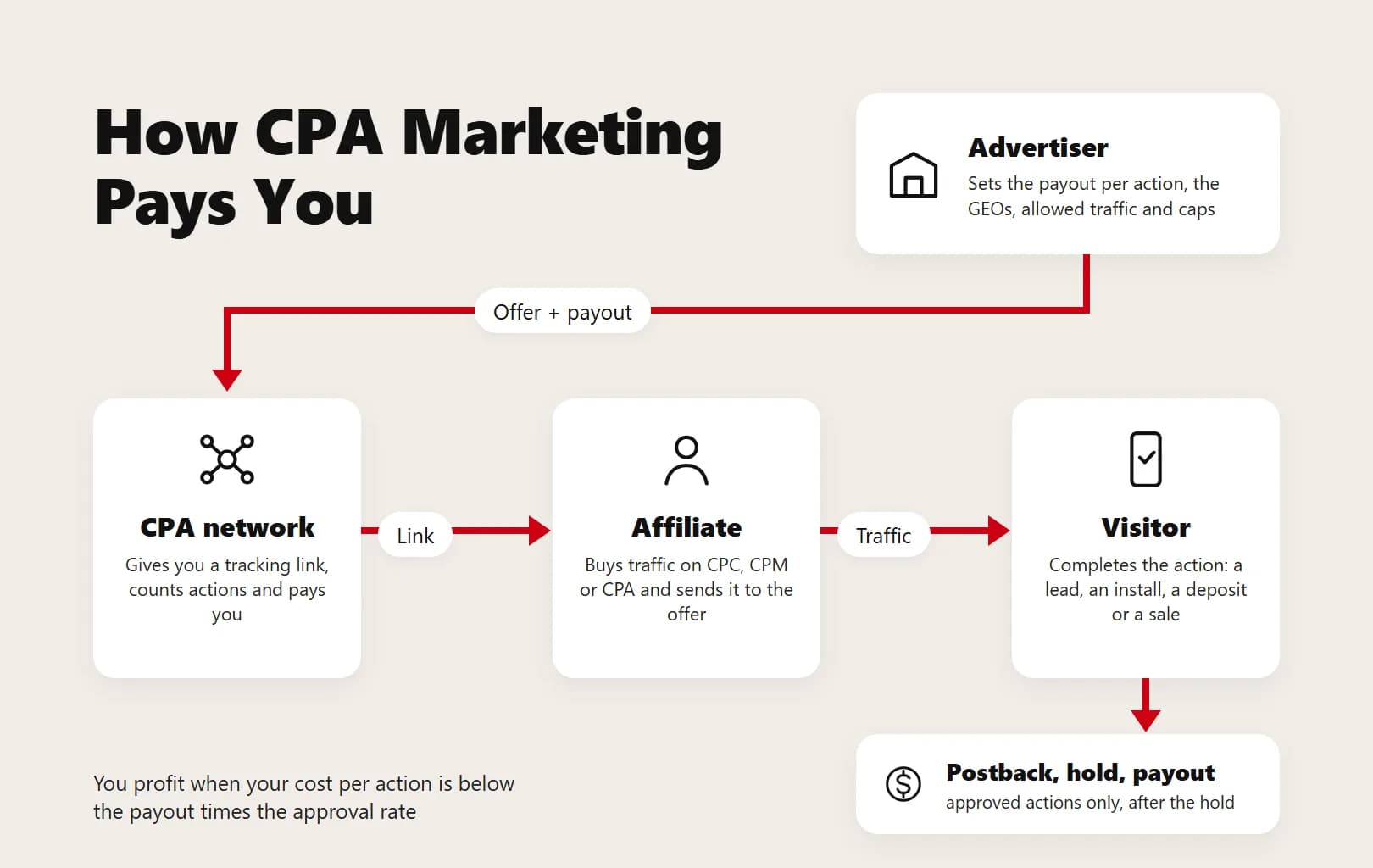
- You pick an offer and read its terms: the payout, the action, the GEOs, the allowed traffic sources, the cap and the hold.
- You get a tracking link with sub-IDs for your source, campaign and placement.
- You send traffic from your site or from a traffic source, usually through a pre-lander.
- The visitor completes the action, and the network passes it to your tracker by postback, so you see which source and placement converted.
- The advertiser approves or rejects it during the hold, and approved actions are paid on the network's schedule once you pass the minimum payout.
CPA vs CPL, CPS, CPI, RevShare and hybrid
CPA is the family name; the action decides what the offer is called. The CPL, CPS and CPI models are CPA with a specific action.
- CPA. You're paid for any agreed action, often a first deposit or a qualified player. Typical verticals: gambling, betting, games, finance. What to check: how the action is defined and its KPIs.
- CPL. You're paid for a lead: a SOI or DOI sign-up, a form, a PIN submit. Typical verticals: dating, sweepstakes, lead generation. What to check: approval rate and rejected leads.
- CPS. You're paid for a sale, as a fixed sum or a percentage. Typical verticals: e-commerce, nutra (COD), info products. What to check: refunds and the approved-order rate.
- CPI. You're paid for an install. Typical verticals: apps and games. What to check: fraud checks on installs.
- RevShare. You're paid a share of what the customer brings over time. Typical verticals: gambling, betting, subscriptions. What to check: negative carryover.
- Hybrid. You're paid a smaller CPA plus a RevShare. Typical verticals: gambling and betting. What to check: both sets of conditions.
CPA pays you now, RevShare pays you later. With CPA the advertiser takes the risk that the customer won't stay; with RevShare you do. That's why CPA deals come with KPIs: in its terms, Pin-Up Partners can withhold CPA or pay it as RevShare when repeat deposits fall under 50% or chargebacks pass 5%.
What CPA offers pay: real examples
Payouts depend on the vertical, the GEO and how hard the action is. Published numbers I checked in November 2026:
- Gambling and betting, per first deposit or qualified player: CPA up to $200 at Pin-Up Partners, $220 at Mostbet, $250 at 1win and $300 for Tier-1 at Parimatch, $150 in its Tier-2 and Tier-3. These are ceilings: your rate depends on the GEO and your traffic. More in our top of gambling affiliate networks.
- Adult and dating, per lead or sale: the sample rates on CrakRevenue's homepage are $60 per sale on a cam offer, $15 per DOI and $5 per SOI; the real ones are only in your account.
- Games, per active player: about €1.80 per player in the gaming case below.
- Adult content, per first purchase: $25 in my adult comics test.
A bigger payout isn't a better offer. A $300 first deposit needs a player who pays; a $5 SOI needs an email. What matters is how many of your visitors complete the action and how many of those actions are approved.
CPA as a metric: the math that decides a campaign
Your CPA = spend / actions. Compare it with the payout times the share of actions that get approved. If the offer pays $20 and the advertiser approves 70% of leads, each lead is worth $14 to you, and that's your ceiling.
Work back to the price you can pay for traffic. Break-even CPC = payout × approval rate × conversion rate. At $14 per lead and 2% of clicks converting, you can pay up to $0.28 a click. On CPM traffic, do the same per 1,000 impressions: if 0.05% of impressions convert, as in the gaming case below, 1,000 impressions bring 0.5 actions and are worth $7 at $14 per action.

3 campaigns, 3 outcomes:
- Gaming on PropellerAds: at the interim point above, $120.037 bought 141 actions, a CPA of $0.851, against a payout of about $2.00 per player. It finished at 156 players, $311.54 in revenue and 160% ROI, most of it after the traffic stopped, because players converted days after the click.
- AI dating on HilltopAds: the network's own case reports 81 subscriptions at a $39.91 CPA from 7.5 million banner impressions. Without the payout, which the case doesn't give, you can't tell whether that CPA made money; that's the first thing to ask of any case.
- My adult comics test: 27 sign-ups at $3.70 each for an offer that paid $25 per first purchase. With 3-5% of sign-ups paying, break-even is $0.75-$1.25 per sign-up, 3-5 times below what I paid, so I stopped after $99.79.
Where to find CPA offers
Pin-Up PartnersRecommended

See the full ranking: 12 Best Gambling Affiliate Networks in 2026: Casino, Betting and iGaming Programs Compared
What is a CPA ad network?
The phrase is used for 2 different things, so check which one you're reading about.
1. A network that pays you per action. That's a CPA network or affiliate network: you join, take offers and get paid per approved action. Compare them in our catalog of affiliate and CPA networks.
2. An ad network where you buy traffic on CPA. You set the price you'll pay per conversion, pass conversions back by postback, and the network shows your ads to the placements that convert at that price. 14 of the 63 traffic sources in our catalog sell this way. Examples:
- Galaksion opens CPA to every account, with a test budget of $10 on push and $20 on popunder, and adds Smart CPA on popunder.
- PropellerAds' CPA Goal works on push and Onclick; its guide says advertisers usually set aside $50 a day for a Tier-3 test and $100 for Tier-1 and Tier-2.
- Kadam's CPA Target works on push, in-page push and pops, through a postback only.
CPA bidding on the traffic side needs conversions to learn from: without a postback and a test budget it has nothing to optimize toward.
CPA traffic: where affiliates buy it
CPA offers take traffic from almost anywhere the advertiser allows: your own SEO site, a Telegram channel or an email list, or paid traffic from ad networks. For paid traffic, the format follows the offer:
- Push and popunder are the cheapest way to test sweepstakes, utilities, dating and gaming offers: see the best push ad networks and popunder ad networks.
- Native suits nutra and finance offers that need a warm-up article: see the best native ad networks.
- Video, social and search bring more expensive, warmer traffic, with stricter ad policies for gambling, finance and adult.
All the formats and their ad networks are in our catalog of traffic sources.
CPA marketing agencies, websites and platforms
A CPA marketing agency usually means a media buying team that runs CPA offers with its own money: it buys traffic, earns the payout and keeps the margin. Some also work for advertisers directly. They're in our catalog of media buying agencies and teams.
A CPA marketing website or platform is either a CPA network's dashboard, where you take offers and see your stats, or the tracker you run campaigns through. You need both: the network's numbers tell you what you'll be paid, your tracker tells you what you spent and where.
How to start CPA marketing
- Pick a vertical and a GEO you can buy traffic for, and an action you can realistically get: a sign-up is easier than a deposit.
- Join 1-2 networks and read their terms: the hold, the cap, the KPIs, the minimum payout and the payout schedule. Our guide on how to tell if an affiliate network is legit shows the checks.
- Set up a tracker with a postback before you spend a cent.
- Calculate the break-even CPC or CPM from the payout, the approval rate and an honest conversion rate.
- Test with a fixed budget on 1 offer, 1 GEO and 1 source. Our guide on how much budget you need to test an offer shows how to size it.
- Cut before you scale: turn off the placements, creatives and pre-landers that spend without approved actions.
The risks: holds, caps, scrubbing and shaving
You're paid for approved actions, and the advertiser approves them. Leads and sales are checked during the hold, and anything the advertiser judges invalid is rejected; networks call this lead scrubbing. CrakRevenue's knowledge base, for example, defines it as removing non-legitimate leads and calls the idea that scrubbing is network shaving a misconception; you can only check that against your own tracker.
The terms can take back what you earned. Fraud clauses let a network freeze a balance while it reviews traffic: CrakRevenue's terms give you 7 days to prove your traffic is clean. CPA deals carry KPIs that can turn a CPA into RevShare, and caps that stop paying once the advertiser has enough. Read them before the first click, keep your own stats, and withdraw as soon as you pass the minimum.
Sources
- Glossary: CPA, the definition and the $3,180 for 318 first deposits example
- catalog of affiliate networks and traffic sources: payout models and pricing, as of November 13, 2026
- Pin-Up Partners terms: CPA withheld or paid as RevShare on repeat deposits under 50% or chargebacks over 5%
- Pin-Up Partners homepage: CPA up to $200
- Parimatch Affiliates homepage and FAQ: CPA up to $300 Tier-1 and $150 Tier-2/3
- 12 Best Gambling Affiliate Networks in 2026: published CPA ceilings of Pin-Up, Mostbet, 1win and Parimatch, checked November 12, 2026
- Homepage: dashboard mock-up with sample rates, $60 per sale, $15 per DOI, $5 per SOI (checked November 12, 2026)
- Lead Scrubbing: definition, shaving called a misconception
- Terms of Service: fraud review, Pending Status, 7 days to provide evidence
- 160% ROI on $120 of pops: fact-checking a gaming case (payout about €1.80 per player, interim dashboard, final results)
- AI dating on HilltopAds at a $39.91 CPA: fact-checking the network's own case
- Adult comics test diary: 27 sign-ups at $3.70, $25 per first purchase, break-even $0.75-1.25
- CPA Pricing Model: test budgets of $10 for On-Page Notification or Push and $20 for Popup/Popunder
- Blog: Smart CPA, popunder only (December 16, 2025)
- CPA Goal for Push, Onclick and Interactive Ads: S2S postback, usual test budgets of $50 and $100 a day
- CPA Target campaign creating: target CPA, postback only, allowed formats
Related terms
Articles that mention CPA
- Top list7 Best Sweepstakes Affiliate Networks in 2026: SOI, DOI and CC Submit Offers Compared
- Top list10 Best Adult Ad Networks in 2026: Where to Buy Cheap Adult Traffic
- GuideTypes of Affiliates: 7 Partner Types, How Each Gets Paid and Who Takes the Most Sales
- AnalysisThe Affiliate Marketing Industry in 2026: How Big It Is, Who Gets Paid and Is It Still Profitable
- Top list12 Top Affiliate Media Buying Teams in 2026: Who They Are and What They Show
- Case fact-check$100K Into a Media Buying Team, Net Profit Up 181%: Fact-Checking the DEVILS Case
Show more (35)
- Top list11 Best Crypto Affiliate Programs in 2026: Exchanges and Wallets Compared
- Top list10 Best Video Ad Networks in 2026: Top Pre-Roll Networks Reviewed for Media Buyers
- Top list10 Best Native Ad Networks and Platforms in 2026 (For Affiliate Marketing)
- Top list12 Best Gambling Affiliate Networks in 2026: Casino, Betting and iGaming Programs Compared
- ReviewClickBank Review 2026: How It Works, What It Pays and the Fees Behind Every Commission
- AnalysisWomen in Affiliate Marketing 2026: 45 Leaders of Networks, iGaming Programs and Media Buying Teams, Graded by Proof
- AnalysisCan You Study Affiliate Marketing at University? We Read the Syllabi
- AnalysisThe Richest Affiliate Marketers in the World, Ranked by Receipts, Not Instagram
- ReviewEvadav Review 2026: Bot Traffic Complaints, Payout-Day Bans and a Run of 5-Star Reviews
- ReviewKingfin Review 2026: The Official Olymp Trade Affiliate Program
- ReviewGalaksion Review 2026: CPA From $10, a $50 Deposit and Direct Publisher Traffic
- ReviewPush.House Review 2026: Traffic Quality for Gambling, Adult and Nutra
- ReviewBidVertiser Review 2026: Ad Formats, Minimum Deposit & Publisher Payouts
- ReviewTrafficStars Review (2026): Minimum Deposit, Ad Formats, Publisher Payouts and Adult Traffic
- NewsSPiCE International 2026 in Cebu: Online Took Over the Philippines, Then the Rules Tightened
- NewsPrediction Markets Summit Europe 2026: Gibraltar Licensed the New Vertical. Can Affiliates Sell It?
- NewsSPARK 2026 Recap: SEO vs AI Search, and the Affiliate Question Nobody Answered
- ReviewTrafficJunky Review: Pornhub Ads, CPM Bidding and the Age-Verification Map
- ReviewKadam Ad Network Review (2026): Minimum Deposit, Ad Formats and CPA Target
- Top list10 Best Push Ad Networks in 2026 (Traffic Sources for Affiliate Marketing)
- ReviewSpy.House Review: Competitor Ads From 27 Sources for $29 a Month, With a Few Rough Edges
- Top listThe Affiliate Rich List 2026: Who Owns the Networks, and What It's Worth
- GuideHow Much Budget Do You Need to Test an Offer? What $100 Can and Can't Tell You
- Case fact-checkAdult Comics Test Diary: $99.79 on HilltopAds and TrafficJunky, 27 Sign-ups, 0 Sales
- GuideIn-Page Push Ads: Push Traffic With No Subscribers, Clicks Under a Cent, and the Catch
- Case fact-checkRaketech's Q2 2026: Revenue -17.6% Under an 'EBITDA Improvement' Headline, Fact-Checked
- Case fact-check59% of Installs Were Bots: An Indie Developer's Google App Campaign, Fact-Checked
- Case fact-checkAI Dating on HilltopAds at a $39.91 CPA: Fact-Checking the Network's Own Case
- AnalysisFull-Cycle Ad Platforms: Not a Pyramid, a Referee Who Also Plays
- Case fact-check$8,690 on Crypto in Google Ads at 121% ROI: Fact-Checking a Case That Sells Accounts
- ReviewAffmine Review (2026): Is It a Scam? Payouts, Terms and Trustpilot Reviews
- ReviewCrakRevenue Review 2026: $100 or $500 Minimum Payout, Net 30 and the Terms Behind Them
- ReviewPin-Up Partners Review 2026: CPA up to $200, RevShare+ up to 50% and the Terms Behind Them
- Top list15 Best Popunder & Popup Ad Networks to Buy Traffic (2026)
- ReviewAffstore Review for Affiliates: Broker Offers, Payouts and Complaints
Questions about CPA
What is CPA marketing?
Affiliate marketing where the advertiser pays a fixed amount for each action you bring: a lead, an install, a first deposit or a sale. You buy or bring the traffic, and you profit when your cost per action is below the payout for approved actions.
What does CPA mean in affiliate marketing?
Cost per action. As a payment model, it's a fixed payout per agreed action. As a metric, it's your spend divided by the actions you got. An iGaming campaign that spent $3,180 for 318 first deposits has a CPA of $10.
How does CPA marketing work?
The advertiser sets a payout per action, a CPA network or affiliate program gives you a tracking link, you send traffic, the network counts the actions and passes them to your tracker by postback, and you're paid for approved actions after the hold.
What is the difference between CPA and CPL?
CPL is a kind of CPA where the action is a lead: a sign-up, a form or a PIN submit. CPA can mean any action, and in gambling it usually means a first deposit or a qualified player.
What is a CPA ad network?
Either an affiliate network that pays you per action, or an ad network where you buy traffic on CPA and pay per conversion, like Galaksion's CPA model, PropellerAds' CPA Goal or Kadam's CPA Target.
Where do I get traffic for CPA offers?
From your own site, channel or list, or from ad networks: push and popunder for cheap tests, native for offers that need a warm-up, and video, social and search for warmer traffic with stricter rules. Check which sources the offer allows.
How much do CPA offers pay?
From a few dollars per lead to hundreds per first deposit. In November 2026, CrakRevenue's sample rates showed $5 per SOI and $15 per DOI, while gambling programs published CPA ceilings of $200-$300 per first deposit or qualified player.
Is CPA marketing good for beginners?
Yes, if you start with simple actions and small tests. A sign-up or SOI offer on push or pops shows you within days whether you can buy an action below the payout. Start with a tracker, a fixed budget and offers whose terms you've read.