

Why Most Affiliates Never Scale Past $10K a Month: The Ceiling Is Cash, Caps and Accounts, Not Talent

Contents 12
Ask a solo media buyer where they got stuck, and a surprising number name the same figure: about $10,000 a month in profit. They found an offer that works, a source that converts, creatives that click. Then every attempt to push past that line ends with ROI sliding into the red, accounts dying or the money simply running out before the payouts arrive.
It feels like a skill ceiling. In most cases it's arithmetic. The same handful of things stop people there: the ROI that paid traffic delivers in 2026, the cash locked between paying for traffic and getting paid for it, offer caps, account limits, and the fact that one person has one pair of hands. Here they are with numbers, and what the ones who got through changed.
How rare $10K a month really is
Most affiliates never get close. In Influencer Marketing Hub's 2022 benchmark survey, 57.55% of affiliates reported under $10,000 a year, 16.21% from $10,000 to $50,000, 5.15% from $50,000 to $100,000, 7.94% from $100,000 to $150,000 and 3.78% above $150,000. Only about 12% were at or above the $100,000-a-year level that $10K a month implies. The same page quotes Authority Hacker's split of affiliates by monthly earnings, where $10,000 a month is exactly where the "Advanced" tier begins: beginners up to $1,000, intermediate $1,000 to $10,000, advanced $10,000 to $100,000.
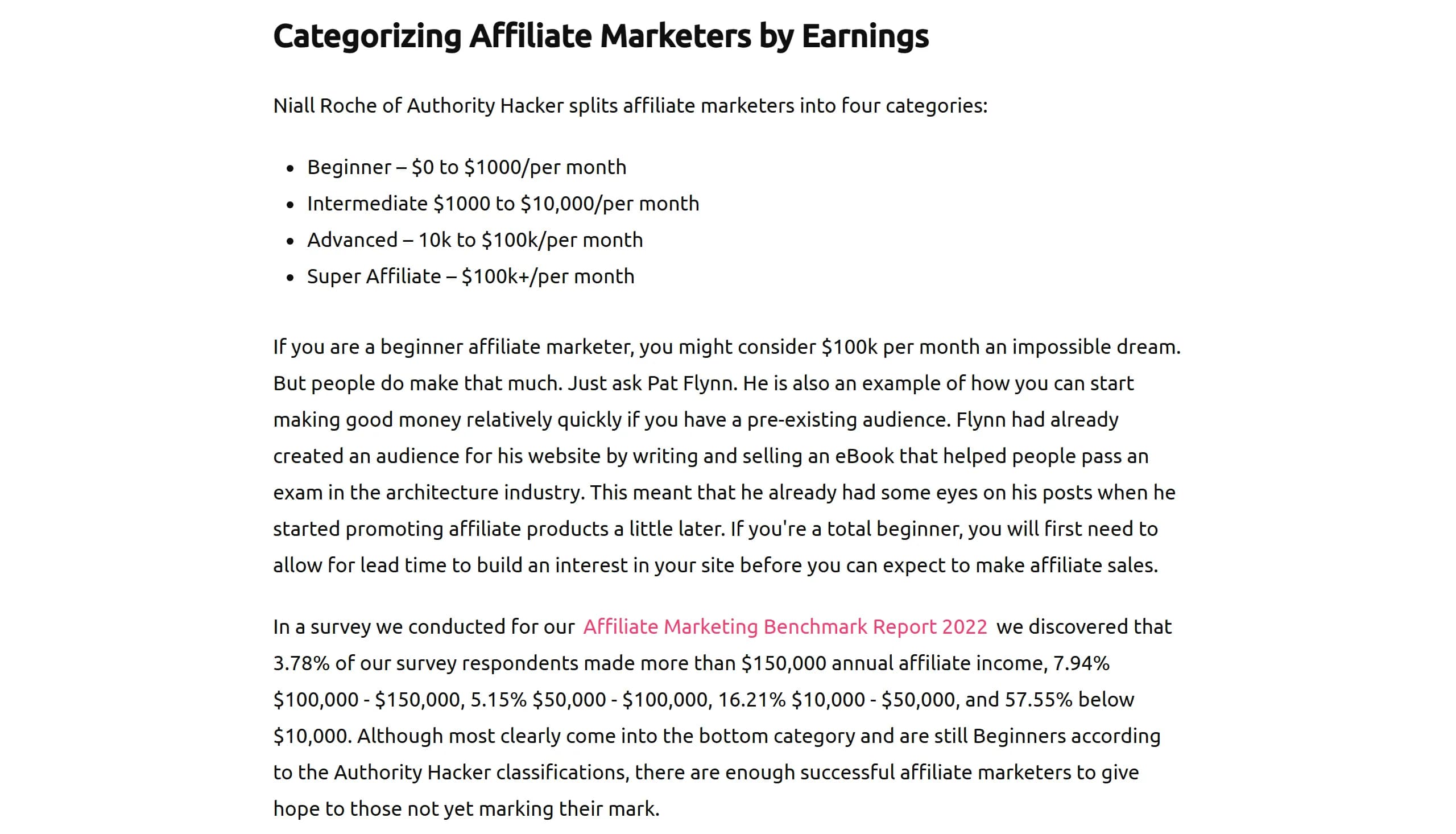
The surveys mostly count content affiliates, not media buyers. These are bloggers and side projects as much as paid traffic teams, and IMH doesn't publish its sample size. There is no public survey of media buying income. What the surveys do show is that $10K a month is already the top tier, which is why the advice that gets people there (find an offer, find a source, test creatives) stops working above it.
The math behind the ceiling
ROI has shrunk, so profit needs a lot of spend. "5 years ago ROI of 200-500+% was considered the norm. Now 20-30% is already an acceptable result," the CBDO of DEVILS, one of the largest Ukrainian buying teams, wrote in June 2026. Profit is spend times ROI, so the spend you need for $10,000 of profit grows fast as ROI falls:
- 100%: $10,000
- 50%: $20,000
- 30%: $33,300
- 25%: $40,000
- 20%: $50,000
And you pay for traffic before you get paid for it. Traffic is prepaid or charged daily, while networks pay after a hold and on a schedule. The cash you need is roughly the daily spend times the number of days between spending and getting paid. At $40,000 a month, about $1,333 a day, our estimate looks like this:
- Weekly, after a 14-day hold — about 21. about $28,000
- Monthly, Net-15 — about 45. about $60,000
- Monthly, Net-30 — about 60. about $80,000
That's before agency top-ups, which are paid in advance, and before a bad week. A buyer with $15,000 of savings can't fund $40,000 of monthly spend on Net-30 terms however good the campaign is. The ceiling is the cash cycle.
Ceiling 1: cash locked in holds and net terms
Fast payouts are a privilege, not a default. Leads approved this week are usually paid after 14 or 30 days, and deposits and chargebacks on financial and gambling offers can take a month or more to clear. Altery's June 2026 guide on affiliate payouts notes that daily payouts apply only to cleared balances and are "gated behind quality tiers or manager approval", while new accounts start on weekly or monthly schedules. Its rule for the reserve: at least the cash you'll spend during the longest realistic gap between paying for traffic and the matching commission clearing.
A frozen balance hurts more than a bad campaign. On the advertiser side, Gabriela Lotto of Loco Advertising tells nutra brands that networks hold funds for 30+ days and payment processors can freeze money for up to 6 months, and recommends a 180-day cash reserve: "If you don't understand the exact flow of cash in your bank account, a six-month merchant freeze will wipe you out." Affiliates feel the same squeeze one step down the chain when an advertiser pays the network late. Before you scale with a network, check how it treats balances on our AffiliateGuardDog warning list.
What changes: buyers who got past this negotiate weekly or daily payouts once their volume proves itself, keep a reserve that covers the longest spend-to-cash gap, and look for advertisers that prepay spend. Everflow's case study of the debt settlement advertiser IDS describes exactly that: it "pre-pays ad spend based on performance" for its media buyers.
Ceiling 2: offer caps
A good offer is someone else's budget. A cap is the number of conversions an advertiser accepts per day, week or month. Hitting it by noon means stopping the campaign or asking the manager for more, and traffic sent past the cap is the fastest way to lose money. Caps are raised for good traffic, but slowly, and the advertiser decides.
What changes: scale across several offers for the same GEO and vertical instead of squeezing one, and move to direct advertisers and private offers, where caps, rates and payout terms are negotiated on the strength of your volume.
Ceiling 3: ad accounts and spend limits
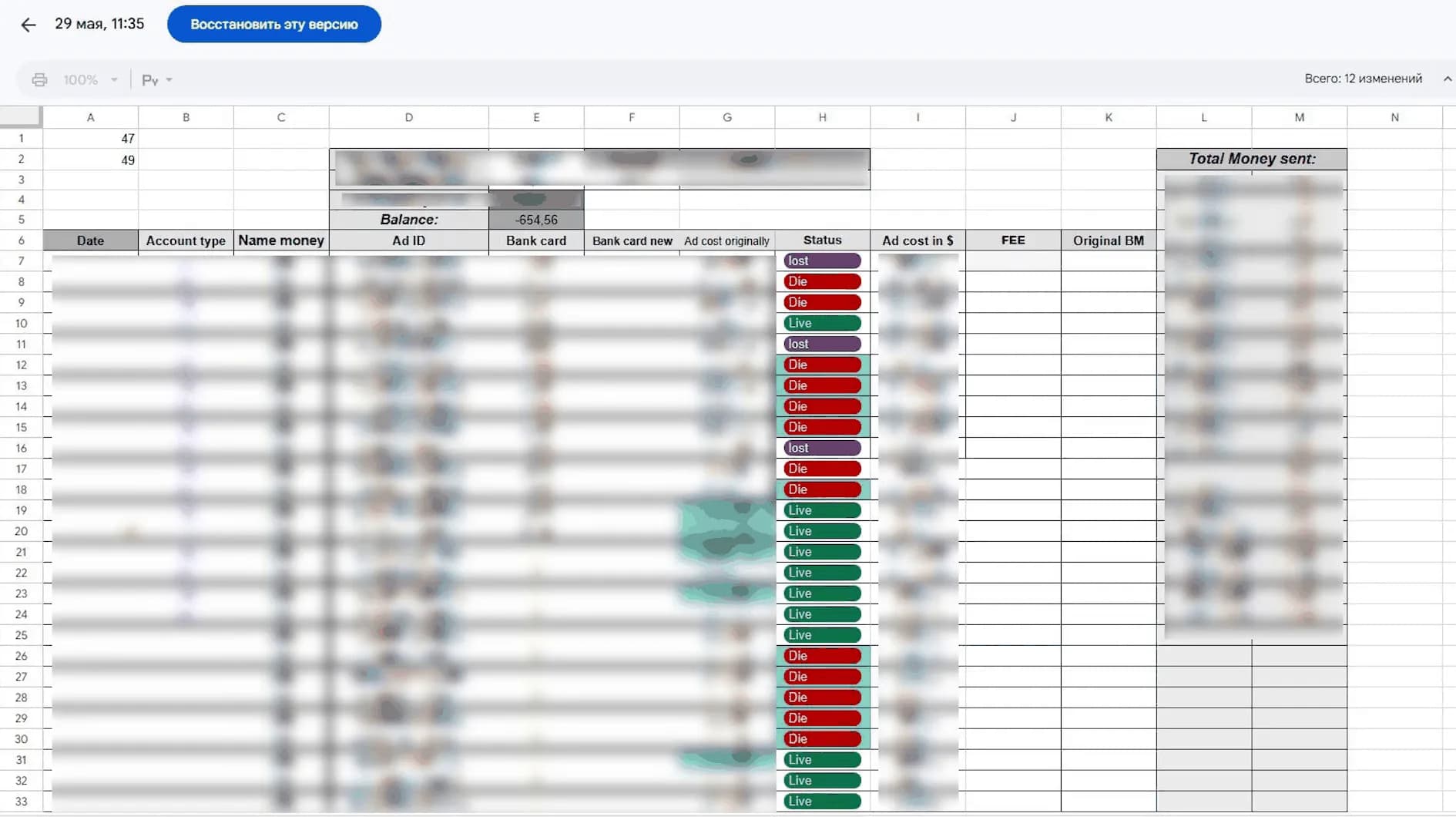
On Facebook, accounts are a consumable. Meta allows online gambling ads only after an advertiser's account is authorized with proof of a license, so affiliates run gambling traffic through agency accounts or farmed ones. In the solo buyer's tier-3 gambling case we fact-checked, the agency took a 7% fee on top-ups, 16 of 27 accounts in the ledger were dead or lost by the end of May, and the agency balance stood at -$654.56.
Every account has a spend limit, and every ban takes a balance with it. New accounts start with low daily limits that grow only with history, so spending more means running more accounts in parallel, and each banned account takes its balance, its warm-up time and the campaign's learning with it. An account vendor's own comparison, which is a marketing source, puts first-week survival at 15-30% for bulk-bought Facebook accounts against 75-90% for accounts farmed in-house.
What changes: a budget line for lost accounts, an own farm or a reliable agency, and more than one traffic source, so a ban wave doesn't stop all revenue at once.
Ceiling 4: ROI falls as the budget grows
The cheapest conversions are bought first. When you raise a budget, the platform has to find more people, and the next ones cost more. A solo buyer described it on Traffic Cardinal back in 2018: "As soon as I start increasing the budget, costs grow faster than profit, and ROI drops all the way to a loss" (translated from Russian). In the same tier-3 case, the buyer scaled budgets in jumps of 5 to 10 times, and a $500 daily budget made the metrics worse.
Creatives burn out faster at scale. More spend means the same audience sees the same ad more often, and click-through falls with every repeat view. Scaling one campaign vertically speeds that up.
What changes: horizontal scaling. Instead of one campaign at 5 times the budget, the same offer goes to new GEOs, new sources and new creative angles, each at a budget where ROI still holds. That needs a steady flow of creatives, which is why creative production is usually the first thing teams hire for. Our creative testing framework shows how to keep that flow cheap.
Ceiling 5: one person, one pair of hands
Testing doesn't scale with the budget, it scales with hours. Horizontal scaling means more GEOs, more creatives, more accounts and more tracker reports, and a solo buyer runs out of hours before money. A January 2026 piece by PGON, a payments platform for buying teams that sells exactly this model, puts a solo buyer's ceiling at 300,000-500,000 rubles a month and contrasts a solo buyer netting 350,000 rubles on 20 million rubles of turnover with a team lead netting 1,050,000 rubles from 10 buyers. The numbers are a sales pitch, but the structure is the point: a team lead earns on other people's volume.
The first hire is rarely another buyer. Media buying teams pool budget, accounts and know-how and negotiate private payouts with networks on the strength of their volume, as our glossary entry on the media buying team explains. Team-building guides for paid media name a creative producer and a tracking specialist among the roles not to delay. In lead generation, LeadGen Economy puts the tipping point for a full-time media buyer at about $30,000 a month of ad spend, which is roughly where the table above puts a buyer chasing $10K of profit.
Ceiling 6: ROI without unit economics
Growth can hide a loss. In September 2026 DEVILS published the case of a gambling buying team it had funded with $100,000. Before the changes, the team made $720,000 in revenue on $585,000 of spend, a 23% ROI. After $67,000 of bonuses, which were half of gross profit, and running costs, it kept $36,000 in net profit: a 5% margin on revenue. One of its 3 groups was positive on gross and negative on the bottom line, while everyone thought all 3 were profitable.
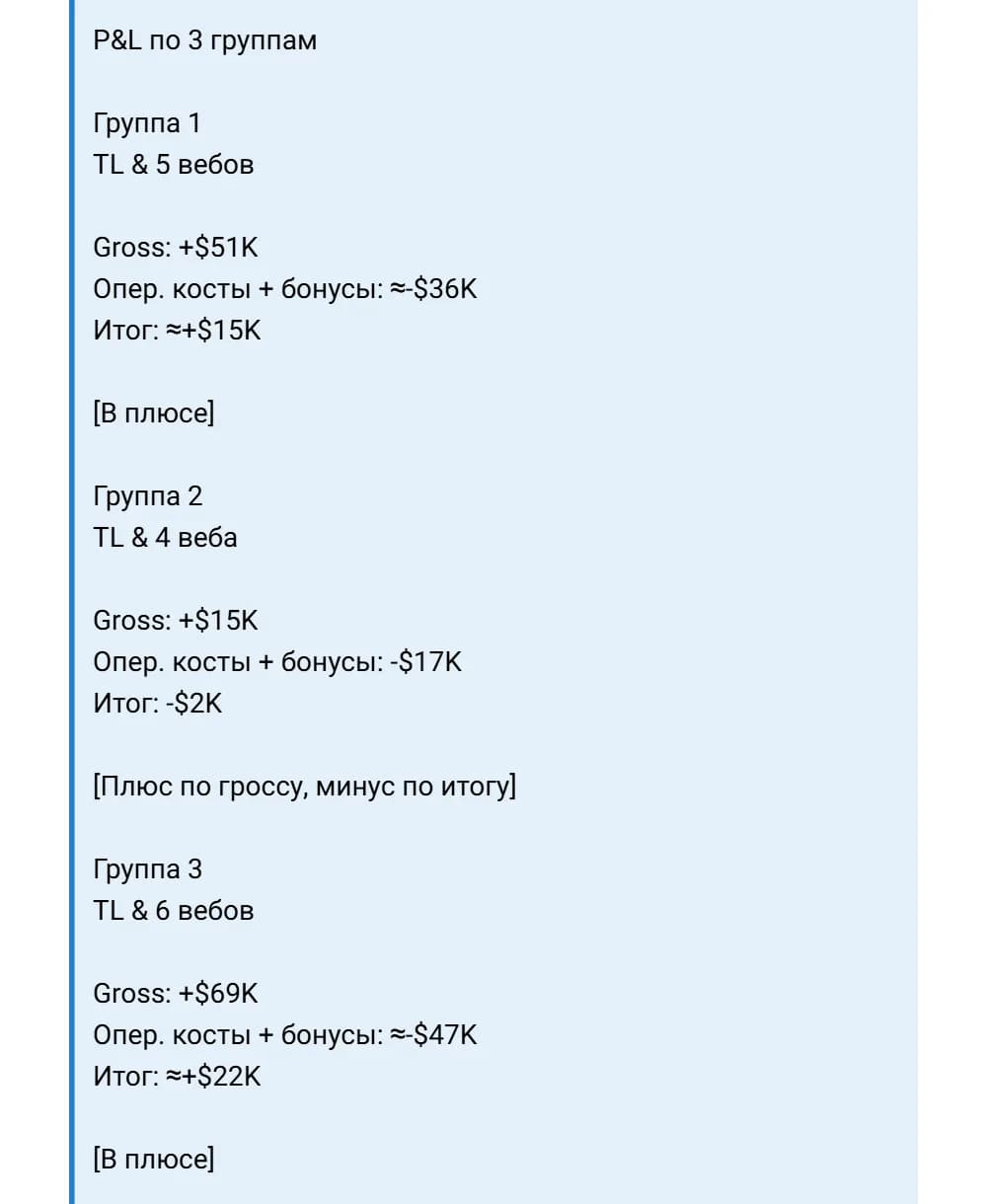
The fix was counting the right number. By DEVILS' own account, after the team started measuring net profit per buyer and group, cut losing parts and renegotiated terms with advertisers, revenue stayed about the same while net profit grew to about $101,000 a month and ROI to about 44%. The figures are self-reported and not independently verified, but the lesson doesn't depend on them: ROI counted on ad spend says nothing about what's left after cuts, bonuses, fees and accounts.
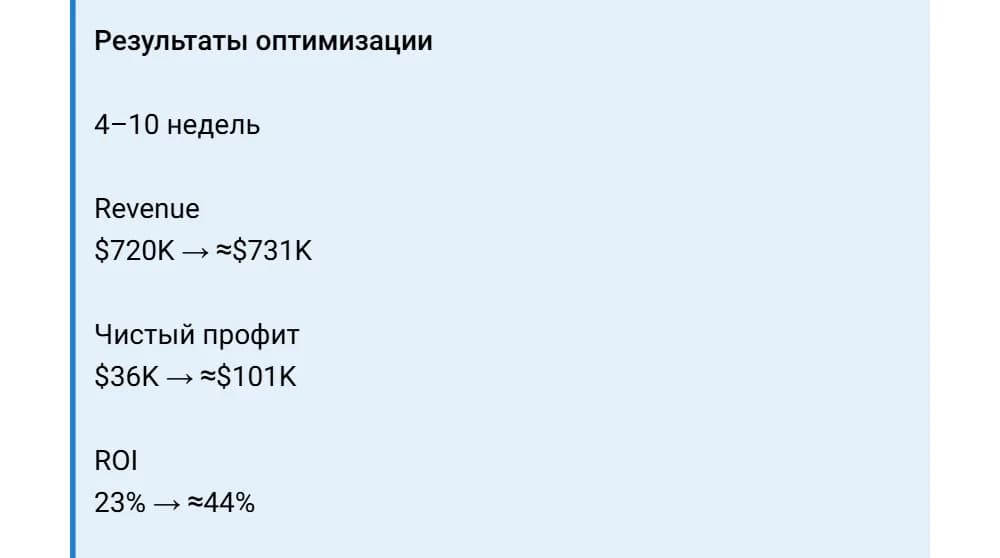
Public case studies tend to show the gross line only; we wrote about why case studies don't reflect reality.
What the ones who got past $10K changed
- Cash — Campaigns paused while you wait for payouts. Weekly or daily payouts negotiated on volume; a reserve for the longest spend-to-cash gap; advertisers that prepay spend
- Caps — The offer stops converting by noon. Several offers per GEO; direct advertisers and private caps
- Accounts — Bans eat the profit. Own farm or a reliable agency; a budget for losses; a second traffic source
- Falling ROI — Every budget increase kills ROI. Horizontal scaling: new GEOs, sources and creative angles
- Hours — No time to test anything new. First hires: creatives and tracking, then buyers paid on net profit
- Unit economics — Profit on paper, nothing in the bank. Net profit per buyer after cuts, bonuses, fees and accounts
Checklist: what to do
Questions and answers
How many affiliates reach $10,000 a month?
Few. In Influencer Marketing Hub's 2022 survey, about 12% of affiliates reported $100,000 a year or more, and 57.55% reported under $10,000 a year. There's no public survey limited to media buyers.
How much ad spend does $10,000 a month in profit take?
At a 25% ROI, about $40,000 a month; at 20%, $50,000. On top of that you need working capital for the gap between paying for traffic and getting paid: roughly $28,000 on weekly payouts after a 14-day hold, and up to $80,000 on monthly Net-30 terms.
Why does ROI drop when I scale a campaign?
Because the platform has to buy more expensive impressions to spend the extra budget, the same audience sees your ads more often, and creatives burn out faster. Caps and lower-quality placements add to it. Scaling into new GEOs and sources holds ROI better than raising one budget.
When should a solo media buyer hire the first person?
When testing, not money, becomes the bottleneck. Most teams hire for creative production or tracking first, then add buyers. In lead generation, about $30,000 a month of ad spend is cited as the point where a full-time buyer pays off.
Is vertical or horizontal scaling better for affiliates?
Use both, but in order. Vertical scaling (raising a working campaign's budget) is quick but hits rising costs, caps and creative fatigue. Horizontal scaling (new GEOs, sources, offers and angles) keeps ROI closer to the original and spreads the risk of bans.
Author’s conclusion
The $10K-a-month wall isn't a test of talent. It's where the ROI of today's paid traffic, payout schedules, caps and ad account limits all start to bite at once, and where one person runs out of hours. Each of those has a known fix, and none of them is a better creative.
My advice: before you try to break through, put the numbers in one table: the spend your target needs at your real ROI, the cash locked by each network's payout terms, the accounts you lose per month and the hours you have. The ceiling usually shows up there long before it shows up in your campaigns, and so does the first hire.
Lu Discover, Editor-in-chief
Sources for this article
- influencermarketinghub.com — Influencer Marketing Hub: How much money do affiliates make (Affiliate Marketing Benchmark Report 2022, annual income distribution)
- t.me — DEVILS: CBDO on ROI norms: 20-30% is now acceptable (June 26, 2026)
- t.me — DEVILS: $100K offer case result, with the case document (September 4, 2026)
- t.me — DEVILS: full text of the case with comments (September 4, 2026)
- t.me — DEVILS: $100K UNIT follow-up: group P&L (September 15, 2026)
- altery.com — Altery: daily payout myths and reserves for affiliates (June 12, 2026)
- everflow.io — Everflow masterclass with Gabriela Lotto on cash flow for high-volume nutra offers
- everflow.io — Everflow: IDS case study (prepaying ad spend for media buyers)
- transparency.meta.com — Meta advertising standards: online gambling and games (authorization required)
- dev.to — OnlineProxy: bulk Facebook accounts vs in-house farming (vendor comparison of survival rates)
- trafficcardinal.com — Traffic Cardinal: forum piece by a solo buyer on ROI falling as budgets grow (August 30, 2018)
- partnerkin.com — PGON corporate blog: scaling a buying team (January 8, 2026; solo vs team lead income)
- funccards.com — FuncCards: media buying team structure from 5 to 50 people
- leadgen-economy.com — LeadGen Economy: building a media buying team for lead generation (updated March 18, 2026)
Related stories
 Guide
GuideIn-Page Push Ads: Push Traffic With No Subscribers, Clicks Under a Cent, and the Catch
 Guide
GuideAffiliate Link Management: Programs Move, Domains Burn, Affiliates Pay
 Analysis
Comments
0 commentsNo comments yet.
Add a comment