

$100K Into a Media Buying Team, Net Profit Up 181%: Fact-Checking the DEVILS Case

Contents 13
A media buying team turns over $720K a month on Facebook and keeps $36K of it. An investor puts in $100K, disbands 1 of its 3 buyer groups, plugs in its own bizdev and analytics, and 2 months later the team keeps $101K on about the same revenue. That's the case DEVILS, a holding that calls itself the leading media buying company in Eastern Europe, published on September 4, 2026, about the team funded under its $100K offer.
This is our review of the case for owners and team leads of media buying teams, and for anyone weighing an investor's money: the case, with the slides of its English version, our math on top of its P&L, what the $100K bought and what the case doesn't show. Editorial fact-check: 2/5.
Short version: the team's P&L is the most detailed we've seen in a case, and it reconciles. Even the ROI jump is almost exactly what the claimed drop in advertiser cuts would produce. But there's no proof of any kind, the funded team is anonymous, and the 2 numbers you'd need to judge the deal, DEVILS' equity share and how the cuts came down, stay hidden. Below: the team before and after, where the $100K went, the share question and what you can repeat.
Who published the case: DEVILS and its $100K offer
The author is DEVILS, a media buying holding that Oleksandr Slobozhenko founded in 2019 as Traffic Devils, the name its social accounts still carry. Its site lists 1M FTDs in 2024, 1,000+ employees, 10 offices and a head office in Warsaw. In January 2025 it launched DEVILS CAPITAL, an "investment platform" for outside teams. Slobozhenko signs the case as Founder & CEO; he returned to the CEO seat in June 2026.
The case is the payoff of a campaign. On March 31, 2026, DEVILS posted the offer: "$100k for operations + unlimited working capital from the DEVILS founder... Any entrepreneurial risks on your side are removed." At an industry conference in early April it collected "389 applications for $100K investment in operations" in 2 days. For scale, DEVILS' recap of the program's first year counted 250 applications and 3 partnerships.
On September 4 DEVILS published the result as a document in its own Telegram channel, with comments from its CEO and COO and an application button at the end. Its full text was republished the same day, and that's the version we quote. DEVILS also presents the case in English on its site, as a page of numbered slides from "[004] Starting metrics" to "[009] Optimization results"; we show those slides below and quote their English text. The funded team stays anonymous: "In the course of negotiations, the unit's founder decided to remain anonymous so as not to publicly link his team with DEVILS in the future." Quotes from the Russian text and DEVILS' posts are our translation.
Our take: this is an investor grading its own investment in a post that recruits the next one. That doesn't make the numbers false. It means they were chosen to sell, and with an anonymous beneficiary nobody outside DEVILS can check them.
The team before the money: $720K a month, 5% margin
The team: 3 years in iGaming, Facebook as its only source, CPA as the model. "Results across ad accounts were stable, but everything rested on the owner's manual management." The structure: 3 team leads and 15 buyers in mixed groups, 3 designers, 2 integrators, 1 account manager, 1 finance specialist, and the owner covering finance "partly."
The starting month, as the case gives it:
- revenue $720K, spend $585K, gross profit $135K, ROI 23%;
- operations about $31K, bonuses for buyers and team leads about $67K;
- net profit $36K, margin 5%.
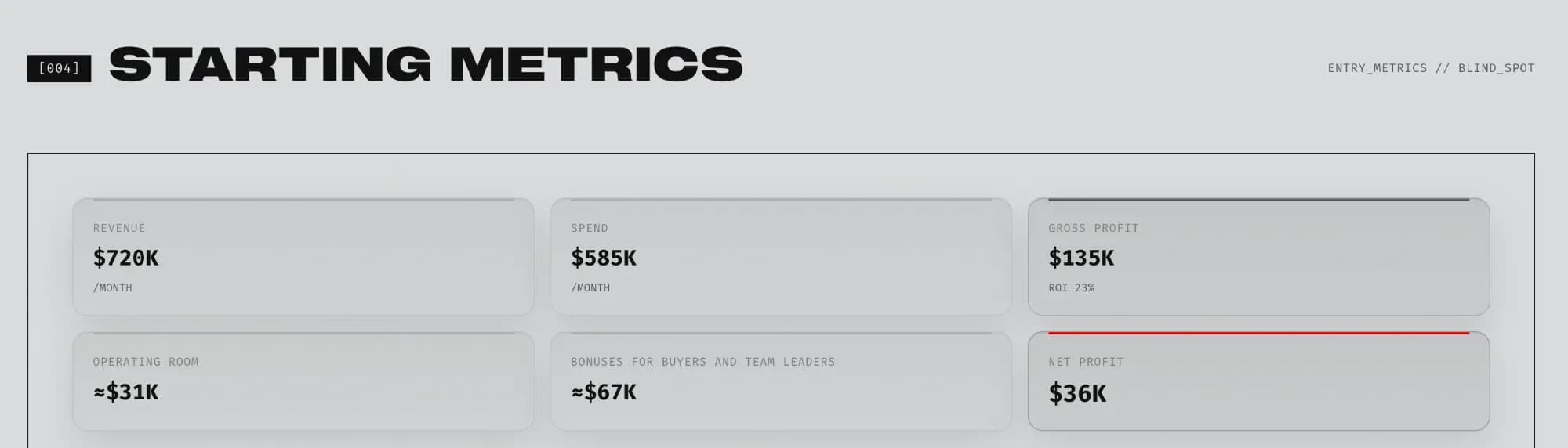
Our math: it reconciles. $720K minus $585K is $135K, and $135K / $585K is a 23.1% ROI, which you can rerun for your own team in our ROI calculator. $135K minus $31K minus $67K is $37K against the stated $36K, inside the "about" signs. The line that explains the rest is the bonuses: $67K is 50% of gross profit. 50 cents of every gross dollar went to buyers and leads before support staff, tools or the owner saw any of it. Each buyer spent about $39K a month.
The case's diagnosis, under "Hidden problem" and a 5% margin: "Owner was focused on the wrong metrics: goals were set for gross and ROI growth instead of net profit." The Russian text adds, in our translation: "The logic of processes was simple: if we pour in profit, everything is fine."
Our take: that's the most common failure in a media buying team, and DEVILS names it correctly. ROI is counted on ad spend, before the team costs a cent. DEVILS' own CBDO wrote in June that "5 years ago ROI of 200-500+% was considered the norm. Now 20-30% is already an acceptable result," and at 23% little is left once people are paid. Bonuses on gross make it worse.
Not shown: the GEO, casino or betting, the advertisers and payouts, and where Facebook accounts, agency fees and apps sit: in spend, in operations or nowhere. $31K of operations for 25 people is thin if the accounts are in it.
The group P&L: 3 groups in profit, 1 losing money
The first step was to split the P&L by group: "We compared the result of each group with the resource it consumed. It was this calculation that showed the objective effectiveness of the teams."
Group | What the case shows | Our math |
|---|---|---|
Group 1: team lead and 5 buyers | Gross $51K, costs and bonuses about $36K, result about +$15K | $10.2K gross per buyer; costs eat 71% of gross |
Group 2: team lead and 4 buyers | Gross $15K, costs and bonuses $17K, result -$2K | $3.8K gross per buyer; costs eat 113% of gross |
Group 3: team lead and 6 buyers | Gross $69K, costs and bonuses about $47K, result about +$22K | $11.5K gross per buyer; costs eat 68% of gross |
All 3 groups | Gross $135K, costs and bonuses about $100K, result about +$35K | $9K gross per buyer; matches the $135K total |
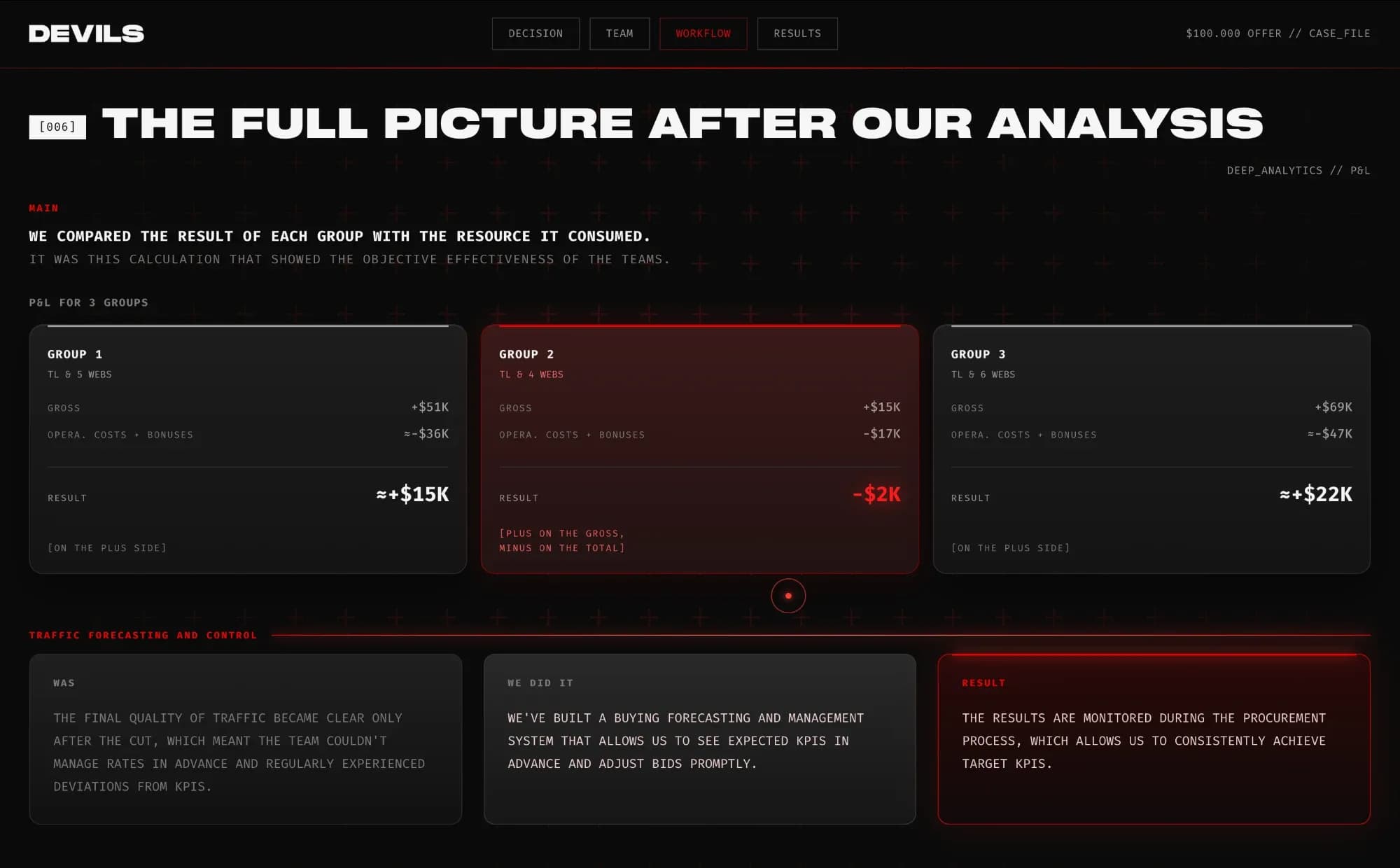
Our math: the groups add up to the total gross exactly, and the results come to $35K against $36K. Costs total $100K against $98K, a rounding gap. Group 2 made about 1/3 of the gross per buyer of the other 2. "All 3 groups poured into profit, but only 2 made money," DEVILS summed up in a follow-up post on September 15.
Our take: this table is the most useful thing in the case, and any owner can build one this week. The catch is in Group 2's $17K. Part of it is bonuses, which leave with the group. Part is its share of the $31K overhead: designers, integrators and finance don't get cheaper because 4 buyers left. If overhead was split by head count, Group 2 carried about $8.6K of it. Kill the group and keep the overhead, and you lose $15K of gross to save roughly $8K-9K: net profit goes down, not up.
DEVILS did more than kill it: 2 buyers were let go, 2 moved into the stronger groups and "inefficient roles and costs" were cut. That combination can work. The case doesn't show which part did the work, and it never says what happened to Group 2's team lead.
The rebuild: 6 steps in 4 weeks, and a dip
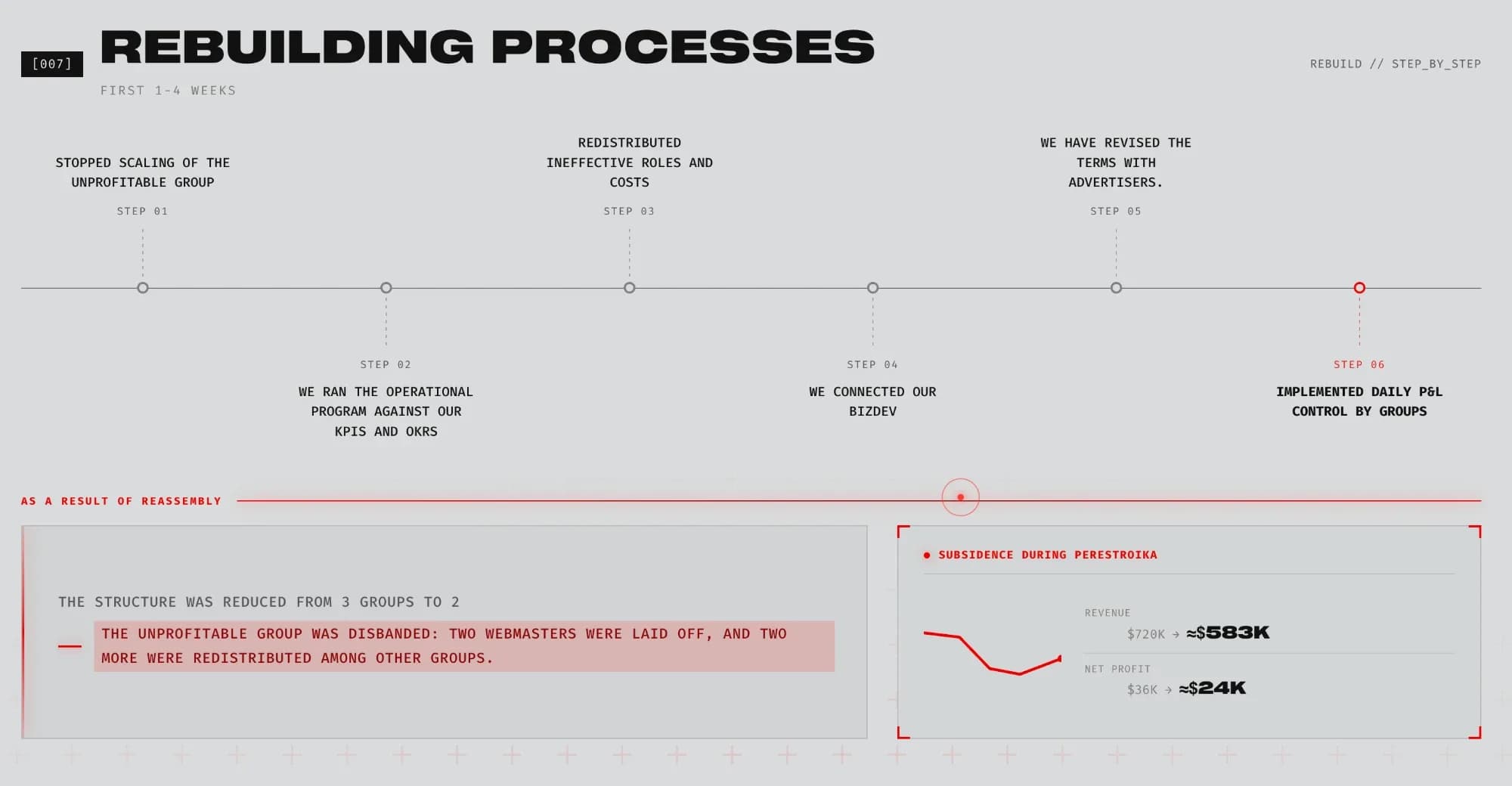
Weeks 1 to 4, per the case:
- "Stopped scaling of the unprofitable group."
- "We ran the operational program against our KPIs and OKRs."
- "Redistributed ineffective roles and costs."
- "We connected our BizDev."
- "We have revised the terms with advertisers."
- "Implemented daily P&L control by groups."
The team went from 3 groups to 2: "The unprofitable group was disbanded", 2 of its buyers were laid off and 2 moved to the other groups. The rebuild cost money while it ran, a dip the English slide calls "subsidence during perestroika": revenue fell from $720K to about $583K, -19%, and net profit from $36K to about $24K, -33%.
Our take: steps 4 and 5 matter more than they look. After them, the team's advertiser relationships run through the investor's bizdev department. That's where better terms come from, and it's also a dependency: if the partnership ends, who owns those deals?
DEVILS' pitch promises a light touch: "We do not interfere in operations without a request from the founders," and the team gets "a dedicated advisor... whose role is to strengthen the business, not to run it." Disbanding a group, rewriting KPIs and plugging in bizdev and finance is running it, with the founder's consent: the call on Group 2 was made "together with the unit's owner."
Where the $100K went
After the rebuild, DEVILS split the $100K into 2 budgets:
- 30%, $30K, "allocated for the first 3 months of the team's work": "This allowed us to completely cover current expenses and maintain focus on traffic";
- 70%, $70K, a "Team reserve fund", a "Budget for the development of our own additional infrastructure", split between the 2 groups: "Each group received funds for their tasks and approaches."
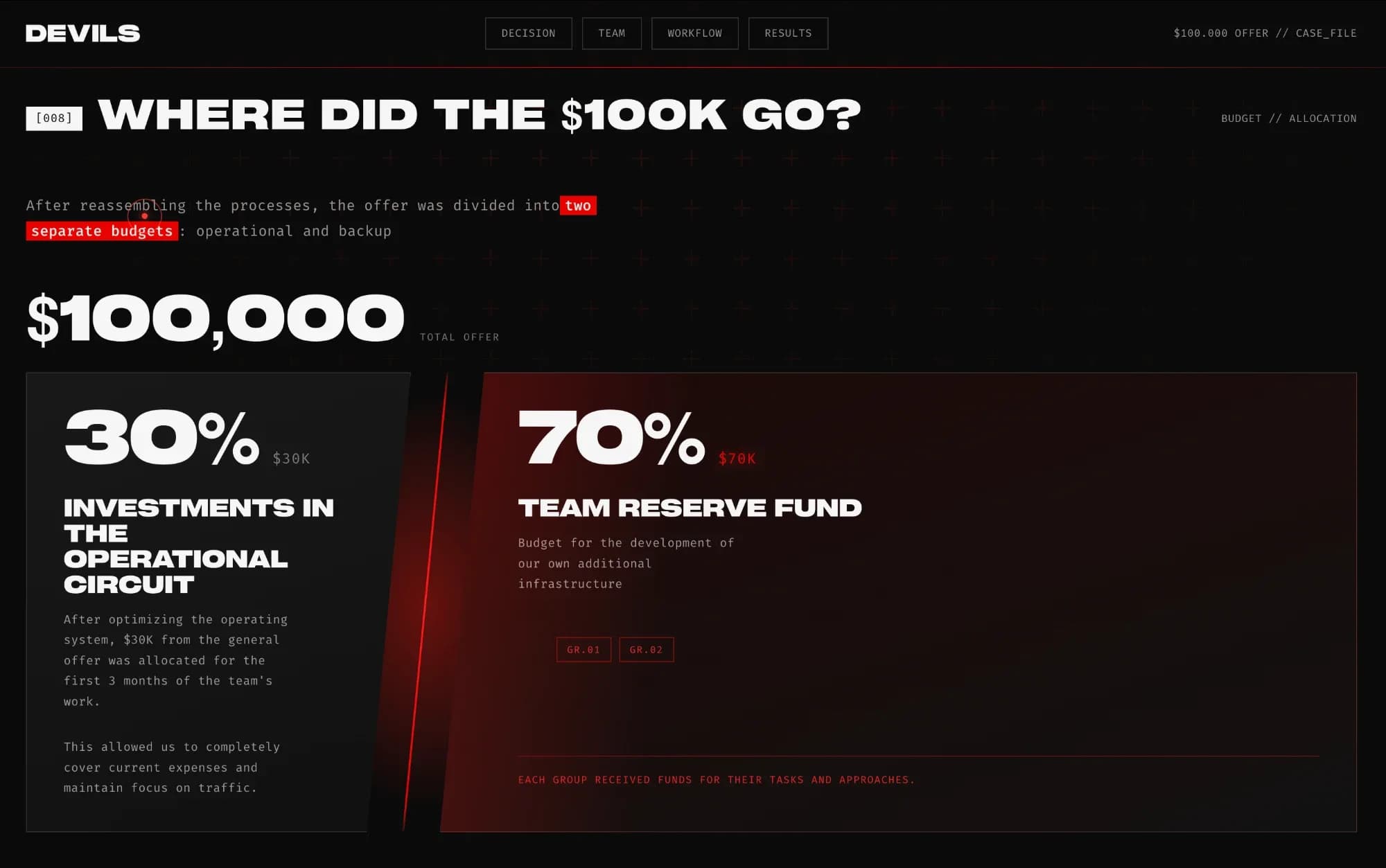
Our math: $30K over 3 months is $10K a month, 1/3 of the $31K of monthly operations before the rebuild. Either operations fell by 2/3, which fits DEVILS' bizdev and finance replacing the team's own, or "completely cover" means part of them. For scale, $100K is 17% of 1 month's ad spend, 2.8 months of the old net profit and about 1 month of the new one.
Not shown: what the $70K bought. "Additional infrastructure" could be accounts, apps, servers or people; the case doesn't list 1 item. The "unlimited working capital" from the March offer isn't mentioned, and for a team spending $585K a month on CPA, paid after reconciliation, float is usually a bigger constraint than $100K. Nor does the case say whether the $100K was cash, credit or DEVILS' services.
The result: $101K net profit, 44% ROI, cuts from 15% to 1%
Weeks 4 to 10, per the case:
- revenue from $720K to about $731K;
- net profit from $36K to about $101K;
- ROI from 23% to about 44%;
- "In 2 months the unit raised net profit by 181% and reached a 14% margin," in the Russian text.
The English slide lists 6 "key changes to the unit system": "Connected the DEVILS BizDev block", "Integrated financial contour", "We tested the design team with the expertise of the creative department", "We reconfigured processes to fit our OKRs and KPIs", "Expanded the capabilities of buying units" and "We moved from assessing traffic based on actual cuts to a system for forecasting and controlling buying."
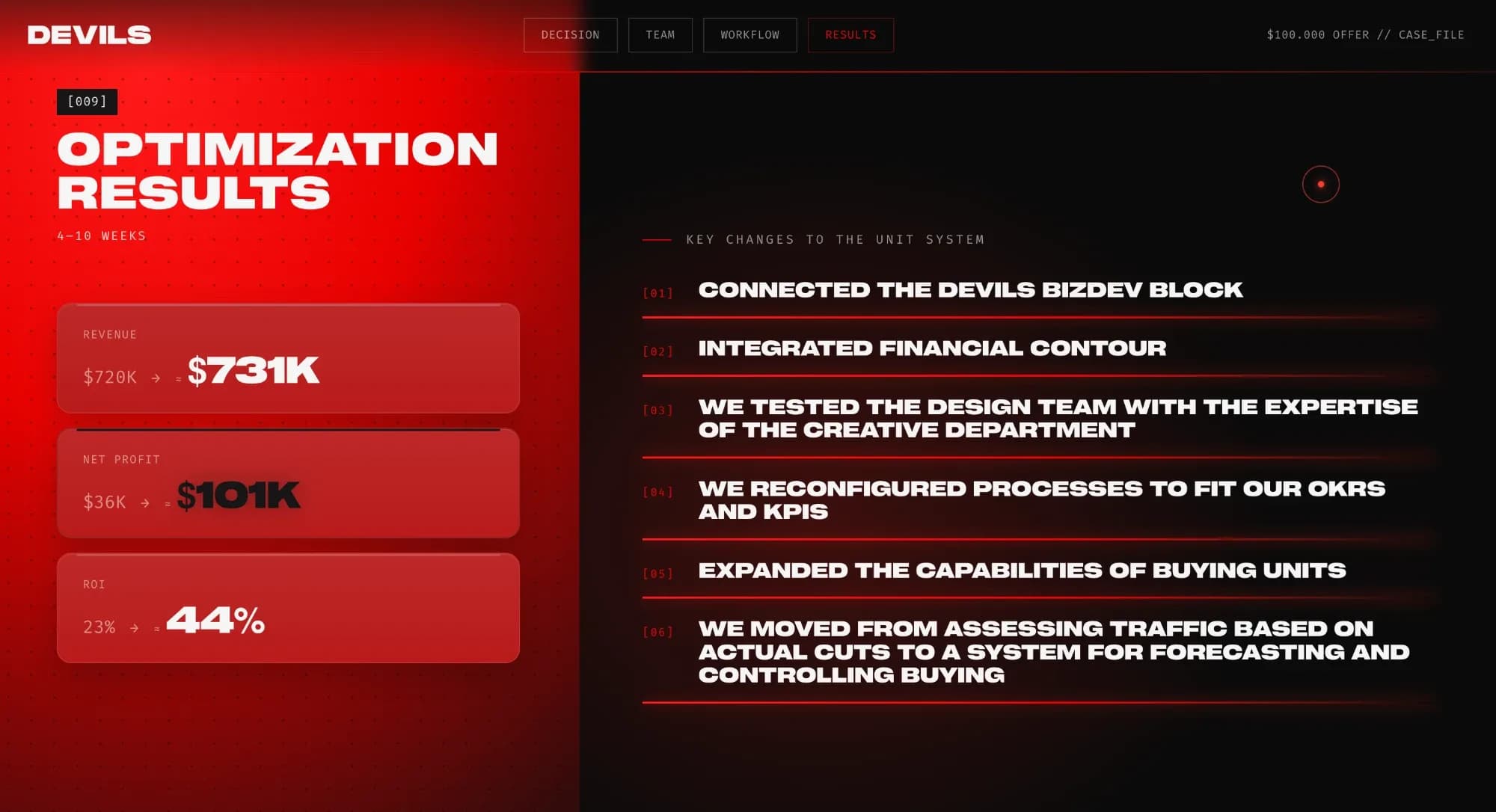
Our math: +181% checks out, $101K / $36K is 2.81, and so does the margin: $101K / $731K is 13.8%. The case gives no spend or costs after the rebuild, but the ROI lets us back them out. At 44%, $731K of revenue means about $508K of spend, 13% less than before, and about $223K of gross profit, 65% more. Costs and bonuses then come to about $122K, up from $98K. Same revenue, less spend, far more gross. Where does it come from?
The Russian text answers in 1 line: "Cuts: from ~15% to ~1%. The predictive model and deep analytics gave the team control over the key metrics of its own traffic." The English slide on the group P&L describes the before and after: "The final quality of traffic became clear only after the cut, which meant the team couldn't manage rates in advance and regularly experienced deviations from KPIs." And: "We've built a buying forecasting and management system that allows us to see expected KPIs in advance and adjust bids promptly."
A cut is the share of first-time deposits the advertiser refuses to pay for at reconciliation, because the players missed its qualification KPIs: deposit size, repeat deposits, activity. Take the case's rates at face value. At a 15% cut, $720K of paid revenue means about $847K of deposits before cuts; at 1%, $731K means about $738K. Both fell 13%, exactly like spend. Before cuts, revenue per dollar of spend didn't move: $1.45 before, $1.45 after. Multiply the old ROI by the change in the cut rate, 1.23 × 0.99 / 0.85, and you get 1.43: a 43% ROI against the 44% reported.
Our take: that's a strong internal check: the after numbers agree with the before numbers and the stated cut rates to within a point. It also tells you what the whole gain in gross is: the advertiser now pays for almost everything the team sends.
The case credits a predictive model, and in June DEVILS claimed the same for its own bizdev: "less than 0.5% traffic cuts in a year" from an AI analytics system. But step 5 was "revised terms with advertisers," and a softer KPI or a new advertiser with looser rules produces the same drop. If payout rates had gone up, revenue per dollar of spend before cuts would have risen; it didn't. So any better terms were about KPIs, not rates. The case doesn't separate the model from the renegotiation, doesn't show the model and doesn't name a single advertiser. If you suspect your own cuts run above what the KPIs justify, our conversion shortfall tester checks whether the gap is bigger than chance.
2 claims in the case run ahead of its own numbers:
- The funded founder: "We built strong buying for 3 years. But we didn't build a business around it. It turned out that the difference is several million dollars a year." The net profit gain is $65K a month, about $780K a year. Even the gross gain, $88K a month, is about $1.06M. Not several million.
- COO Anna: net profit grew "exclusively through management decisions and the rebuild of processes." But $30K of the $100K was set aside to cover current expenses for 3 months. If that $10K a month sits inside the $101K, about $10K of the $65K gain is the investor's money, and management alone made about $91K, +153%. Still strong, not "exclusively."
The number the case leaves out: DEVILS' share
Every investment has a price, and this one isn't named. The DEVILS CAPITAL deck spells out the mechanics: it reviews 6-12 months of P&L, sets "a valuation multiple" and takes a stake as "a significant minority shareholder." In its words: "The potential equity range is 10% to 50%, depending on the level of involvement and risk." Profits "are distributed as dividends by mutual agreement," and the share pays for capital and "resources" together.
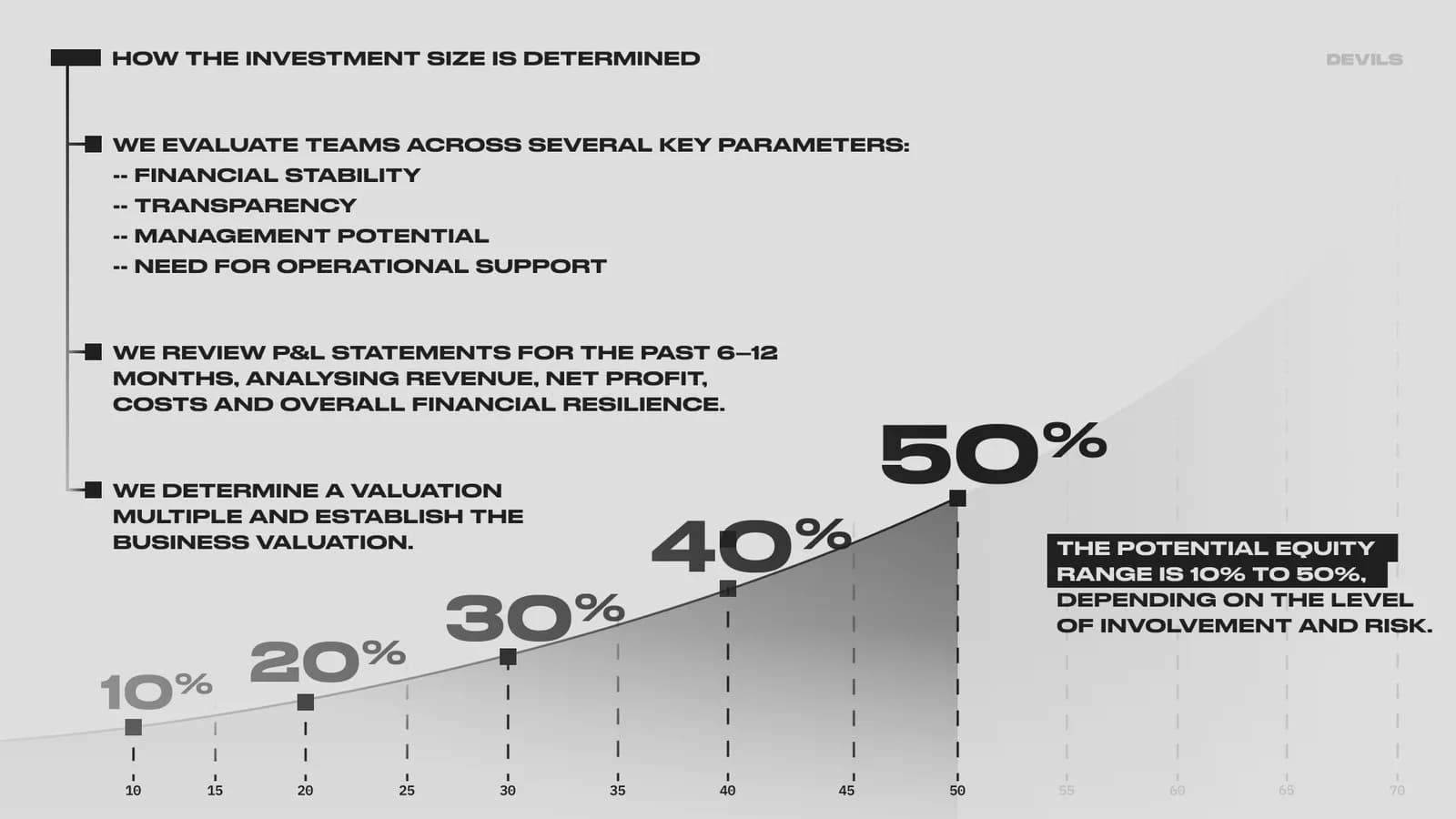
This team got the deep version of involvement: bizdev, finance, creative and new OKRs. Here's what the result is worth to each side across that range, if all $101K is paid out and DEVILS charges nothing else:
DEVILS' share | What the owner keeps | What DEVILS gets | Implied value, if the share bought only the $100K |
|---|---|---|---|
DEVILS takes 10% | Owner keeps $90.9K a month, +153% vs $36K before | DEVILS gets $10.1K a month, its $100K back in about 10 months | Implied value $1M, 2.3 times the team's pre-deal annual profit of $432K |
DEVILS takes 30% | Owner keeps $70.7K a month, +96% | DEVILS gets $30.3K a month, $100K back in 3.3 months | Implied value $333K, 0.8 times the pre-deal annual profit |
DEVILS takes 50% | Owner keeps $50.5K a month, +40% | DEVILS gets $50.5K a month, $100K back in 2 months | Implied value $200K, under 6 months of the old profit |
Our take: at 10%, the owner did very well. At 50%, he still earns more than before, but he sold 50% of a business making $432K a year for $100K plus services. Both readings fit the case. The share is the 1 number an applicant needs most, and it's the 1 number missing.
Facebook iGaming: the part nobody shows
The case says "FB" and nothing else about traffic. Meta allows online gambling ads "only once an ad account has obtained authorization," with "evidence that the gambling activities are appropriately licensed by a regulator." An affiliate team can't get that for someone else's casino, so CPA casino traffic on Facebook usually runs through iGaming apps or PWAs on bought, farmed or agency accounts. That's where bans, account costs and most of the risk sit, and the case is silent on all of it, though DEVILS runs its own farm, apps and PWAs. 10 days after the case, DEVILS itself wrote about Facebook: "When the source storms, teams don't cut volumes." Its own deck lists "dependence on 1-2 traffic sources" as a threat for smaller teams. This team has 1.
Fact-check: what the author showed and what they hid
We rate every case on 10 points: what an outsider needs to judge the result and repeat it. For an investor's case about its own deal, the offer becomes the team and the deal terms, and the P&L matters more than the funnel. Like most case studies, this one is selectively true rather than fake.
Point | Status | What we found |
|---|---|---|
Setup: period, GEO, source, model | Partial | 3 years in iGaming, Facebook, CPA, weeks 1-4 and 4-10. No dates, no GEO, no casino or betting split, no advertisers. |
Author and independence | Partial | DEVILS is public, and its CEO and COO sign the case. But the investor is grading its own deal in a post with an application button, and the funded team is anonymous. |
Finances: the team's P&L | Showed | Before, per group, during and after. Totals reconcile within $1K-2K, and the ROI jump matches the stated cut rates. Costs after the rebuild aren't split. |
Proof | Hid | Neither the Russian text nor the English slides show 1 screenshot of ad accounts, advertiser stats, payouts or the P&L itself. Every number is typed, now in designed slides. |
Traffic: source, GEO, bids | Hid | Facebook is named. GEO, offers, payouts, bid levels and the advertisers behind the "revised terms" are not. |
Tools and systems | Partial | Daily group P&L and "a buying forecasting and management system" are described. The model, its inputs and the tools behind it are not shown. |
Creatives | Hid | The design team was "boosted" by DEVILS' creative department. No creatives, approaches or volumes. |
Apps, PWAs and landing pages | Hid | Not a word, on a source where casino traffic lives or dies by them. |
Consumables and the $100K | Hid | No accounts, agency fees or apps in the costs. The $70K reserve has no item list, and DEVILS' equity share isn't given. |
Repeatability today | Partial | The method, a group P&L, targets on net and cut tracking, is repeatable by any owner. The result rests on DEVILS' model, bizdev and advertiser terms, available only inside the deal. |
Score: 2/5. On the P&L alone this case would rate a 3 or better: before, per group, during and after, and the numbers hold together down to the cut rate. The English version on DEVILS' site adds clear slides and a fuller description of the forecasting system, but not proof: it repeats the same typed numbers. But a case is worth what you can check and repeat. There's no proof of any kind, and the funded team is anonymous. The 2 numbers you'd need, DEVILS' share and how the cuts fell from 15% to 1%, are hidden, and 2 headline claims run ahead of the math. The mechanics are visible; the proof, the deal and the repeatability have holes. That's a 2.
Checklist: what to do
Questions and answers
How does DEVILS CAPITAL invest in media buying teams?
Per its site and deck: an application, an NDA audit of 6-12 months of P&L, a valuation multiple and an equity stake of 10% to 50%, depending on risk and involvement. The team gets capital plus DEVILS' analytics, bizdev, HR, creative and finance, and profits are paid as dividends by agreement.
What changed in the team that got $100K?
1 of 3 buyer groups was disbanded, DEVILS' bizdev and finance were plugged in, advertiser terms were revised, and cuts fell from about 15% to about 1%. Net profit went from $36K to $101K a month.
What are cuts in iGaming CPA?
Cuts are first-time deposits the advertiser refuses to pay for at reconciliation because the players missed its quality KPIs, such as deposit size, repeat deposits or activity. At a 15% cut rate, about 1 in 7 deposits you paid traffic for brings no money.
Is a 23% ROI good for a media buying team?
DEVILS calls it a standard market result for 2026. But ROI is counted on ad spend before team costs: at 23%, this team kept 5% of revenue as net profit, because bonuses took 50% of its gross.
How much equity is $100K worth in a media buying team?
It depends on profit and on what else the investor brings. At this team's pre-deal profit, $100K for 10% values it at $1M, and $100K for 50% at $200K. Ask for the multiple in writing.
Author’s conclusion
As a lesson in team economics, this case is worth reading twice. It shows, with a P&L that reconciles, how a team turning over $720K a month can keep 5%: bonuses on gross, overhead spread across groups that don't earn it, and cuts nobody sees until reconciliation. As evidence, it's an investor's ad for its own program. There's no proof of any kind, the team has no name, the share DEVILS took is never stated, and the founder's "several million a year" is about $780K by the case's own numbers.
My advice: do DEVILS' first month of work yourself before anyone buys a share of your team. Build the group P&L, move bonuses from gross to contribution, and track cuts per advertiser weekly: that alone is where most of this case's profit came from. If you do apply for an investor's money, the $100K is the smallest number in the deal. Get the equity share, the valuation multiple, the working capital terms and the ownership of your advertiser relationships in writing, and talk to a funded founder first.
Lu Discover, Editor-in-chief
Our verdict on this case
On the P&L alone this case would rate a 3 or better: before, per group, during and after, and the numbers hold together down to the cut rate. The English version on DEVILS' site adds clear slides and a fuller description of the forecasting system, but not proof: it repeats the same typed numbers. But a case is worth what you can check and repeat. There's no proof of any kind, and the funded team is anonymous. The 2 numbers you'd need, DEVILS' share and how the cuts fell from 15% to 1%, are hidden, and 2 headline claims run ahead of the math. The mechanics are visible; the proof, the deal and the repeatability have holes. That's a 2.
Our fact-check of the public case: what the numbers show, what is missing. Scores are never for sale.
Sources for this article
- DEVILS — $100K offer case result, post in the C-Level DEVILS channel with the case document (September 4, 2026)
- DEVILS — full text of the case with comments by Oleksandr Slobozhenko, COO Anna and the funded team's founder (September 4, 2026)
- DEVILS — $100K UNIT follow-up: group P&L and the decision to disband group 2 together with the owner (September 15, 2026)
- DEVILS — the offer: $100k for operations and unlimited working capital (March 31, 2026)
- DEVILS — conference results: 389 applications in 2 days (April 4, 2026)
- DEVILS — DEVILS CAPITAL first-year recap: 250 applications, 3 partnerships (January 19, 2026)
- DEVILS — AI analytics case: under 0.5% traffic cuts in a year (June 5, 2026)
- DEVILS — Oleksandr Slobozhenko returns as CEO (June 24, 2026)
- DEVILS — CBDO on ROI norms: 20-30% is now acceptable (June 26, 2026)
- DEVILS — why some buying teams fall apart, on Facebook storming (September 14, 2026)
- devils.inc — DEVILS CAPITAL: criteria, deal flow, equity range of 10% to 50%, FAQ on operational involvement
- devils.inc — DEVILS CAPITAL presentation: equity range, dividends, dedicated advisor, infrastructure
- devils.inc — DEVILS company page: 1M FTDs in 2024, 1,000+ employees, 10 offices
- transparency.meta.com — Meta Advertising Standards: Online gambling and games
Related stories
 Case fact-check
A Media Buying Team Lost $29K on TikTok in 2 Months: The Owner's Post-Mortem, Fact-Checked
 Case fact-check
Why a Media Buying Team Closed Its Nutra Department After 21 Months: The Write-Up, Fact-Checked
 Case fact-check
Comments
0 commentsNo comments yet.
Add a comment