

$3,207 a Month on Facebook Gambling in Tier-3: Fact-Checking a Solo Buyer's Record May

Contents 13
A solo media buyer who goes by Robb posts a monthly income diary on YouTube: he started Facebook gambling in January 2026 with $5,000 and reports every month in numbers. The May episode is billed as "the record": $3,207 net, $1,269 from 1 campaign, spend up to $900 a day, all in 1 tier-3 GEO with 2 offers.
This is our review of the case for media buyers who run, or plan to run, gambling offers on Meta in cheap GEOs: his day-by-day walk-through in translation, our math on his spreadsheet and dashboards, Meta's rules, and what he doesn't show. Editorial fact-check: 3/5.
Short version: this is one of the more transparent cases you'll see, with real Ads Manager screens and a month ledger that reconciles to the cent. But the $1,269 is revenue, not profit, the $3,207 is a change in his balance, and the profit earned in May was $2,874. The GEO, offers and creatives stay hidden, and a month later a line called "Bonus" in his sheet turned out to be agency spend nobody had billed yet.
Who Robb is and what the May video claims
Robb runs a small YouTube channel, "Robb on traffic arbitrage," with 468 subscribers, and a Telegram channel with 576 at our check on October 3, 2026. The Telegram description sums up the project: "Showing the path from $5K in arbitrage. Goal: $20K a month." In his first episode he says he came from Telegram ads, where he "managed 21M in ad budget" in 2025 without naming the currency, and that he had run Facebook ads before, back in 2023.
His monthly results so far, by his own count: January -$1,150, February +$276, March +$1,728, April +$1,593. The May video, "How much I earned in traffic arbitrage in May? (Record)," came out on July 2, 2026, runs 7:42 and had 733 views when we checked. It's in Russian; every quote below is our translation, with the timestamp.
The video opens with a message from his own Telegram comments, which he puts on screen himself: "Started drawing profit for the HR people lately? Don't BS us." His comment on it: "A subscriber in my Telegram channel didn't even believe you can earn this much solo in arbitrage in 2026" (0:19).

Context: the jab has a background. In April, a post he shows later in the same video says: "Many asked about a team. HR hasn't replied to my resume yet." By the July episode he had joined a team on a probation period. A buyer looking for a job has a reason to look good, and the subscriber says so. The May video sells nothing except the Telegram channel: no network link, no course, no shop.
The setup: 1 tier-3 GEO, 2 offers, agency accounts and a PWA
"Reminder: I run tier-3, 1 GEO, 2 offers" (0:25). Everything else comes from the screens and the expense sheet:
- Traffic: Facebook, optimized for "Website purchases," which in his funnel is the FTD postback. Before it come 2 events, lead and registration.
- Accounts: agency accounts for 7% of every top-up. In January he explained the choice: "all those king accounts, mommy accounts and BM setups are a nightmare to me."
- App: a PWA, an installable web page that looks and behaves like an app, at $399 for the month, plus 10 domains.
- Tools: Dolphin Cloud at $99.99, ChatGPT at $63.25, a $10 spy-tool line, a tracker fed by postbacks.
- Payout: not stated. 141 FTDs in his best campaign earned exactly $1,269, which is $9 per FTD, and the month averages $9.31 per deposit.
Not shown: the country, the offers, the affiliate network and the PWA. Campaign names on screen carry a "BF" tag. If that's a country code, it's Burkina Faso, and in the June episode he says the install losses he found with his PWA service were "only in Africa." He never names the GEO, and the tag may mean something else.
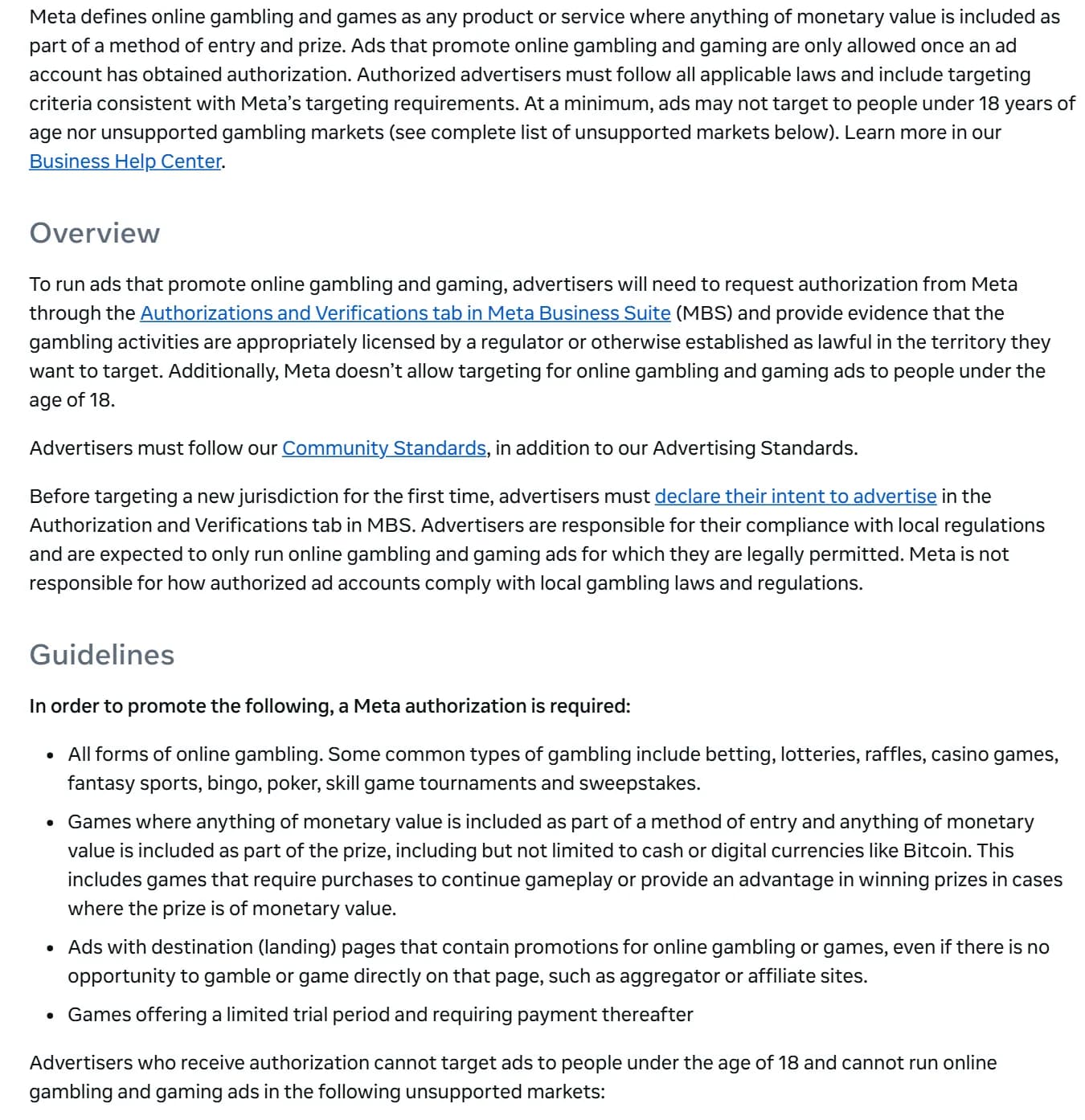
Our take: Meta allows online gambling ads only "once an ad account has obtained authorization," with evidence that the gambling is "appropriately licensed by a regulator" in each target country, and the policy explicitly covers "aggregator or affiliate sites." Authorized advertisers still can't target under-18s or 19 unsupported markets, including India, Pakistan, Bangladesh, Egypt and the Philippines, several of them classic tier-3 gambling GEOs. Nothing in the case suggests his accounts hold that authorization. The rejected creatives and the overnight bans you'll see below are what running outside it costs.
The agency account is the solo buyer's shortcut: someone else owns the business infrastructure, you rent ad accounts and pay a percentage on each top-up. You don't farm or buy accounts. You pay 7% forever, and when an account dies, you ask for a new one.
Testing creatives: ABO 1-17-1 at $8 per ad set
May started late. A Telegram post from the end of April, shown in the video, says his budget had run out and he'd be back "after the May holidays," with 50 new creatives planned. The first launch failed: "I launch ABO 1-17-1 and nothing happens. 0 regs, 0 FTD, 0 leads" (0:32). The domain he'd bought through a Telegram bot had died, and a friend helped him set up a new one.
The relaunch, in his words:
- 2 ABO 1-17-1 campaigns, 1 campaign with 17 ad sets of 1 ad each, at $8 a day per ad set. In the first, 2 creatives caught on, 1 of them with registrations too expensive: "Max should be up to $2. I kept it only because reg to deposit is 50%" (0:52). In the second, only 1 creative caught, the same one.
- 2 ABO 1-10-1 retests with those creatives: in 1 campaign the earlier winner worked again, in the other nothing caught.
- 14 new creatives on 2 ABO 1-14-1: "The first campaign didn't catch on at all, but the second showed a really solid result" (1:28).
His kill thresholds for ABO on this GEO: "leads up to $0.70, registrations up to $2 and FTD up to $5. I always try to let every ad set spend around $1 to $1.50" (1:46). The summary card later in the video says registrations up to $3, so the 2 numbers disagree.
Our math: at $0.31 to $0.70 per lead, $1.50 buys 2 to 5 leads. Every verdict on an ad set rests on a handful of events. Meta's own guidance says an ad set leaves the learning phase "after about 50 results in the week after the ad set's last significant edit," and warns against high ad volumes: "When you create many ads and ad sets, the delivery system learns less about each ad and ad set." Robb does the opposite on purpose.
Our take: this is spray and cut, and it's rational where an FTD costs $3 to $5. A losing ad set dies at $1.50 to $5, a winner gets a budget, and the false negatives are the price of speed. The retest in 1-10-1 is the right hedge: a creative killed on 3 leads deserves a second look. The same rules don't travel up-market. In January he tried a tier-2 GEO on a $60 payout and lost $220 in 2 days; at that price every threshold, and every verdict, costs about 7 times more.
The $1,269 campaign, day by day
The second ABO 1-14-1 started on May 9, and he walks through it day by day:
- May 9: ad sets with 0 leads are off at once; those with 1 lead above $0.70 go next; 1 with a single registration is off at $4. "If there had been 2 registrations, I'd have run it to $5 and waited for an FTD" (2:20).
- May 10: 5 ad sets left. "Every day the audience changes, and it doesn't matter what happened yesterday, so we look at the metrics fresh every day" (2:28). 1 ad set with cheap registrations but no FTD at $5 is off; another with 1 FTD runs overnight and is off in the morning.
- May 11: 3 creatives left, 1 of them with leads above $3 is off. "If something doesn't catch on, the next day you just switch it off, and income is higher" (3:01).
- May 12: 2 ad sets left; he barely raises the budget "to keep ROI stable."
- May 13: 1 ad set's FTD cost reaches his ceiling: "Into the FTD price I put the cost of installs and the percentage for agency accounts. So I need an FTD under $7. Beyond that I'm pouring into the red" (3:15). He keeps it, hoping for late conversions.
- May 14: the cost recovers, but in the evening the creative is rejected, "and nothing could be done about it."
- May 15: 1 creative left with good prices, and "at night the whole account got banned" (3:37).
The result: "Spend $507, 141 FTD, $3.60 per FTD. And earned from this campaign alone: $1,269 gross. Net, you can count yourselves" (3:41).
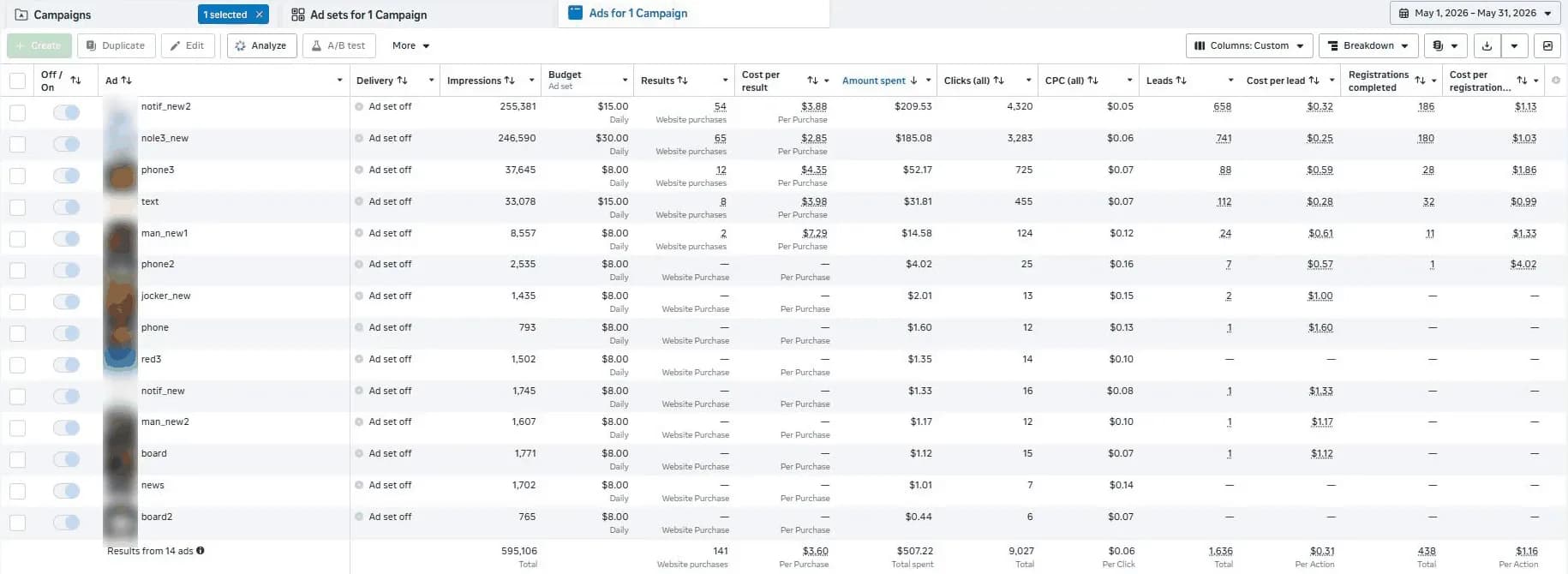
The recording is dated June 22 by the taskbar clock, with the report set to May 1 to 31.
Our math: 141 FTDs times $9 is exactly $1,269, so the "earned" figure is revenue. Profit on ad spend is $761.78, an ROI of 150%. After the 7% agency fee on the top-ups behind that spend (about $38) and the PWA cost at his monthly average of $0.40 per deposit (about $57), the campaign made roughly $670. He does say "gross," and he does say "count yourselves." The video title and description still say "earned $1,269."
The funnel is clean enough to read: CPM $0.85, CTR 1.52%, click to lead 18.1%, lead to registration 26.8%, registration to FTD 32.2%. On the day-1 screen, the campaign spent about $173 and got 48 FTDs, a third of its total, on the first day alone.
His $7 ceiling also checks out. A $9 payout minus 7% for the agency is $8.37 per FTD, minus about $0.40 of PWA cost per deposit leaves around $8. A $7 ceiling keeps roughly $1 of margin per FTD at the worst moment.
Our take: a winner that lives 7 days, loses its creative on day 6 and its account on day 7 is the normal life cycle in this setup, not bad luck. The kill rules make money because they cut losers early; they don't protect winners. The only defense is the next creative and the next account, which is why the video spends more time on testing than on the winner.
Scaling with CBO: 1-3-3 or 1-1-3, and 10 times the budget in a day
Alongside the tests, and through the second half of May, he scales through CBO, where Meta allocates 1 campaign budget across the ad sets. "In ABO every ad set catches a different audience, while in CBO it's 1 audience for all ad sets" (4:32). His CBO thresholds are looser: leads up to $1.50, registrations up to $3, FTD up to $5, and "to understand whether it caught the audience, you need to see 1 FTD under $5 and at least 2 registrations" (4:44).
The rules for touching a campaign: "We don't go into the campaign and switch off ad sets and ads only after the first FTD. If the metrics are good but there's no FTD at $5, we just switch the campaign off and don't wait" (4:50). After the first FTD, ad sets and ads with no spend are switched off "so CBO doesn't accidentally dump the budget there" (5:19).
On structure: "1-3-3 or 1-1-3, no big difference for me, but I think 1-3-3 has a better chance of catching, simply because there are more ad sets" (4:20).
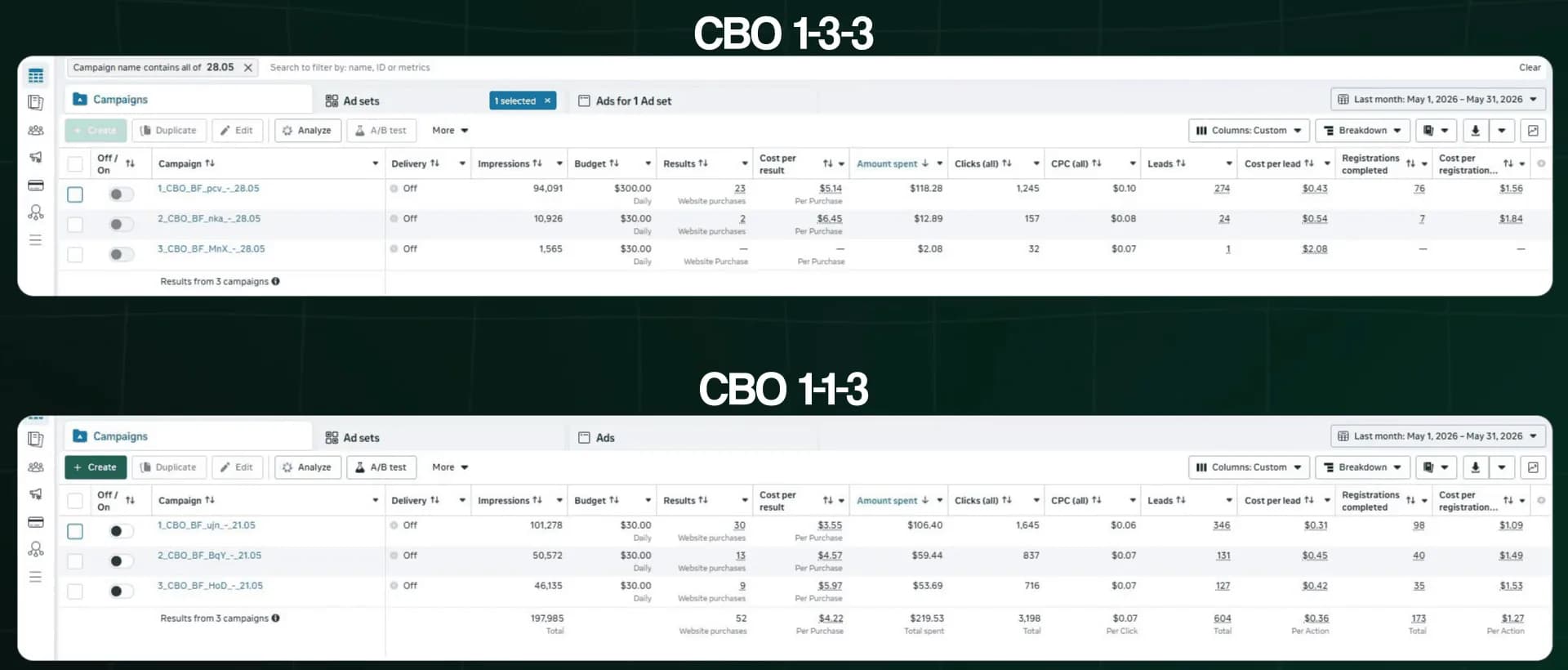
Our math: his own samples point the other way. The 1-1-3 set on screen made 52 FTDs at $4.22; the 1-3-3 set made 25 at $5.33. That's 1 day each with different creatives, so it proves nothing either way. His April video also preferred 1-3-3, so the preference is consistent; the evidence for it just isn't on screen. Treat the structure question as open and test both on your own creatives.
Then the budget: "I used to push an account from $30 to $150, now up to $300. I tried raising the budget to $500 in 1 day, but the metrics fly off" (5:23). The chapter title calls it "the CBO campaign whose budget I raised 10 times in a day."

Our math: the $300 campaign on May 28 spent $231.80 for 45 FTDs at $5.15, about $405 in revenue at $9 and a 75% ROI on spend. Not every $300 budget turns into spend: the 1-3-3 campaign with the same budget that day spent $118.28. And $5.15 is just over his own $5 line, so the 10x jump held, barely.
Our take: in CBO it's not "1 audience," it's 1 wallet. Meta moves the budget toward whichever ad set it predicts will convert, which is why he leaves the campaign alone until the first FTD and then shuts off the ad sets that get nothing. Meta's help page asks advertisers to "avoid frequent budget changes (which can cause an ad set to re-enter the learning phase)." His 5x and 10x jumps ignore that, and in a GEO with $0.85 CPMs it seems to work up to around $300. His own ceiling at $500 is the honest part.
He also shows scaling live, on June 23: "Today 7 accounts were launched, 3 CBO each. The campaigns are identical everywhere, nothing is different" (5:36). On screen, 4 accounts didn't catch, 1 of them after an FTD he admits he "held too long," and 3 did, with some campaigns already raised to $150. In the June episode he returns to the same screen: the 3 accounts that caught were the 3 left, and 1 of them "just got banned" as he was about to raise it to $300.
Our take: 7 identical launches, 3 results, 1 ban. The account is part of the variance, and the CBO method needs several accounts in parallel to work at all. Budget for the ones that never catch.
The month in 1 spreadsheet
The strongest proof in the video is his Google Sheet for May: installs, registrations, deposits, spend, revenue and profit for each of the 31 days, plus a side panel with every cost.
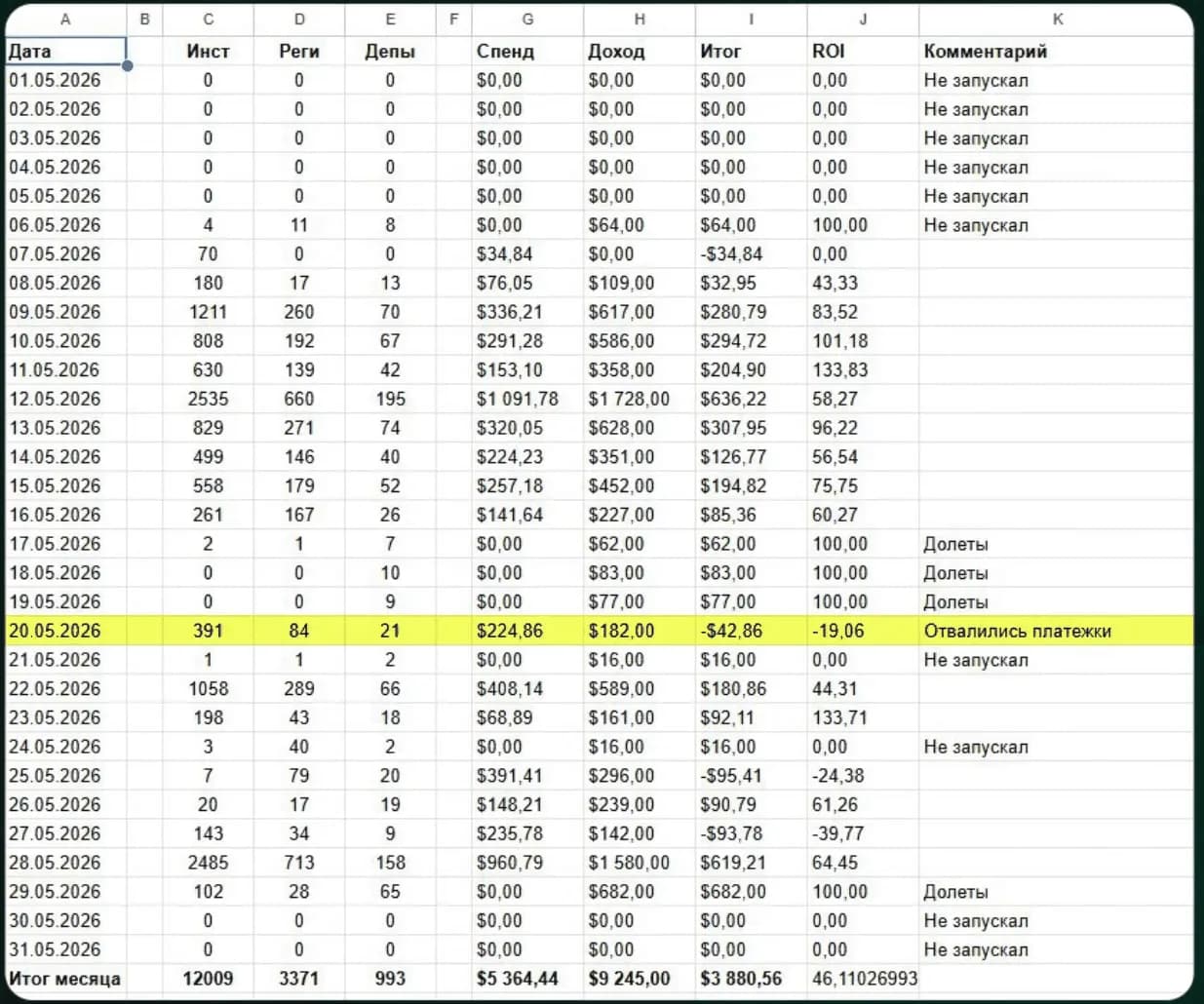
Our math: we added up every column. Registrations, deposits, spend, revenue and the result match the totals to the cent: $9,245 minus $5,364.44 is $3,880.56. Installs add up to 11,995 against 12,009 in the total, a 14-install gap that doesn't touch the money.
The ROI cell doesn't hold. 46.11% is the average of the 31 daily ROI values, including 10 days scored at 0 and 5 days with no spend scored at 100%. The real ROI on ad spend is $3,880.56 / $5,364.44 = 72.3%. With the month's $1,006.34 of costs, it's 45.1%, which lands near the broken cell by coincidence.
The rest of the month in his numbers:
- 993 deposits: $5.40 in ad spend each, $6.42 all-in, against $9.31 of revenue. That's about $2.89 of margin per deposit, and $5.40 is above his own $5 target.
- 17 days with spend, 10 days not launched at all, 4 days with late conversions only.
- 4 losing days: May 7, 20, 25 and 27, together -$266.89.
- $900 a day happened on 2 days: $1,091.78 on May 12 and $960.79 on May 28. The median spending day was $235.78.
- First half, May 1 to 16: $2,193.64 profit on $2,926.36 spend, 75% ROI. Second half: $1,686.92 on $2,438.08, 69%.
The video closes the first half at "+$2,193" on screen (4:12), and the sheet agrees: $2,193.64. He adds that it's "more than for all of April." That holds even like for like: April's ad-level profit was $1,448.06. But the CBO scaling didn't raise volume in May. The second half spent less and earned less than the first.
An anomaly he doesn't mention: on May 25 and 26 he spent $539.62 and logged 27 installs, against 96 registrations and 39 deposits. The install count clearly failed on those days. A month later he found that his PWA service had been losing more than 50% of installs on the way to his tracker "all this time." The money columns don't depend on installs, but every cost per install in this sheet does.
Payment outages, a dead day and a $654 hole at the agency
He doesn't hide the bad days:
- May 20: "The payment methods dropped. They drop a lot in this GEO in general... You can't do anything here, you just have to switch everything off" (6:42). The sheet shows -$42.86 and the comment "payment methods dropped."
- May 27: "Nothing caught on that day. It was the first time for me, I didn't really understand anything. I just switched everything off and relaunched the next day" (6:53). The sheet: -$93.78. May 25, -$95.41, isn't explained.
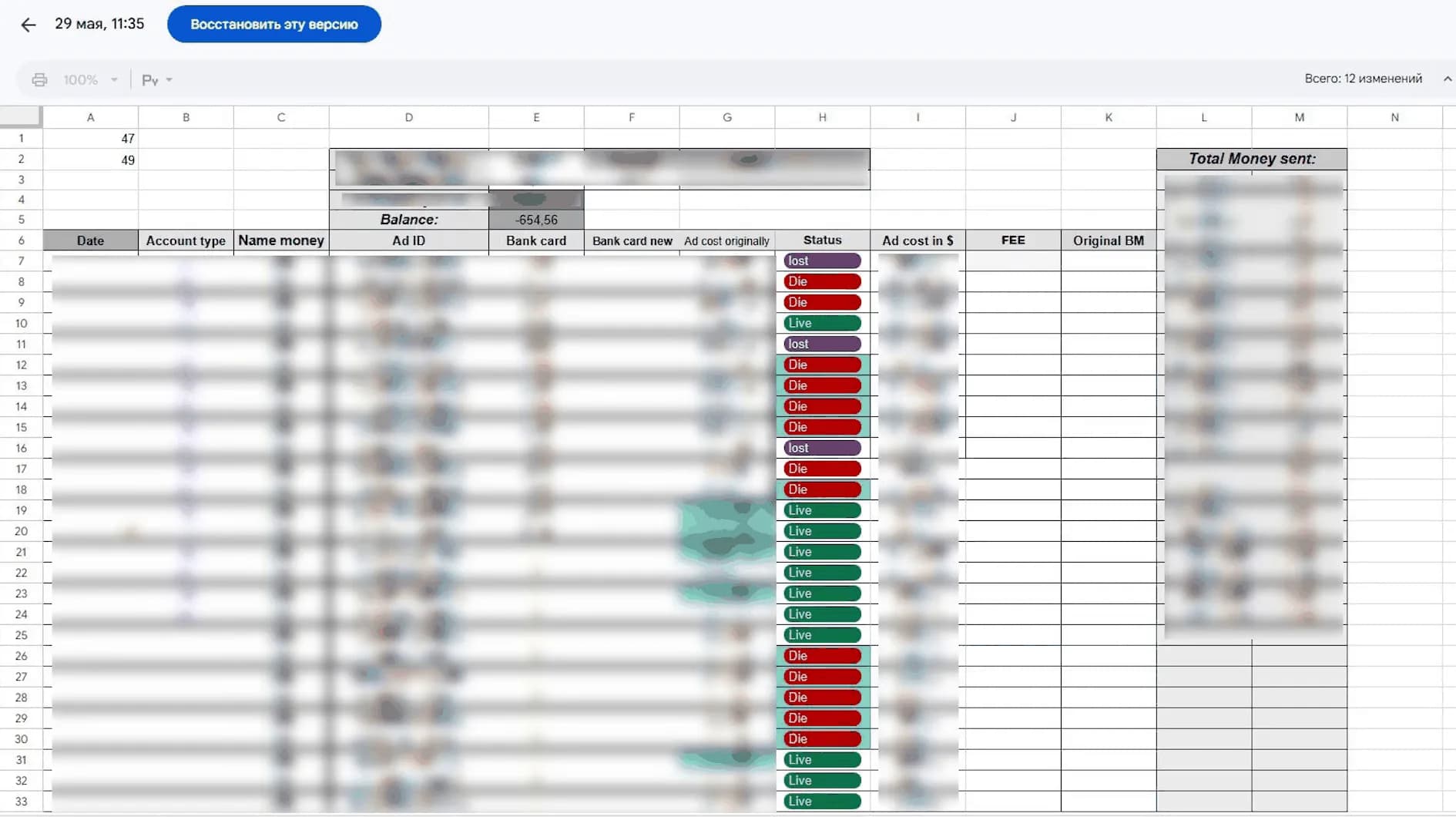
- The agency: "I went into the minus at my agent by $654. That happens too. He missed it, I missed it... I said: the payouts will come and I'll pay it all... I've already covered it, and we keep working" (7:03).
Our take on payments: in many tier-3 markets deposits go through local payment methods, and when the casino's provider fails, registrations keep coming while deposits stop. Your spend doesn't stop with them. In the June episode he shows what it looks like from the inside: reg to deposit at 31% for 2 hours, then 16%, then 5%, "and the advertiser will say: everything's fine on our side, the problem is your traffic." The defense is boring: hourly reg-to-deposit checks in the tracker, 2 or more advertisers per GEO, and a rule to pause first and ask questions second, which is what he did on May 20.
On the agency sheet: the statuses aren't dated on screen, but 16 of 27 rows are dead or lost accounts. Agency accounts are cheap to enter and expensive to keep alive.
$3,207 or $2,874: what income means in this case
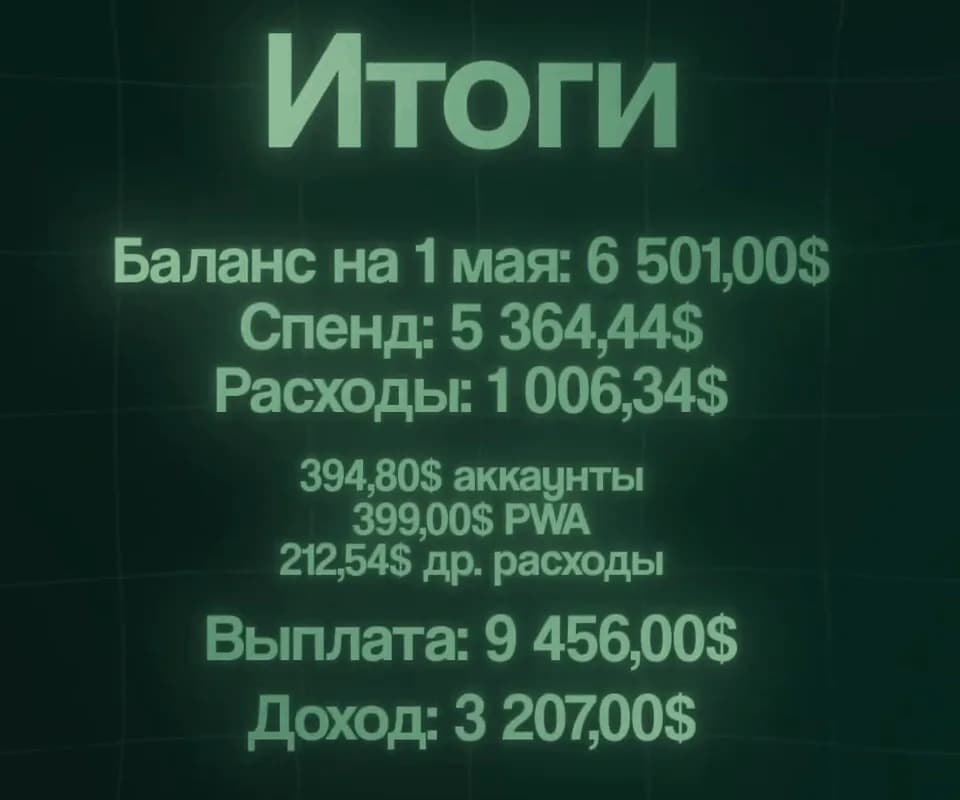
The final card of the video: "Balance on May 1: $6,501. Spend: $5,364.44. Expenses: $1,006.34: $394.80 accounts, $399 PWA, $212.54 other. Payout: $9,456. Income: $3,207" (7:24).
Our math: the side panel of his sheet explains every line.
- "Accounts" isn't accounts. $394.80 is exactly 7% of $5,640 he sent to the agency, which left $5,245.20 for ads.
- "Income" is the change in his total balance: $9,708 at the end of May minus $6,501 at the start, $3,207. In cash terms, $9,456 of payouts minus $5,640 to the agency, $399 to the PWA and $212.54 of other costs is $3,204.46, within $3 of it.
- Profit earned in May is a different number, and his sheet has it: "expected income," $2,874.22. That's $9,245 of revenue minus $5,364.44 of spend minus $1,006.34 of costs. The $333 gap has 2 sources. Payouts in May exceeded May's revenue by $211, because they include money for April's deposits while some of May's paid out in June. And $119 of May's spend wasn't paid for with May's top-ups: it came from April's leftover agency balance and the "Bonus" line.
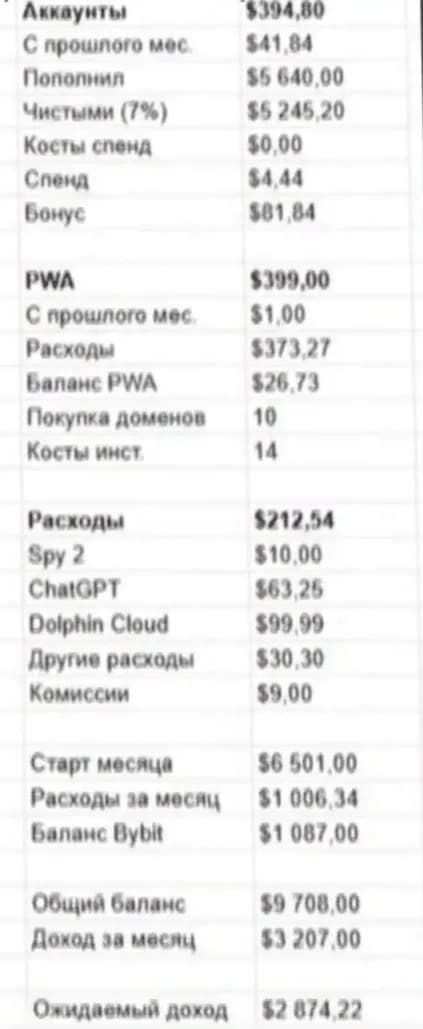
Then there's the "Bonus" line, $81.84 in May. The agency balance works out only with it: $41.84 carried over plus $5,245.20 plus $81.84, minus $5,364.44 of spend, leaves the $4.44 in the sheet. In the June episode he explains it: "I was just spending more every month than I topped up, and I thought, accounts get banned, so the agent doesn't charge the money... But it turned out he hadn't counted an account for several months" (5:50, June video). The agency billed him $1,237.13 of debt for past months, and he paid it in June.
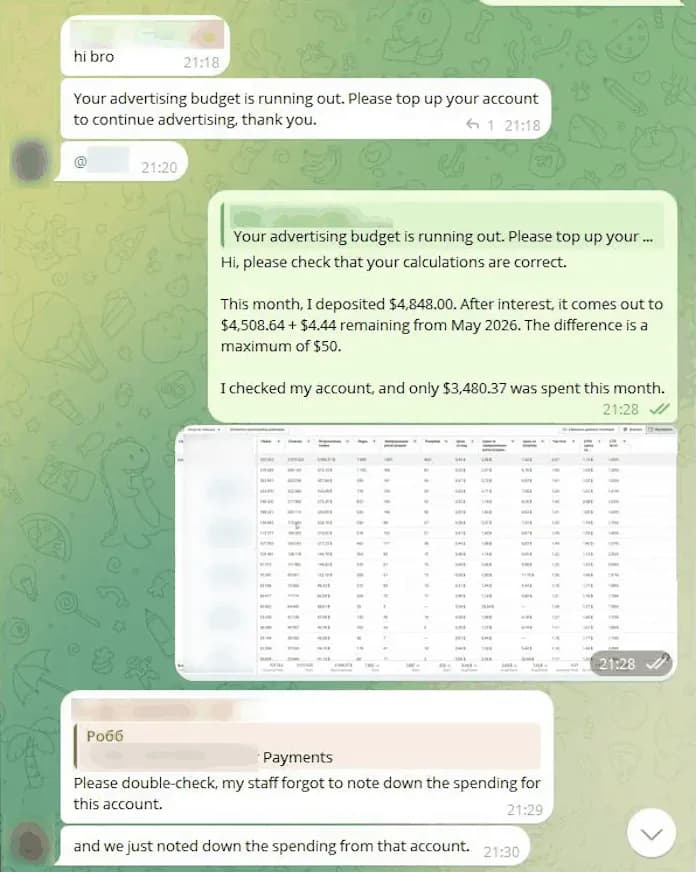
Our take: by his own sheet, $81.84 of May's spend sat in that bill; the April sheet, shown in the same June video, has a bonus of $667.83, so the 2 months explain about $750 of the $1,237. The balance figure counted that money as his. The "expected income" line didn't: it subtracts the full spend from Ads Manager, so the debt hits his cash, not May's profit. The good news for the case is that the ledger is real: the $4.44 and the PWA's $26.73 carry into June to the cent, and the same $4.44 appears in his June message to the agency. The total balance doesn't carry: May ends at $9,708, June starts at $5,549. A withdrawal would explain it, and his June sheet does have a "withdrawn to rubles" line, but the May video doesn't say.
For a buyer comparing his months with yours, use the "expected income" line: $2,874 for May, still his best month up to then.
Fact-check: what the author showed and what they hid
We rate every case on 10 points: what an outsider needs to judge the result and repeat it. Most case studies are selectively true rather than fake, and this one is more true than most.
- Setup: period, GEO, offer, model — Partial. May 2026, Facebook, gambling, "tier-3, 1 GEO, 2 offers." The country, the offers, the network and the payout are hidden; we derived about $9 per FTD from his own numbers.
- Author and independence — Partial. A pseudonymous solo buyer with a public monthly diary and no sponsor in this video. He was applying to teams at the time, and later episodes plug his network manager.
- Finances — Showed. Spend, revenue, payouts, every cost line and both profit figures are on screen and reconcile. The headline $3,207 is a balance change, May's earned profit was $2,874, and the "Bonus" line was unbilled agency spend.
- Proof — Partial. Real Ads Manager recordings with dates, the daily ledger and the agency's own sheet. No network dashboard, payout screen or tracker report for May.
- Source and targeting — Showed. Structures (ABO 1-17-1, 1-10-1, 1-14-1, CBO 1-3-3 and 1-1-3), $8 and $30 budgets, kill thresholds for each stage and the budget steps. Targeting settings and placements aren't shown.
- Tools — Partial. Agency accounts at 7%, Dolphin Cloud, a PWA, ChatGPT and a spy tool appear as cost lines. The agency, the PWA service and the tracker aren't named in this video.
- Creatives — Hid. Only file names such as notif, phone, text and joker. Thumbnails are blurred, and the approach behind the winners isn't explained.
- PWA and landing pages — Hid. The PWA cost of $399 and 10 domains are listed, but no PWA page, design or prelander is shown.
- Consumables — Partial. The price is clear: 7% of every top-up. How many accounts May used and how long they lived isn't given; the agency sheet shows 16 dead or lost accounts in 27 rows.
- Repeatability today — Partial. The method is spelled out step by step, but without the GEO, offers and creatives it can't be copied, and the next month brought more payment outages, a 50% install leak and a $1,237 agency bill.
Score: 3/5. This case shows more than most: real dashboards with dates, a month ledger that reconciles to the cent, the losing days left in and the author's own skeptic quoted on screen. On transparency of money it's close to a 4. But everything you'd need to repeat the result is hidden: GEO, offers, network, creatives and PWA. There's no payout proof for May, and the headline numbers flatter him: $1,269 is revenue, and $3,207 is a balance change on top of agency spend that hadn't been billed yet. Solid, with the key parts hidden: a 3.
Checklist: what to do
Questions and answers
Can you run gambling ads on Facebook in 2026?
Only from an ad account with Meta's authorization, backed by proof of a license or legal status in each target country. Ads can't target under-18s or 19 unsupported markets, including India, Pakistan, Bangladesh, Egypt and the Philippines. The rule covers affiliate landing pages too.
What is an agency ad account and what does it cost?
An ad account that sits in an agency's business infrastructure and is rented to you. In this case the price is 7% of every top-up, $394.80 on $5,640 in May. You don't farm or buy accounts, but you depend on the agency's records: here it missed an account's spend for months.
What FTD cost works for tier-3 gambling on Facebook?
It depends on the payout. In this case the payout is about $9, the author kills ad sets with no FTD at $5, treats $7 as the ceiling and averaged $5.40 in ad spend per deposit, $6.42 all-in. Derive your own ceiling from your payout and costs.
ABO or CBO for testing gambling creatives?
The author tests in ABO, 1 ad per ad set at $8 a day, and scales winners in CBO at $30 and up. ABO forces spend into every creative; CBO lets Meta pick, which is cheaper once you already know which creatives work.
Why is a media buyer's income not the same as profit?
Cash moves on a delay. Payouts in a month include earlier conversions, and unbilled costs can sit outside the books. In this case income by balance was $3,207, helped by $81.84 of spend the agency hadn't billed yet, while profit earned in May was $2,874.
Author’s conclusion
This is what a useful case looks like: not a screenshot of 1 good day but a month of dashboards, a ledger that reconciles, the losing days and an agency mess the author could have left out and didn't. The method holds together. Tiny ABO tests, kill rules at a few dollars and CBO with 5x to 10x budget jumps are discipline for a market where an FTD costs $3 to $5, not a secret. The weak spots are the headlines: $1,269 is revenue, $3,207 is a balance, and the profit he earned in May was $2,874.
My advice: take the rules, not the result. Derive your FTD ceiling from your own payout and costs, cut ad sets that miss it the same day, re-test the killed creatives once and scale only what survives 2 days. Run at least 2 advertisers per GEO, watch reg to deposit by the hour, and reconcile the agency's statement with Ads Manager every week, because any line called "bonus" is a debt with a delay. And read every income video, including your own, by the profit earned that month, not by how much the balance moved.
Lu Discover, Editor-in-chief
Our verdict on this case
This case shows more than most: real dashboards with dates, a month ledger that reconciles to the cent, the losing days left in and the author's own skeptic quoted on screen. On transparency of money it's close to a 4. But everything you'd need to repeat the result is hidden: GEO, offers, network, creatives and PWA. There's no payout proof for May, and the headline numbers flatter him: $1,269 is revenue, and $3,207 is a balance change on top of agency spend that hadn't been billed yet. Solid, with the key parts hidden: a 3.
Our fact-check of the public case: what the numbers show, what is missing. Scores are never for sale.
Sources for this article
- youtube.com — Robb: How much I earned in traffic arbitrage in May? (Record), the case video (July 2, 2026)
- youtube.com — Robb: 6 months in traffic arbitrage, June results: agency debt of $1,237, payment outages and PWA install losses (August 8, 2026)
- youtube.com — Robb: How I almost went into the red in April: April sheet with the $667.83 bonus line and CBO 1-3-3 vs 1-1-3 (May 15, 2026)
- youtube.com — Robb: How much I earned in March: payouts, ad account and payment problems (April 15, 2026)
- youtube.com — Robb: Traffic arbitrage from scratch in 2026 with $5,000: agency accounts at 7% and the tier-2 test (January 15, 2026)
- youtube.com — Robb: My first team, July results: probation period in a team (August 29, 2026)
- youtube.com — Robb: YouTube channel: episodes and subscriber count
- t.me — Robb: Telegram channel: description with the $20K a month goal and subscriber count
- transparency.meta.com — Meta Advertising Standards: Online Gambling and Games (authorization, licensing evidence, unsupported markets)
- facebook.com — Meta Business Help Center: About the learning phase (50 results, ad volume, budget changes)
Related stories
 Case fact-check
Raketech's Q2 2026: Revenue -17.6% Under an 'EBITDA Improvement' Headline, Fact-Checked
 Case fact-check
59% of Installs Were Bots: An Indie Developer's Google App Campaign, Fact-Checked
 Case fact-check
Comments
0 commentsNo comments yet.
Add a comment