

$2,837 in 34 Days, 85% on 2 Exam-Result Days: Adsterra's Pakistan Publisher Case, Fact-Checked

Independent and reader-supported. Some links here are affiliate links: if you sign up through them, we may earn a commission at no cost to you. It never changes our scores or verdicts. Affiliate disclosure
Contents 16
Between August 1 and September 3, 2026, a 22-year-old solo publisher from a village in Punjab earned $2,837.58 on Adsterra from .pk websites for school students. $2,426.55 of it, 85%, came on 2 days: the days Punjab's education boards announced the Class 10 and Class 9 exam results. Adsterra published his account on its blog on October 20, 2026.
This is our review of the case for publishers who monetize their own sites with pop and push formats: our math on the dashboard numbers, what the case's own screenshots don't reconcile, what Google and Chrome say about these formats, and what you can repeat. It's a publisher case, not a media buying one, so in our checklist "traffic" replaces the traffic source and "site and placements" replace landers. Editorial fact-check: 3/5.
Short version: the revenue adds up to the cent, and the format split is the most useful data in it. Popunders and a Smartlink made 94% of the money from 30% of the impressions, while a 300x250 banner made 2% from 38%. But the sites aren't named, the "100% organic Google Search" claim doesn't match the case's own Search Console and Analytics screenshots, the 177,039 push subscribers come with no dashboard, and the case is published by the network it praises, which pays $200 per published case.
The case at a glance
Item | What the case says |
|---|---|
Publisher | Hamza Ali, "Hamza Blogger," 22, works alone from Punjab, Pakistan |
Sites | .pk education sites for Pakistani students, not named |
Period | August 1 to September 3, 2026 (34 days) |
Network and formats | Adsterra: popunder, Smartlink (he calls it Direct Link), Social Bar, banner 300x250 |
Revenue | $2,837.58 from 2,979,286 impressions and 105,680 clicks |
Best day | August 6, 2026: $1,480.35 |
Traffic, as claimed | "100% organic Google Search": 405,000 clicks in 3 months, average position 4.3 |
Costs, as claimed | $100-$200 hosting in an event month, about $13 a year per domain, $500 once for push software, about 240 hours |
Published by | Adsterra's blog, October 20, 2026 |
Our score | 3/5 |
Who published the case: Adsterra, about its own publisher
The case is Adsterra's blog post. It's written up by Maria Littera, Adsterra's Lead Content Creator, and told in the first person by Hamza Ali, "known online as Hamza Blogger." It opens with a fair disclaimer: "This is a publisher's own account of his results and methods. Your numbers will depend on your niche, traffic and execution." It closes with "sign up with Adsterra and test these formats on your own audience."
It's his second Adsterra case. On September 29, 2025, the same blog published Hamza Ali and his school friend Mutee Ur Rehman: "Within just the last month, Adsterra helped us earn $2,700." The new case mentions the friend once: "He works on something else now, so the sites are mine alone."
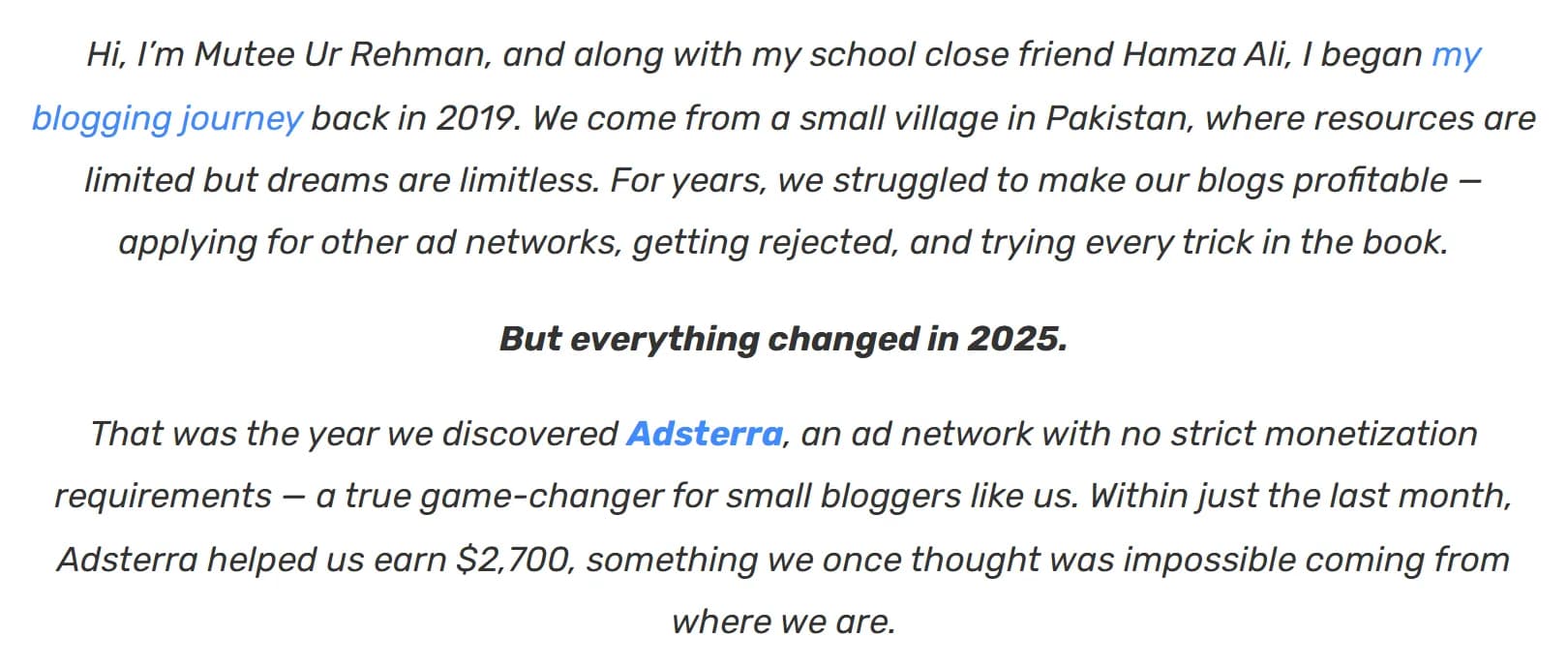
Adsterra pays for these stories. Its call for cases, dated October 10, 2026: "You get $200 for each story where you teach other marketers, affiliates, and publishers." The money is credited to the publisher's Adsterra account after the network reviews the data and screenshots. Whether this case was paid isn't disclosed. Outside Adsterra's blog we found no site, channel or profile for "Hamza Blogger."
The text was edited heavily. 1 paragraph appears twice word for word: first about "the networks I tried earlier," then under a heading that names AdSense.
Our take: a real-looking publisher with a 2-year record on the same blog, telling a story the network wants told. That's not a reason to dismiss the numbers. It's a reason to check each claim against the screenshots, which is what we did.

Adsterra2.4
Ad network behind this case: popunder, Smartlink, Social Bar
The setup: Punjab exam results on .pk domains
"Education in Pakistan runs on a calendar: Results, admissions, dates, forms, schedules. Every one of those has a fixed day." His model is to publish about 2 months before a known date, rank by the day itself, and keep the server alive when "hundreds of thousands of students search for the same thing at the same time." The reader he describes wants their own result, "by roll number, right now."
The case never names the events. The dates do. On Thursday, August 6, 2026, all 9 Punjab education boards announced the Class 10 (Matric) results; the Lahore board alone had 282,308 candidates. On Wednesday, September 2, all 9 boards announced the Class 9 results at 10:00 a.m. Both dates were public weeks ahead: on July 9, ProPakistani reported the boards' tentative schedule, August 6 for Class 10 and September 2 for Class 9. And the 2 apps in his Cloudways screenshot run on domains with "class result" in their names.
Our take: the niche is board exam results for Punjab's secondary-school students, and the "calendar" is a published timetable. That's the strength of the model: the date of the next spike isn't a guess. It's also the limit: a couple of big days a year per exam, shared with "20 to 30 sites competing seriously on my main keywords," by his own count. And the readers are school students, which matters for the ad formats below.
The money: $2,837.58, and 85% of it on 2 days
The top days from his Adsterra dashboard, as the case lists them:
Date | Impressions | CPM | Revenue |
|---|---|---|---|
August 6, 2026 | 2,291,458 | $0.646 | $1,480.35 |
September 2, 2026 | 440,680 | $2.147 | $946.20 |
August 7, 2026 | 49,154 | $2.342 | $115.11 |
September 1, 2026 | 69,159 | $1.339 | $92.62 |
September 3, 2026 | 19,833 | $3.091 | $61.31 |
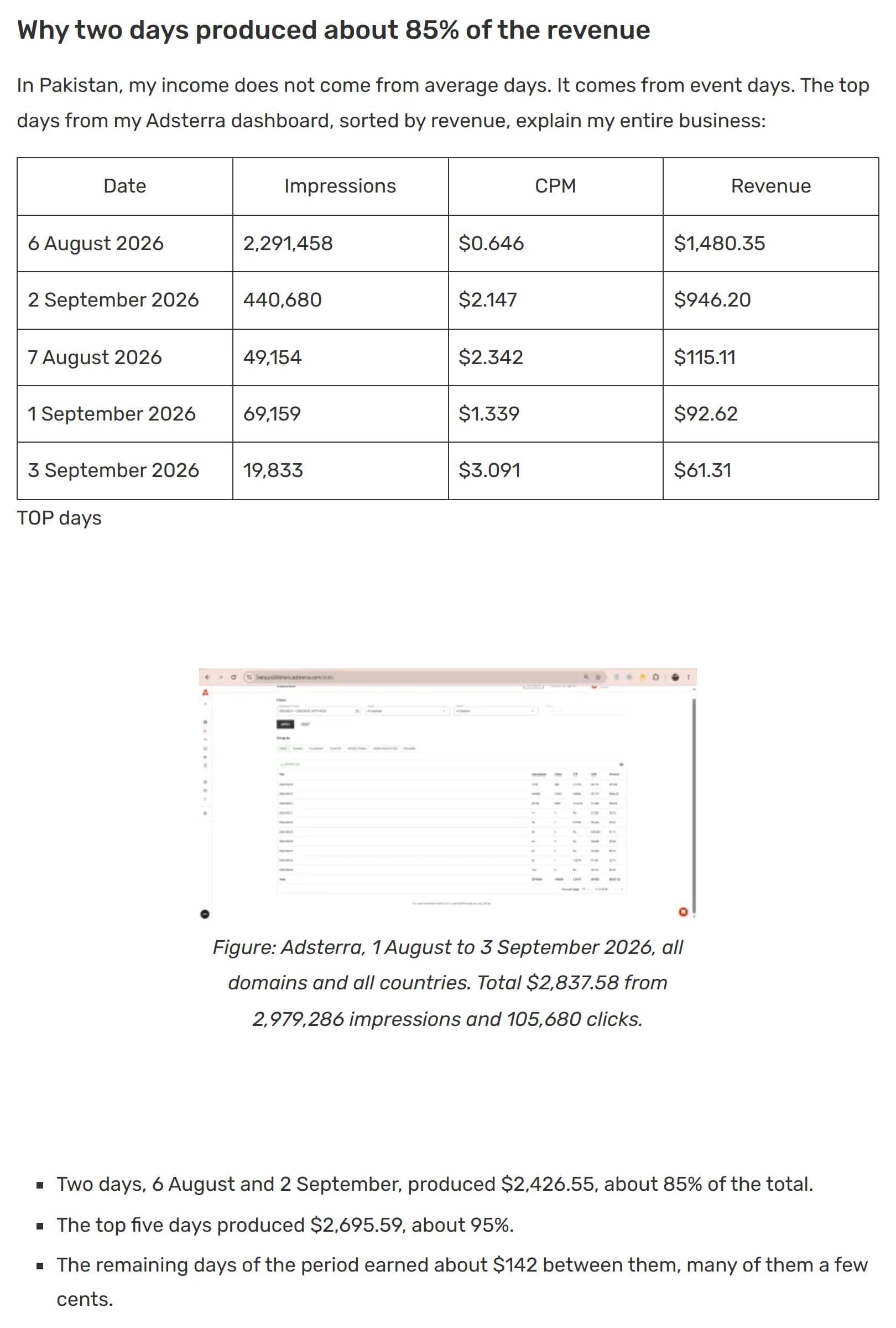
Our math:
- every row reconciles: impressions times CPM gives the revenue within 7 cents, the gap from rounding the CPM;
- August 6 and September 2: $2,426.55, or 85.5% of $2,837.58; the top 5 days: $2,695.59, or 95.0%;
- the other 29 days: $141.99 together, $4.90 a day, from 109,002 impressions, about 3,760 a day;
- across the period: $0.95 per 1,000 ad impressions, and the 3.547% CTR matches 105,680 clicks;
- August 6 alone had 77% of all impressions and 52% of the revenue.
In a calendar niche the average day is meaningless.
The CPM jump between the 2 events. He writes: "On 2 September I had only a fifth of that traffic, but the CPM was $2.147... Raw traffic was not the improvement. Placement was." A blended CPM is mostly a mix, though. In his own placement table a banner impression earned $0.048 and a popunder $1.65 to $4.10, so taking banner and Social Bar impressions off the pages raises the average by itself. His Analytics screenshot for September 2 points the same way: 1M page views but only 440,680 ad impressions that day, 0.44 per view, so most views carried no banner at all. 4 placements in his table have IDs above 31,000,000 while the rest are in the 30 millions, which suggests they were created later, for the new setup.
Not shown: the placement split for each of the 2 days, so "better placement" and "fewer cheap units" can't be told apart. Also not shown: the daily dashboard itself at a readable size. The screenshot in the case is 450 px wide, and its numbers can't be read; the table is typed.
Which formats paid: popunders 76%, banners 2%
His placement screenshot is the most useful data in the case. We added up its visible rows by format:
Format (placements) | Impressions | eCPM | Revenue | Share of revenue |
|---|---|---|---|---|
Popunder (5) | 760,797 | $2.85 | $2,165.68 | 76.3% |
Smartlink, "Direct Link" (1) | 146,389 | $3.41 | $499.04 | 17.6% |
Social Bar (3) | 804,987 | $0.12 | $98.96 | 3.5% |
Banner 300x250 (1) | 1,117,486 | $0.048 | $53.40 | 1.9% |
Rows below the visible part | 149,627 | $0.14 | $20.50 | 0.7% |
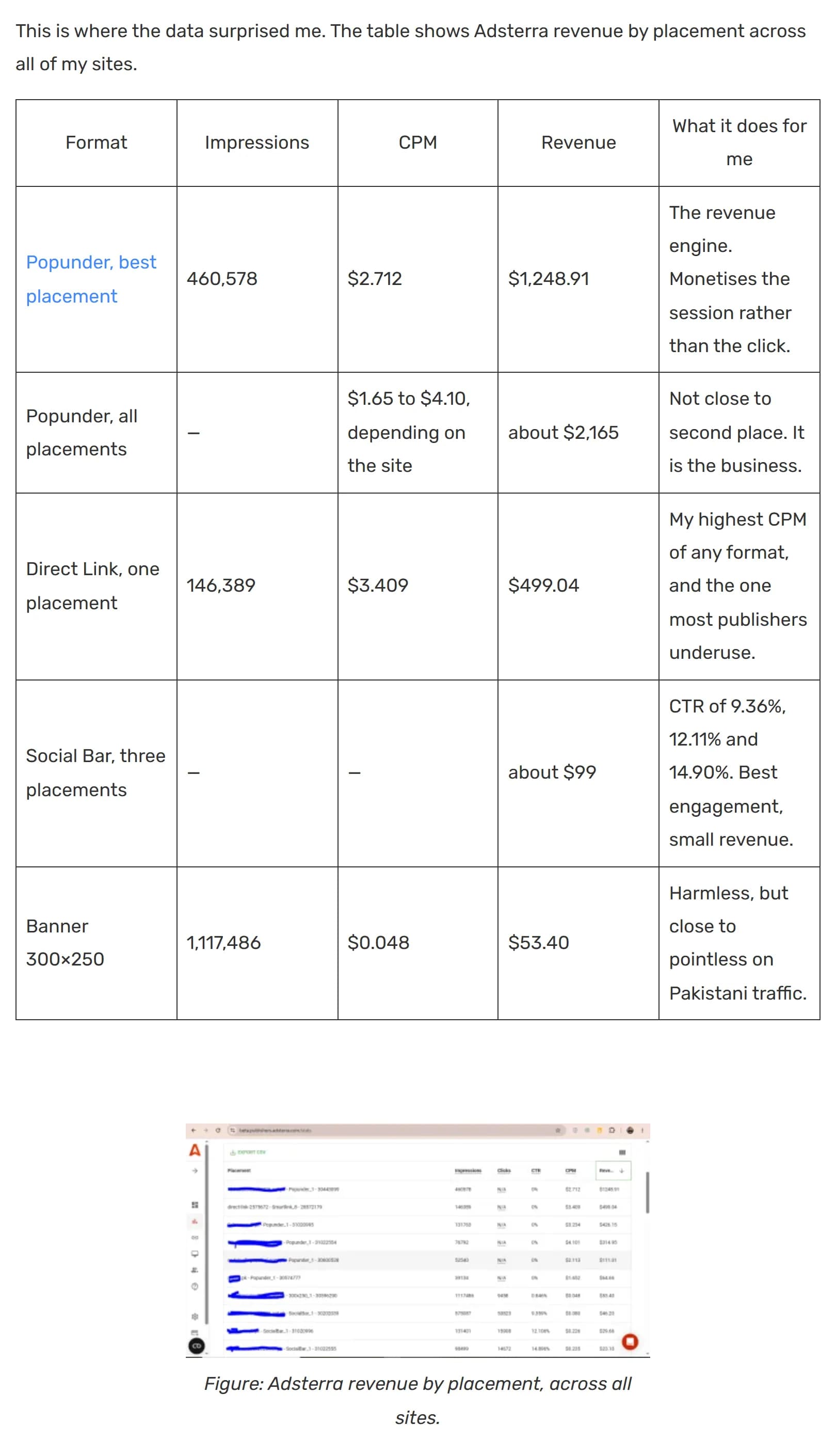
Our math:
- the visible rows add up to $2,817.08, 99.3% of the period total, so the undated placement table almost certainly covers the same 34 days;
- popunders and the Smartlink: $2,664.72, 93.9% of the revenue, from 30.4% of the impressions;
- banner and Social Bar: 64.5% of the impressions for 5.4% of the revenue;
- the 5 popunder placements run from $1.652 to $4.101 CPM, his "$1.65 to $4.10, depending on the site";
- Social Bar's 9.36% to 14.90% CTR paid $0.0009 to $0.0019 per click.
What "Direct Link" is. In the dashboard it's "SmartLink_8": Adsterra's Smartlink, a URL that sends a visitor to whichever ad pays most. Where it sat on his pages isn't shown. In the 2025 case, the 2 friends advised putting it behind "Download File" and "Watch Now" buttons, and Adsterra added a note that its terms "prohibit motivated traffic."
Our take: the lesson that banners are "close to pointless on Pakistani traffic" on Tier-3 mobile visitors is backed by real numbers, and it's the part most worth testing on your own site. Social Bar is weaker than he thinks. He reads its CTR as proof that "my readers engage without being annoyed," but advertisers paid less than 0.2 cents per click, which says those clicks were worth almost nothing to them. A high CTR on a notification-style unit on phones is what accidental taps look like too. For scale, the 2025 case quoted Social Bar at $1 to $2 CPM and Smartlink at "up to $10"; this dashboard shows $0.08 to $0.24 and $3.41. If you're choosing a network for your own pops, our popunder ad networks list covers the publisher side too, and in-page push ads explains the format behind Social Bar.
The traffic: "100% organic Google Search"
"All traffic is 100% organic Google Search. No paid traffic, no social traffic, nothing extra." The case backs it with a Search Console screenshot: 405,000 clicks, 6.08M impressions, 6.7% CTR and an average position of 4.3 over 3 months, from early June to early September.
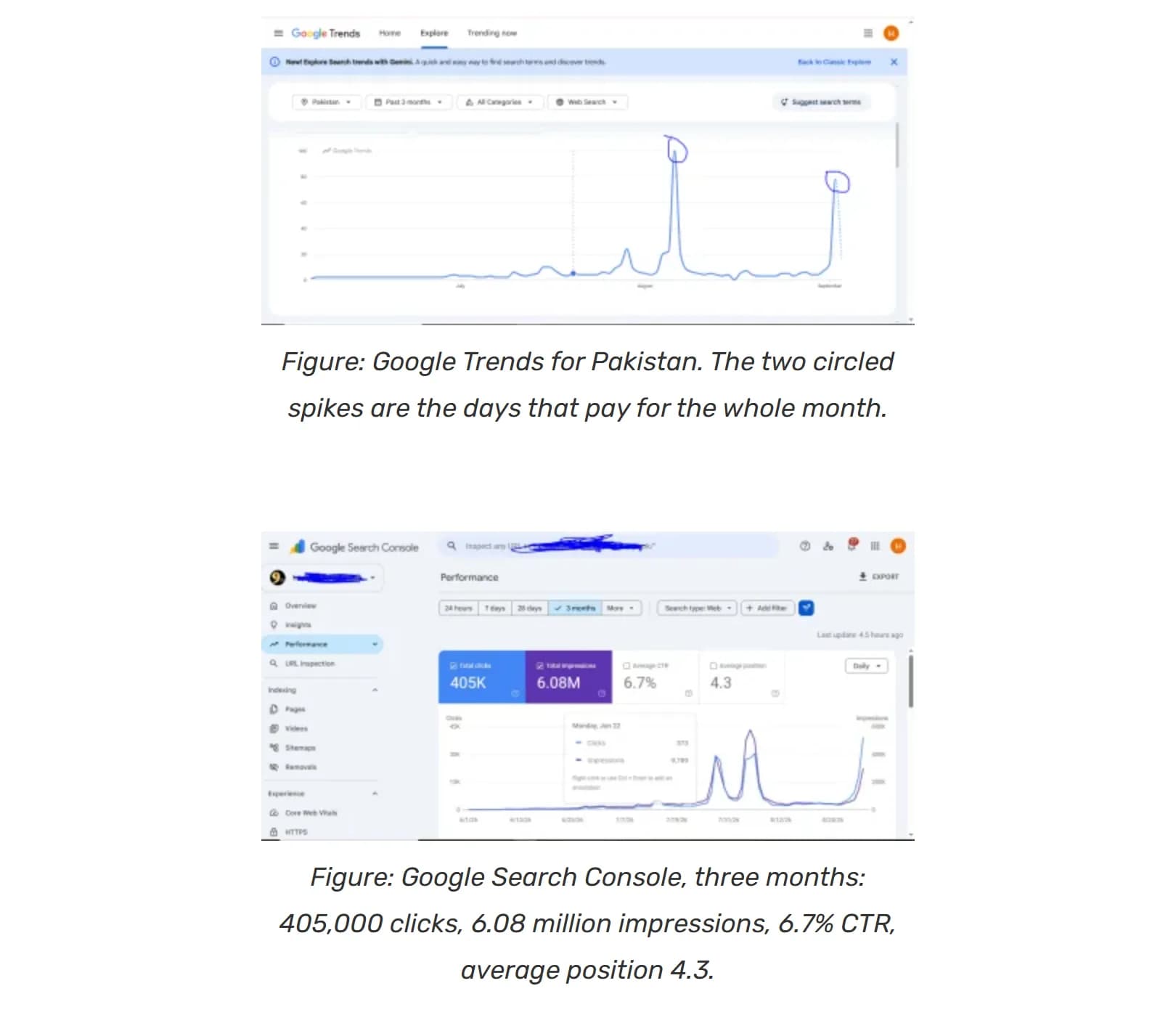
Our math:
- 405,000 clicks over 6.08M impressions is 6.66%, as shown;
- by our reading of the chart, its daily peaks are about 30,000 clicks around August 6 and 35,000 to 40,000 at the right edge, around September 2;
- his Google Analytics screenshot for September 2 shows 350,000 active users and 1M views, about 10 times the Search Console peak.
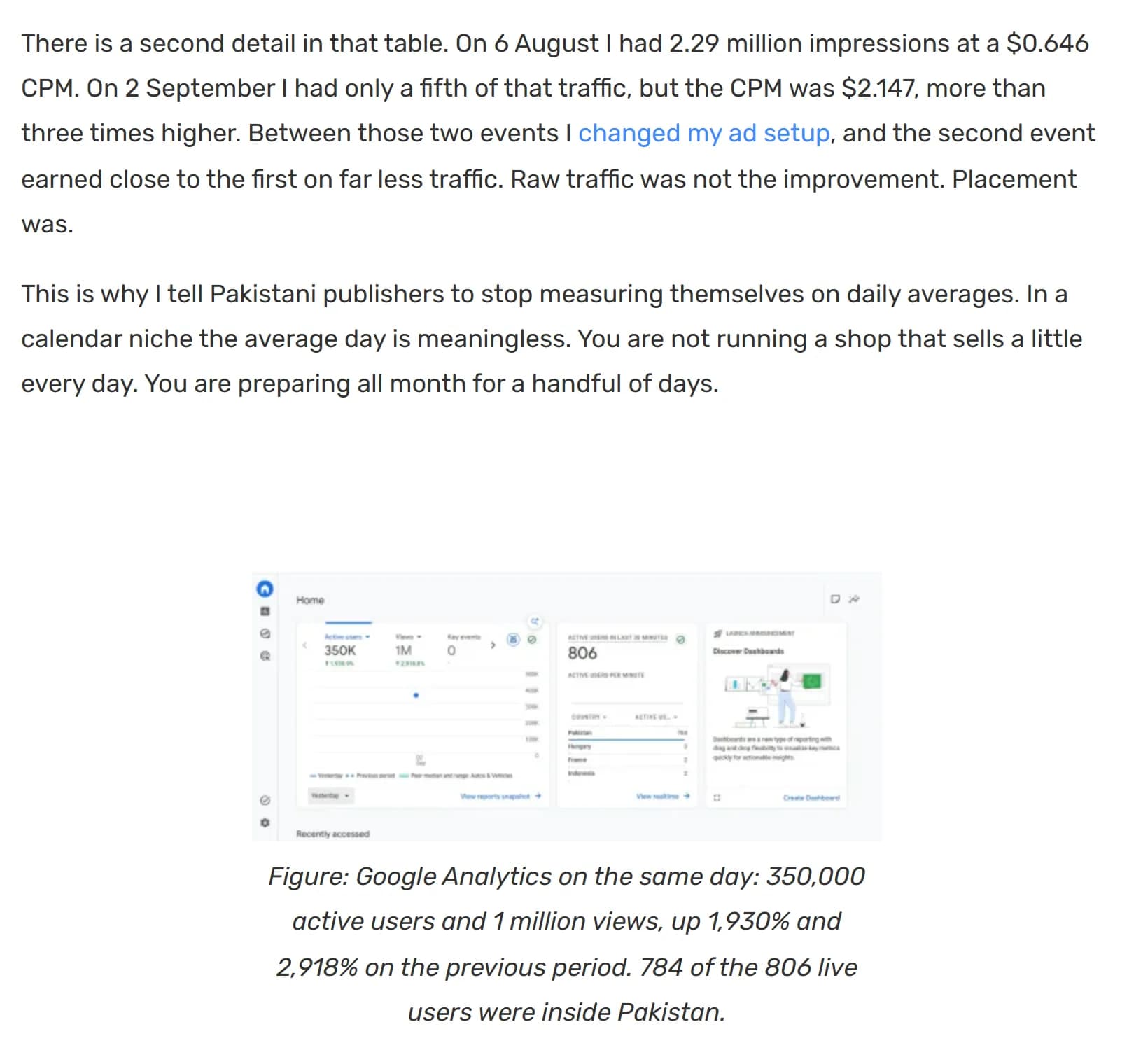
2 explanations fit, and the case gives neither. The Analytics property may cover more sites than the 1 Search Console property shown: Adsterra's stats are for "all domains," and his Cloudways account runs 2 apps with about 200,000 visits each. Or a large share of result-day visitors didn't come from Google web search: Search Console's web report doesn't count Google Discover, and links passed around WhatsApp and Facebook groups show up as other channels in Analytics. In the 2025 case, the same publisher wrote that "most of our traffic came from Google Discover" and that they shared posts in "local WhatsApp and Facebook groups." 1 Analytics channel report would settle it.
Also hidden: the search terms (the Trends query is cropped out), the pages, and eCPM by country and device. His Adsterra screenshot shows "Country" and "Device format" tabs; the case doesn't open them. Analytics shows 784 of 806 live users in Pakistan, 97%, so the GEO is clear, but not what a Pakistani mobile pop paid against the rest. His claim that AI Overviews cut his traffic "by roughly 40%" on affected queries comes without data.
Our take: none of this makes the traffic fake. Analytics, Search Console, Cloudways and Adsterra all show a real spike on result days. It makes the "100% Google" claim unproven, and that claim carries the SEO half of the case.
177,039 push subscribers in a day
"On 2 September, the same day the site earned $946.20, I collected 177,039 push subscribers with a self-hosted push notification service. The numbers are the point, not the tool."
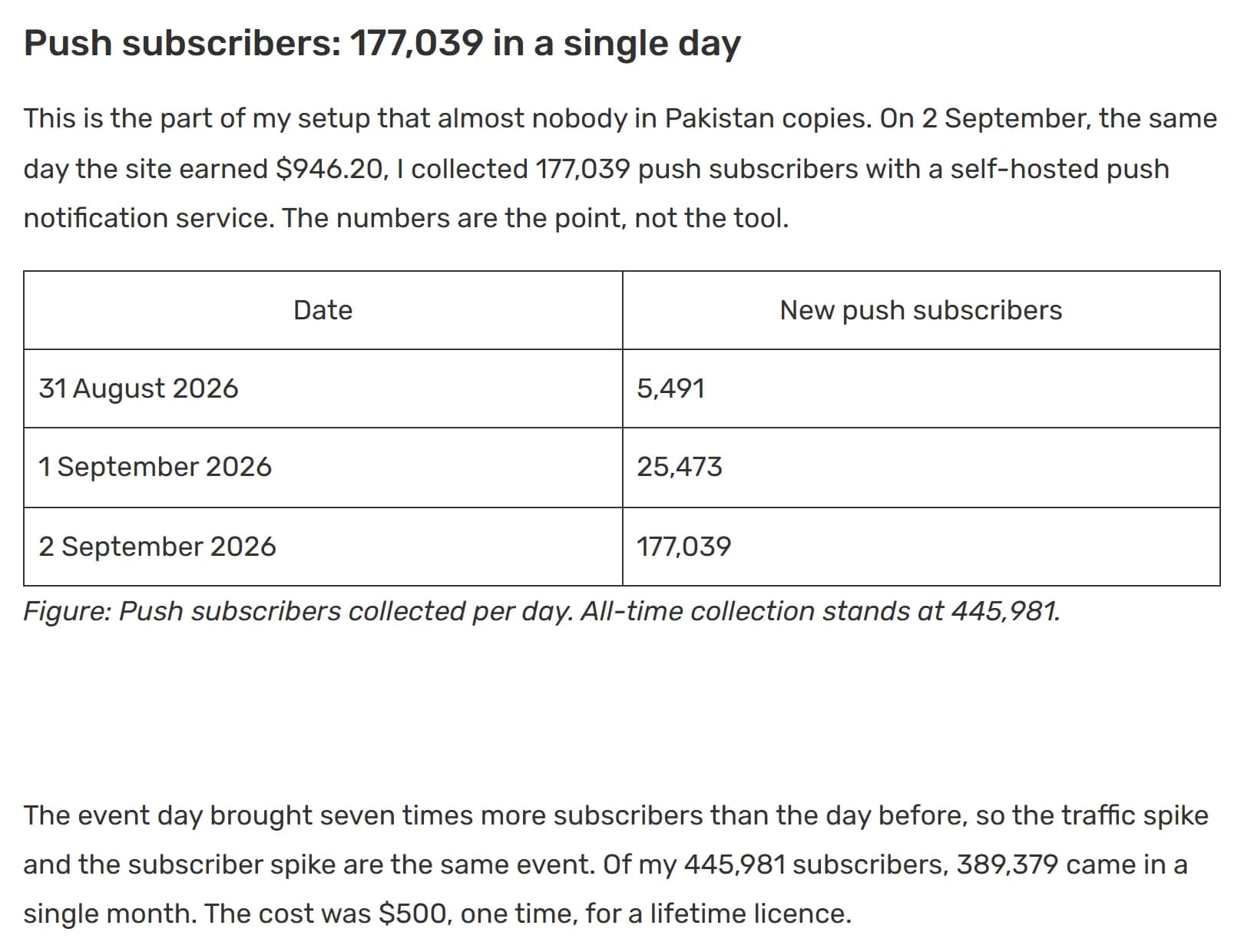
Our math:
- 177,039 is 6.95 times the 25,473 of the day before, his "seven times";
- 389,379 of 445,981 all-time subscribers came in 1 month: 87%;
- against the 350,000 active users Analytics shows for September 2, it's 1 new push subscription for every 2 users, about 51%.
Not shown: a push dashboard (the numbers are typed into a table), the software, the opt-in rate, unsubscribes, what he sends, and whether the list earns anything. Nothing in the case says the list made money in the period.
Our take: students who opted in on result day are a real asset for next year's dates, if the list holds up. Half of all users accepting notifications is a number we'd want to see inside the push tool before believing it. And messages to a list of school students raise the same audience question as the pops below.
Costs and time: what the $2,837 cost
Item | Cost, as the case gives it |
|---|---|
Cloudways hosting, event month | $100 to $200 |
Cloudways hosting, quiet month | "Much lower" |
.pk domain | PKR 3,600 a year, about $13, each |
Push notification software | $500 once, lifetime licence |
SEO tools, writers, paid traffic | None |
Time before the first event | About 240 hours: 150 articles at about 20 minutes (50 hours) plus 190 hours of research, setup and testing |
Our math: $2,837.58 minus $200 of hosting, the $500 push licence and $26 for 2 domains leaves $2,111.58, about $8.80 an hour for his 240 hours. Leave the one-off licence out and it's $2,611.58, about $10.90 an hour. That's before the event days themselves, which he spent "watching the hosting."
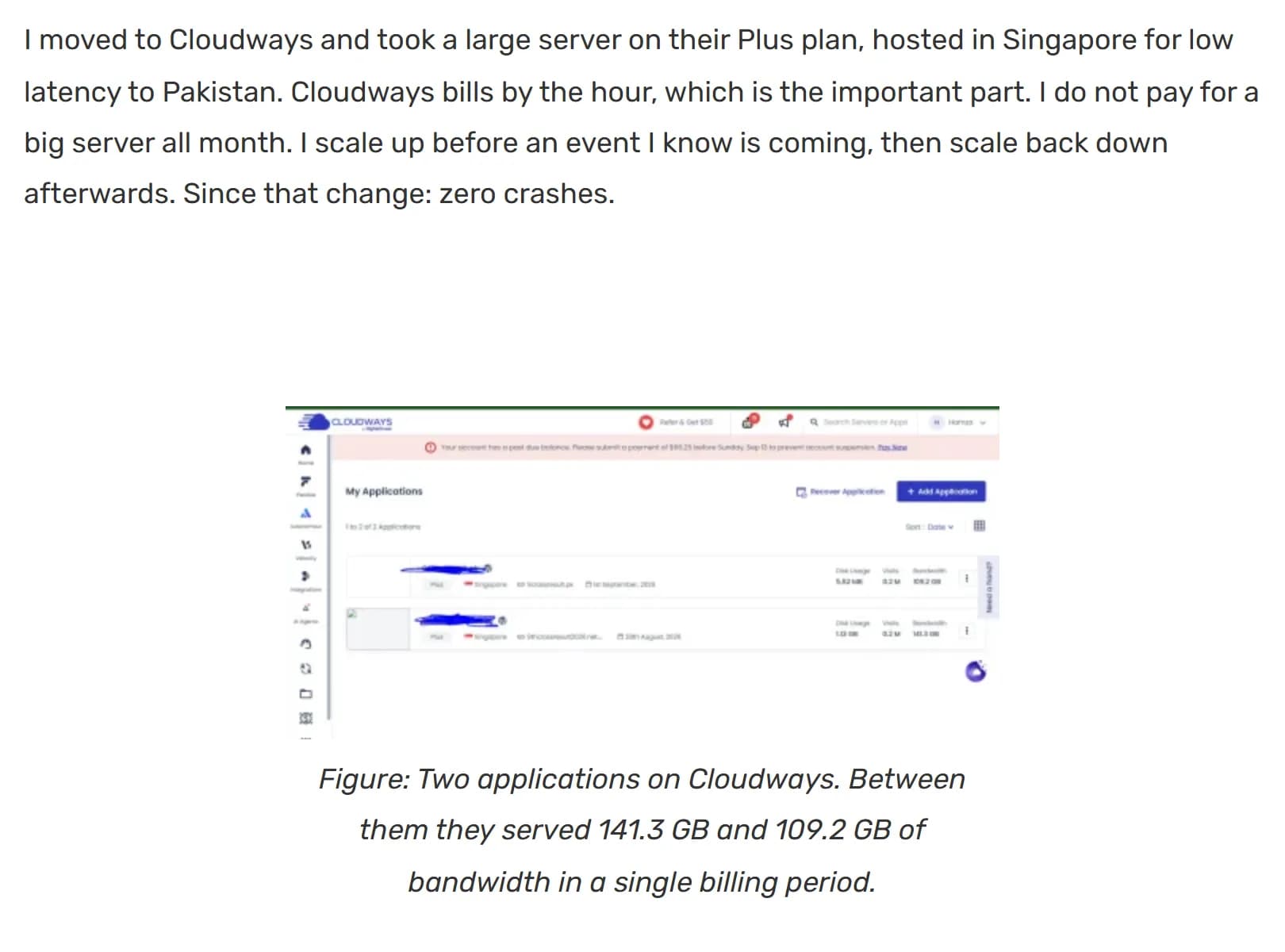
The hosting proof covers 1 event, not 2. "A crash on 6 August would have cost me $1,480," he writes, and since the move to Cloudways: "zero crashes." His Cloudways screenshot shows 2 apps created on August 28 and September 1, after the August 6 spike. Where the 2.29M impressions of August 6 were served isn't shown.
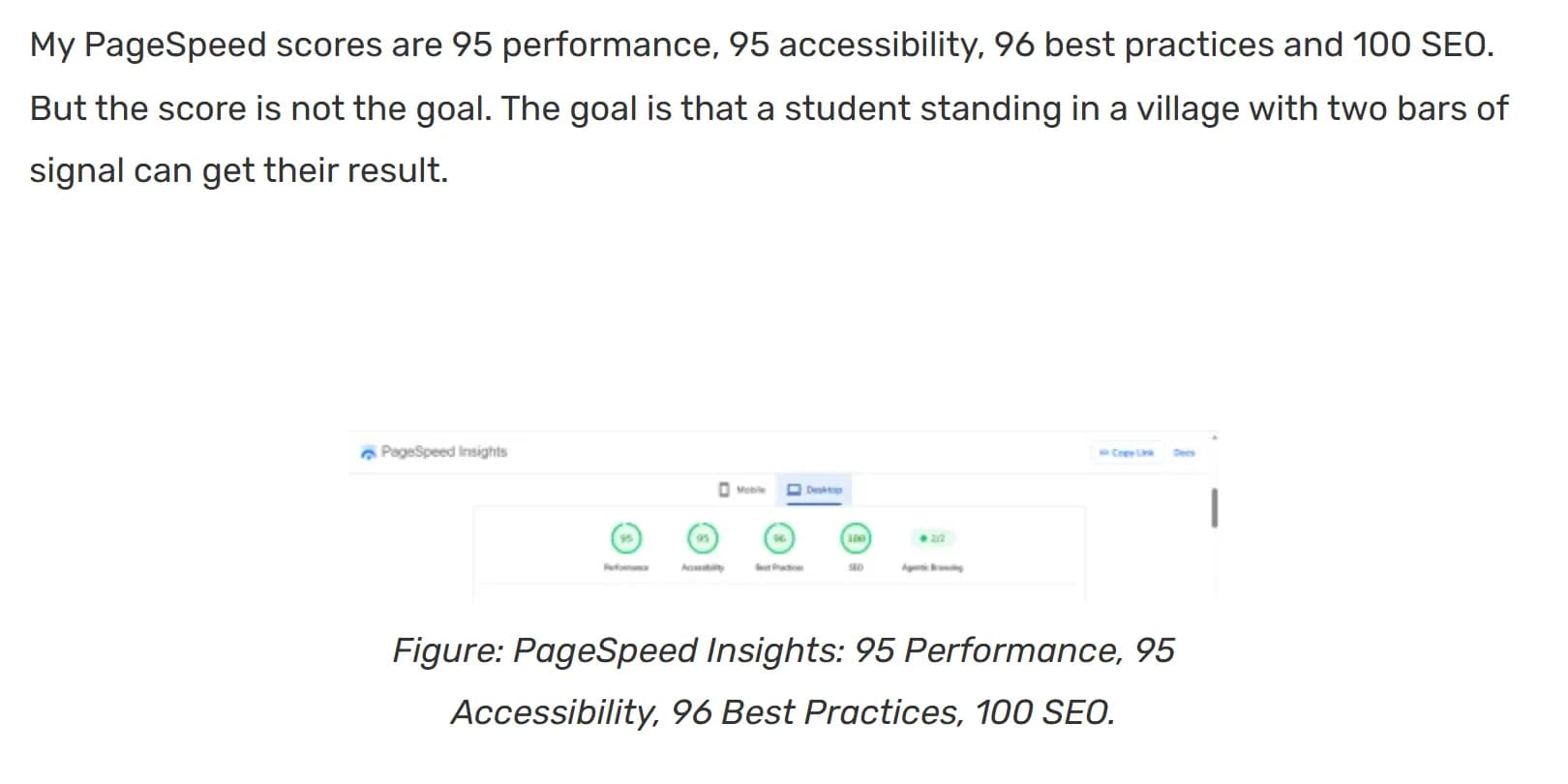
The speed proof is desktop. He calls mobile page speed "my number one metric." His PageSpeed screenshot, 95 performance, 95 accessibility, 96 best practices and 100 SEO, is on the Desktop tab, and the tested URL isn't shown.
The case also lists a "previous payment received" of $1,979.33 without saying which period it covers; his Search Console chart shows another spike in late July.
Why he left AdSense, and what Adsterra's terms say
His reasons: on big days "an ad serving limit gets applied, at the precise hour the traffic is worth the most," and "accounts get suspended around payment time." Google confirms the mechanism: it "may sometimes place a limit on the number of ads your AdSense account can show. This might be a temporary ad serving limit while we get to know you and evaluate your traffic quality, or it might be because we've identified invalid traffic concerns." Such a limit usually lasts under 30 days, Google says. A site whose daily users jump by about 1,930% is exactly the traffic that gets evaluated.
Adsterra's publisher terms, last updated June 29, 2026, pay on the 1st and 16th of each month on a NET15 basis, with a $5 minimum via Paxum per its publishers page. The same terms let it hold payments, take back revenue and close accounts.
The risk he left isn't absent at Adsterra. Its publisher terms let it hold payment "if we suspect that you may be in breach" (5.17), adjust your balance for advertiser chargebacks even after payment (5.4), and suspend an account "without prior notice" (7.1). If it terminates an account under 7.1, the balance is "deemed forfeited" (7.5). Read sections 5 and 7 before a big event, not after.
Popunders on a school audience: what Google and Chrome say
What Google Search says. Its page-experience self-assessment asks: "Does your content avoid using an excessive amount of ads that distract from or interfere with the main content? Do your pages avoid using intrusive interstitials?" It also says that "beyond Core Web Vitals, other page experience aspects don't directly help your website rank higher." On overlays, Google is more direct: "Intrusive dialogs and interstitials make it hard for Google and other search engines to understand your content, which may lead to poor search performance." His rule, "Overloading ads does not increase my income. It destroys the traffic that creates the income," is consistent with that.
Where each format sits. A popunder opens an ad in a new tab behind the page. It doesn't cover the content, so it isn't an interstitial in Google's definition, and Adsterra sells pops as "UX-friendly since they don't interrupt users." Social Bar overlays part of the screen; Adsterra's own 2025 case described its ads as looking like "system notifications, chat boxes, or alerts." A 300x250 banner is the kind of small unit Google recommends instead of overlays.
What Chrome can do. The real exposure isn't ranking. It's the browser.
Google's list of abusive experiences includes "Fake Messages," ads or elements "that resemble chat apps, warnings, system dialogs, or other notifications that lead to an ad or landing page when clicked," and "Misleading Site Behavior," page features such as "play buttons, 'next' arrows, close buttons, or navigation links that lead to an ad."
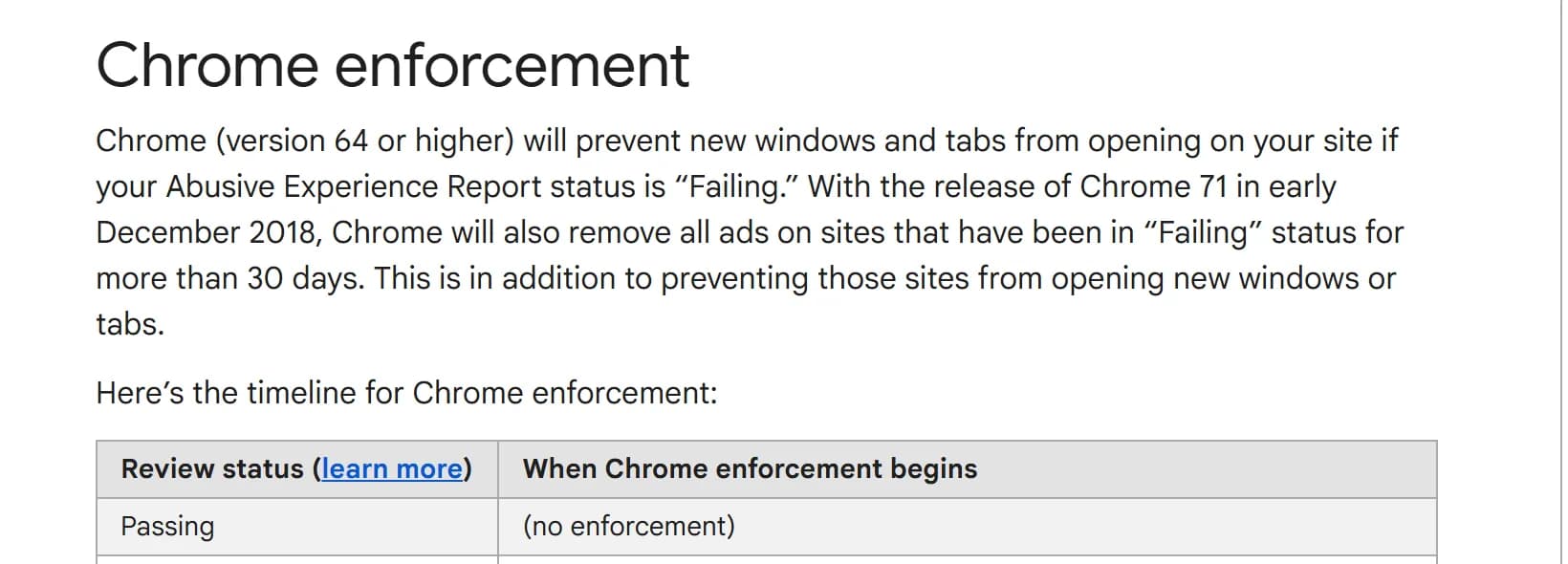
94% of this revenue depends on opening new tabs and pages. If a site fails Google's Abusive Experience review, Chrome stops it from opening new windows and tabs, which is how popunders work, and after 30 days in "Failing" removes all its ads. A notification-style unit that leads to an ad, or a Smartlink behind a "check result" button, is the kind of experience the review lists. After adding these formats, watch the Abusive Experience Report in Search Console.
The audience. Class 9 and Class 10 students are school-age. Adsterra's publishers page says that "lots of solid iGaming, VPN, and E-commerce advertisers run Pop ads," and its 2025 case shows that a publisher chooses mainstream or non-mainstream ads for a Smartlink. This case doesn't say which ads the students saw.
Our take: his instinct to cut banners and keep pages light is right for SEO. But a business where 94% of the money comes from new tabs and a redirecting link sits on Chrome's terms, not just Google's rankings, and on an audience of teenagers the ad categories matter as much as the CPM. The case covers neither.
What a publisher can repeat
- The calendar. Fully repeatable wherever dates are published: exam boards, admissions, tax deadlines, sports fixtures. The Punjab result dates were in the news 4 and 8 weeks ahead, and he says he publishes about 2 months before.
- Hosting before the spike. Hourly billing and scaling the server ahead of a known date is cheap insurance; his worst case, a crash on a $1,480 day, is easy to picture.
- The format test. Put popunder, Smartlink, Social Bar and a banner on separate placements and read revenue by placement, as he did. Expect different CPMs: they depend on country, device and which ad categories you allow.
- The push list. The mechanics are repeatable; his numbers are unproven, and what a list like this earns isn't shown.
What isn't repeatable: the dollar amounts. They come from 2 days of 1 exam season, shared with 20 to 30 competitors, on traffic whose sources the case doesn't break down. For a wider view of networks that take sites like this, see best ad networks for website monetization.
Fact-check: what the author showed and what they hid
We rate every case on 10 points: what an outsider needs to judge the result and repeat it. For a publisher case, the traffic source becomes the site's traffic, the creatives become the content, and the landers become the site and its placements. Like most case studies, this one is selectively true.
Point | Status | What we found |
|---|---|---|
Setup: period, GEO, niche, model | Partial | 34 days, Pakistan, education results, Adsterra CPM formats. Sites and events aren't named; the dates point to Punjab's Class 10 and Class 9 results. |
Author and independence | Partial | A named publisher in his 2nd Adsterra case. Published and edited by the network it praises, which pays $200 per case; no public footprint outside Adsterra's blog. |
Finances | Partial | Revenue reconciles to the cent by day and by placement. Costs come as ranges; no profit line. |
Proof | Partial | Adsterra, Search Console, Analytics, Cloudways and PageSpeed screenshots, but 450 px wide; the daily table is typed, and push has no screenshot. |
Traffic and targeting | Partial | "100% organic Google" against a 10x gap between Analytics and Search Console. No channels, queries or pages. |
Tools | Partial | Cloudways, Cloudflare, Search Console, Trends, Alerts, PageSpeed named. Push software and AI tool unnamed. |
Content | Partial | On-page checklist, 150 articles, AI drafts with manual fact-checks, 12 links. No page shown. |
Site and placements | Hid | No site, no page with the ads on it, no Smartlink placement, no push prompt. |
Costs and consumables | Showed | Hosting, domains, push licence and a 240-hour time breakdown. |
Repeatability today | Partial | The calendar method transfers. The money rests on 2 days and on formats Chrome can block. |
Score: 3/5. The numbers that matter most to a publisher are here: daily revenue that adds up to the cent, a placement table that shows popunders and a Smartlink making 94% of the money and banners 2%, and honest costs and hours. It stops at 3 because the sites, the pages and the ad placements are hidden, the "100% Google" traffic doesn't match the case's own screenshots, the push numbers come without proof, and the case is published and edited by the network it promotes, which pays for cases. Useful data in a vendor's frame: a 3, not a 4.
Checklist: what to do
Questions and answers
How much does Adsterra pay for Pakistani traffic?
In this case, $0.95 per 1,000 ad impressions on average: $2,837.58 from 2,979,286 impressions between August 1 and September 3, 2026. Popunders paid $1.65 to $4.10 CPM, a Smartlink $3.41, Social Bar $0.08 to $0.24 and a 300x250 banner $0.048. That's 1 publisher's result on exam-result days, not a rate you can expect.
Which Adsterra ad format pays best for a Tier-3 mobile site?
On this site, the Smartlink had the highest CPM, $3.41, and popunders made the most money, 76% of the total. Banners took 38% of the impressions for 2% of the revenue. Test formats on separate placements on your own Tier-3 traffic before you decide.
Do popunder ads hurt SEO?
Not directly, as long as they don't cover the page. Google warns about intrusive interstitials and dialogs that obstruct content, which "may lead to poor search performance," and a popunder opens in a tab behind the page. The bigger risk is Chrome: if a site fails Google's Abusive Experience review, Chrome blocks it from opening new windows and tabs and, after 30 days, removes all its ads.
Why does AdSense limit ads on a traffic spike?
Google says it may limit ad serving while it evaluates an account's traffic quality or because of invalid traffic concerns, usually for less than 30 days. A site whose traffic jumps by about 1,930% in a day, as in this case, fits the pattern that gets evaluated.
Can an exam results website make money?
Yes, mostly on the result days themselves. In this case, 2 result days in Punjab produced 85% of a 34-day period's $2,837.58 on Adsterra, and the other 29 days averaged $4.90. Plan costs and hosting around those days, not around a monthly average.
Author’s conclusion
This is a better case than most network case studies: the daily revenue reconciles, the placement table is real data, and the conclusion it supports is useful. On Pakistani mobile traffic, popunders and a Smartlink paid, and banners didn't. But it's packaged by the network that profits from the formats it recommends, the sites and placements stay hidden, the "100% Google" traffic doesn't match the case's own screenshots, and the push numbers rest on a typed table. Read it as 1 publisher's best 34 days, told by his ad network.
My advice: if you have a calendar niche, copy the method, not the numbers. Publish weeks before the date, scale the server before the spike, and test each format on its own placement. Then check what your pops and Smartlinks actually show your readers, especially if they're teenagers, and watch Chrome's Abusive Experience Report as closely as your CPM.
Lu Discover, Editor-in-chief
Our verdict on this case
The numbers that matter most to a publisher are here: daily revenue that adds up to the cent, a placement table that shows popunders and a Smartlink making 94% of the money and banners 2%, and honest costs and hours. It stops at 3 because the sites, the pages and the ad placements are hidden, the "100% Google" traffic doesn't match the case's own screenshots, the push numbers come without proof, and the case is published and edited by the network it promotes, which pays for cases. Useful data in a vendor's frame: a 3, not a 4.
Our fact-check of the public case: what the numbers show, what is missing. Scores are never for sale.
Sources for this article
- adsterra.com — the case: Hamza Ali's .pk education sites, $2,837.58 from August 1 to September 3, 2026, written up by Maria Littera (October 20, 2026)
- adsterra.com — earlier case with the same publisher and his co-founder: $2,700 in a month, Google Discover traffic, Smartlink advice (September 29, 2025)
- adsterra.com — Get paid for case studies: $200 for each published story (October 10, 2026)
- adsterra.com — publisher terms: payments on the 1st and 16th on NET15, holds, chargebacks, suspension and forfeited balances (last updated June 29, 2026)
- adsterra.com — for publishers: popunder ads, $5 minimum payout via Paxum
- support.google.com — Chrome enforcement for the Abusive Experience Report
- support.google.com — Abusive experiences: fake messages, misleading site behavior and others
- developers.google.com — Understanding page experience in Google Search results
- developers.google.com — Avoid intrusive interstitials and dialogs
- support.google.com — AdSense ad serving limits
- dunyanews.tv — Punjab boards announce matric results 2026 (August 6, 2026)
- propakistani.pk — All Punjab boards confirm Class 9 result date and time: September 2, 2026, 10:00 a.m. (August 31, 2026)
- propakistani.pk — Tentative result dates for Class 9 and 10 Punjab matric exams 2026 (July 9, 2026)
Companies in this article
- AdsterraTraffic source2.4
Related stories
 Top list
10 Best Native Ad Networks and Platforms in 2026 (For Affiliate Marketing)
 Top list
The Affiliate Rich List 2026: Who Owns the Networks, and What It's Worth
 Guide
Comments
0 commentsNo comments yet.
Add a comment