

High-Ticket Affiliate Marketing for Beginners: Offers, Traffic and Realistic Timelines


Contents 11
Here's the uncomfortable truth: most "gurus" who tell you to slap an affiliate link on a blog post and wait are selling you the dream, not the job. High-ticket affiliate marketing isn't about finding an expensive product. It's about building a small ecosystem around a buying decision people take seriously.
What high-ticket affiliate marketing is
Selling fewer things for much more money. Instead of chasing 1,000 conversions at $5 commission, you aim for 5 conversions at $1,000.
Price isn't the whole story. The real numbers are lifetime value (LTV) and trust. Nobody drops $2,000 on software or a retreat after clicking a random banner. They need to be nurtured, and you're the one who has to provide the expertise.
The reality check
Most affiliates fail here because they treat high-ticket offers like impulse buys: cold traffic, a direct link to a $500 subscription, and a lot of money donated to Google Ads. High ticket needs a funnel, a brand and patience.
What makes a good high-ticket product
Generic web hosting is a red ocean full of giants outbidding you. To pick a winner, find a category where you can legitimately claim expertise, and look for three things:
- High value: it solves a painful, expensive problem.
- Buzz: people are already talking about it.
- Freshness: new enough that search results aren't owned by the biggest publishers.
Niche examples that convert because the audience is specific:
- for serious home cooks: hand-forged Japanese knife sets recommended by particular chefs, not "kitchen knives";
- for gamers: complete esports setups (chairs, keyboards, hardware) used by pros;
- for tech buyers: enterprise AI automation tools or dedicated servers, not cheap shared hosting;
- for the very top end: private aviation route-planning software or global concierge subscriptions.
Watch the trends. When a hit show makes its characters' outfits sell out, fast creators who publish short videos about the looks, with links to the high-end originals, catch that wave. Emily in Paris and Wednesday both did this. You have to be fast.
If you target Europe
European buyers (DACH, the Nordics, the UK) are skeptical and allergic to salesy copy. High-ticket demand there leans towards fintech, green tech and specialized B2B software.
- Privacy sells: tools that protect data (VPNs, secure browsers) do well in Germany and France.
- Compliance matters: financial offers must be white-hat and compliant; European regulators don't play.
The upside: payouts in euros and pounds are often higher, and competition in German, Italian or Polish content is much lower than in English.
Low ticket or high ticket?
A year-long test described in the original version of this guide compared two high-ticket brands.
Brand 1 was hungry: strong PR, active social accounts, giveaways and influencers who genuinely used the product. When a recognized expert recommended it, it read as a testimonial, not an ad. Traffic converted easily, because the brand had already built trust.
Brand 2 was an established giant resting on its name: old articles everywhere, no extra effort. Registrations came in, sales didn't; it took 8–10 months to see the first real commissions.
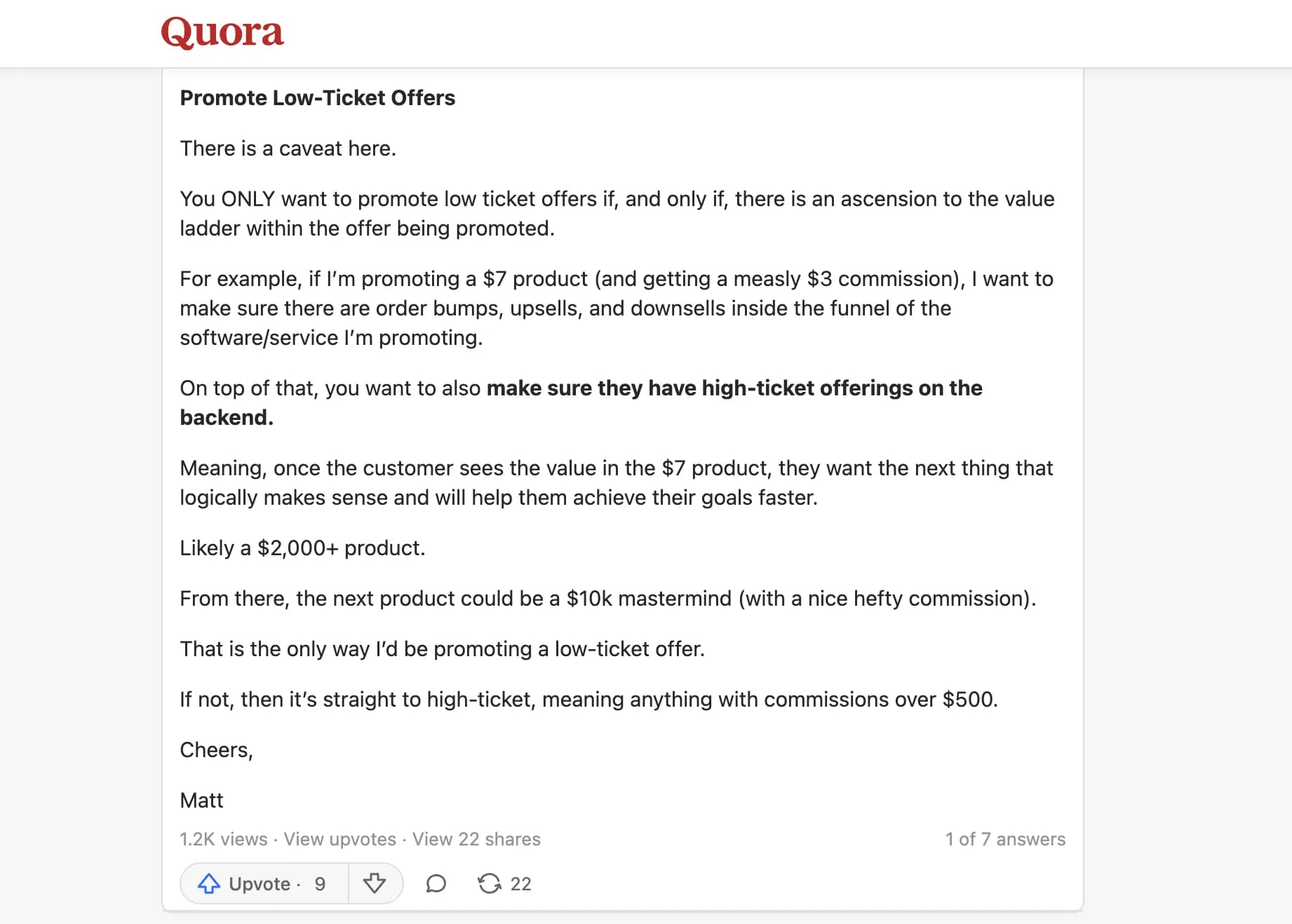
The lesson: high ticket converts slower. If you need cash flow next month, low-ticket offers (sweepstakes, utilities) give faster feedback. If you're building for the next two years, go high ticket, and pick brands that actively support their partners.
Traffic: the expensive truth
Where does traffic for a $2,000 product come from? Not from cheap pop-unders. You need to persuade, give people time and follow up.
- The ecosystem: a website as the content hub, supported by YouTube, short video and an email list.
- The funnel: you're not selling the product; you're selling the click to your detailed review or comparison.
- The cost: a white-hat SEO site or a personal brand usually takes 6–12 months before serious results.
With a budget you can speed things up with paid search on "review" and "alternative" keywords, but expect high cost per click.
High-ticket categories worth a look
Rough commission ranges below are what programs in these categories typically advertise; check each program before you plan around a number.
1. Tools for other marketers. Antidetect browsers, proxies and VPNs sold to media buying teams, which often pay for 6–12 months up front. Typical payouts: $100–$500+ per sale. Content that works: honest reviews and comparisons of tools for multi-account work.
2. Fintech. Pro subscriptions to trading and charting tools, premium bank cards and crypto platforms. High lifetime value through subscriptions and fees; payouts via RevShare or CPAs of $200–$1,000+. Regulated heavily: check each offer's compliance in your GEO.
3. Education and certifications. Course subscriptions, nanodegrees and coding bootcamps, often paid by employers, so price sensitivity is lower. Typical payouts: $300–$3,000. Channels: LinkedIn and career-advice content.
4. Business software. CRMs, e-commerce platforms, website builders on higher tiers. $100–$2,000 CPA or a high recurring percentage. Content that works: "X vs Y" comparisons for specific business types.
5. Health tourism. Hair transplants, dental implants, private clinics. $100–$300 per lead, sometimes a share of the treatment cost. A sensitive, regulated topic: target "cost of X in [country]" searches and be scrupulous about claims.
6. Performance infrastructure. Managed hosting and high-performance cloud for developers. $100–$500 CPA. Technical tutorials ("how to speed up WordPress") convert well.
7. Premium consumer goods. Premium e-bikes, $3,000 mattresses, high-end massage chairs. CPA from about $200. Influencer content and aesthetic visual platforms do the selling.
Tips so you don't get wrecked
- Check the lifetime value, not just the CPA. A $500 one-off payout sounds great; 30% recurring on a $100 monthly subscription is worth more over two years if customers stay.
- Reputation is currency. Some high-ticket programs won't accept you without a portfolio or a working site. Don't apply from a free email address.
- Pay with time or money. SEO and content cost time; ads cost money. If you can't wait six months for SEO, be ready to spend several thousand dollars testing ads.
- Capture the lead. Never send paid traffic straight to a high-ticket offer. Send it to a page that collects an email or a follow, then to the offer, so you can follow up when they don't buy on day one.
Checklist: what to do
Questions and answers
What is high-ticket affiliate marketing?
Promoting products or services that pay large commissions per sale, often $100 to $2,000 or more, instead of many small ones. You sell less often, so trust, expertise and follow-up matter more than volume.
Is high-ticket better than low-ticket for beginners?
Not automatically. Low-ticket offers (sweepstakes, utilities, cheap apps) give faster feedback and cash flow. High-ticket takes longer to convert and needs a brand and content, but builds a more durable business. Many affiliates start low-ticket to learn traffic, then move up.
Which traffic works for high-ticket offers?
Traffic that can be nurtured: an SEO content hub, YouTube, social content and an email list. Paid search on 'review' and 'alternative' keywords can speed things up but costs more per click. Cheap interruptive traffic such as pops rarely sells a $2,000 product.
How long does it take?
A white-hat SEO site or a personal brand usually needs 6 to 12 months before serious returns. Paid search can shorten that if you have the budget to test.
Is a big CPA always better than recurring commission?
No. A $500 one-off payout sounds great, but 30% recurring on a $100/month subscription pays $720 in the first two years if the customer stays. Compare lifetime value, not the headline number.
Author’s conclusion
High-ticket affiliate marketing isn't a get-rich-quick scheme. It's a business model for patient people: part marketer, part product expert, part media company. The math is attractive because each sale matters; the work is harder because each sale has to be earned with trust.
My advice: niche down until you can be the go-to source in one expensive, specific category, choose brands that actively support their partners, and build the email list from day one. Then give it the months it needs.
Lu Discover, Editor-in-chief
Sources for this article
- aliencpa.com — Original guide (January 2026), rewritten
Related stories
 Guide
GuideHow Much Budget Do You Need to Test an Offer? What $100 Can and Can't Tell You
 Analysis
Why Most Affiliates Never Scale Past $10K a Month: The Ceiling Is Cash, Caps and Accounts, Not Talent
 Guide
Guide
Comments
0 commentsNo comments yet.
Add a comment