

3,292 Deposits, $12 Each, 27% ROI: What Doesn't Add Up in PropellerAds' iGaming Case

Independent and reader-supported. Some links here are affiliate links: if you sign up through them, we may earn a commission at no cost to you. It never changes our scores or verdicts. Affiliate disclosure
Contents 13
An iGaming company that runs its own product sets a target of about $12 per first deposit on PropellerAds, then starts showing ads again to people who signed up but never paid. In the next 30 days it spends $40,443, books 3,292 first deposits at $12.29 each and, per the case, earns a 27% ROI. PropellerAds published the story on November 12, 2026, under a headline that says audiences "helped reach" those deposits.
This is our review for media buyers and iGaming advertisers who buy on CPA Goal or retarget sign-ups: the case retold, our math on every number, what PropellerAds' own help center says about how CPA Goal bills, and where the story and the table part ways. Editorial fact-check: 2/5.
Short version: the table is clean, and every total adds up to the dollar. But the 27% ROI has no revenue behind it, "$12 per deposit" is a target on a model billed per click or impression, not a payout, and the audiences the headline credits brought 616 of the 3,292 deposits. The rest came from regular campaigns that had launched 11 days before the case period began. There's no GEO, no brand and no screenshot of any dashboard.
Who published the PropellerAds case and what it claims
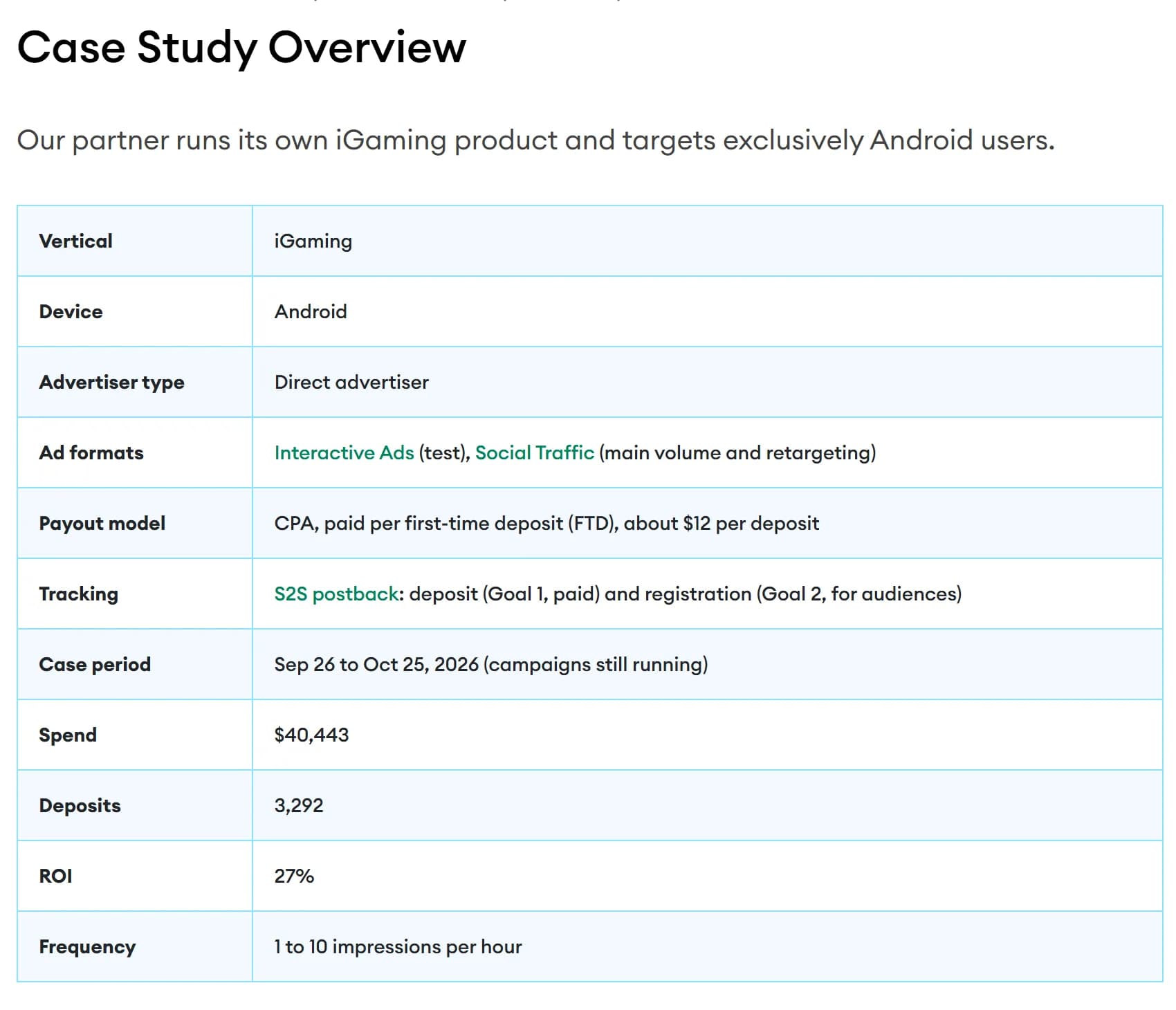
PropellerAds, a self-serve ad network, published "CPA for Deposits: How Audiences Helped Reach 3,292 First Deposits in 30 Days [Case Study]" on its blog on November 12, 2026, signed by Olya Mikheeva. The advertiser appears only as "our partner," which "runs its own iGaming product and targets exclusively Android users." The case calls it a direct advertiser: the product owner buys the traffic itself, with no affiliate network in between.

PropellerAds2.2
Self-serve ad network: Onclick, Push, Interactive and Paid Social

The case in its own numbers:
- vertical: iGaming, the advertiser's own product, Android only;
- formats: Interactive Ads for the test, Social Traffic for "main volume and retargeting";
- model: "CPA, paid per first-time deposit (FTD), about $12 per deposit";
- tracking: S2S postback, the deposit as Goal 1 and the registration as Goal 2 for audiences;
- period: September 26 to October 25, 2026, "campaigns still running";
- result: $40,443 spent, 3,292 deposits, 15,676 registrations, 20.7M impressions, 27% ROI and "13x" spend growth month over month.
The post carries its own disclaimer: "These are one advertiser's results for this offer and period. Results vary by GEO, offer, traffic and setup."
Our take: this is the latest in a run of iGaming cases PropellerAds has published since it launched Paid Social Traffic in June 2026. On July 24 it posted 42,097 deposits in Southeast Asia with the countries called "GEO 1" to "GEO 3". On September 2 it compared paid social and popunder in "a single GEO in Southeast Asia". On November 11, in a Kyrgyzstan and Tajikistan case, it wrote that "the team is keeping" deposits, revenue and ROI "private." The pattern holds here: real-looking volumes, an anonymous advertiser, a hidden country and a "Launch your campaign" button at the end. That doesn't make the numbers false. It means nobody outside PropellerAds has checked them, and the advertiser can't be asked. Most case studies are selectively true; one written by the seller of the traffic is selective by design.
The setup: a test, a whitelist and then audiences
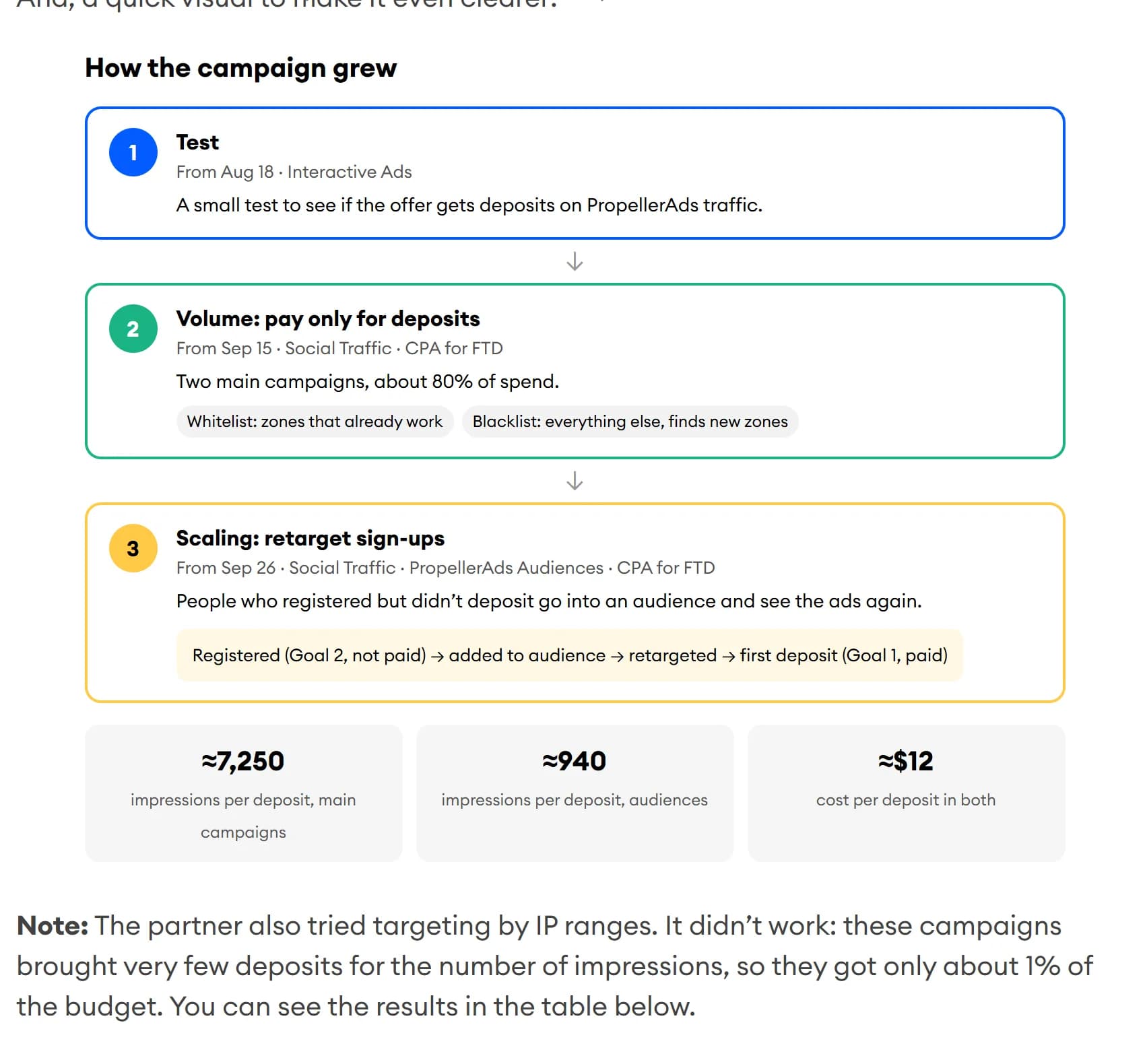
The case describes 3 steps. Keep the dates in mind, they matter for the math later:
- August 18: the test. Interactive Ads, "to see if the offer converts on PropellerAds traffic." Per PropellerAds' own guide, Interactive Ads put "a short mini-flow in front of the offer: a tap, a swipe, a quiz."
- September 15: Social Traffic, split in 2. The first campaign ran only on a whitelist of zones that "already brought conversions." The second ran on everything else with a blacklist of zones that didn't, and fed new winners to the whitelist. In the case's diagram, these 2 "main campaigns" took "about 80% of spend."
- September 26: audiences. The partner started "adding registered users to PropellerAds Audiences and retargeting them right away, also on Social Traffic," split into "registrations, depositors, and separate traffic segments." A separate test on IP ranges got "about 1% of the budget."
Social Traffic here means Paid Social. The case links the term to PropellerAds' launch post of June 18, 2026, for Paid Social Traffic: "a standalone paid source aggregated from our supply partners," reaching users "active on social feeds," with no creatives needed beyond the landing page. The launch post names "PH, BR, BD, TH, ZA, ZW, CG, TZ, NG, MY, and ID" as the top GEOs and says "iGaming and Finance advertisers get an easier start flow." It's separate from the older Social traffic type inside Onclick, which comes from "bloggers and publisher-owned channels."
The tracking. The advertiser's platform sends 2 events by S2S postback: the deposit as Goal 1, "paid," and the registration as Goal 2, "for audiences." PropellerAds' help center explains why the order matters: "Only events from the main postback affect performance in CPA goal campaigns." So the algorithm optimized for deposits, and registrations only filled the retargeting pool. Per the help center, Audiences can collect "converted users" through S2S tracking, keep each user for 90 days and allow up to 15 audiences per account.
Frequency is given as "1 to 10 impressions per hour." The case doesn't say which campaigns ran at 10.
The money: every total adds up
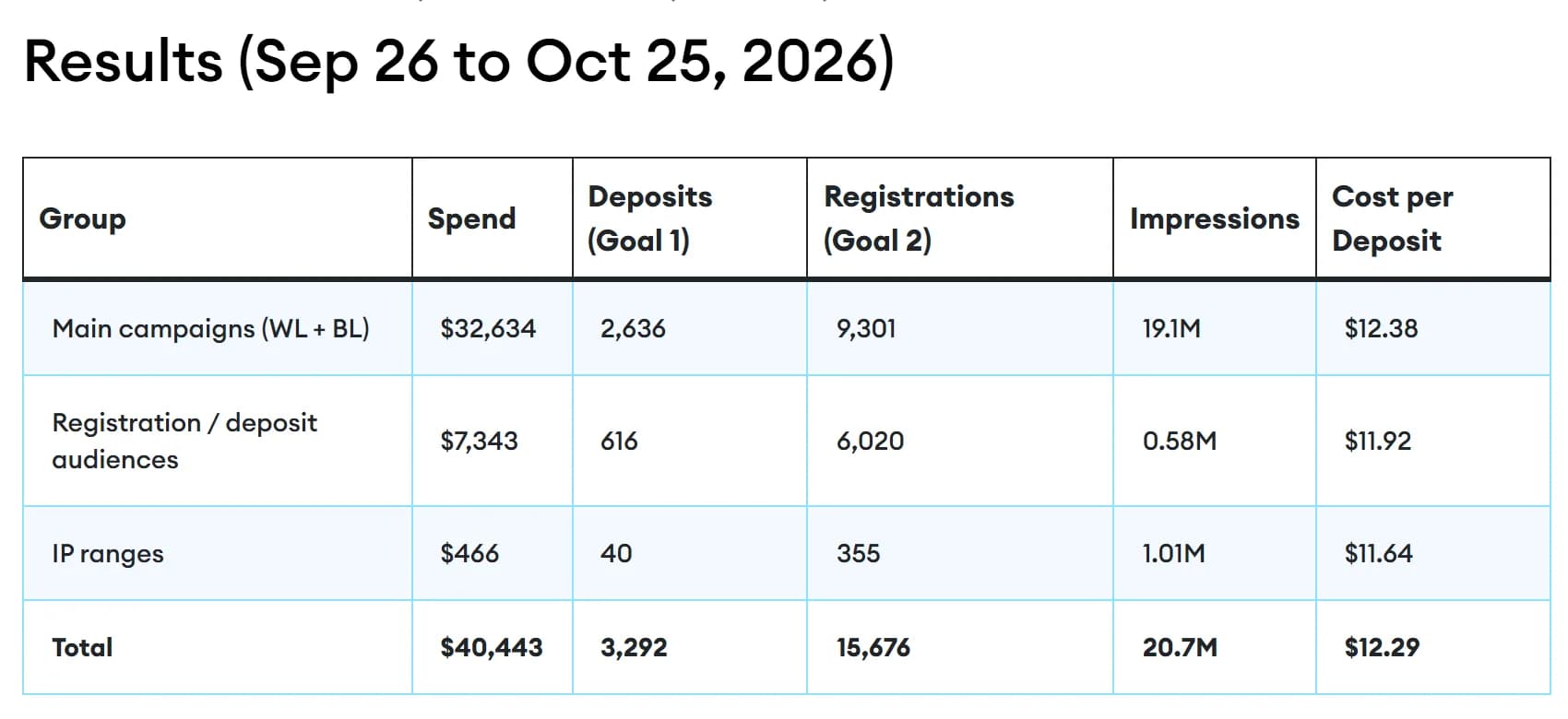
We added the columns the case leaves out:
Group | Share of spend | Cost per deposit | Registration to deposit | Spend per 1,000 impressions |
|---|---|---|---|---|
Main campaigns | 80.7% | $12.38 | 28% | $1.71 |
Audiences | 18.2% | $11.92 | 10% | $12.66 |
IP ranges | 1.2% | $11.65 | 11% | $0.46 |
Total | 100% | $12.29 | 21% | $1.95 |
Our math:
- spend: $32,634 + $7,343 + $466 = $40,443; deposits: 2,636 + 616 + 40 = 3,292; registrations: 9,301 + 6,020 + 355 = 15,676; impressions: 19.1M + 0.58M + 1.01M = 20.69M, shown as 20.7M;
- cost per deposit: $40,443 / 3,292 = $12.29, and every group row checks out; IP ranges come to $11.65 against the table's $11.64, a rounding of the $466;
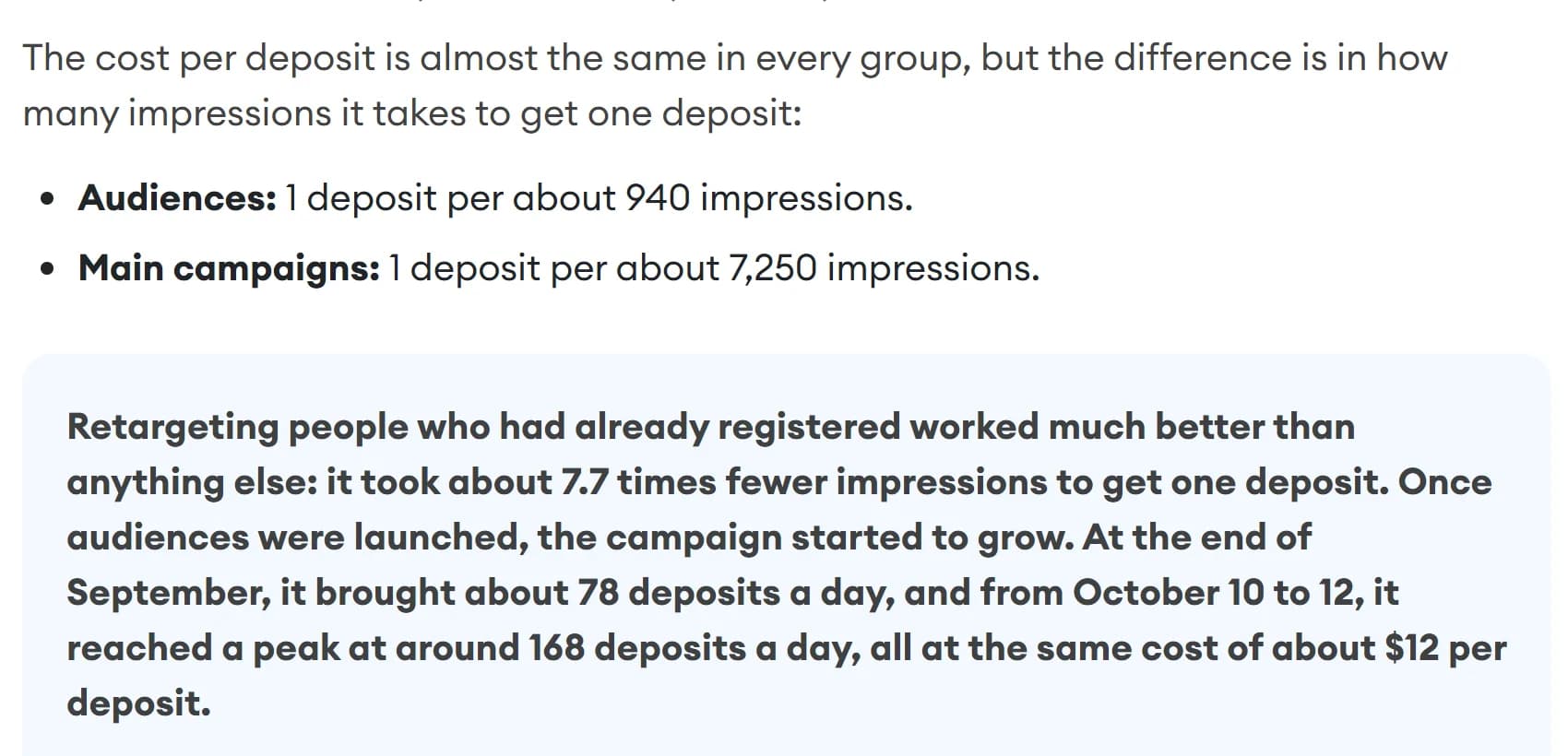
- impressions per deposit: 580,000 / 616 = 942 for audiences and 19.1M / 2,636 = 7,246 for the main campaigns, a 7.7x gap, as the case says;
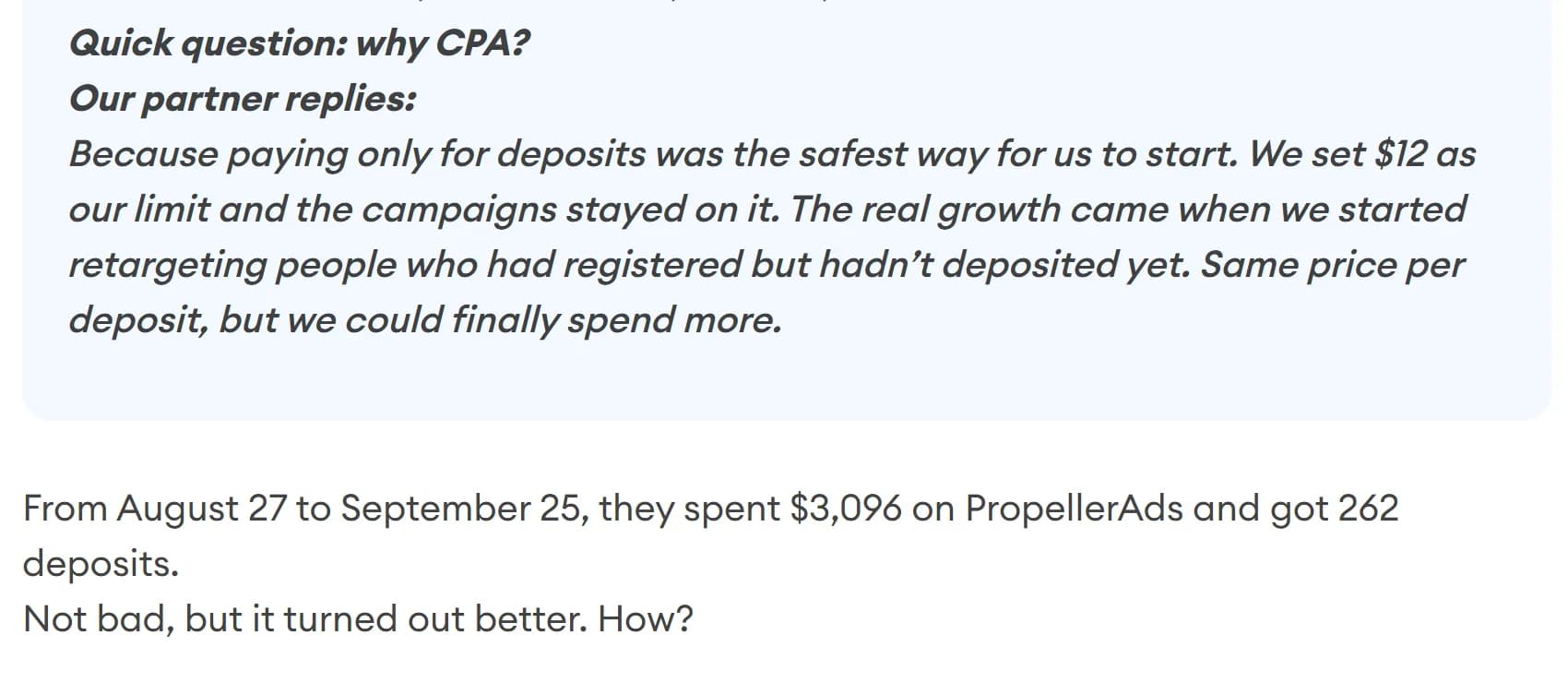
- the month before: from August 27 to September 25, $3,096 for 262 deposits, or $11.82 each. So spend grew 13.1x, deposits 12.6x, and the cost per deposit rose 4%.
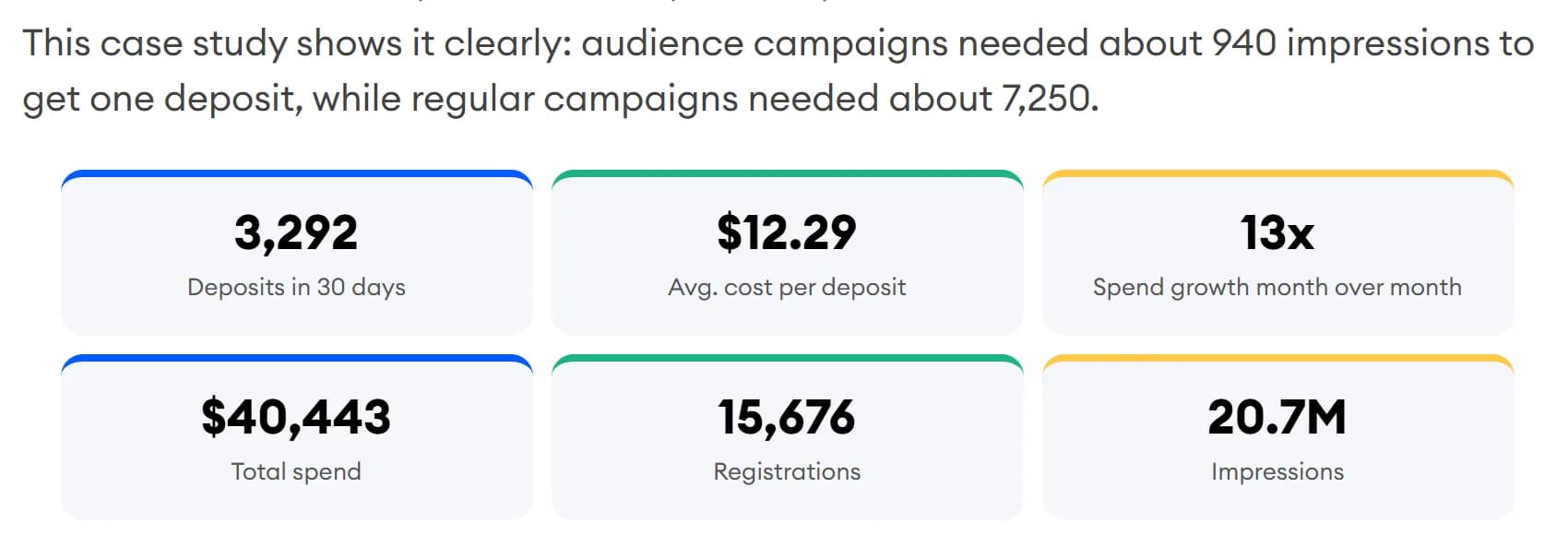
Nothing in the table contradicts itself. The problems start where the text explains it.
Problem 1: "$12 per deposit" is a target, not a payout or a price
The case's summary table calls it the "Payout model: CPA, paid per first-time deposit (FTD), about $12 per deposit." The partner, asked why CPA, answers:
Because paying only for deposits was the safest way for us to start. We set $12 as our limit and the campaigns stayed on it.
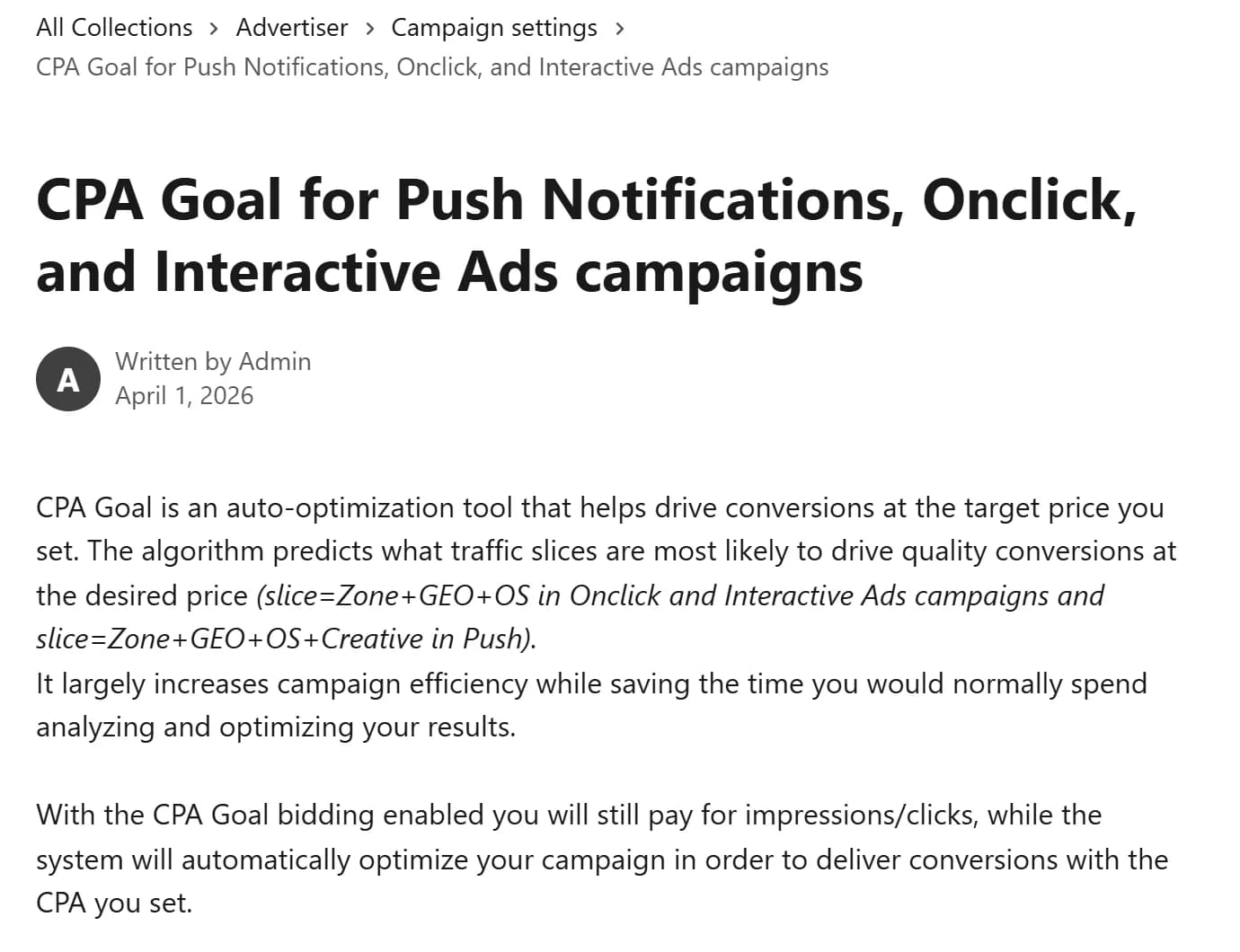
PropellerAds' own help center describes CPA Goal differently: "With the CPA Goal bidding enabled you will still pay for impressions/clicks, while the system will automatically optimize your campaign in order to deliver conversions with the CPA you set." It adds that "during the testing period, the cost of traffic per conversion may exceed the CPA Goal."
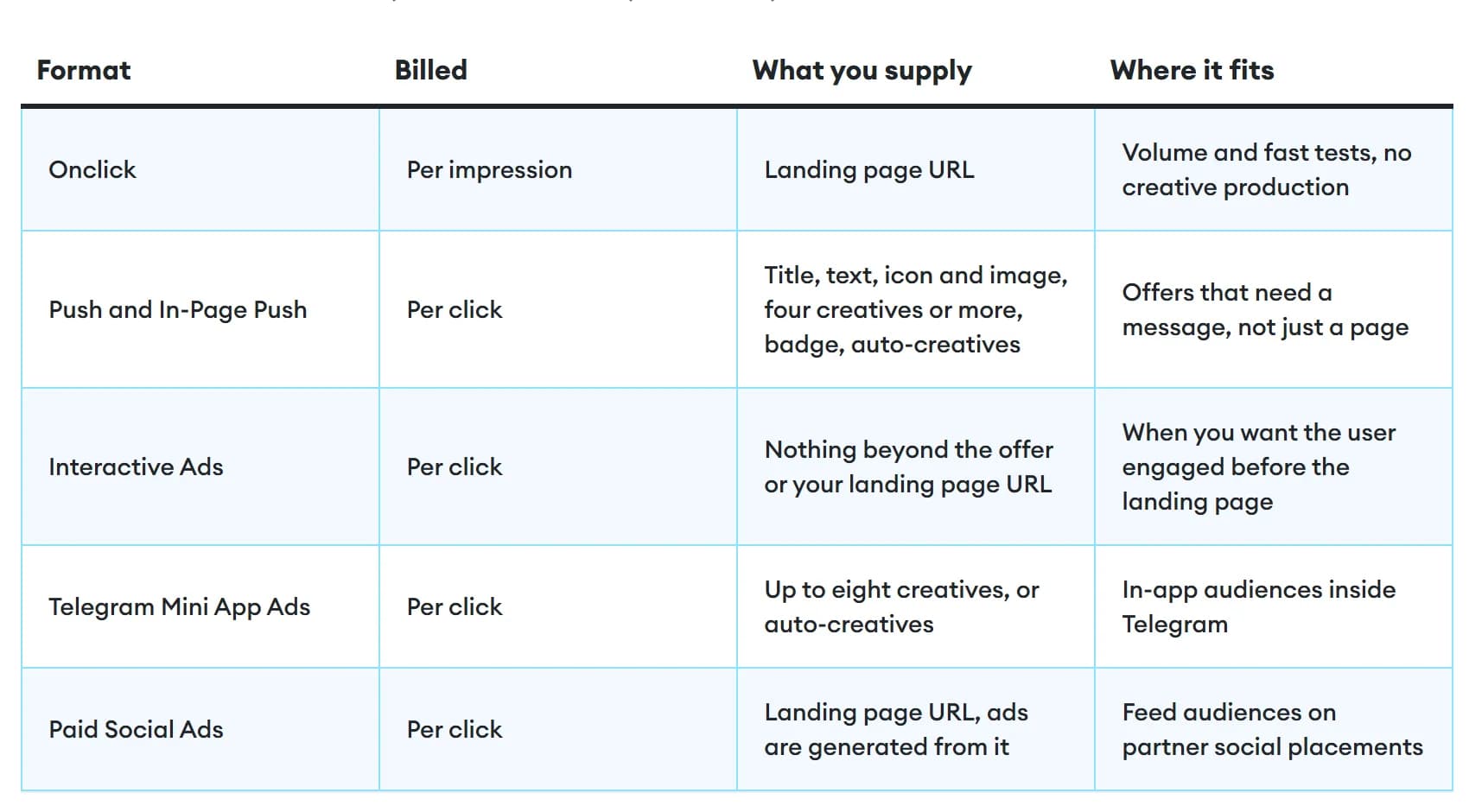
The network's 2026 guide to CPA Goal, the page this case links as its "CPA bidding model," lists every format as billed per impression or per click, with Paid Social Ads "Per click." The same guide's summary table says CPM for Paid Social; either way, not per deposit.
Our math: that's why the cost per deposit in the table isn't exactly $12. The main campaigns came in at $12.38, 3.2% above the partner's "limit," and the total at $12.29, 2.4% above it. Audiences and IP ranges landed under it. With a fixed price per deposit, the main campaigns couldn't have paid more than the limit.
Why it matters: "paid per FTD" reads as if the risk sits with the network. It doesn't. The advertiser pays for every click or impression, and the algorithm tries to keep the average near the target. On a stable campaign the difference is a few percent, as here. On a new GEO, a broken postback or a weak landing page, the advertiser pays for the traffic whether deposits come or not.
CPA Goal on PropellerAds is billed per click or impression, not per conversion. The $12 you enter is the average the algorithm aims for, and the help center says the cost per conversion "may exceed the CPA Goal" while the campaign learns. In this case the main campaigns ran 3.2% over the advertiser's $12 "limit." Budget for the overshoot, cap daily spend, and fire a test conversion before you scale.
Problem 2: the 27% ROI has no revenue
The summary table gives spend, deposits and "ROI 27%." Nowhere does the case give revenue, profit, what counts as revenue or over what period.
Our math:
- if ROI is profit over spend, 27% on $40,443 means about $51,363 of revenue and $10,920 of profit: $15.60 of revenue per first deposit against $12.29 of cost, or $3.32 of profit per player;
- if you read "about $12 per deposit" as a payout, the way the word invites, the campaign loses money: 3,292 × $12 = $39,504 against $40,443 spent, -$939 or -2.3%. The break-even payout is $12.29;
- to reach 27% on a $12 payout, each deposit would have to cost $9.45, and the month $31,106 instead of $40,443.
So the 27% and the $12 don't contradict each other; they measure different things. $12 is the advertiser's cost. The 27% has to come from the advertiser's own revenue from its players, and the case doesn't show a dollar of it.
What could sit between "$12" and "27%":
Possible explanation | What it would mean | Does it fit? |
|---|---|---|
Player revenue of a direct advertiser | About $15.60 per first depositor | Most likely. Not defined: first deposits, GGR, NGR or a forecast |
Revenue keeps growing as players play | No affiliate in this deal. For a RevShare affiliate, a 30-day ROI would be an early snapshot | |
Different CPA targets by GEO or campaign | Rows from $11.64 to $12.38 | Explains why rows differ, not where 27% comes from |
Fees left out | PropellerAds' Service Fee on top-ups, payment processing | Each would lower the real ROI; the case doesn't say |
Rounding | "About $12" is $12.29 | 2.4% matters only if $12 were a payout |
27% as margin, not ROI | Profit over revenue | Would need $16.83 per deposit |
PropellerAds' Terms and Conditions confirm the fee line: the advertiser "agrees to pay a Service Fee for the processing of payments," a percentage "depending on the payment method." Whether the $40,443 includes it isn't stated.
Another check: PropellerAds' CPA Goal guide tells advertisers to "start from your payout. A target CPA in the range of 70 to 90% of it is the usual starting point." $12 is 77% of $15.60. So a 27% ROI is what you'd expect if the advertiser values a first depositor at about $15.60 and set the target by the network's own rule. That makes the number plausible. It doesn't make it shown. The window matters too: a player who made a first deposit on October 24 had days, not weeks, to generate revenue before the case was written.
Our take: player value is the most private number a casino has, so its absence is understandable. But it's the number that decides whether $12.29 a deposit is a good deal or a slow loss, and the reader can't check it. To run your own version, our deposit unit economics calculator turns a cost per deposit and a value per player into ROI and payback.
Problem 3: audiences got the headline, the regular campaigns got the deposits
The headline credits audiences, and the partner says "the real growth came when we started retargeting." The table tells a different story.
Our math:
- audiences brought 616 of the 3,292 deposits, 18.7%, on 18.2% of the spend. The 2 main campaigns brought 2,636, 80.1%;
- without audiences, the main campaigns and IP ranges spent $33,100, 10.7 times the $3,096 of the month before;
- that month, August 27 to September 25, had Social Traffic only for its last 11 days. By the case's own timeline, the first 19 days were still the Interactive Ads test. So "13x month over month" compares a mostly-test month with a full month of the main campaigns;
- audiences averaged about 21 deposits a day. The case says the account went from "about 78 deposits a day" at the end of September to "around 168" on October 10 to 12. Most of that jump has to come from the main campaigns.
The 7.7x. The case's main argument for audiences is that "it took about 7.7 times fewer impressions to get one deposit." That's true, and it barely touches the advertiser's wallet. On CPA Goal the algorithm pays more for impressions where conversion rates are high: audiences cost $12.66 per 1,000 impressions against $1.71 for the main campaigns, 7.4 times more. Fewer, pricier impressions gave a deposit 3.7% cheaper, $11.92 against $12.38. The 7.7x is an efficiency number for the network's inventory, not a saving for the buyer.
IP ranges. The case says IP-range targeting "didn't work" because it "brought very few deposits for the number of impressions." By the advertiser's own measure it was the cheapest group, $11.64 a deposit. What it couldn't do was scale: 40 deposits in a month. That's a volume problem, judged by a metric the advertiser doesn't pay for.
What the table can't show: incrementality. Every deposit from an audience campaign came from someone who had already registered. Some of them would have deposited anyway, after a reminder from the casino itself or a day's thought. Without a holdout, a share of registrants kept out of the audience, there's no way to know how many of the 616 deposits the $7,343 actually caused.
And 2 things the audience row doesn't explain:
- it shows 6,020 registrations from audiences made of people who had already registered;
- 1 of the 3 audience groups is "depositors," who by definition can't make a first deposit.
Either the audiences included more than registrants, the "separate traffic segments," or Goal 1 counted repeat deposits too, or the same people registered more than once. The case doesn't say, and the answer changes what "616 first deposits from retargeting" means.
The GEO and the license: not in the case
The case never names the country, the brand or a license. "Android" and "direct advertiser" are all a reader gets. For an iGaming product that's the missing piece: whether a casino may take players, and whether it may advertise, is decided country by country.
PropellerAds puts that responsibility on the advertiser. Its Terms and Conditions, last updated July 21, 2026, list "Regulated entities that do not have the appropriate licensing" among the businesses it doesn't accept. The advertiser warrants that it has "all necessary rights, permits and licenses to start and manage ad campaigns" and to run its business "in the selected jurisdictions." The Paid Social launch post adds that "our standard ad quality guidelines and ad policy apply as usual."
Our take: without the GEO, a reader can't tell whether $12.29 is a good price, whether Paid Social even runs there, or whether the product is legal where it's sold. Before you copy the setup, check the license and the ad rules of your own GEO, not the case's.
Can you repeat it in November 2026?
What you can copy:
- the tracking: the deposit as the main postback event and the registration as a second goal, so CPA Goal optimizes for money while registrations build a pool;
- the structure: a whitelist campaign, a discovery campaign with a blacklist that keeps finding zones, and audiences on top;
- the target logic: a CPA Goal at roughly 70-90% of what a depositor is worth to you, per PropellerAds' own guide.
What you can't:
- The economics. The setup works for a direct advertiser who keeps the player's money. An affiliate paid a fixed CPA of $12 would lose 2.3% at these costs; you'd need a payout above $12.29 just to break even.
- The GEO and the product. Neither is named, and Paid Social isn't live everywhere: the launch post lists 11 GEOs, "with more countries on the way."
- The audience effect. 616 deposits with no holdout and 2 unexplained figures in the same row.
Our take: before you test, write down what a first depositor is worth to you over 30 days and set the CPA Goal from that. Keep part of your registrants out of the audience and compare their deposit rate with the retargeted part. If the difference is small, you're paying $12 for players you already had. Our ROI calculator and the earlier PropellerAds pops case we checked show the same rule from another angle: judge a campaign by the money that arrives, not by the dashboard's favorite metric.
Fact-check: what the author showed and what they hid
We rate every case on 10 points: what an outsider needs to judge the result and repeat it. As with the HilltopAds and TrafficStars cases, the author here is the network selling the traffic.
Point | Status | What we found |
|---|---|---|
Setup: period, GEO, offer, model | Partial | Dates, Android, formats, CPA Goal and both tracking events are given. No GEO, no product, no brand; "iGaming" could be casino, betting or both. |
Author and independence | Hid | Written by the traffic source about its own new format, ending with a sign-up button. The advertiser is anonymous and can't be asked. |
Finances | Partial | Spend, deposits, registrations and cost per deposit reconcile to the dollar. The 27% ROI has no revenue, no definition and no window, and "payout" labels a cost. |
Proof | Hid | No dashboard, tracker or postback screenshot: tables and a diagram drawn for the post. |
Source and targeting | Partial | Formats, the whitelist and blacklist split, audiences, IP ranges, the $12 target and frequency are named. No zones, audience sizes, targets by GEO or settings per campaign. |
Tools | Partial | PropellerAds Audiences and S2S postback. The tracker isn't named. |
Creatives | Hid | Paid Social builds ads from the landing page; none are shown. |
Landing pages and app | Hid | An Android product, with no word on whether it's a store app, an APK or a web app, and no landing page. |
Consumables | Showed | None needed: a self-serve account, no ad accounts or proxies. |
Repeatability today | Partial | The tracking and campaign structure can be rebuilt on any PropellerAds account. The GEO, the player value and the real effect of audiences are unknown. |
Score: 2/5. The table is cleaner than most network cases: every total reconciles, and the structure, with deposits as the main goal, registrations for audiences and a whitelist next to a blacklist, can be rebuilt in an afternoon. But the 27% ROI stands on revenue nobody shows, "$12 per deposit" describes a target on a model billed per click, the audiences the headline credits brought 18.7% of the deposits, and the advertiser, the country and the proof are all missing. The mechanics are visible; the money, the proof and the attribution are not. On our scale, that's a 2.
Checklist: what to do
Questions and answers
Does PropellerAds charge per conversion on CPA Goal?
No. PropellerAds' help center says that with CPA Goal "you will still pay for impressions/clicks," while the algorithm buys traffic to hit your target cost per conversion. In this case the target was $12, and the main campaigns averaged $12.38 per deposit.
What is Paid Social Traffic on PropellerAds?
A format PropellerAds launched in June 2026: ads in social feeds bought through its supply partners and generated from your landing page, with no social ad accounts of your own. The network names iGaming, finance and mobile software as the strongest fits and PH, BR, BD, TH, ZA, ZW, CG, TZ, NG, MY and ID as its top GEOs.
How do PropellerAds Audiences work for retargeting?
You collect users by clicks, by conversions sent through S2S postback or with a retargeting pixel, then target or exclude that audience in a campaign. Users stay in an audience for 90 days, and an account can hold up to 15 audiences. In this case registrations were sent as a second goal to build the audience.
Is retargeting sign-ups worth it for iGaming?
It can add volume at a similar price: here audiences brought 616 deposits at $11.92 each against $12.38 on the main campaigns. Whether those deposits are extra depends on how many registrants would have deposited without ads, and only a holdout group shows that.
How do you calculate ROI on a CPA deposit campaign?
ROI is profit divided by spend: revenue minus spend, divided by spend. Here 27% on $40,443 implies about $51,363 of revenue, or $15.60 per first deposit. At a $12 payout per deposit, the same campaign would be at -2.3%.
Author’s conclusion
This is a tidy case with 1 strong idea: optimize CPA Goal for deposits, and use the registration event, which most buyers waste, to build a retargeting pool. Its table reconciles to the dollar. The story around the table holds up less well. "$12 per deposit" is a target on a model billed per click, not a payout and not a cap. The 27% ROI has no revenue behind it. The audiences the headline credits brought 616 of 3,292 deposits, and the "13x" compares a full month of scale with a month that was mostly a test. There's no GEO, no brand and no proof.
My advice: take the tracking setup, not the headline. Send deposits as your main event and registrations as a second goal, then test audiences against a holdout before you believe they add anything. Set your CPA Goal from what a depositor is worth to you and expect to pay a few percent over it. And if you're an affiliate on a fixed CPA, do the math the case skips: at $12.29 a deposit, you need more than $12.29 a deposit to make money.
Lu Discover, Editor-in-chief
Our verdict on this case
The table is cleaner than most network cases: every total reconciles, and the structure, with deposits as the main goal, registrations for audiences and a whitelist next to a blacklist, can be rebuilt in an afternoon. But the 27% ROI stands on revenue nobody shows, "$12 per deposit" describes a target on a model billed per click, the audiences the headline credits brought 18.7% of the deposits, and the advertiser, the country and the proof are all missing. The mechanics are visible; the money, the proof and the attribution are not. On our scale, that's a 2.
Our fact-check of the public case: what the numbers show, what is missing. Scores are never for sale.
Sources for this article
- PropellerAds — CPA for Deposits: How Audiences Helped Reach 3,292 First Deposits in 30 Days [Case Study], by Olya Mikheeva (November 12, 2026)
- PropellerAds — help center: CPA Goal for Push Notifications, Onclick and Interactive Ads campaigns, "you will still pay for impressions/clicks" (April 1, 2026)
- PropellerAds — CPA Goal guide: billing by format, Paid Social billed per click, a target at 70-90% of the payout (updated September 24, 2026)
- PropellerAds — Paid Social Traffic launch: supply partners, top GEOs, iGaming and finance (June 18, 2026)
- PropellerAds — help center: S2S conversion tracking, the goal parameter and "Only events from the main postback affect performance in CPA goal campaigns"
- PropellerAds — help center: Audiences 2.0, collecting users by clicks, conversions or pixel, 90 days, up to 15 audiences
- PropellerAds — help center: pricing models in the self-service system, CPA Goal built atop CPM or CPC bidding
- PropellerAds — Terms and Conditions, last updated July 21, 2026: non-acceptable businesses, licenses, Service Fee
- PropellerAds — Paid Social Traffic on iGaming Offers in Southeast Asia: 42k+ Deposits in 30 Days, countries shown as GEO 1 to GEO 3 (July 24, 2026)
- PropellerAds — Paid Social Traffic for iGaming: 7,375 deposits at $9.89 in 30 days, "a single GEO in Southeast Asia" (September 2, 2026)
- PropellerAds — iGaming on Paid Social Traffic: 46K+ Sign-Ups at $0.81 Each, Kyrgyzstan and Tajikistan, deposits, revenue and ROI kept private (November 11, 2026)
Companies in this article
- PropellerAdsTraffic source2.2
Related stories
 Case fact-check
160% ROI on $120 of Pops: Fact-Checking a Gaming Case Won After the Traffic Stopped
 Top list
10 Best Push Ad Networks in 2026 (Traffic Sources for Affiliate Marketing)
 Top list
Comments
0 commentsNo comments yet.
Add a comment