

$12K of Video Pre-Roll in India at 40% ROI: Fact-Checking TrafficStars' iGaming Case

Independent and reader-supported. Some links here are affiliate links: if you sign up through them, we may earn a commission at no cost to you. It never changes our scores or verdicts. Affiliate disclosure
Contents 13
An ad network publishes a case from its own traffic: an anonymous casino and sportsbook operator opens India, leaves popunder at 10–15% ROI and buys video pre-roll on xHamster and other sites. Over 30 days that's 28.1M impressions, 201 first deposits at $59.89 each, $12,037 spent and $16,852 back: a 40% ROI. TrafficStars published it on November 10, 2026.
This is our review of the case for media buyers and iGaming teams who buy video or adult traffic: the case retold, our math on its numbers, what its screenshots prove, and what India's law says about the market it describes. Editorial fact-check: 2/5.
Short version: the spend side is as well documented as network cases get, with 5 report views that agree to the cent. But the revenue behind the 40% is a column with an asterisk and no footnote, the operator and the funnel are hidden, and every image carries an AI assistant's content credential. The dates on the screenshots put the whole campaign after May 1, 2026, the day India's ban on real-money games and their advertising took effect. The case doesn't mention the law.
Who published the TrafficStars India case and what it claims
TrafficStars, a self-serve ad network from Limassol and the official advertising partner of xHamster, published the case on its blog as "How Video Pre-Roll Turned India Into a Growth Market for an iGaming Operator." The byline is Orestis Leventis; the only quote comes from Ksenia, Head of Partnership Success, who appears under her first name only. The advertiser is described as "an iGaming operator running casino and sportsbook offers" and isn't named.

TrafficStars1.5
Self-serve ad network: video pre-roll, popunder and xHamster ads
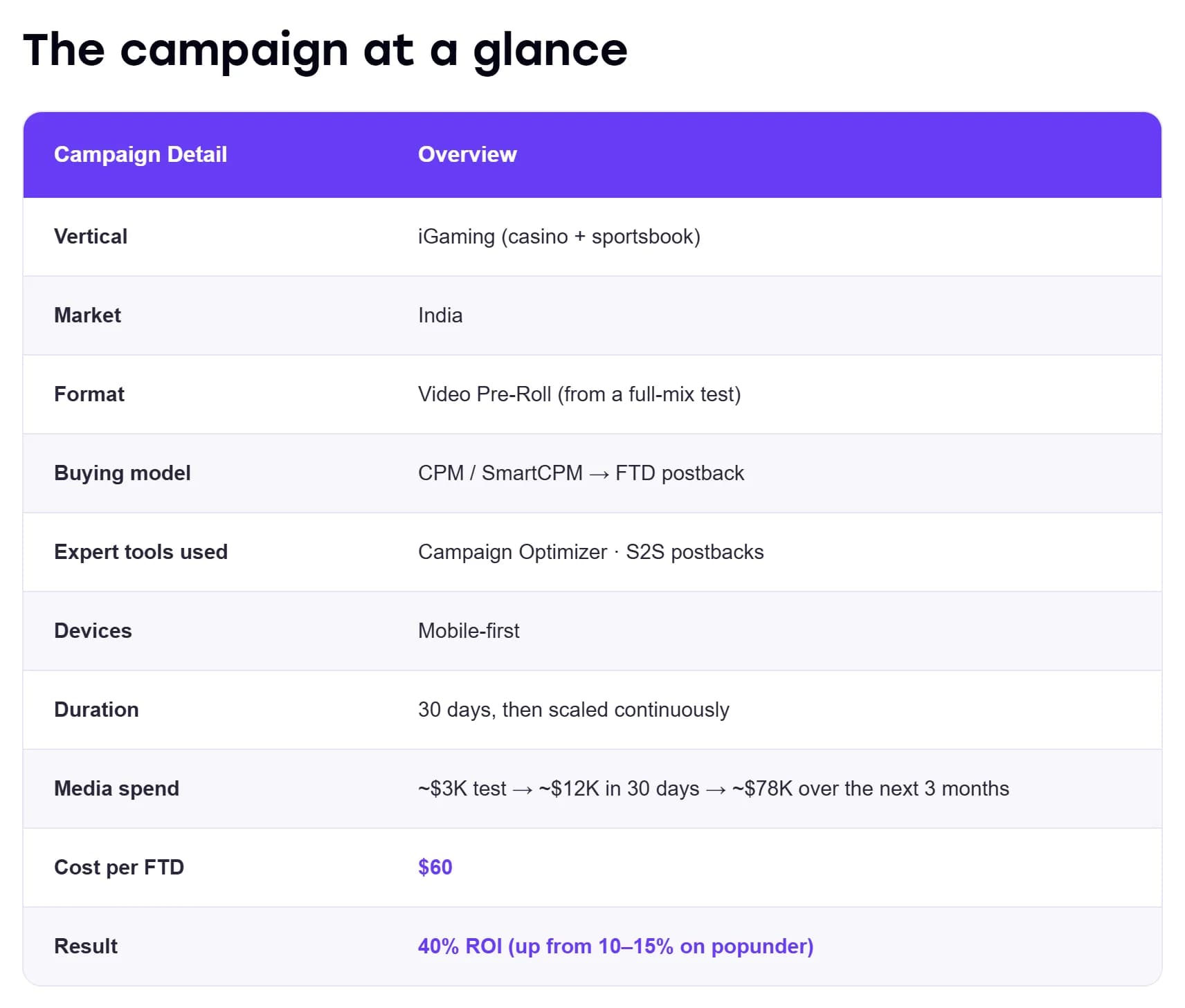
The key points, as the case's own summary table lists them:
- vertical: iGaming, casino and sportsbook; market: India;
- format: video pre-roll, picked from a test of all video formats;
- buying model: CPM or SmartCPM, judged on an FTD postback;
- tools: TrafficStars' Campaign Optimizer and S2S postbacks; devices: mobile-first;
- media spend: about $3K test, about $12K in 30 days, about $78K over the next 3 months;
- result: $60 per first-time deposit and 40% ROI, "up from 10–15% on popunder," plus +18% branded search after 3 months.
Once we planned and produced the right video creative and split the buy down to spot and creative on xHamster and other premium sites, it moved to a 40% ROI at a $60 deposit.
Our take: the publisher is the traffic source, and here it's more than that: by its own account TrafficStars planned and produced the videos. The case ends with "Let TrafficStars produce the creative" and a Get Started button. That's normal for a network blog and doesn't make the numbers false. It does mean nobody outside TrafficStars has checked them, and the operator can't be asked. Most case studies are selectively true; one written by the seller is selective by design.
The setup: 30 days from June 29, 2026
The dates are on the screenshots, not in the text. The case says only that the test ran 10 days and that "from 09/07 the discovery campaign was paused." The reporting screenshots carry the year: the test campaign ran June 29 to July 8, 2026, the 3 dedicated campaigns July 9 to 28, and the full 30-day view covers June 29 to July 28, 2026. The scale-up of about $78K followed over "the next 3 months," and the branded-search screenshot compares June 1–28 with September 28 to October 25, 2026.
The build. 1 global video campaign with all 4 formats enabled: Pre-Roll, Video IM Slider, Video Outstream and vertical Shorts. Targeting was "mobile, non-proxy traffic," bought on CPM; the campaign report lists the model as plain CPM. Frequency was capped at 3 impressions per user per day. The operator's platform sent an S2S postback on every first deposit, so TrafficStars' reports show FTDs and cost per FTD next to the spend.
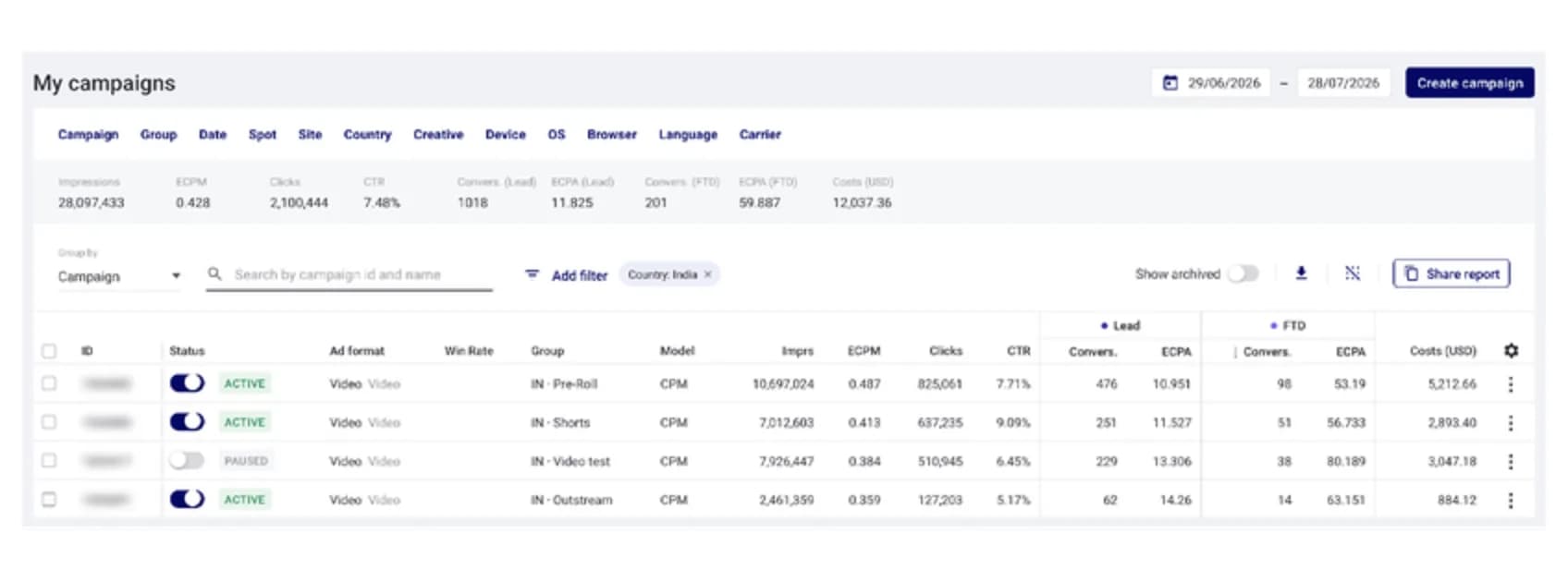
The split. After 10 days and about $3,000, the test was paused and its budget moved into 3 dedicated campaigns: Pre-Roll, Shorts, and Outstream on 2 select spots. The reason is mechanical: on TrafficStars "bid, budget, whitelist and rules all live at the campaign level," so a winner needs its own campaign to get its own bid. IM Slider was paused.
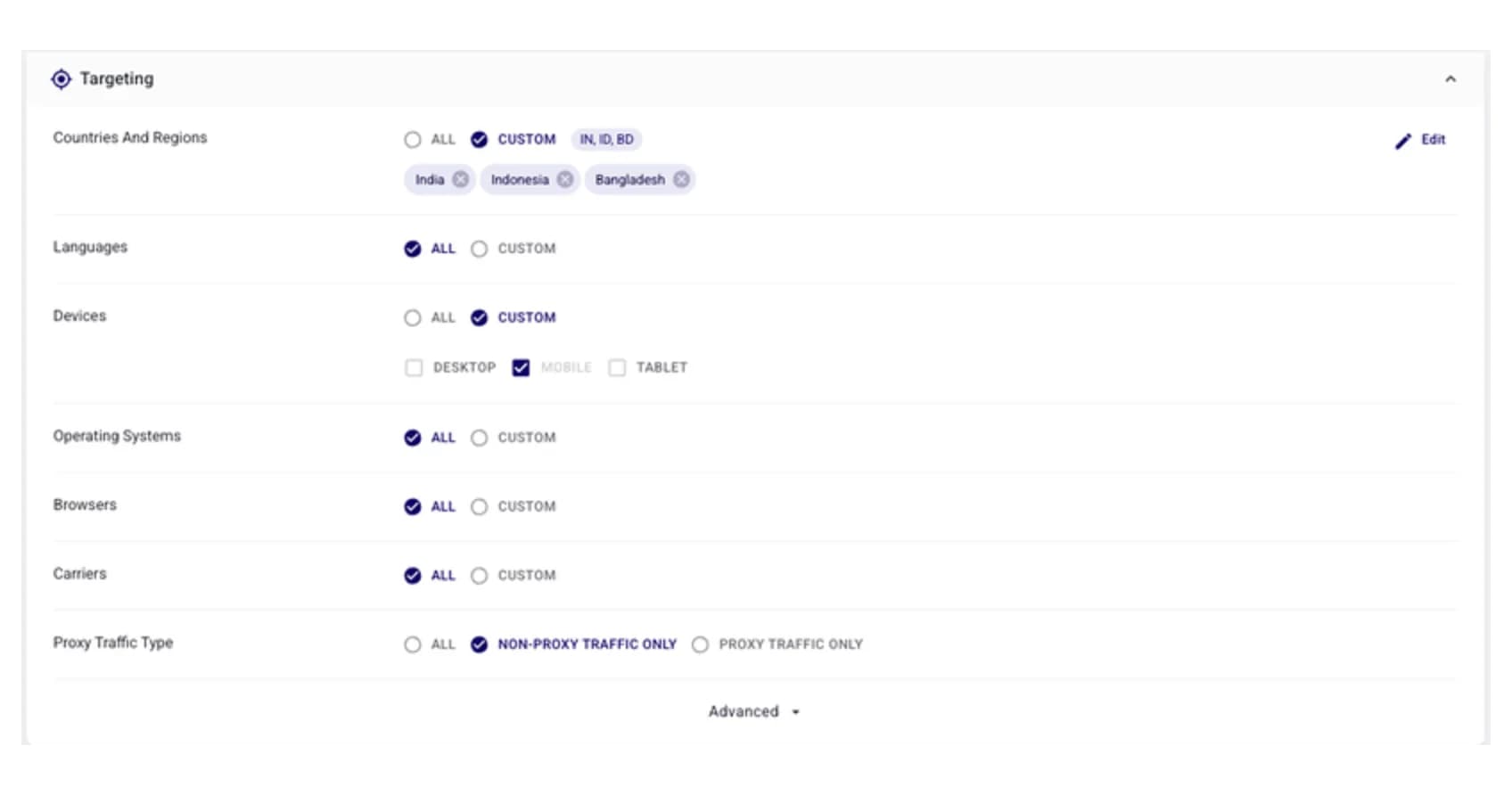
What doesn't fit the story. The targeting screenshot lists 3 countries: India, Indonesia and Bangladesh. Every report in the case is filtered to "Country: India," and the text never mentions the other 2. The Optimizer screenshots further down are named "iGaming SEA," with a rule group "SEA 1." So at least some of the setup screens may come from a wider South and Southeast Asia campaign, not from the India one.
The money: $12,037 in, $16,852 back
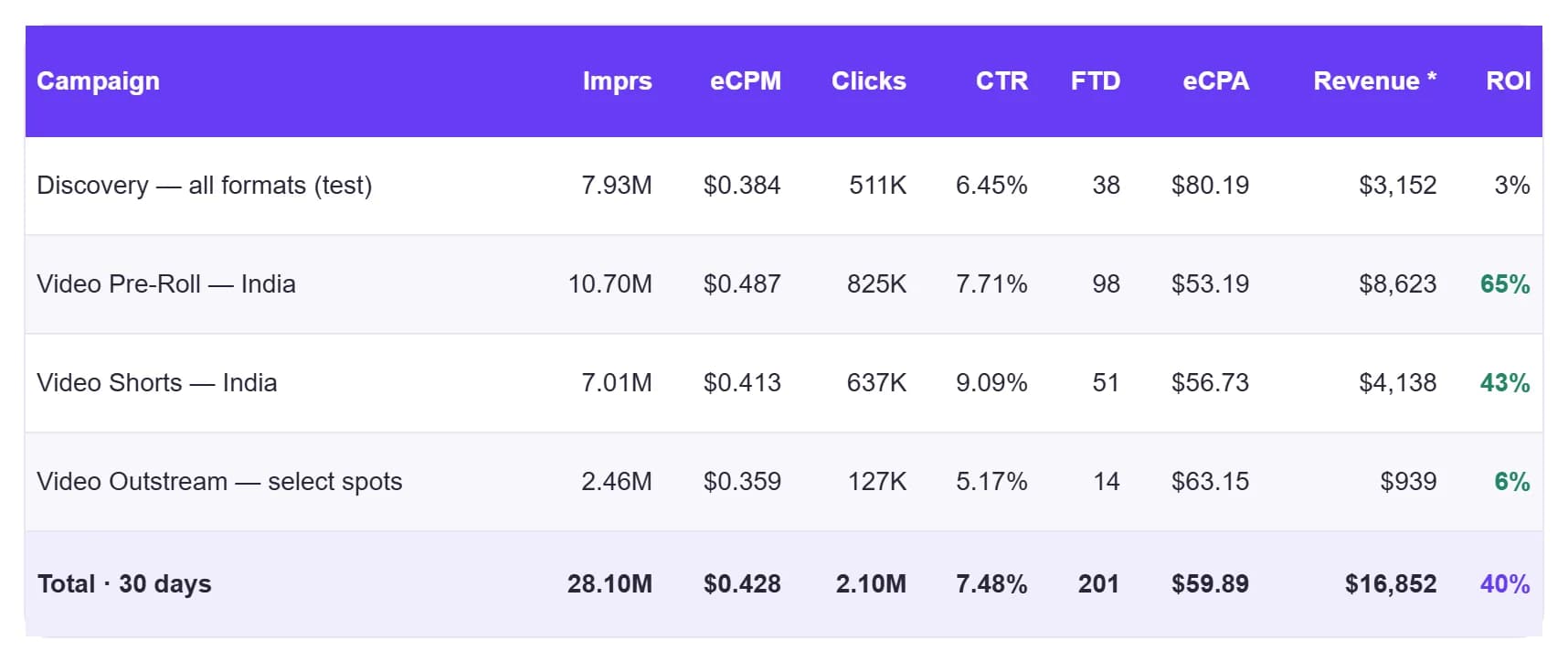
The case's results table gives impressions, eCPM, clicks, CTR, FTDs, cost per FTD, revenue and ROI for each of the 4 campaigns. We recomputed every row from the TrafficStars campaign report. Spend is impressions times eCPM, and it also equals FTDs times cost per FTD:
Campaign | Spend (report) | FTDs at cost | Revenue (case) | Profit and ROI |
|---|---|---|---|---|
Test, all formats | $3,047.18 | 38 at $80.19 | $3,152 | $105, 3.4% |
Pre-Roll | $5,212.66 | 98 at $53.19 | $8,623 | $3,410, 65.4% |
Shorts | $2,893.40 | 51 at $56.73 | $4,138 | $1,245, 43.0% |
Outstream, 2 spots | $884.12 | 14 at $63.15 | $939 | $55, 6.2% |
Total, 30 days | $12,037.36 | 201 at $59.89 | $16,852 | $4,815, 40.0% |
Our math:
- ROI is profit over spend: ($16,852 − $12,037) / $12,037 = 40.0%, so the headline number holds on the case's own figures;
- profit over the 30 days is about $4,815, and 71% of it came from the Pre-Roll campaign alone;
- revenue per depositor is $83.84 on average, $87.99 on Pre-Roll and $67.07 on Outstream;
- the funnel: 28.1M impressions, 2,100,444 clicks, 1,018 registrations at $11.82 each, 201 FTDs, so 19.7% of registrations deposited;
- cost per FTD fell from $80.19 in the test to $55.15 across the 3 dedicated campaigns, as the case says.
The daily pace. The case says spend climbed from about $300 a day in the test to over $550 by the end of the month. The daily report it shows covers July 1–16: $299 to $338 a day in the test, then $334 to $414. For the dedicated campaigns to total $8,990.18 by July 28, the last 12 days must have averaged about $496 a day, so a finish above $550 is plausible. The scale-up that followed, about $78K over 3 months, works out to roughly $850 a day. No result is given for it.
What the reports prove, and what they don't
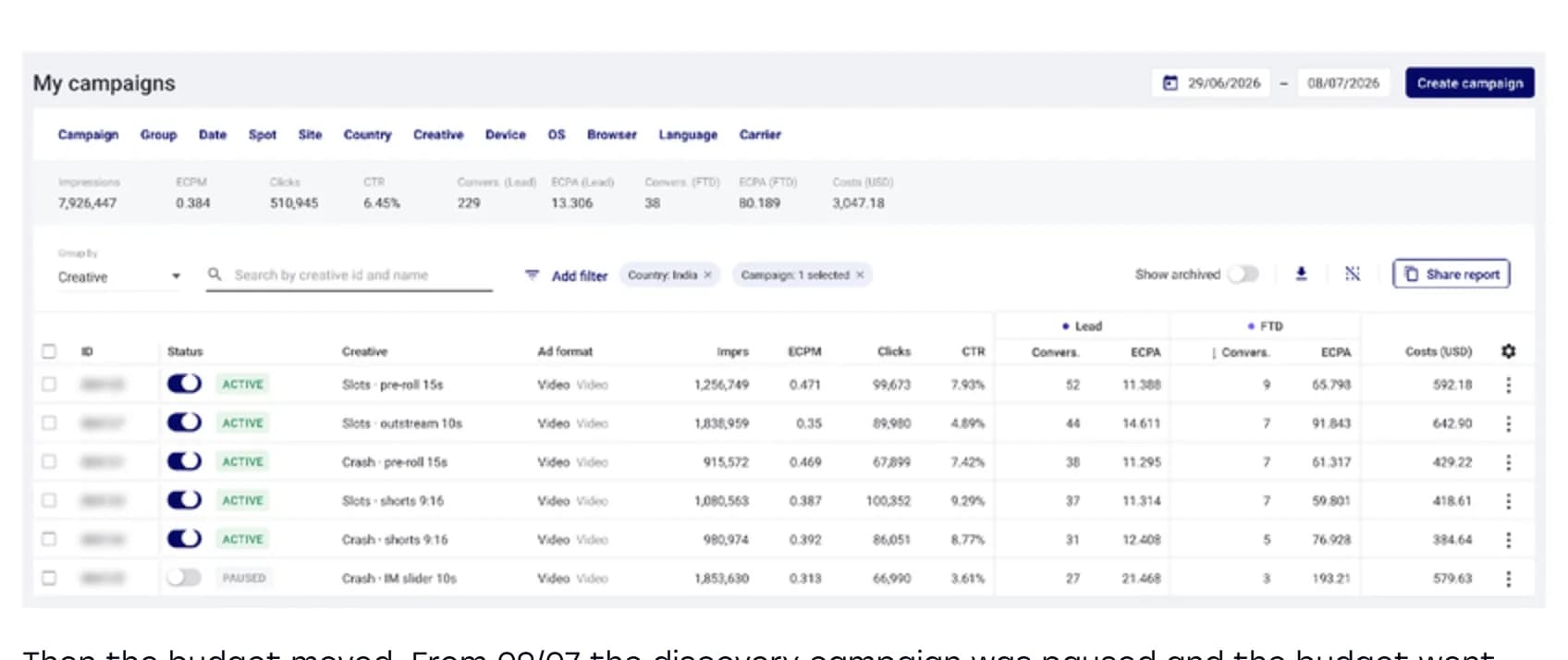
5 report views, 1 set of numbers. The case shows TrafficStars reports grouped by campaign, by creative, by spot and by date, plus the test campaign on its own. They agree to the cent: the 9 spots in the spot view add up to $8,990.18 and 163 FTDs, the 6 test creatives to $3,047.18 and 38 FTDs, and the 16 days of the daily view to $5,560.41. Each row's cost also matches its own eCPM and cost per FTD. That's rare in network cases, and it's the strongest part of this one.
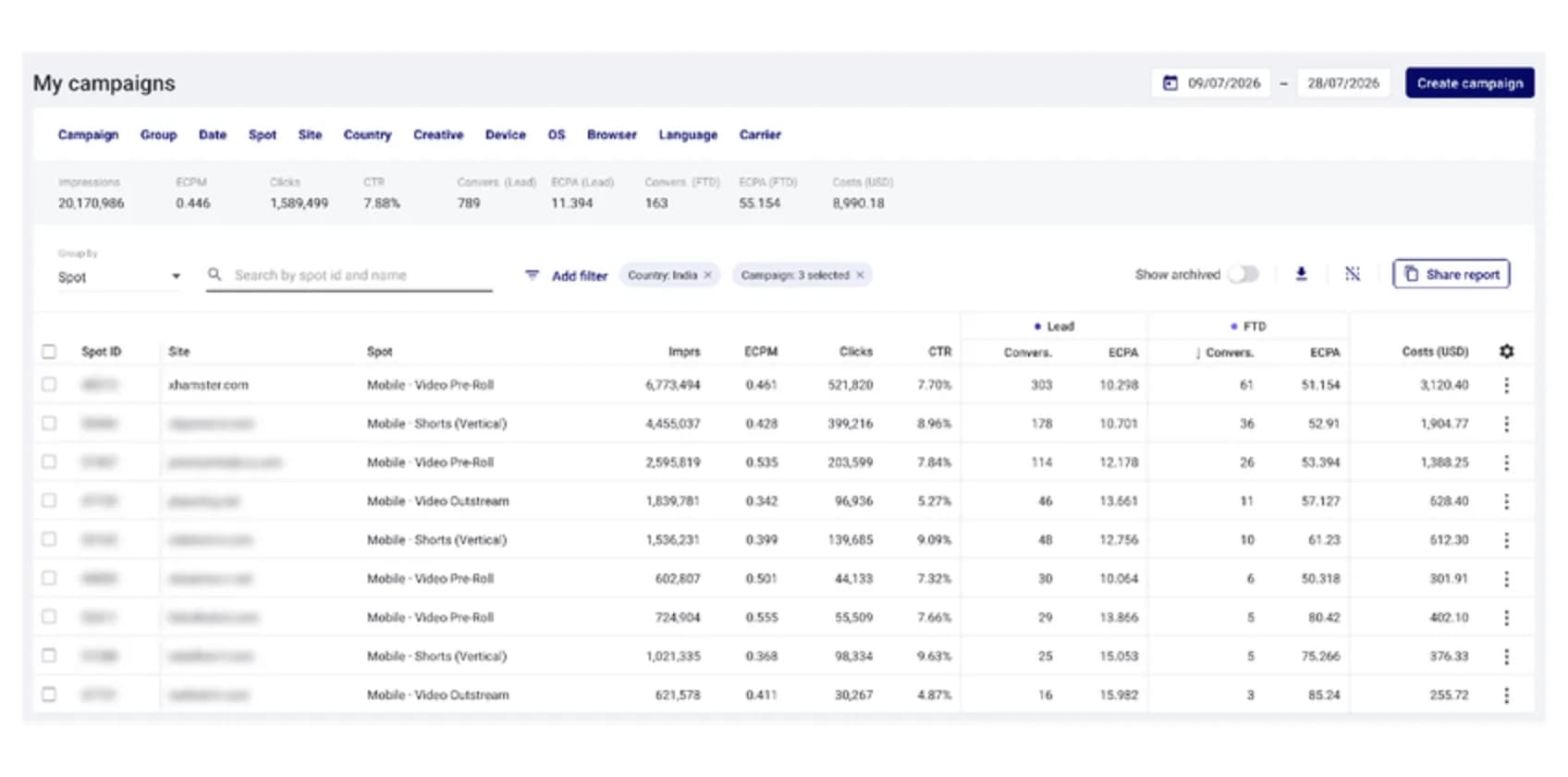
xHamster carried the result. The only site left unblurred, xhamster.com mobile pre-roll, took $3,120.40, or 35% of the dedicated spend, and brought 61 FTDs, 37% of them, at $51.15 each. The other 8 spots are blurred.
Revenue is not in any screenshot. TrafficStars reports what the network knows: impressions, clicks, cost and the conversions the postback sends. The revenue column exists only in the case's own table, under the heading "Revenue *". The asterisk has no footnote. Revenue could mean deposits, GGR or NGR, and they're very different numbers: a 40% "ROI" on deposits isn't profit for an operator. The case says only that the FTD columns were "matched daily against the operator's own revenue data."
The window is unclear too. The table says "Total · 30 days," and the text adds that "38% of depositors" re-deposited "within 30 days." A depositor who arrived on July 28 had no time to re-deposit inside a June 29 to July 28 window, so either revenue was counted over a longer period or the late cohorts are underweighted. Neither the cohort data nor the 38% is shown.
The images went through an AI assistant. We downloaded the original files. All 12 images in the case text, the reporting screenshots included, carry a C2PA content credential issued by Anthropic, PBC, through "Anthropic Claude Content Signing." The recorded action is "Opened a pre-existing file," and the credential adds: "Claude provided this file at the request of a user and may have created or modified the file contents," with origin confidence "unknown."
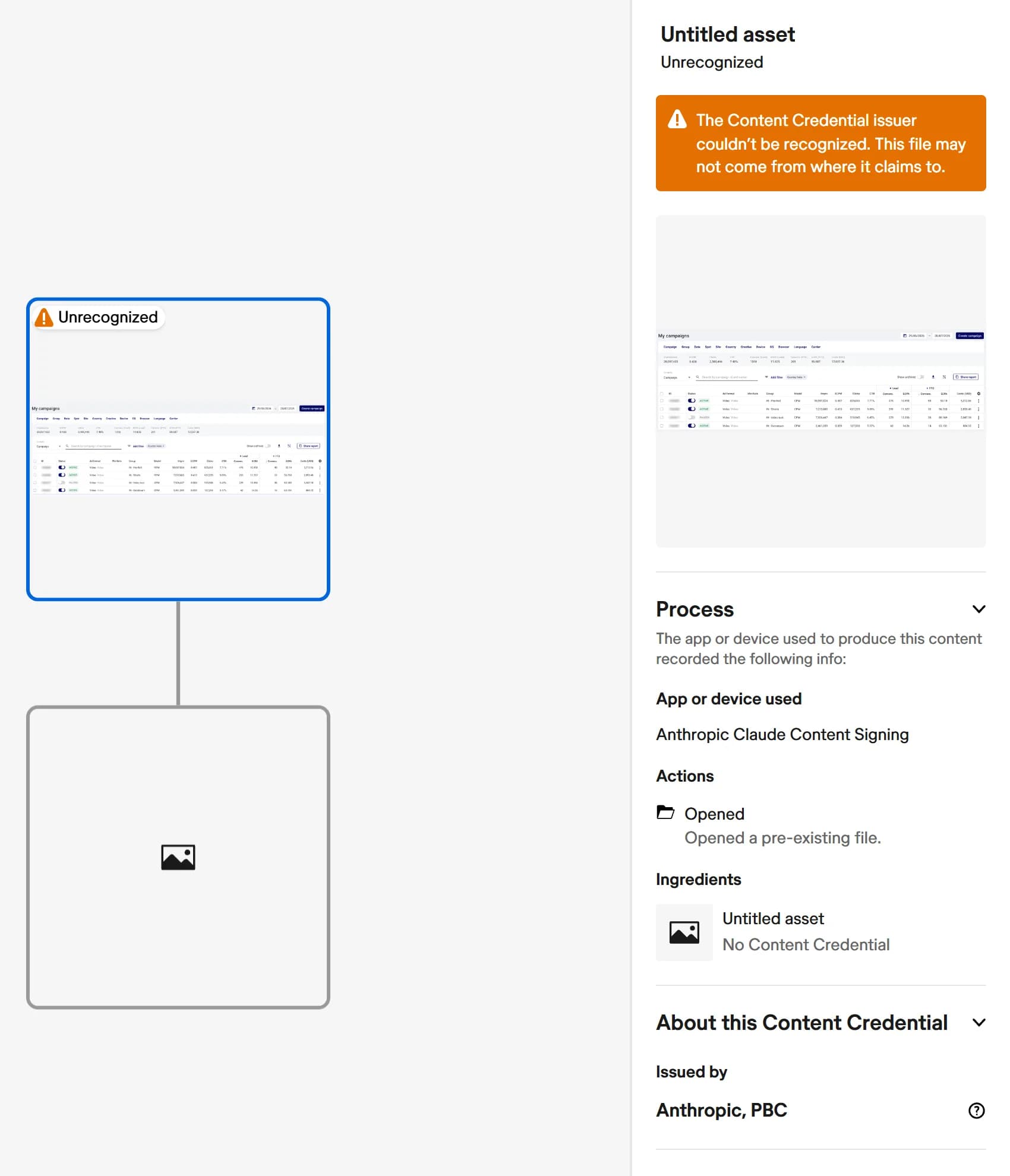
That isn't the mark of an image model drawing a dashboard; it says the files passed through Claude on their way to the blog. The likeliest reason is mundane: the spot IDs, site names and search query are blurred, and every image is exactly 824 pixels wide. But it means these aren't untouched screenshots, the credential can't say what was changed, and the originals aren't in the case.
The Optimizer screens don't quite match the text. Rule 1 blocks a site after 10,000 impressions at a CTR under 1%, checked over the last 2 days. Rule 2 raises a spot's bid when it has more than 3 registrations at an eCPA under $10. The screenshot shows the step: +$0.001 every 2 days, against eCPMs of $0.36 to $0.49, or about 0.2% per step. And a banner on the same screen says Optimizer rules "work only with data from the default 'Lead' goal," so the automation optimized on registrations, not deposits. The case admits this further down, after saying the buy was "always optimized against the FTD postback."
Popunder's 10–15% has no numbers behind it. There's no spend, period or screenshot for the popunder test the whole story starts from.
Creatives and funnel: made by the network, not shown
6 test creatives, by name only. The test report lists them: Slots pre-roll 15 s (9 FTDs at $65.79), Slots outstream 10 s (7 at $91.84), Crash pre-roll 15 s (7 at $61.34), Slots shorts 9:16 (7 at $59.80), Crash shorts 9:16 (5 at $76.93) and a Crash IM slider 10 s, paused at 3 FTDs for $579.63, or $193.21 each. The text describes the approach: "the spin, the multiplier, the near-win," an "offer-first hook, promo-code headline, one Sign-up CTA."
None of the videos is shown. The case has 3 creative images. 2 are stills captioned "Just an example of TrafficStars production for various iGaming advertisers," so not this campaign's. The third is captioned as how the pre-roll "renders in the player: a Slots/Crash hook," but it shows a generic sports betting ad with the promo code "STAR" and a $50 bonus, on a how-to slide that reads "here is an example of how a Pre-Roll ad will look like on a publisher's site."
A 7.48% CTR isn't intent. The case reads the high CTR as proof that "the audience–creative–placement fit was real." The funnel says otherwise: 2,100,444 clicks produced 1,018 registrations, 1 for every 2,063 clicks. We read most of those clicks as taps on a mobile pre-roll player, not decisions. The money was decided after the click, and that part of the funnel, the landing page, the bonus terms and how Indian players paid in, isn't shown at all.
+18% branded search: what the Search Console screen shows
The case's "bonus return" is branded search up about 18% after 3 months. The screenshot is a Google Search Console comparison for India with 1 query, blurred: September 28 to October 25, 2026 against June 1–28, 2026, the 4 weeks before the first video impression.
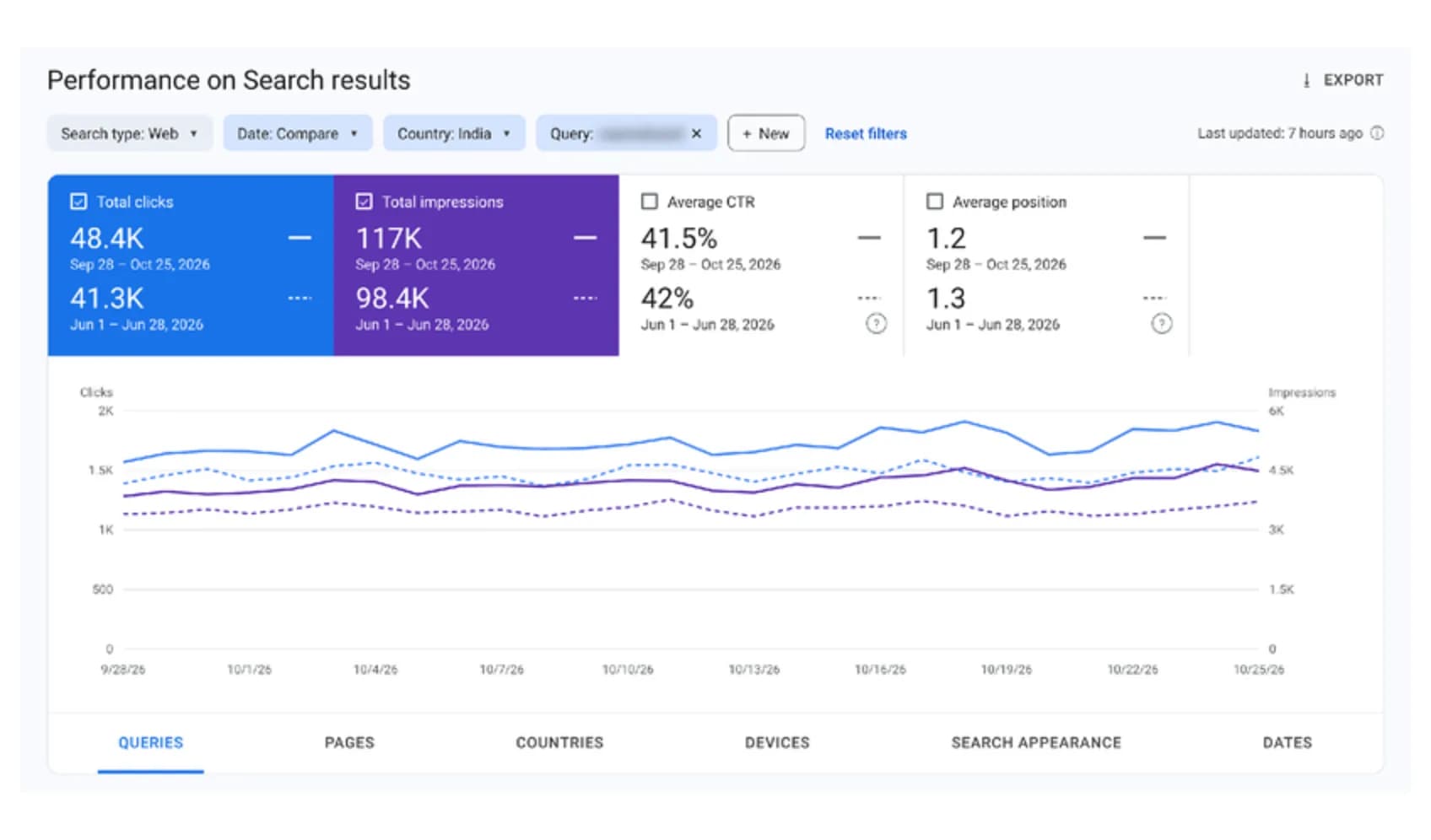
Our math: clicks rose from 41.3K to 48.4K, +17%; impressions from 98.4K to 117K, +19%. The "roughly 18%" sits between the 2.
What it can't show: the query is hidden, so we can't tell it's the brand. The 2 periods are 4 months apart, with nothing to separate video from season, other channels or the operator's other marketing. And the June baseline undercuts the story's start: a query with 98.4K impressions and 41.3K clicks in India in the 4 weeks before the campaign doesn't belong to a brand new to India, whatever the case says about "a market that was new to them."
India's law: the campaign ran after the ban took effect
The Act. India's Parliament passed the Promotion and Regulation of Online Gaming Act, 2025, Act No. 32 of 2025, which received the President's assent on August 22, 2025. It defines an "online money game" as one played "by paying fees, depositing money or other stakes in expectation of winning," "irrespective of whether such game is based on skill, chance, or both." Casino games and sports bets played for deposits fit that definition. Section 1(2) applies the Act to services "offered within the territory of India or operated from outside the territory of India."
What it bans. Section 5 bans offering online money games. Section 6 bans advertising them, and it's written wide:
No person shall make, cause to be made, aid, abet, induce, or otherwise be involved in the making or causing to be made any advertisement, in any media including electronic means of communication, which directly or indirectly promotes or induces any person to play any online money game or indulge in any activity promoting online money gaming.
Section 7 bars banks and anyone "facilitating financial transactions" from processing payments for these games.
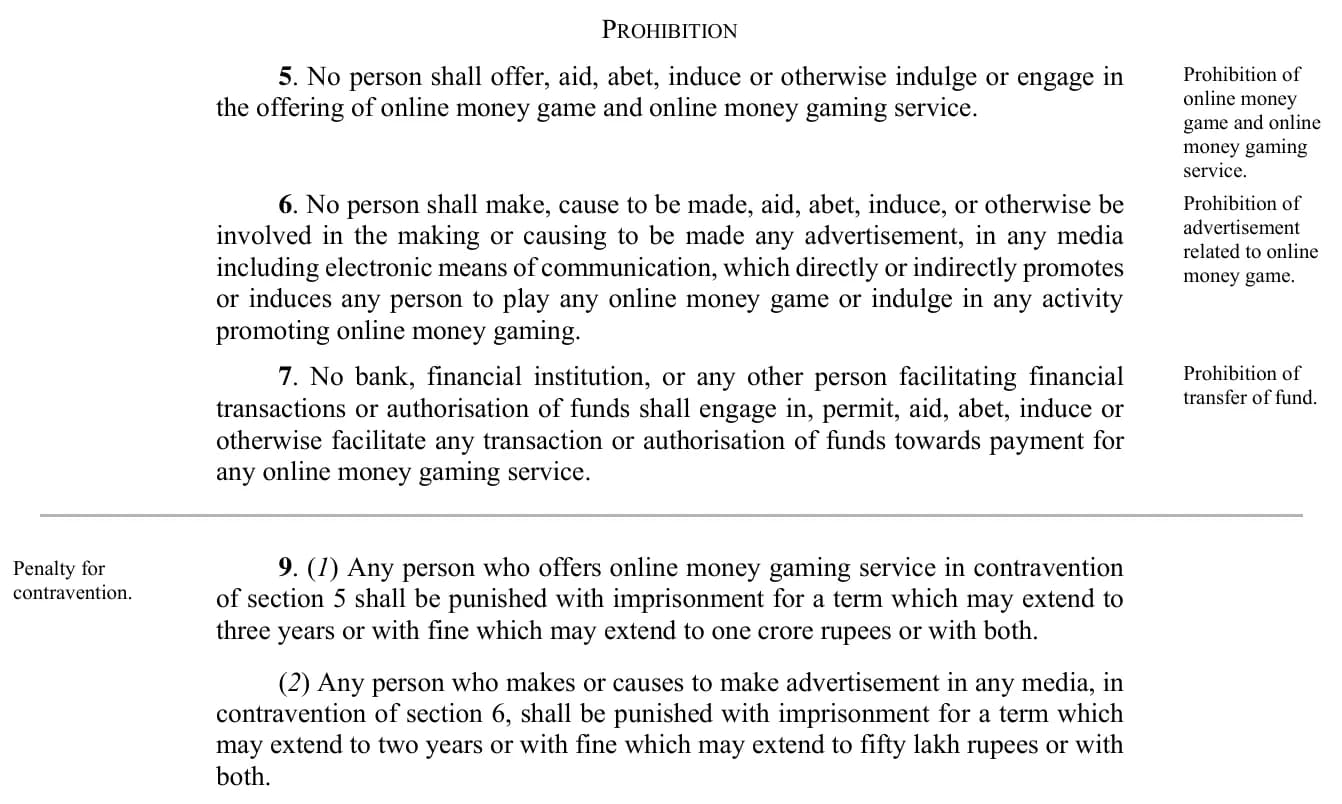
The penalties. Under section 9(2), advertising in breach of section 6 carries up to 2 years in prison, a fine up to ₹5 million (50 lakh), or both; a repeat conviction carries 2 to 3 years and ₹5 million to ₹10 million. Offering a money game carries up to 3 years or ₹10 million (1 crore). Under section 11, when a company commits an offence, the people in charge of that part of its business can be prosecuted too. Section 14 lets the government block any information "in relation to online money gaming service" when sections 5, 6 or 7 are broken.
The date. The Act came into force only when the government notified a date. On April 22, 2026, the Ministry of Electronics and IT published notification S.O. 1994(E): "the 1st day of May, 2026 as the date on which the provisions of the said Act shall come into force." The same day it notified the Promotion and Regulation of Online Gaming Rules, 2026, also in force from May 1, and set up the Online Gaming Authority of India, which can issue directions on "advertisements relating to online games." In September 2025 the Supreme Court took over the challenges to the Act from 3 High Courts; that order didn't suspend it.
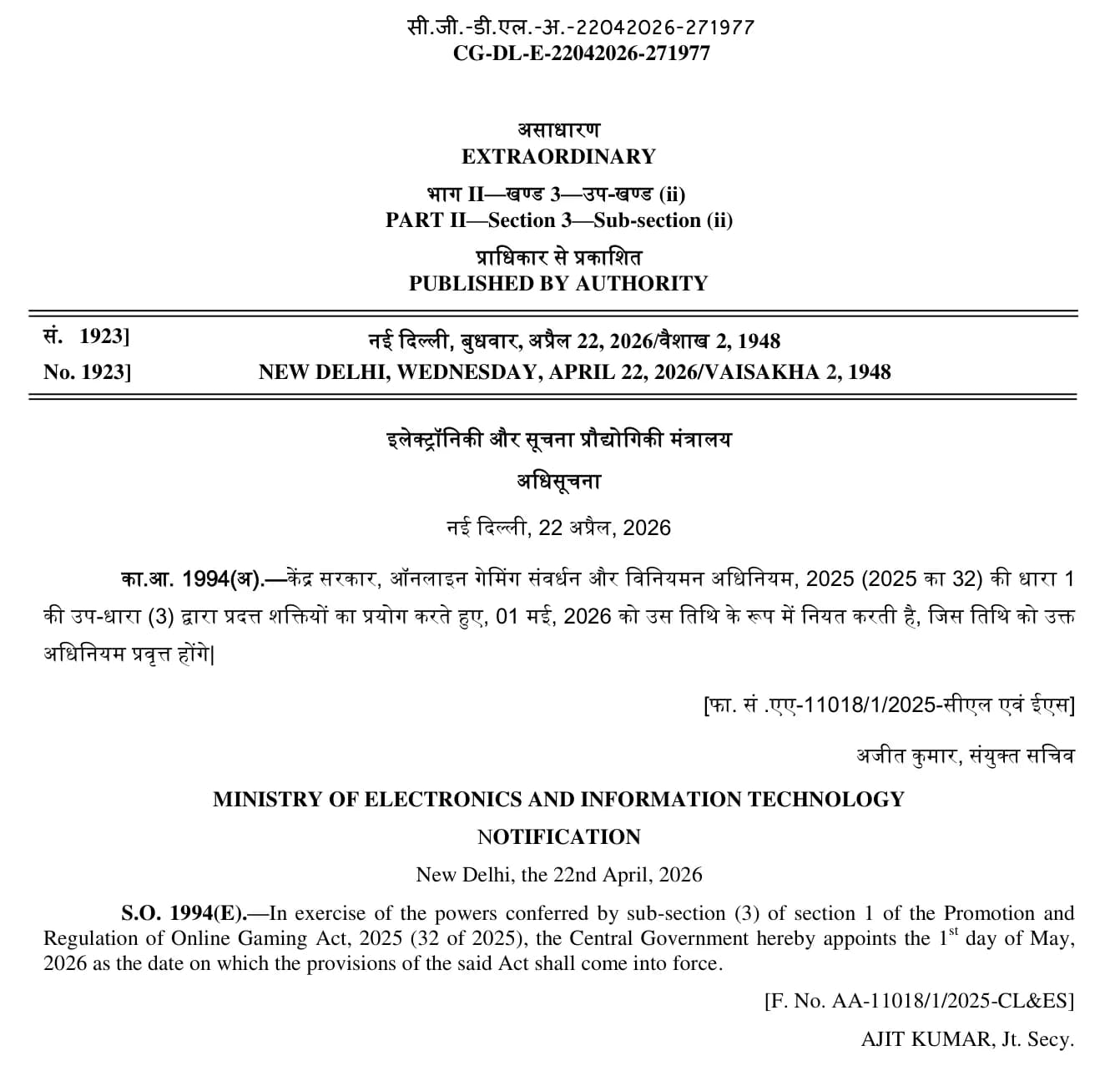
Put the case on that timeline: every day of the campaign falls after May 1, 2026.
Date | What happened |
|---|---|
August 22, 2025 | The Act receives the President's assent |
April 22, 2026 | Notifications: the Act and its Rules in force from May 1 |
May 1, 2026 | Online money games and their advertising banned in India |
June 29 to July 28, 2026 | The case's 30 days: $12,037 of pre-roll for a casino and sportsbook |
August to October 2026 | About $78K more "scaling the same strategy in India" |
November 10, 2026 | TrafficStars publishes the case |
It wasn't open before the Act either. Since June 2022 India's Ministry of Information and Broadcasting has advised media against ads for online betting platforms, noting that "betting and gambling is prohibited in most parts of the country." Its advisories of October 3, 2022 and March 21, 2024 add that "online advertisement intermediaries" are advised "not to target such advertisements towards the Indian audience." In April 2026 MeitY reminded intermediaries that the Act "expressly prohibits online real-money gaming activities in all forms."
TrafficStars' own pages. Its gambling traffic page says the platform "accepts regulated gambling offers where legally permitted." Its iGaming page files India under "regulatory gray areas requiring local legal guidance." And its terms, last updated July 7, 2026, make the buyer warrant that its ads "will not violate any applicable laws" (clause 7.2) and "comply with all applicable advertising" laws (clause 27.3). In this case the network says it made the creative itself.

What this means for you. Whether anyone is liable for this campaign is for Indian authorities and courts to decide, and we're not one of them. What the text of the Act says is plain: section 6 covers anyone who makes, causes or is involved in an ad that promotes an online money game, in any media, and since May 1, 2026 that has carried up to 2 years in prison. A case that shows a casino buying pre-roll in India in July 2026 is not a playbook you can follow there.
The case says nothing about the Act, a license, how players in India deposited despite section 7, or why the network's "where legally permitted" line didn't apply. We found no statement from TrafficStars on it.
What you can repeat, and where
The method travels. Strip out India and the case holds a sound way to buy video for iGaming in a market where it's legal:
- Wire the S2S postback on the first deposit before the first impression.
- Run 1 discovery campaign across all video formats with a fixed test budget, here 10 days and about $3,000.
- Split each winning format, and later each winning spot and creative, into its own campaign, because bids, budgets and whitelists live at the campaign level.
- Automate the cuts: block sites that burn impressions at a CTR far below the rest, cap frequency, and judge spots on cost per FTD, not CTR or eCPM.
- Pause what can't reach the deposit target, as the case did with IM Slider at $193 per FTD.
The numbers don't. The $60 FTD and the $0.43 eCPM are India's prices, the revenue per depositor is 1 operator's, and the creatives came from the network's studio. A brand that already drew 41.3K branded clicks in India in the 4 weeks before started with an advantage a new brand won't have.
Where to try it. Pre-roll for iGaming means adult and mainstream video inventory with a network that accepts gambling, in a GEO where you or the operator hold an iGaming license and advertising is allowed. Our comparison of video ad networks lists 10 that sell pre-roll, with published floors and vertical rules, and our TrafficStars review covers its $100 minimum deposit, refund and moderation rules.
Fact-check: what the author showed and what they hid
We rate every case on 10 points: what an outsider needs to judge the result and repeat it. We recomputed every figure from the case's screenshots, read the Act and its notifications in the Gazette of India, and checked the image files' content credentials. For an ad network case, the consumables point becomes the cost of everything besides media.
Point | Status | What we found |
|---|---|---|
Setup: period, GEO, offer, model | Partial | India, casino and sportsbook, CPM video, and dates on the screenshots: June 29 to July 28, 2026. The text gives no year, and the operator, offer and revenue model are hidden. |
Author and independence | Partial | Published by TrafficStars, which sold the traffic and made the videos, with a sales call to action. The operator is anonymous; the quote is signed with a first name. |
Finances | Partial | Spend, FTDs and costs reconcile to the cent, and the 40% recomputes. Revenue is the operator's figure under an asterisk with no footnote; the $78K scale-up has no results. |
Proof | Partial | 5 report views and a Search Console chart that agree with each other. No revenue screen, the images carry an AI assistant's credential, and sites and the query are blurred. |
Source and targeting | Showed | Formats, mobile, non-proxy, CPM, frequency cap, Optimizer rules and the top spot are given. The targeting screen adds Indonesia and Bangladesh without explanation. |
Tools | Showed | TrafficStars' Optimizer and an S2S postback from the operator's platform. No external tracker, and the Optimizer reads registrations, not deposits. |
Creatives | Partial | 6 creatives named with formats, lengths and results. None of the videos is shown; the 3 creative images come from other work. |
Landing pages and funnel | Hid | "Offer-first hook, promo-code headline, one Sign-up CTA" and nothing more: no landing page, bonus terms or payment flow. |
Costs beyond media | Hid | The network produced the videos; what that cost the operator isn't said. |
Repeatability today | Hid | The method transfers to legal markets. India doesn't: real-money games and their ads have been banned there since May 1, 2026, before the campaign began, and the case never says so. |
Score: 2/5. The spend side is as good as network cases get: 5 dated reports that agree to the cent, the settings on screen and a named top spot. But the revenue behind the 40% is a column with an asterisk and no footnote, the operator, the funnel and the videos stay hidden, every image carries an AI assistant's credential, and the market itself closed to these ads 2 months before the first impression. Solid on spend, closed on money and not repeatable where it ran: a 2.
Checklist: what to do
Questions and answers
Is online casino advertising legal in India in 2026?
No. Since May 1, 2026, India's Promotion and Regulation of Online Gaming Act, 2025 bans online money games, whether skill or chance, and any advertisement that promotes them in any media. It also applies to services operated from outside India.
What is the penalty for advertising online money games in India?
Up to 2 years in prison, a fine up to 50 lakh rupees (₹5 million), or both, under section 9(2) of the Act. A repeat conviction carries 2 to 3 years and a fine of 50 lakh to 1 crore rupees, and company officers in charge can be prosecuted too.
Does TrafficStars accept iGaming ads?
Yes, where they're legal. Its gambling traffic page says it "accepts regulated gambling offers where legally permitted," and its terms make the advertiser responsible for complying with advertising law. Its India case doesn't say how it fits that rule.
What cost per FTD can video pre-roll reach for iGaming?
In this case $59.89 per first deposit across 30 days in India, $53.19 on the Pre-Roll campaign and $51.15 on xHamster mobile pre-roll. Those are India's prices with the network's own creatives, and India has banned these ads, so treat them as a reference only.
Does video advertising increase branded search?
This case shows clicks on 1 blurred query in India rising 17% and impressions 19% between June and October 2026. There's no control group or same-season baseline, so the lift can't be put down to video alone.
Author’s conclusion
The case is better documented than most network blog posts: 5 report views that agree to the cent, settings and rules on screen, a named top spot and a funnel you can follow from impression to deposit. It's also exactly what it looks like: a sales page from the network that sold the traffic and made the videos, built around revenue nobody outside the operator can see, with images that passed through an AI assistant on the way. And it describes a market that had banned real-money gaming ads 2 months before the first impression, without a word about it.
My advice: take the method and leave the market. Wire the deposit postback first, test all video formats on a fixed budget, split the winners by spot and creative, and judge them on clicks to registration and cost per FTD. Do it only in a GEO where the operator is licensed and the ads are legal, and get the operator's definition of revenue before you believe any ROI, including your own.
Lu Discover, Editor-in-chief
Our verdict on this case
The spend side is as good as network cases get: 5 dated reports that agree to the cent, the settings on screen and a named top spot. But the revenue behind the 40% is a column with an asterisk and no footnote, the operator, the funnel and the videos stay hidden, every image carries an AI assistant's credential, and the market itself closed to these ads 2 months before the first impression. Solid on spend, closed on money and not repeatable where it ran: a 2.
Our fact-check of the public case: what the numbers show, what is missing. Scores are never for sale.
Sources for this article
- Orestis Leventis, TrafficStars — Case Study: How Video Pre-Roll Turned India Into a Growth Market for an iGaming Operator (November 10, 2026)
- egazette.gov.in — The Promotion and Regulation of Online Gaming Act, 2025 (No. 32 of 2025), Gazette of India, August 22, 2025: sections 1, 2, 5, 6, 7, 9, 11 and 14
- egazette.gov.in — MeitY notification S.O. 1994(E), April 22, 2026: the Act in force from May 1, 2026
- egazette.gov.in — Promotion and Regulation of Online Gaming Rules, 2026, G.S.R. 303(E), April 22, 2026, in force from May 1, 2026
- egazette.gov.in — MeitY notification S.O. 1992(E), April 22, 2026: the Online Gaming Authority of India constituted
- pib.gov.in — MeitY: the Promotion and Regulation of Online Gaming Rules, 2026 come into force on May 1, 2026 (April 22, 2026)
- pib.gov.in — Ministry of Information and Broadcasting, Lok Sabha reply: penalties for offering and advertising online money games (March 18, 2026)
- mib.gov.in — Advisory of October 3, 2022 on advertisements of online betting platforms: betting "prohibited in most parts of the country," intermediaries advised not to target the Indian audience
- mib.gov.in — Advisory of March 21, 2024 on ads of offshore online betting platforms: online advertisement intermediaries advised not to target the Indian audience
- meity.gov.in — Advisory to VPN service providers and intermediaries on blocked online betting platforms (April 9, 2026)
- Supreme Court of India — order of September 8, 2025 in Union of India v. Head Digital Works, T.P.(C) 2484-2486/2025, transferring the challenges to the Act (copy of the order)
- trafficstars.com — Gambling traffic: "accepts regulated gambling offers where legally permitted" (checked November 18, 2026)
- trafficstars.com — iGaming ads: India among "regulatory gray areas requiring local legal guidance" (checked November 18, 2026)
- trafficstars.com — xHamster ads: "Official Exclusive Advertising Partner of xHamster" (checked November 18, 2026)
- trafficstars.com — Terms and conditions, last updated July 7, 2026: clauses 7.2, 7.6 and 27.3 on compliance with applicable laws
- contentcredentials.org — Content Credentials Verify: result for the case's campaign report image (checked November 18, 2026)
Companies in this article
- TrafficStarsTraffic source1.5
Related stories
 Top list
10 Best Adult Ad Networks in 2026: Where to Buy Cheap Adult Traffic
 Top list
9 Best Display and Banner Ad Networks for Advertisers in 2026
 Top list
Comments
0 commentsNo comments yet.
Add a comment