

Why Affiliate Marketing Case Studies Don't Reflect Reality

Contents 11
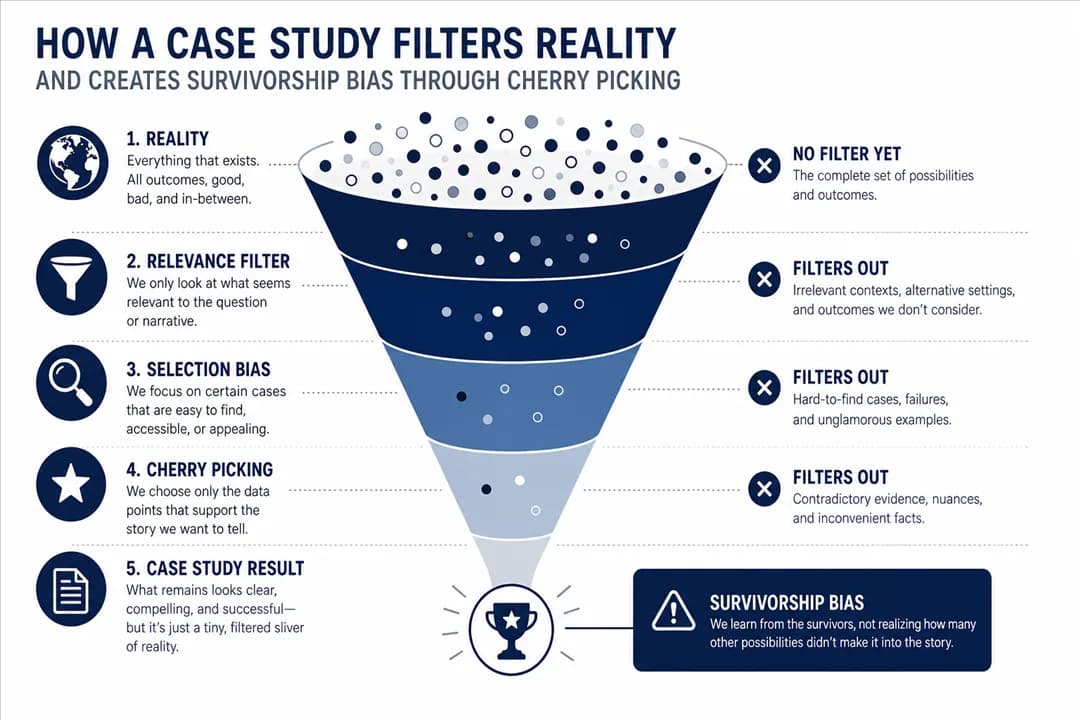
Are affiliate marketing case studies fake? Usually not, and that's the problem. Most of them are selectively true: a real winning campaign, shown without the dead tests, the tool costs, or the hundreds of people who ran the same playbook and lost money. In one widely cited survey, 57.55% of affiliates earn under $10,000 a year. You'll never read their case study.
The case study economy nobody audits
Every affiliate vertical runs on the same content engine. A network posts a "$0 to $14K a month" breakdown. A course seller drops dashboard screenshots into a YouTube ad. A forum member starts a follow-along that stops, conveniently, right after the first profitable week.
None of this is illegal by default, and much of it is real data from a real campaign. Almost all of it is useless, or harmful, as evidence of what you should expect.
Before we dig in:
- Survey data puts 57.55% of affiliate marketers below $10,000 a year, while published case studies overwhelmingly show five- and six-figure outcomes.
- The "average" affiliate income (about $8,038 a month in widely cited statistics) is a mean pulled up by a top few percent, not a median experience.
- The people who publish case studies (course sellers, ad networks, trackers, forums) usually earn money when you act on them.
- The FTC has turned unrepresentative success stories into enforcement cases: MOBE, Lurn and Publishing.com ($1.5 million, April 2026).
- US rules require disclosing the generally expected results when a testimonial is atypical. Most case studies don't.
The numbers case studies never show
Published success stories are the numerator. The denominator is everyone who tried. Influencer Marketing Hub's benchmark survey breaks annual affiliate income down like this:
- Under $10,000: 57.55% of affiliates
- $10,000–$50,000: 16.21%
- $50,000–$100,000: 5.15%
- $100,000–$150,000: 7.94%
- Over $150,000: 3.78%
If content matched reality, more than half of everything published would describe people earning under $850 a month. Instead the genre lives in the top rows.
The "average income" makes it worse. Aggregated data from DemandSage, citing Authority Hacker's survey, puts the average affiliate at about $8,038 a month, while the same dataset shows most affiliates earning up to $80,000 a year and around 1% above $1 million. A handful of very large media buyers pull the mean up the way one billionaire raises the average wealth of a bus. Case study marketing quotes the mean; reality lives at the median.
Anatomy of a published case study
Take any "How I made $25K with one campaign" post and audit what it discloses.
What you see:
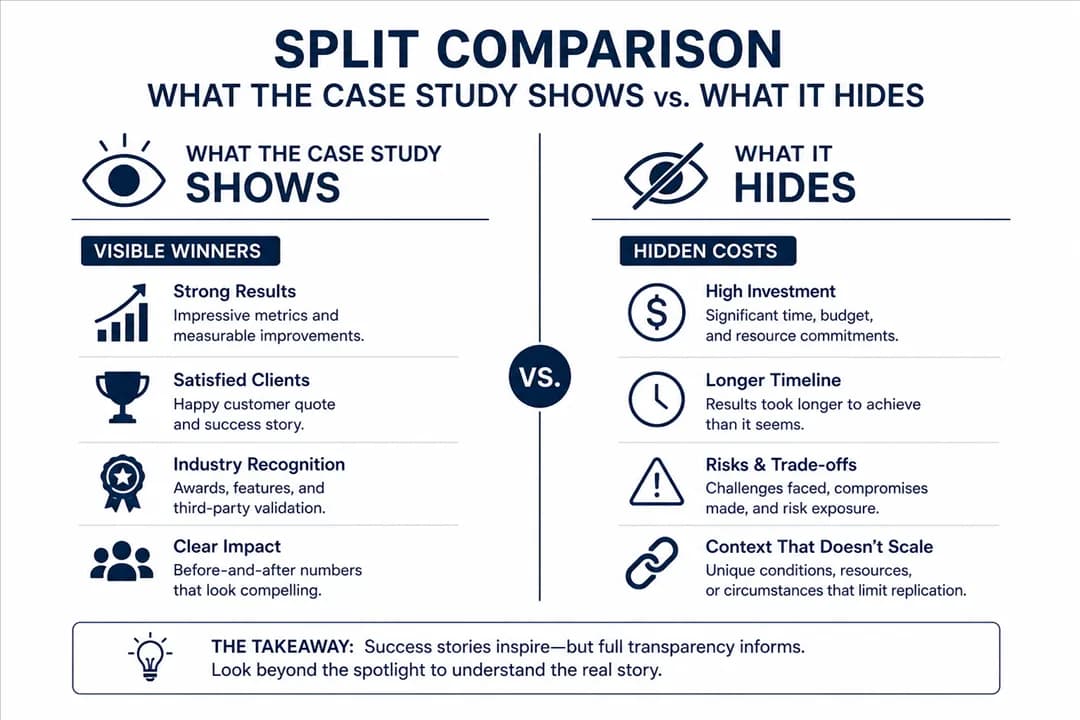
- revenue, almost always gross: the screenshot shows payouts, not profit;
- one campaign, the winner, usually its best window;
- a clean story: insight, launch, scale;
- a timeframe chosen after the fact.
What you almost never see:
- testing burn: the dead campaigns that paid for the winner; media buyers kill most of their tests;
- the tool stack: tracker, spy tools, proxies, antidetect browsers, assistants;
- payout reality: was the commission paid, or is it a pending balance? An approved number isn't money;
- decay: an angle that worked eight months ago is usually saturated by the time you read about it; publishing it costs the author nothing because the edge is spent;
- time: hours of setup and creative iteration compressed into "I launched and optimized."
None of this needs dishonesty. A fully truthful case study with these gaps still misleads, because readers fill the gaps with optimism. And every case study passed an editorial filter before a market one: the author chose which campaign, which weeks and which metrics to show.
Who publishes case studies, and why
Ask one question about any case study: what does the publisher sell?
Course sellers. The case study is the top of the funnel; the product is the course. Publishing.com's flagship program cost up to $1,995, and its CEO promised in a promotional email that buyers could "copy the EXACT system hundreds of my students use to make $1k to $3k a month in passive income." According to the FTC, most buyers never made that kind of money.
Ad networks and traffic sources. A winning campaign on a network is an ad for the network's traffic. Forum follow-along contests are often sponsored by ad networks, with prizes from the network itself. That doesn't make the threads fake; many are excellent. It means the case-study culture is funded by companies that profit when you spend on traffic.
Trackers, spy tools and other SaaS. "How I found this winning creative," published by a spy tool, is a product demo wearing a story.
Networks recruiting affiliates. ROI stories on network blogs are marketing material reviewed by the marketing team, not audited disclosures.
Affiliates themselves. Referral commissions, paid communities, personal brands, and at the dark end, recruiting downlines.
A case study from someone with no financial stake in your next move is a collector's item. Treat the rest as advertising: sometimes honest advertising, but advertising.
Survivorship bias: the engine behind every success story
Even if every publisher were neutral, case studies would mislead, because of who gets to write one. You only write a retrospective if you won. The people who burned $3,000 testing sweepstakes offers and quit don't build audiences around it. Failure in this industry is silent by design.
That's why "the screenshots are real" misses the point. Real screenshots from a biased sample lead to conclusions as wrong as fake ones. A course showing 50 student wins tells you nothing without knowing whether it has 200 students or 20,000.
Forum follow-alongs show the filter live. Threads start with energy, post a few rounds of data, then go quiet when the campaign stops cooperating. The ones that end in triumph get shared for years; the abandoned majority slides off the first page. Nobody hides the evidence; nobody ever adds it up.
When case studies become legal cases
Regulators keep building large cases on top of success stories. Three FTC actions show the pattern.
MOBE. "My Online Business Education" sold a "21-step system" for $49, then pushed buyers into membership packages costing thousands of dollars, marketed with success stories and earnings claims. The FTC sued in 2018, and by April 2022 had returned more than $23 million to over 37,000 consumers.
Lurn. The FTC sued the online coaching company in September 2023. One of its programs claimed consumers could "Fail 98% of the Time & Still Be Able to Make $11,453 Per Month." According to the complaint, nothing backed the claims and very few, if any, consumers made money. In June 2024 the FTC sent more than $2.4 million back to buyers.
Publishing.com (April 2026). Publishing.com and its two principals agreed to pay $1.5 million over earnings claims for its self-publishing courses, and must substantiate future earnings claims. The complaint also described the testimonial machine behind the marketing: reviews written by employees and founders' relatives without disclosure, testimonials incentivized with prizes, cash and services, and refunds at times conditioned on a positive testimonial.
Three products, one engine: atypical winners presented as the expected outcome. This doesn't mean every course or network with case studies is running a MOBE. It means the incentives are the same, and when regulators audit the numbers behind success stories, the numbers often fail.
What US rules require (and almost nobody does)
In October 2021 the FTC sent a Notice of Penalty Offenses on money-making claims to more than 1,100 companies. It restated long-standing law: it is unlawful to misrepresent the profits a participant can expect, including implying that the profits shown are typical when they aren't.
The FTC's Endorsement Guides close the loophole most case studies live in. A truthful testimonial from a real person with an atypical result is still deceptive unless the advertiser clearly discloses the generally expected results, in a way that's hard to miss, not in a footnote. The FTC's own research found that even "results not typical" disclaimers don't undo the impression that a testimonial is typical.
Apply that to the average affiliate case study: a real, atypical winner, no data on typical outcomes, often published by someone selling a course or traffic. Much of the genre is non-compliant marketing. It survives because enforcement targets the biggest schemes. "Hasn't been sued" is not the same as "honest."
How to read a case study critically
You don't need to ignore case studies. Their tactics, creatives and funnel structures can be useful. Stop reading them as evidence of expected returns.
- Identify the publisher's revenue model first. If acting on the story sends money to its author, weigh it as an ad.
- Look for net, not gross. No spend breakdown, no tool costs, no failed-test budget: that's a revenue screenshot, not a P&L.
- Ask for the denominator. How many campaigns died first? How many students didn't get the result?
- Check the timeframe and the date. A 30-day window from a 12-month campaign is a highlight reel; an edge from 2024 republished in 2026 is archaeology.
- Verify payment, not dashboards. Balances are theoretical until withdrawn.
- Apply the FTC test. If adding the honest line ("most people who follow this earn close to nothing") would kill the post's persuasive power, the post was persuasion, not information.
The same filter, side by side:
- Numbers: trust net profit with spend and tool costs; distrust a gross revenue screenshot.
- Sample: trust stories that include failures and dead tests; distrust a single winning campaign.
- Publisher: trust content with no product attached to the conclusion; distrust a course, traffic or tool sold in the same post.
- Timeframe: trust a dated, full campaign lifecycle; distrust a cropped or undated window.
- Framing: trust "atypical, here's the typical range"; distrust "copy my exact system."
- Proof: trust payment proof and third-party data; distrust dashboard screenshots alone.
Checklist: what to do
Questions and answers
Are affiliate marketing case studies fake?
Some are: the FTC's MOBE and Publishing.com cases documented invented or incentivized testimonials. Most are worse than fake in a quieter way: they're selectively real. Genuine data from an unrepresentative winner, stripped of costs, failures and context.
Do affiliate marketers really make money?
Some do. In Influencer Marketing Hub's survey, 3.78% of affiliates reported more than $150K a year and 16.21% between $10K and $50K. But 57.55% reported under $10K, and the often-quoted average of about $8,038 a month is pulled up by a small top group.
Is publishing an exaggerated case study illegal?
In the US it often can be, if it creates a misleading impression of typical earnings. The FTC's 2021 Notice of Penalty Offenses on money-making claims and its Endorsement Guides require that atypical results come with the generally expected results. Enforcement is selective, so non-compliant content is everywhere. This is a pattern, not legal advice.
Why do networks and forums publish case studies at all?
Because they convert. A network's success story sells its offers and traffic, and forum follow-along contests are often sponsored by ad networks. The content can still be useful for tactics; it just isn't neutral evidence.
How do I check a case study before acting on it?
Use the checklist: the publisher's revenue model, net versus gross, the denominator, dates, payment proof and the expected-results test. Then check the offer or platform against independent complaint sources such as forums, Trustpilot and Reddit.
Author’s conclusion
Case studies don't reflect reality because they were never built to. They're survivorship-filtered marketing assets, usually published by someone who earns when you act on them, and often describing an edge that's already gone.
That's also how we'll run our own case-study column: every case we publish gets a fact-check of what the author left out, where the numbers don't add up and who profits from the story, plus a verdict and a score. Read case studies for tactics, and price in that the failures you'd need for a base rate were never published.
Lu Discover, Editor-in-chief
Sources for this article
- aliencpa.com — Original article (July 2026), rewritten
- influencermarketinghub.com — Influencer Marketing Hub: affiliate marketing benchmark survey (income brackets)
- demandsage.com — DemandSage: affiliate marketing statistics (average income, citing Authority Hacker)
- ftc.gov — FTC: Publishing.com to pay $1.5 million (April 2026)
- ftc.gov — FTC: more than $23 million returned to MOBE customers (April 2022)
- ftc.gov — FTC: $2.4 million sent to Lurn customers (June 2024)
- ftc.gov — FTC: Notice of Penalty Offenses on money-making claims (October 2021)
- ftc.gov — FTC: Endorsement Guides, what people are asking
Related stories
 Case fact-check
Adult Comics Test Diary: $99.79 on HilltopAds and TrafficJunky, 27 Sign-ups, 0 Sales
 Case fact-check
Raketech's Q2 2026: Revenue -17.6% Under an 'EBITDA Improvement' Headline, Fact-Checked
 Case fact-check
Comments
0 commentsNo comments yet.
Add a comment