

AI Dating on HilltopAds at a $39.91 CPA: Fact-Checking the Network's Own Case

Independent and reader-supported. Some links here are affiliate links: if you sign up through them, we may earn a commission at no cost to you. It never changes our scores or verdicts. Affiliate disclosure
Contents 15
An ad network publishes a case from its own traffic: an AI companion subscription app, Tier-1 countries, slim 300×100 mobile banners, 7,517,828 impressions, 81 paid subscriptions and a $39.91 cost per subscription against a $40 target, June 10–23. AI companions are the dating offer everyone wants to test in 2026, and mainstream social keeps pulling their ads, so adult display networks are where the volume gets bought.
This is our review of the case for media buyers and app teams testing AI dating on adult banner traffic: the case retold, our own math on its numbers, what the screenshots really prove and what's missing. Editorial fact-check: 2/5.
Short version: the settings are shown in full and the arithmetic holds to the cent. But the 7.5M is the daily budget divided by the bid, the results come as an infographic, revenue for the window was never provided, the banners on show are illustrations, and the "ROI by format" chart contains values ROI can't take. And the case was written by the network that sold the traffic.
Who published the HilltopAds AI dating case and what it claims
HilltopAds, a self-serve ad network, published the case on its blog on August 10, 2026, as "7.5M Impressions and 300 Creatives: Inside a Tier 1 AI Dating Campaign," in 16 languages. The quotes come from Elm, Business Development Manager at HilltopAds, who appears under that name only. The advertiser stays anonymous: "an 18+ AI companion service built around realistic characters, personalized conversations, and paid subscription access."
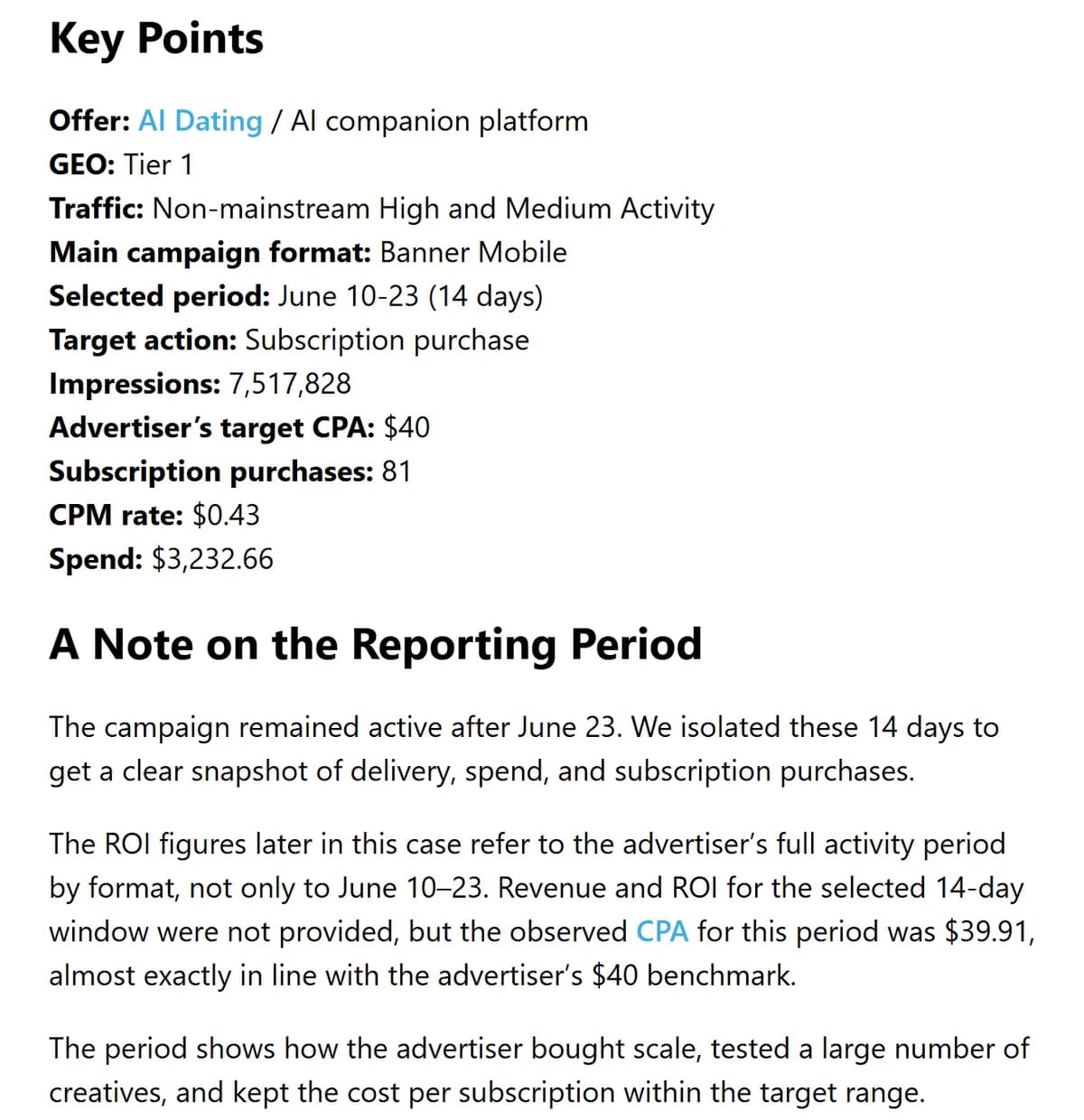
The key points, as the case lists them:
- offer: AI Dating / AI companion platform;
- GEO: Tier 1; traffic: Non-mainstream High and Medium Activity;
- main format: Banner Mobile, 300×100;
- period: June 10–23, 14 days;
- target action: subscription purchase, with the advertiser's target CPA at $40;
- result: 7,517,828 impressions, 81 subscription purchases, $0.43 CPM, $3,232.66 spend.
Our take: the publisher here is the traffic source, and the case sells that traffic. It carries 5 sign-up buttons with tracking tags, a "Minimum deposit $100" banner, and links to the network's "Buy traffic for AI tools" page, which claims a "107%" average ROI for AI tools advertisers. That's normal for a network blog and doesn't make the numbers false. It does mean nobody outside HilltopAds has checked them, and the advertiser can't be asked. Most case studies are selectively true; one written by the seller is selective by design.
The 14-day window: what the case admits up front
To its credit, the case says what's missing before you ask: "The campaign remained active after June 23. We isolated these 14 days to get a clear snapshot of delivery, spend, and subscription purchases." And: "Revenue and ROI for the selected 14-day window were not provided."
Our math: $3,232.66 / 81 = $39.91 per subscription. That's 5.8 subscriptions and $230.90 of spend a day, and 1 subscription per 92,813 impressions, or 10.8 per 1M impressions.
Our take: the CPA lands 9 cents under target in a window the network picked after the fact, from a campaign that kept running. Nothing says why these 14 days, what the CPA was before and after, or how long the advertiser had been buying. A window picked by the seller is a highlight until the full period is on the table.
Not shown: revenue, profit, the subscription price, and whether the 81 come from the network's postback stats or the advertiser's own reports.
The setup: mobile banners, 18+ channels, 1 view per 6 hours
The settings, in the case's words and screenshots:
- ad format Banner Mobile, pricing model CPM;
- traffic channels Non-Mainstream (18+) High Activity and Medium Activity;
- frequency capping: 1 display per 6 hours;
- Tier 1 GEO, no browser or OS restrictions, no day or hour schedule;
- Proxy: Disallow, WebView: Allow;
- Automatic Optimization off, weak creatives disabled by hand;
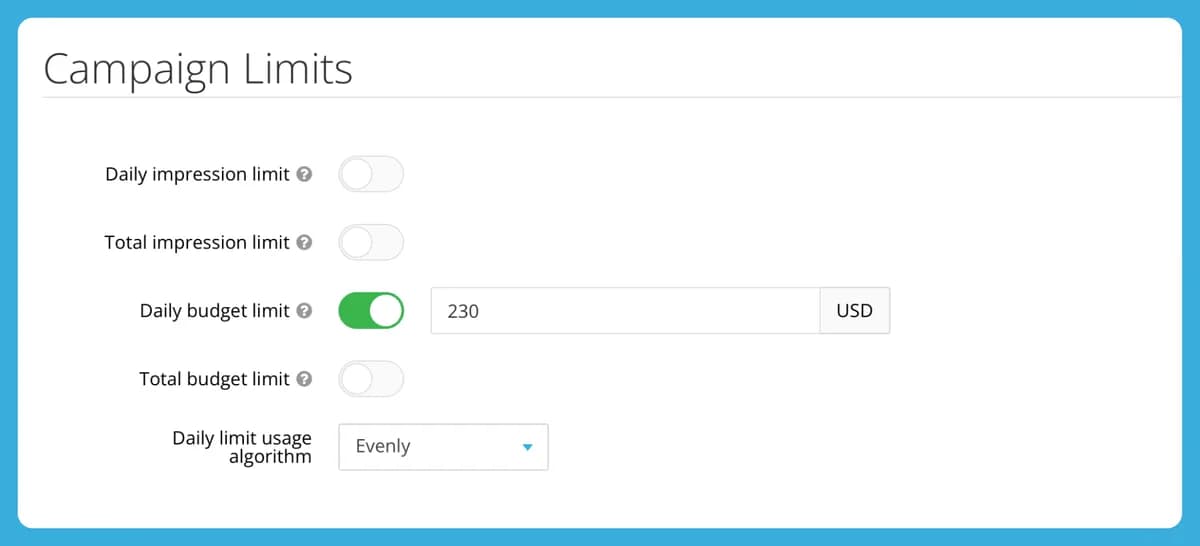
- CPM bid $0.43, daily budget limit $230, spent evenly.
"In other words, CPM was used to buy traffic, while CPA was used to evaluate the acquisition result."
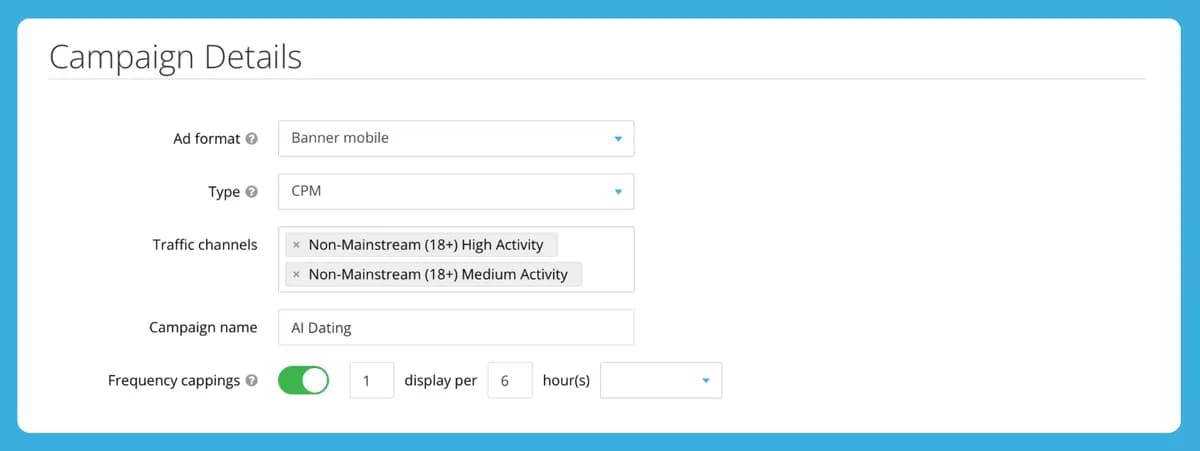
Our take: this is the strongest part of the case. Every switch is on screen, and anyone with an account can rebuild the campaign in minutes. Buying on CPM and judging on CPA is the right frame for a subscription product. Note what the screenshots are, though: the campaign creation form, ending in an "Add campaign" button. They document the settings, not the campaign's history.
1 display per 6 hours means up to 4 a day per user, 56 over 14 days. With about 300 banners in rotation that's tolerable; with 5 it would burn the audience fast, which is the case's own argument.
WebView left on means in-app inventory alongside mobile browsers. For a product that sells a paid subscription, I'd split in-app traffic into its own campaign and see whether those users ever reach the paywall.
Not shown: the lever media buyers pull first on a CPM network, placements. The case says the optimization happened at the creative level and never mentions cutting publisher zones or building a blacklist. Postback is "recommended" before launch, but the case doesn't say this advertiser used it.
"Tier 1" means 32 countries at 1 bid
The GEO screenshot shows the network's TIER1 preset: 32 countries, from the US, UK, Germany and Japan to Slovenia, Macao, Saudi Arabia and the UAE. The case names the United States, France and Canada as the strongest countries and adds: "No country had to be fully removed during the reported optimization period."
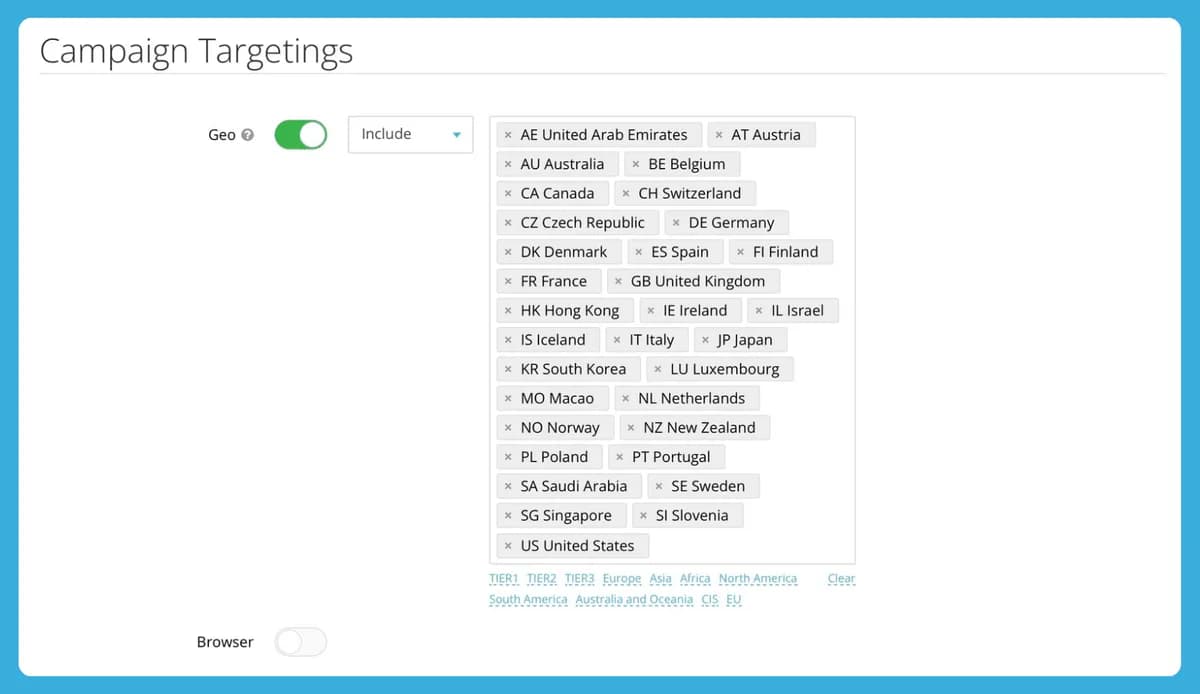
Our take: 1 bid of $0.43 for the US and Slovenia means overpaying in some countries and underbidding in others. With no spend or CPA by country, "strongest" is a claim, not a number. The first thing a media buyer would do is move the 3 winners into their own campaigns with their own bids and budgets. And an 18+ product shown in Saudi Arabia and the UAE, where pornography is illegal, is a compliance question the case never asks.
7.5M impressions is the budget, not the result
The headline number takes 1 division to explain.
Our math: the daily cap was $230. 14 days × $230 = $3,220, and the campaign spent $3,232.66, only $12.66 (0.4%) more, so the cap was hit every day. $230 at $0.43 per 1,000 buys 534,884 impressions a day, or 7.49M over 14 days. The 7,517,828 in the headline is the budget divided by the bid. Spend divided by impressions gives exactly $0.43: the campaign paid its bid on every impression.
The case's own estimator screenshot puts the available volume for this setup at about 6.7M impressions a day at bids of $0.43–$0.46. The campaign bought about 537K a day, 8% of that.
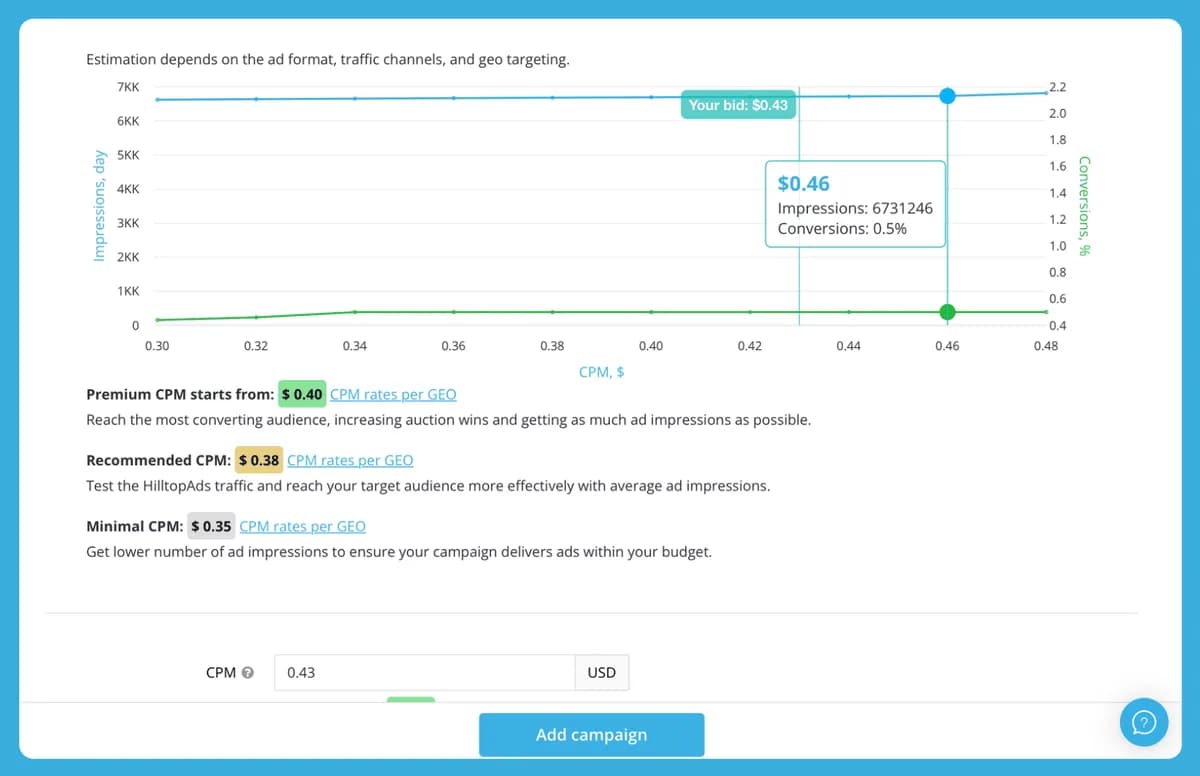
Our take: scale was never tested. The case shows this offer can buy $230 a day at its target CPA, not that it can buy $2,300. The estimator also shows the volume curve almost flat from $0.30 to $0.48, about 6.6M to 6.8M a day, with the $0.43 bid above the "Premium CPM starts from $0.40" tier.
If the same 7.5M impressions had cost $0.35, the "Minimal CPM," spend would have been $2,631 and, if the subscription rate held, the CPA $32.48. It wouldn't hold in full, because lower bids lose the better placements. But a bid test is the cheapest lever in the account, and the case doesn't mention one. Our max bid calculator works the ceiling backwards from your payout and conversion rate.
What a $39.91 subscription is worth
The case judges the result against a "$40 benchmark" and never says what a subscriber pays.
"Target CPA" can mean 2 things. If the advertiser owns the app, $40 is the price of a new subscriber, and profit depends on how long that subscriber keeps paying. If the advertiser is an affiliate on a $40 payout per subscription, 81 × $40 = $3,240 against $3,232.66 spent: $7.34 of profit, 0.2% ROI, a break-even fortnight. The case doesn't say which.
Our math: for a benchmark, take Candy.ai's public prices on October 3, 2026: $9.99 for the 1st month and $13.99 after it, $26.97 for 3 months, or $47.88 for 12 months. An annual subscriber covers a $40 CPA with the 1st charge, with $7.88 left before payment fees and the cost of generating images. A monthly subscriber covers it only with the 4th charge: 3 charges add up to $37.97, 4 to $51.96. Whether $39.91 is a win depends on the plan mix, the LTV and the churn the case doesn't show.
Not shown: everything between the banner and the payment: clicks, CTR, landing page visits, registrations, free messages, the paywall. Without them you can't tell whether a weak day was the banner, the landing page or the price.
300 creatives: the testing math doesn't add up
The creative pool is the core of the case: "Across the advertiser's active campaigns, around 300 creatives were used." Elm adds: "Realistic banners showed the best results," and later: "The biggest challenge was the volume of creatives. The volume and variety of the creative pool also had the strongest effect on the result." The method: the advertiser "removed the banners that failed to bring subscription purchases" and kept the stronger ones running.
The case shows 5 "realistic" approaches, a portrait, a lifestyle shot, a chat hook, an emotional angle and a "premium match," under the subtitle "Anonymized creative directions that performed well in testing."
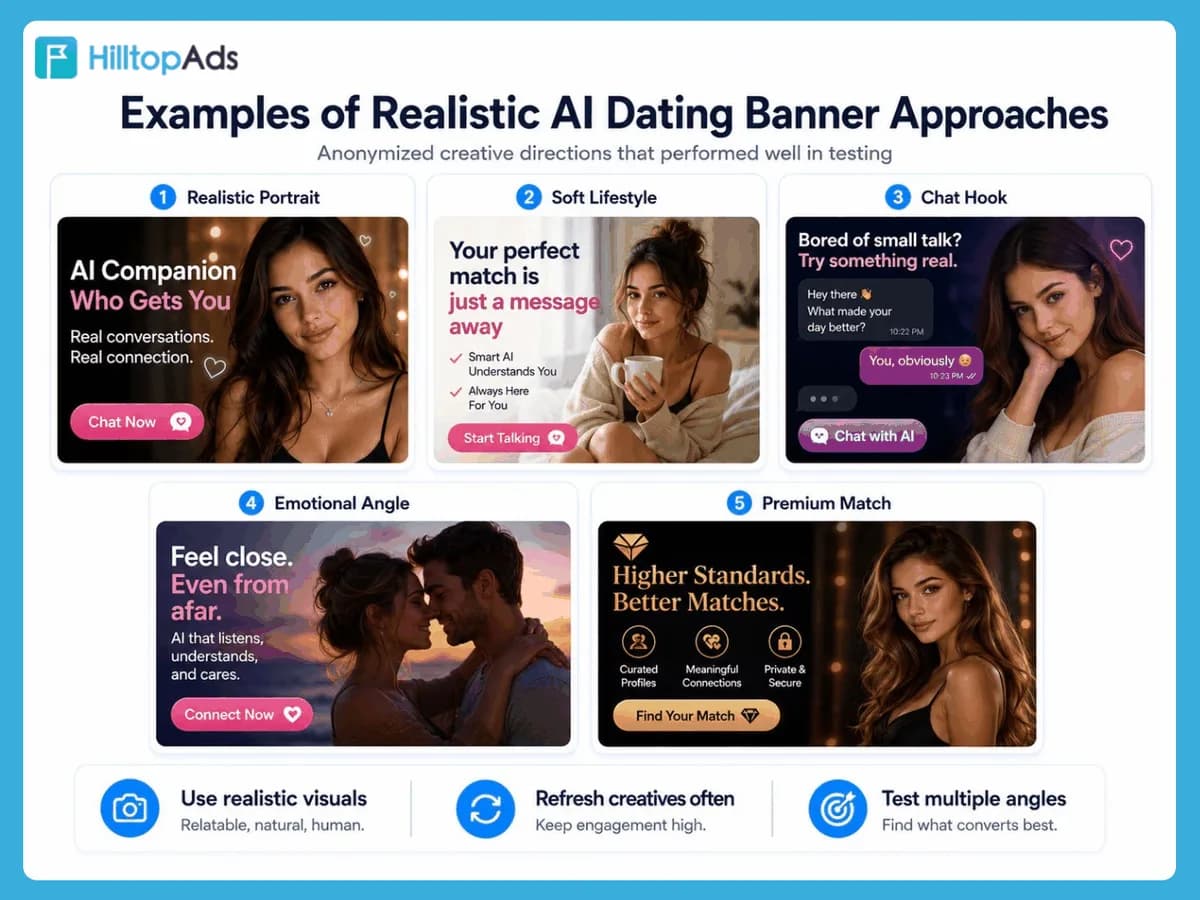
Not shown: any real banner. The 5 examples are illustrations, and none of them is 300×100: they're wide cards, while the format the case is about is a 3:1 strip. The case's "300×100 vs 300×250" picture uses a VPN banner and a web hosting banner. There's no CTR, CPA or impression count for any creative or any approach.
Our math: if all 300 banners had run in this window, each would have had about 25,059 impressions, $10.78 of spend and 0.27 expected subscriptions at the target CPA. At that depth, a banner converting exactly on target shows 0 subscriptions 76% of the time, so switching off banners with no subscriptions kills good and bad ones alike.
To judge a banner on the paid event, it needs spend in multiples of the CPA. An on-target banner shows 0 subscriptions after $40 of spend 37% of the time, and after $120, 5% of the time. 300 banners × $120 is $36,000, 11 times what this window spent.
Our take: either the advertiser judged banners on clicks or registrations, which the case doesn't say, or the culling ran mostly on noise. The method that works is layered: cut on CTR and cost per registration first, judge subscriptions only on a short list, then make variations of the winners. Our creative testing framework lays it out step by step.
"Realistic" is also the word that gets AI companion ads pulled elsewhere. Meta's ad standards say ads "must not contain imagery depicting nudity, sexual activity, depictions of people in explicit or sexually suggestive positions." On September 16, 2026, the UK's Advertising Standards Authority ruled against a paid Meta ad for the AI companion app tyan.ai, finding it "portrayed the woman as a submissive and compliant sexual object created for the viewer's gratification." Adult networks are where these banners can still run, which is why this case exists at all.
The format "ROI" that can't be ROI
Beyond the 14 days, the case compares formats over "the advertiser's full activity period," from "the advertiser's internal reporting": Banner Mobile +42%, Banner Desktop +39%, Video VAST Desktop +17%, Video VAST Mobile -24%, Popunder -123%, Popunder Mobile -655%. It adds a fair caveat: "We do not have the exact ROI formula or the revenue period behind them, so it is safer to use the figures only to compare formats."
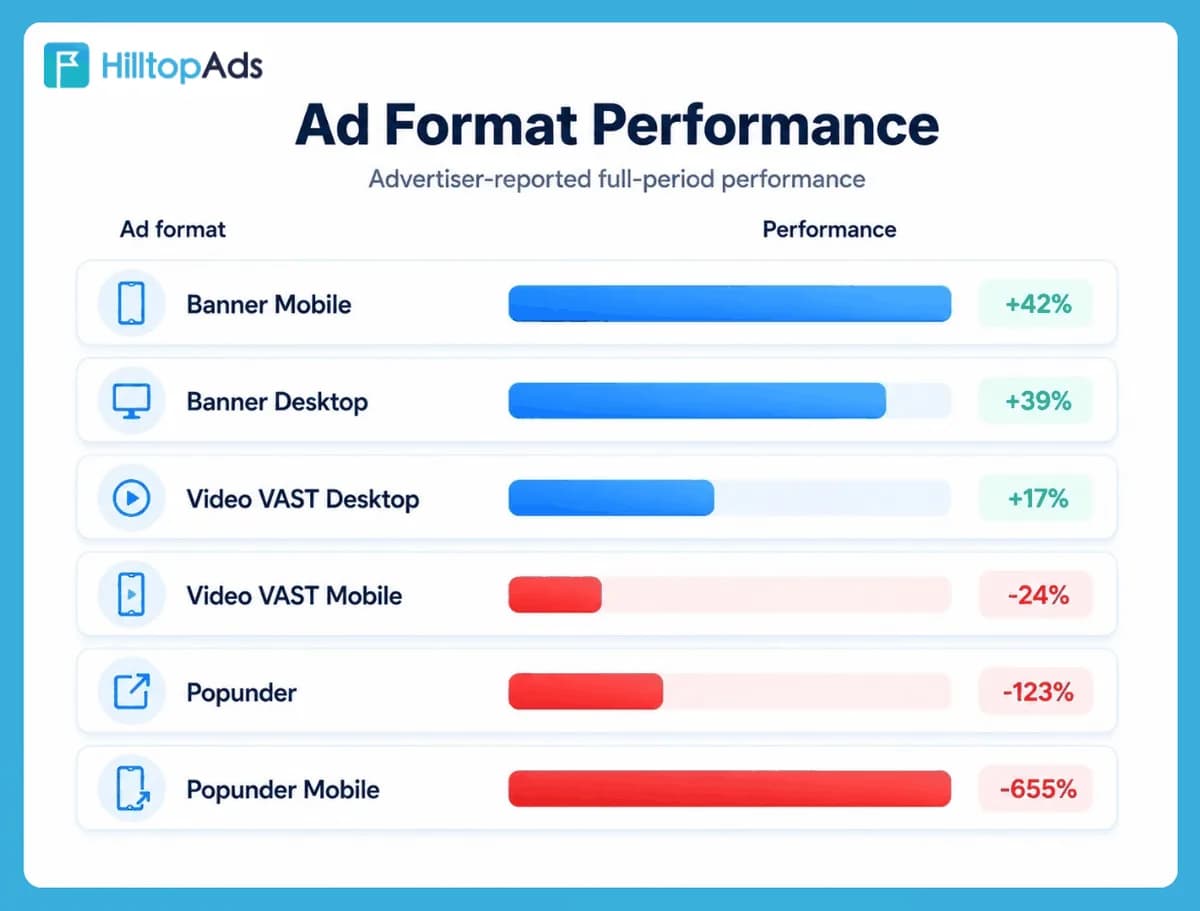
Our math: ROI is profit divided by spend, and it can't go below -100%: with 0 revenue you lose what you spent and no more. So -123% and -655% are some other metric. 1 formula that produces such numbers is margin, profit divided by revenue. Read that way, -655% means spend was 7.55 times revenue, an ROI of -87%; -123% is an ROI of -55%; Banner Mobile's +42% is +72%, and Banner Desktop's +39% is +64%. The bars don't follow the values either: -655% and +42% are drawn the same length.
Our take: I'll give the network credit here. The post reports that popunder lost money for this offer, while the 2 older dating cases linked near the end of the same post sell popunder mobile at 183% and 102.41% ROI. That fits the product. A subscription sold by a character's face needs the face before the click, and a banner shows it, while a popunder opens a page the user never asked for. The older cases were classic adult dating offers, a different funnel. Still, a chart of advertiser-reported figures with an unknown formula, redrawn by the seller, gives a direction, not data.
What the results "screenshot" is
The results section closes with a card: "14-Day Campaign Results," 7.5M impressions, 81 subscriptions, $3,232.66 spend, $39.91 observed CPA, and the line "Strong performance. Scalable testing."
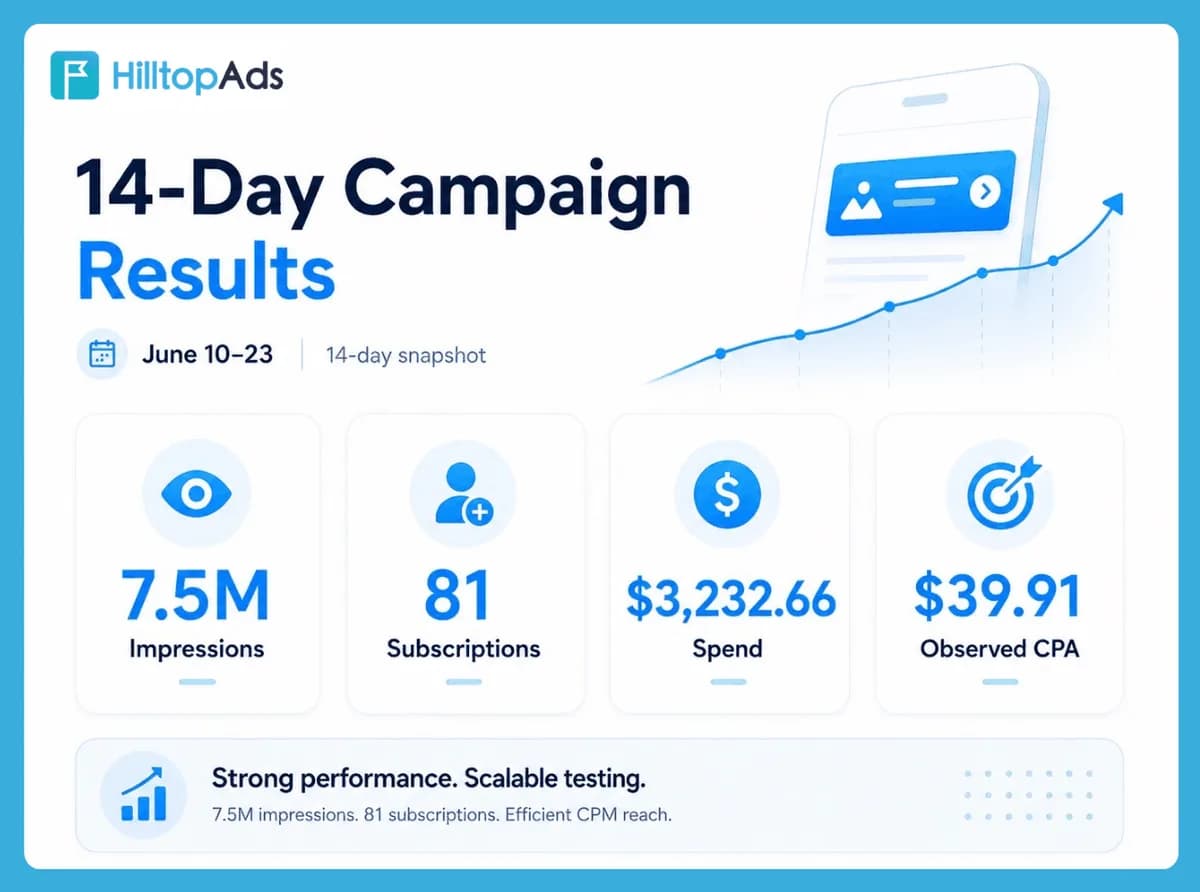
Our take: that's a designed infographic, not the statistics page. The network owns the platform, so a screenshot of the campaign's stats with dates and a conversions column would cost it nothing and would prove the 81. It isn't there.
Elm's advice: a $10,000 test budget
"Launch unique creatives and try different ad formats. Prepare enough budget for a proper test. For this vertical, around $10,000 gives the campaign more room to test." The case adds that this "is not a required platform minimum."
Our take: the direction is right: AI dating doesn't test on 5 banners and $200. But the number comes from the person selling the impressions, and it's 100 times the $100 minimum deposit and 3 times what this case spent in its 14 days. At $40 a subscription, $10,000 buys 250 subscriptions: enough to compare 2 or 3 formats and 10–12 concepts, not 300 banners. Spend it in layers, and keep your own tracker data from the first impression.
Fact-check: what the author showed and what they hid
We rate every case on 10 points: what an outsider needs to judge the result and repeat it. For an ad network case, the consumables point becomes the cost of everything besides media: creatives, tracking and landing pages.
- Setup: period, GEO, offer, model — Partial. Dates, the Tier-1 list, format, CPM buying and the $40 target are given. The app, its subscription price and the payout model are not.
- Author and independence — Partial. Published openly by HilltopAds, the network that sold the traffic, with 5 sign-up buttons. The advertiser is anonymous, and the bizdev manager appears by first name only.
- Finances — Partial. Spend, impressions, subscriptions and CPA reconcile to the cent. Revenue, profit and ROI for the window were "not provided," and the format figures use an unknown formula with values ROI can't take.
- Proof — Partial. Real screenshots of the settings form and the traffic estimator. The results come as a designed infographic: no stats page, conversions column or postback log.
- Source and targeting — Showed. Format, channels, frequency cap, the 32-country list, filters, bid, daily cap and schedule are all on screen. Missing: spend and CPA by country, and any placement cuts.
- Tools — Hid. No tracker named, postback only "recommended," nothing on how about 300 banners were made.
- Creatives — Partial. 5 approaches described. The images are illustrations in the wrong shape for 300×100, with no CTR or CPA for any banner.
- Landing pages and funnel — Hid. No landing page, no prelander, no registration or paywall step, no plan prices.
- Costs beyond media — Hid. The cost of producing about 300 banners, tracking and landing pages isn't mentioned.
- Repeatability today — Partial. The settings can be copied in minutes. The offer, banners and funnel can't, the window was picked by the seller, and spend above $230 a day was never tested.
Score: 2/5. The setup is shown in full and the numbers reconcile, which is more than many cases offer, and the case is candid about what it doesn't have. But the money stops at CPA, the proof of the result is an infographic, the creatives are illustrations, the format chart can't be read as ROI, and the story is told by the seller of the traffic about a window it picked. The mechanics are visible; the money, the proof and the repeatability are not. On our scale, that's a 2.
Checklist: what to do
Questions and answers
Is HilltopAds good for AI dating offers?
This case shows 1 AI companion app buying Tier-1 mobile banners on HilltopAds at $39.91 per subscription for 14 days on a $230 daily budget. It doesn't show revenue, spend beyond that budget or anything outside the network's own reporting, so treat it as a setup to test, not proof of profit.
What CPA is realistic for AI dating subscriptions?
This case reports $39.91 per subscription on Tier-1 banner traffic. Whether that pays depends on the plan: at Candy.ai's public prices, an annual subscriber ($47.88) covers $40 at once, while a monthly subscriber needs 4 charges to cover it.
Mobile banner or popunder for AI companion offers?
In this advertiser's reporting, banners beat popunder by a wide margin, which fits the product: the banner shows the character before the click. The figures use an unknown formula, so test both formats on your own offer before you decide.
How many creatives do you need to test an AI dating offer?
Far fewer than 300 on a $10,000 budget. At a $40 CPA that budget buys about 250 subscriptions. Screen concepts on clicks and registrations first, then give a short list of finalists at least 3 times the target CPA each.
Can ROI be lower than -100%?
No. ROI is profit divided by spend, and with 0 revenue you lose 100% of the spend. A figure like -655% is another metric, often profit divided by revenue, and it needs the formula next to it.
Author’s conclusion
The case is more honest than most network blog posts: it says revenue wasn't provided, warns that the format figures aren't final ROI, and admits that popunder lost money. It is also exactly what it looks like: a sales page from the network that sold the traffic, built around a 14-day window it picked, a headline number that is the budget divided by the bid, banners that are illustrations and a results card instead of a stats page. The useful part is the setup and 1 direction: for a product sold by a character's face, banners beat popunder.
My advice: copy the settings, not the conclusion. Get the subscription price and plan mix before you accept any target CPA, split the top countries, pass the zone ID through postback, test the bid as well as the banners, and judge creatives on clicks and registrations before you judge them on subscriptions. Start with a budget you can read, not the $10,000 the seller suggests, and scale only what your own tracker shows paying.
Lu Discover, Editor-in-chief
Our verdict on this case
The setup is shown in full and the numbers reconcile, which is more than many cases offer, and the case is candid about what it doesn't have. But the money stops at CPA, the proof of the result is an infographic, the creatives are illustrations, the format chart can't be read as ROI, and the story is told by the seller of the traffic about a window it picked. The mechanics are visible; the money, the proof and the repeatability are not. On our scale, that's a 2.
Our fact-check of the public case: what the numbers show, what is missing. Scores are never for sale.
Sources for this article
- hilltopads.com — Elm, HilltopAds: 7.5M Impressions and 300 Creatives: Inside a Tier 1 AI Dating Campaign, the case (August 10, 2026)
- hilltopads.com — Elm, HilltopAds: the same case, Russian version (August 10, 2026)
- hilltopads.com — HilltopAds: Running the Dating offer at HilltopAds: ROI 102.41%, popunder mobile in Canada (March 12, 2024)
- hilltopads.com — HilltopAds: Achieve 183% ROI using HilltopAds Popunder traffic for Non-Mainstream Dating Offers (June 28, 2024)
- hilltopads.com — HilltopAds: Buy traffic for AI tools, with the 107% average ROI claim
- candy.ai — Choose your plan: 1, 3 and 12-month prices (checked October 3, 2026)
- asa.org.uk — ASA Ruling on Animcha Ltd t/a tyan.ai (September 16, 2026)
- transparency.meta.com — Meta Advertising Standards: Adult Nudity and Sexual Activity
Companies in this article
- HilltopAdsTraffic sourceNot rated yet
Related stories
 Analysis
Full-Cycle Ad Platforms: Not a Pyramid, a Referee Who Also Plays
 Top list
Popunder Ad Networks for Affiliates: 15 Sources to Test
 Case fact-check
Comments
0 commentsNo comments yet.
Add a comment