
Creative Testing for Affiliates: A Broad-to-Narrow Framework That Saves Budget


Contents 9
You can have tight targeting, a big budget and a great offer, and still burn money if the creative doesn't land. Every media buyer has watched a "genius" concept flatline while a scrappy meme ad prints for a competitor. Creative testing is where the real work starts.
Too many affiliates treat it like a lottery: throw ideas at the wall, see what sticks, call it strategy. There's a method to it: find winning concepts systematically, kill losers fast and scale winners until they're spent.
Why creative testing feels like a shot in the dark
The core problem is cash flow. You can't know what works without testing, and testing everything drains the budget on duds. That leads to two classic failures:
- spending thousands on ten concepts that were doomed from the start;
- skipping an unconventional idea that would have been your best campaign.
The goal isn't to test more; it's to test smarter, which means screening ideas before they ever touch your ad account.
Pre-screen concepts before spending a dime
Before you open a design tool or brief a designer, filter your ideas on paper. Only the strongest should get budget.
Study what already runs. Use spy tools to see what direct competitors are running, and look for longevity, not just inspiration. If a competitor has run the same angle for months, that's a strong signal: nobody keeps paying for a loser.
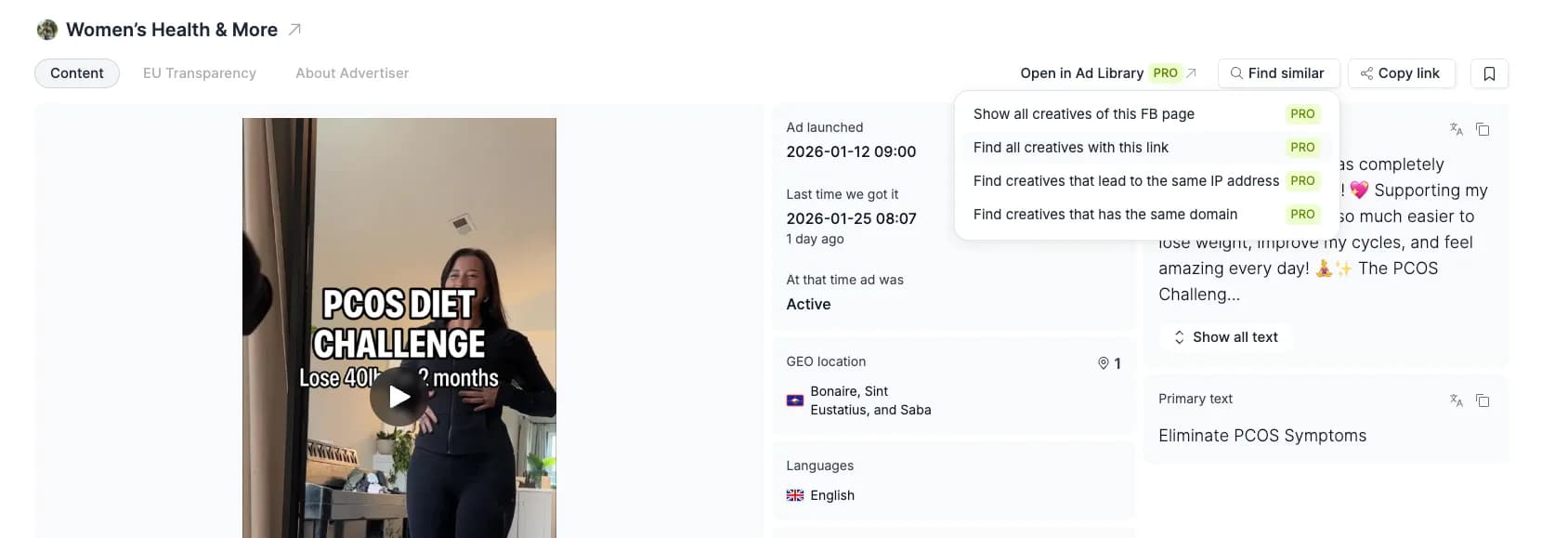
Tools worth knowing:
- Meta Ad Library: free and official, for ads on Facebook, Instagram and the rest of Meta's network.
- AdPlexity: covers social, pop, native and push advertising.
- Adligator, Tyver and Adheart: focused on Facebook ads, with trials or a few free searches a day and paid plans for heavy use.
Segment the audience. "Everyone" isn't an audience. Are you targeting 25-year-old men into sports betting, or 45-year-old women looking for skincare? Each group has its own language, triggers and pain points, and each concept must speak to one of them.
Run concepts as organic posts first. Post them on a relevant page or in a group. If an image or video gets no engagement for free, paying to promote it rarely makes it a winner. Likes, shares and comments are your green light.
The framework: test in layers
Once you have pre-screened concepts, test one major variable at a time. Forget button colors; look for big wins first.
1. Test big concepts. Start with your core hypotheses: a problem-solution angle against a testimonial angle against a humor angle. Set up a campaign with Campaign Budget Optimization (CBO) and put each concept in its own ad set. Let Meta's algorithm allocate the budget. The concept that attracts spend and delivers results is your first winner.
2. Isolate the winning element. In a new campaign, test variations of the winner: same angle, different hooks in the first three seconds of the video, different primary images. Product shot or person using the product? This is where incremental gains live.
3. Refine copy and CTA. With a winning visual and angle, test headlines, body copy and the call to action. Does "Learn more" beat "Shop now"? This is the last layer.
This order stops you from spending money on button colors for a concept that was never going to work.
Scaling the winner
Finding a winner is half the battle. Scaling it without burning it out is the other half.
- Don't jump the budget tenfold on the existing ad set: it can unsettle the algorithm and reset the learning phase.
- Duplicate the winning ad set into a new CBO campaign, and launch the winning post ID into new ad sets for related audiences.
- Make variations. If a video wins, cut five similar versions with a different hook or music. Fresh versions delay ad fatigue and extend the campaign's life.
Reading your results
Real creative analysis is pattern hunting. Line up your winners and ask what they share:
- the emotional trigger: fear, relief, curiosity, excitement;
- the format: video, image, carousel;
- the first three seconds: what stops the scroll.
CTR is only the start. The question is what made someone click and then convert, and the answer becomes your next set of hypotheses.
Testing never stops
Your winning ad will be tired next month. Markets shift, trends move on, audiences get bored. A disciplined process turns creative testing from gambling into a routine: always one concept being scaled, one being refined and a few being screened.
Checklist: what to do
Questions and answers
What is the most effective creative testing method?
Broad to narrow. Test completely different concepts first (for example user-generated content against a polished studio ad). Once a concept wins, test smaller elements inside it: hooks, visuals, headlines, the CTA. You end up optimizing something that already has potential.
How does creative analysis actually work?
Look for patterns across your winners: the emotional trigger (fear or excitement), the format (video or image), the first three seconds. Don't stop at CTR; ask why someone clicked and converted, then build new hypotheses from that.
Which spy tools help with creative research?
The Meta Ad Library is free and official. Paid tools such as AdPlexity, Adligator, Tyver and Adheart add filters, history and coverage of other networks; several offer a few free searches a day. Look for ads that have run for a long time: advertisers don't keep paying for losers.
What is a creative strategy in advertising?
Your plan for what you say and how you say it: the audience, their core problem, the angle and the format. A good strategy keeps all ads consistent and pointed at the same business goal.
How do I scale a winning creative without killing it?
Don't multiply the budget of the existing ad set; that can reset learning. Duplicate the winning ad set into a new CBO campaign, reuse the post ID in related audiences, and launch variations with different hooks or music to delay fatigue.
Author’s conclusion
Creative testing feels like a lottery when you test random ideas and a system when you test in layers. Pre-screen on paper and with organic posts, test concepts before details, then scale the winner through duplication and variations.
My advice: never stop the loop. Today's winner will be tired next month, so the best time to test the next concept is while the current one still pays.
Lu Discover, Editor-in-chief
Sources for this article
- aliencpa.com — Original guide (February 2026), rewritten
- facebook.com — Meta Ad Library (free)
Related stories
 Guide
GuideHow Much Budget Do You Need to Test an Offer? What $100 Can and Can't Tell You
 Analysis
Why Most Affiliates Never Scale Past $10K a Month: The Ceiling Is Cash, Caps and Accounts, Not Talent
 Guide
Guide
Comments
0 commentsNo comments yet.
Add a comment