
Is an Affiliate Network Legit? Check Before You Waste Money Driving Traffic

Independent and reader-supported. Some links here are affiliate links: if you sign up through them, we may earn a commission at no cost to you. It never changes our scores or verdicts. Affiliate disclosure
Contents 9
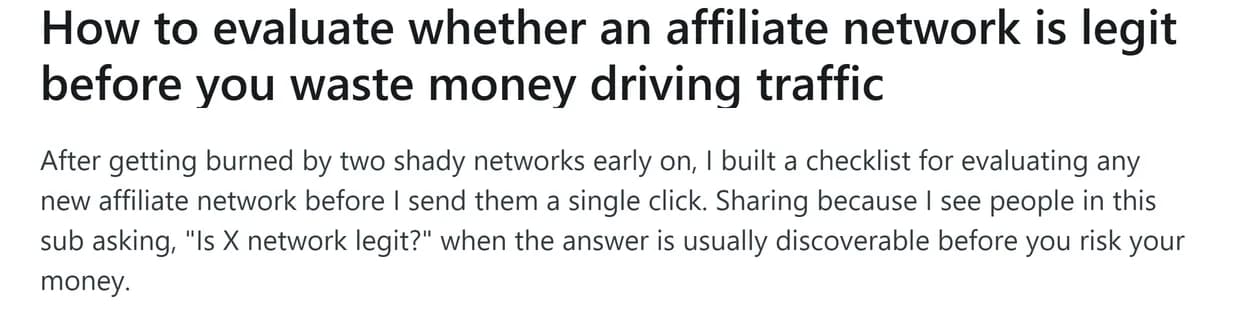
"How to evaluate whether an affiliate network is legit before you waste money driving traffic." That's the title of a September 29 post in r/Affiliatemarketing, and the most honest phrasing of this question I know. Checking a program before your first dollar is the sacred problem of the whole trade, and after 10 years in it I still can't answer it with a guarantee.
Nobody can. A freelance client can refuse to pay, an employer can fire you, and people who don't pay exist in every business. The difference with an affiliate network is that it's at its best while you test it: programs have learned to mimic the good, loyal and honest ones.
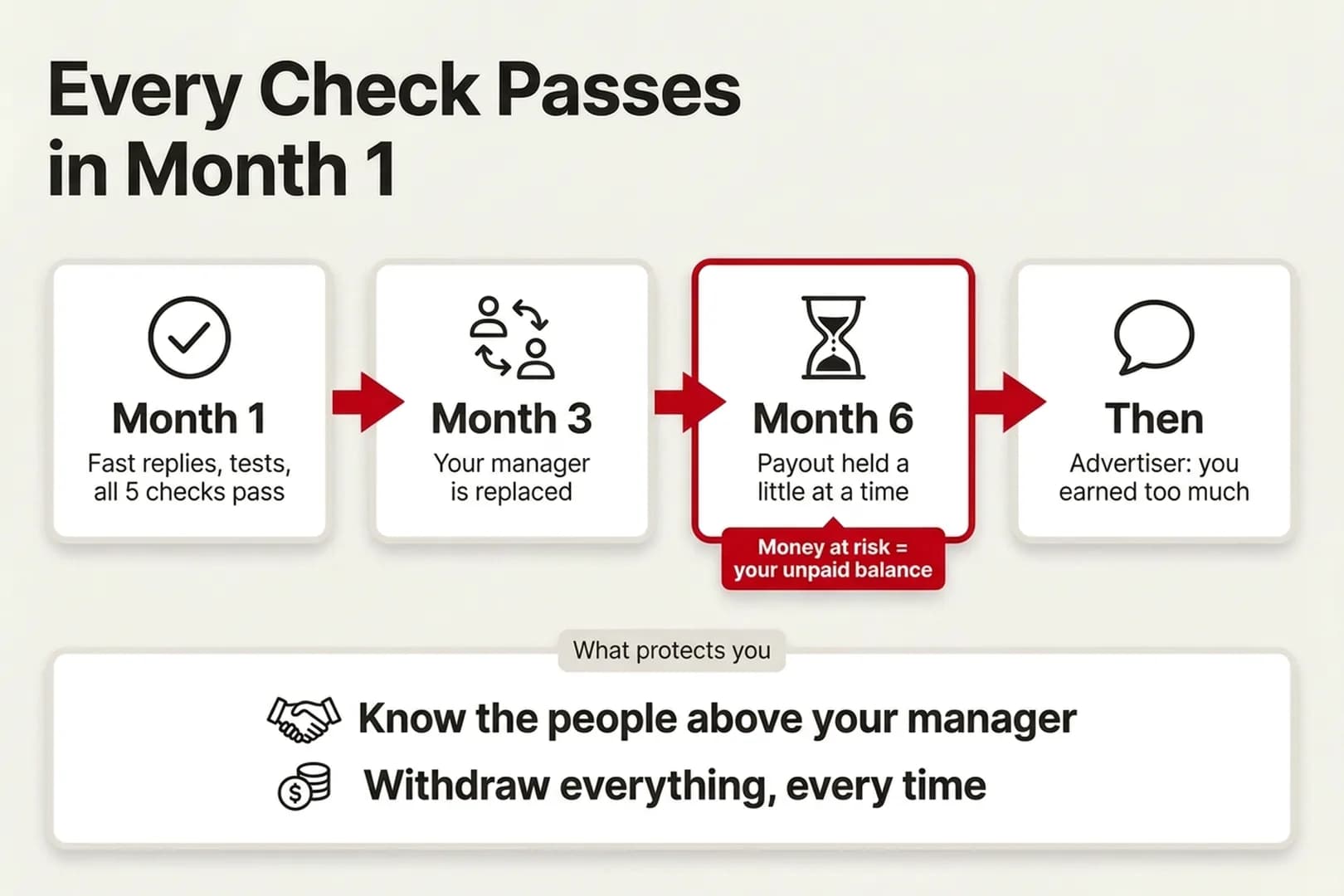
So the frame comes before the checklist. You can check how a network behaves today and what the terms you sign already allow. What protects a media buyer later is people you know above the manager and a balance kept close to zero. Below: what the popular checks really test, why programs pass them in month 1, what the terms say, and the 2 habits that help.
The Reddit checklist: 5 steps that test the network today
Its author paid for the checklist before writing it, with 2 networks that burned them early on:
The 5 steps are sensible, and I'd run every one. Here's what each asks and what it really tests:
- 1. Reputation — Read reviews past page 1: "Five complaints from different people is a pattern". The network's past with others
- 2. Support — Email the affiliate manager before signup; over 48 hours to reply is a bad sign. The sales side
- 3. Payment terms — Prefer Net-30 and $50–$100 thresholds. Promises about your money
- 4. Test campaign — Send $50–$100 and compare the network's clicks with your own tracking. The click counter
- 5. Offer quality — Offers from "real, recognizable advertisers". Who stands behind the offers
All 5 tests describe the network up to today, and mostly while you're new and worth courting. A manager who answers a prospect within 24 hours proves the sales team works, not the finance team. The post ends on exactly that failure: the networks that burned the author "were responsive until I sent traffic, then went silent when payment was due."
The test campaign has the same blind spot: comparing clicks with a real tracker catches a crude counter, but clicks are the cheapest thing to count honestly. The money sits in your approval rate and in who decides what counts as a valid conversion, which is where shaving lives, and a $50 test rarely produces enough conversions to judge either.
"Better to lose $50 than $500," the post concludes. But the test caps only the loss of the test: by month 6, the money at risk is whatever the network owes you, and no $50 campaign measures that.
Why an affiliate network passes every check in month 1
What happens by month 6 usually isn't a plan. Nobody builds an affiliate program intending to stiff affiliates, since everybody wants to make money, but not every program gets out of a crisis fairly. Two patterns show how that looks from your side.
The first is typical. Month 1 goes to tests of the offer, the tech and the links, while the manager answers almost instantly, sends tips and examples, shares creatives and practically works for you day and night. Then, 3 months in, the program lets that manager go for its own reasons, and a newcomer takes over.
The newcomer can't evaluate your traffic, so payouts get squeezed and stretched, the newcomer goes missing, and normal communication fades. That's the mild version: the problem is a person, and asking for a different manager sometimes fixes it.
The second is closer to my own reality. My media buying team ran traffic to a program for 6 months, and the traffic suited everyone: the network, the advertiser, us. In month 6 the network didn't refuse our payout; it started holding it back a little at a time, asking us to wait, moving the dates, reminding us it was the holidays. Then the advertiser said we had earned too much and they wouldn't pay that much, and that was it.
Notice the order: first a hold that grows by small steps, then the reason. Nothing in month 1 could have shown it, because in month 1 we hadn't earned enough to be a problem.
And every program's rules allow that outcome. You'd expect a right to refuse payment only from programs running grey offers or black ones. White networks write it too, as a line about disputed situations, worded so you can't argue with it legally. Does that make every program a place to avoid? No. It makes the terms the place to look.
Affiliate network payment terms: 7 networks, one right to withhold
We read the publisher terms of 7 networks, from big retail platforms to CPA networks: ClickBank, MaxBounty, CPAlead, Awin, impact.com, Admitad and MyLead. Every one reserves the right to withhold, reverse or forfeit commissions, and ClickBank's Client Contract says it most bluntly:
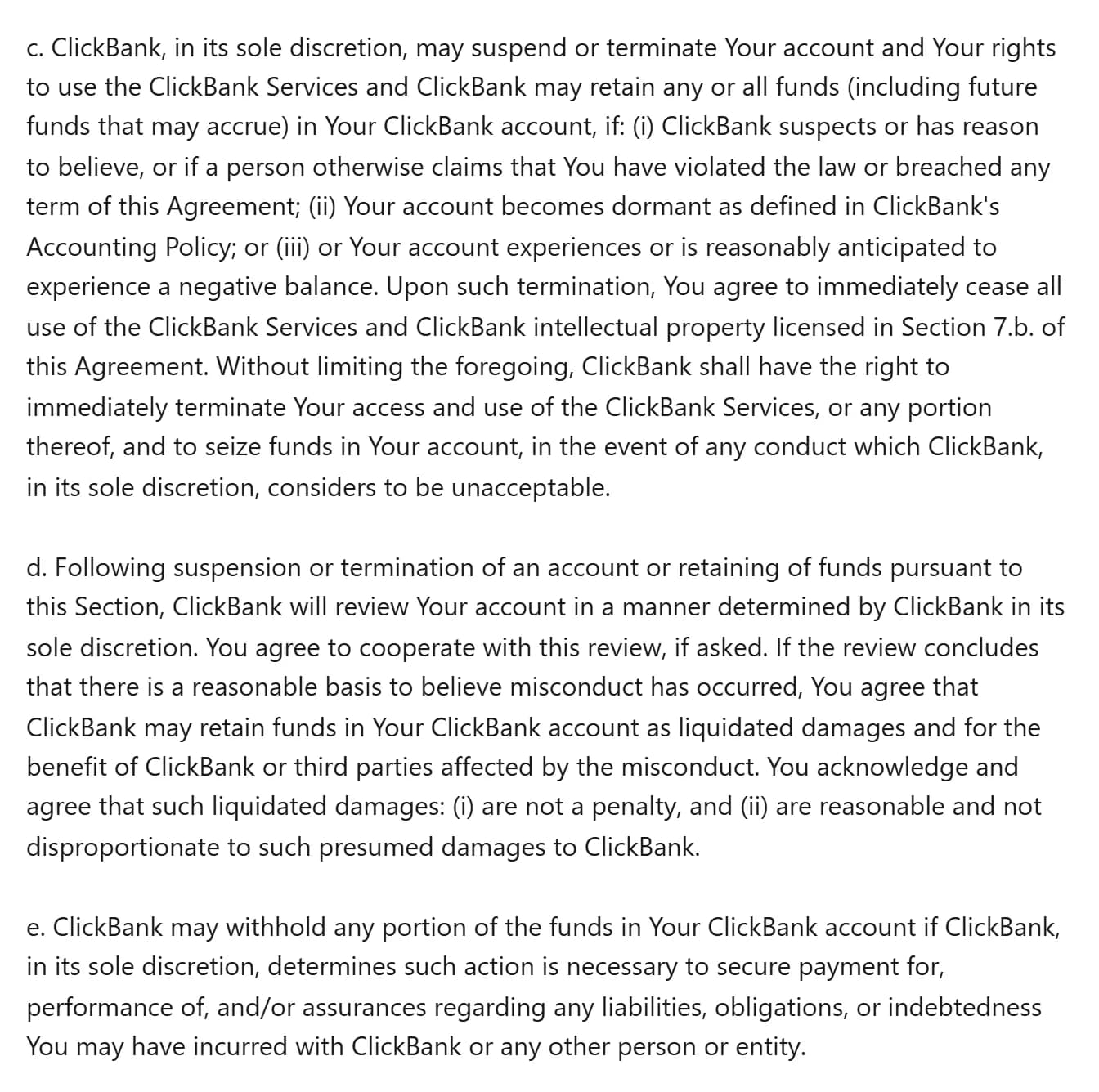
Read the trigger, not just the penalty: ClickBank can retain funds if it "suspects or has reason to believe," or if "a person otherwise claims," that you broke a term. MaxBounty's reversals "may be applied at any time, including for Actions during a period where payment has already been issued." At CPAlead, suspicion means "You will forfeit all Commissions, pending further investigation," and you get "seven (7) days" to prove otherwise.
My problem is the wording, not the companies. Networks write these lines because fraud is real, but "sole discretion" puts the accusation, the evidence and the verdict on one side of the table. These are standard clauses, and that's the point: you've already accepted them everywhere you work.
The structure matters more than any clause. At 6 of the 7, a commission is payable only after the advertiser pays the network, or in MaxBounty's words, "only after MaxBounty receives full payment from the Advertiser." If the advertiser doesn't pay and MaxBounty elects not to either, your recourse under its 7.3 is "to make a claim against the relevant Advertiser(s)."
Read that with my month-6 story in mind: your payout depends on a company you never signed with. Here are the 7 side by side, from their own pages at the time of writing:
- ClickBank. Payout schedule: Every 2 weeks; weekly with direct deposit. Minimum: From $50, default $100; $5 per payment. What the terms let them do: Retain "any or all funds" on suspicion; 12-week reserve on part of revenue.
- MaxBounty. Payout schedule: About 15 days after month end, then weekly at its discretion. Minimum: $100. What the terms let them do: Reverse actions even after payment.
- CPAlead. Payout schedule: About 30 days after month end. Minimum: $50. What the terms let them do: Forfeit commissions on suspicion; 7 days to prove otherwise.
- Awin. Payout schedule: 1st and 15th of the month. Minimum: Set "from time to time". What the terms let them do: Withhold until conditions are met; no payments during a suspension.
- impact.com. Payout schedule: Per brand contract. Minimum: Varies by method. What the terms let them do: Seek return of paid commissions, even after termination.
- Admitad. Payout schedule: Within 45 business days of a request. Minimum: Per currency. What the terms let them do: Withdrawal limits; write-off after 9 idle months.
- MyLead. Payout schedule: Within 14 working days of a request. Minimum: 100 euros. What the terms let them do: Block and withhold; 7 days to return funds for rejected leads.
Some lines run the other way, like MyLead's: on termination, "the Publisher has the right to withdraw all accumulated funds." Terms tell you what a network may do. Who the network is takes other checks, and several are free.
Free checks: what a registry, Wayback and an exhibitor list prove
Start with the legal entity, because that's who holds your money. Awin's terms print its company number, 04010229, and the UK's Companies House shows the record for free, with no login:
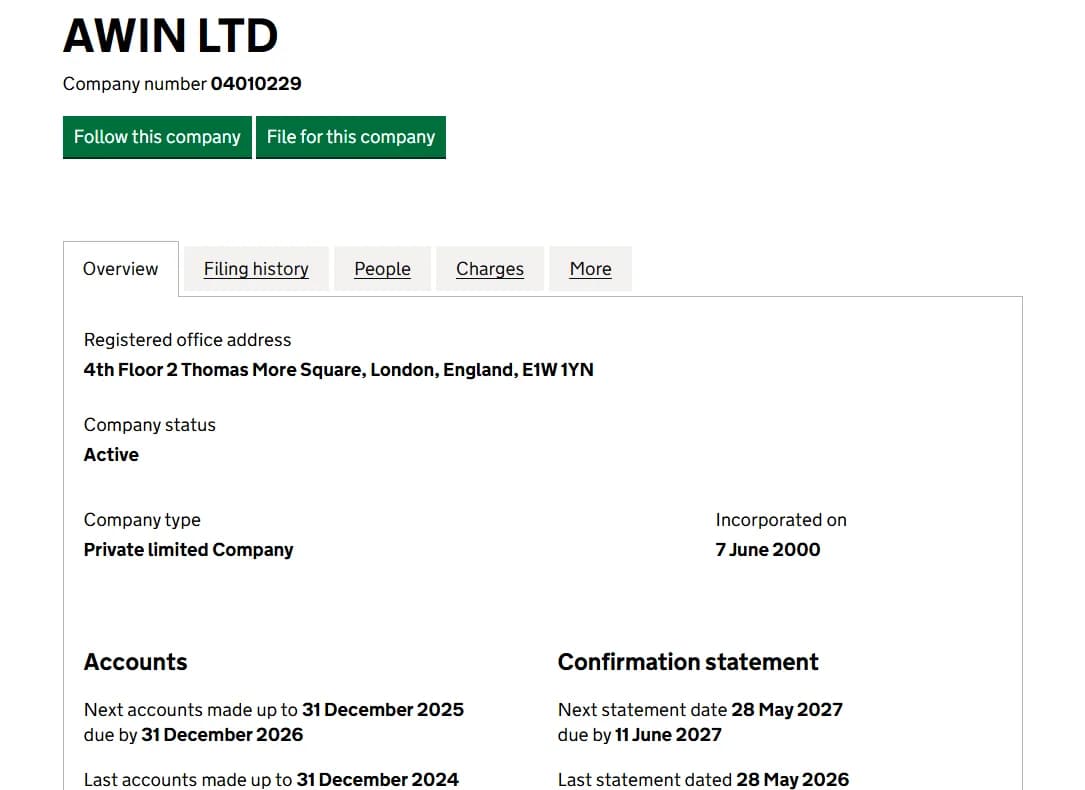
The company is active, was incorporated on June 7, 2000 as Affiliate Window Limited and has been renamed twice since: brand names change, company numbers don't. What a registry can't prove is payment. Every page says "Companies House does not check the accuracy of the information filed," and an active company can still stop paying.
The Wayback Machine shows the minimum age of a web presence, with a caveat: domain age is not company age. Its first capture of awin.com is dated April 29, 1999, more than a year before the company was incorporated, and the archive can't say who owned the domain then. Snapshots of a terms page also show whether payout conditions changed, and when.
Together, the 2 records show that a brand and its legal entity aren't always the same age. The first capture of mylead.global is dated November 20, 2018, while MYLEAD LTD, the UK entity in MyLead's terms, was incorporated on July 4, 2023 as a holding company. Groups restructure, which is normal; you just want to know which company holds your balance.
Published payout terms are a real criterion too, and all 7 networks above publish theirs without a login. That proves a network is willing to be read, not that the text is friendly.
The last check is the Reddit post's own red flag: "No presence at affiliate industry events or in affiliate communities." Affiliate World Asia, in Bangkok on December 9–10, 2026, lists its exhibitors with filters by company type, from Affiliate Network to Direct Advertiser:
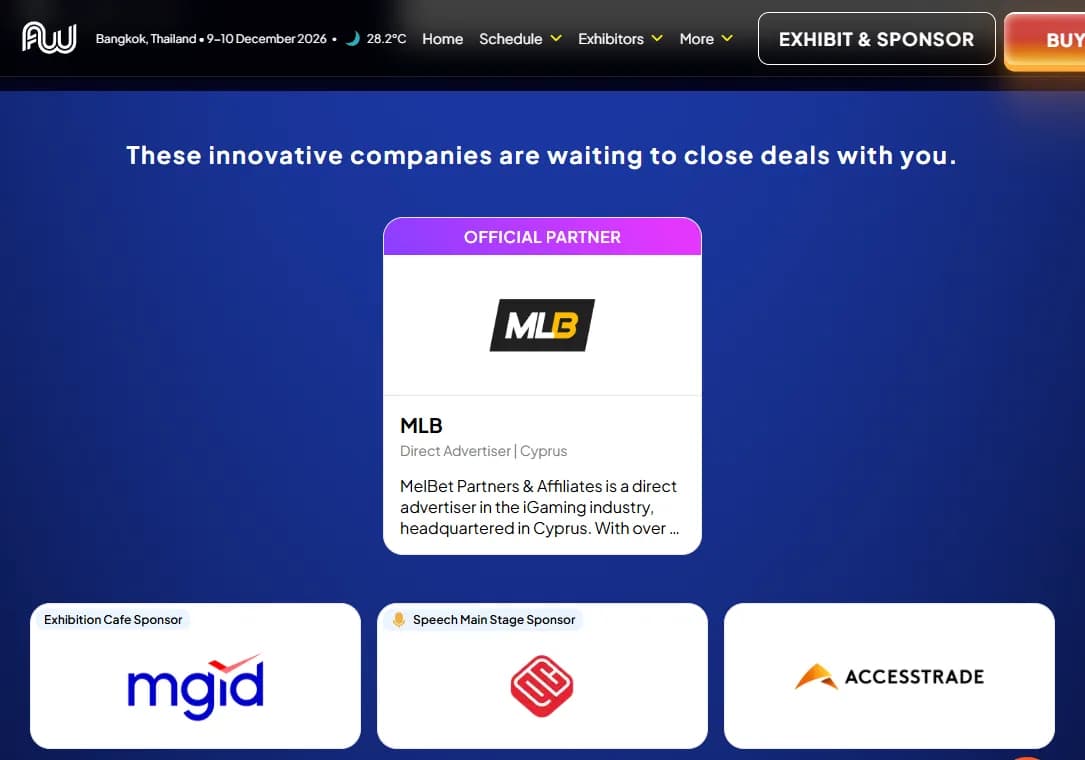
A stand proves a company paid for a booth and will have people in a room on known dates, not that it pays. What it does give you is a list of people to meet, and that's where real protection starts.
What protects you: people above the manager and an empty balance
None of these checks would have saved my team's month-6 payout. In my experience, 2 things can protect you, though neither guarantees anything.
Know the people, not the signup form. Go to conferences and meet the program: not only its managers, but the head, the owner and the advertisers, who often come too. Work with them like clients you have a deal with, built in person rather than through a registration form. In a dispute, that usually means better odds of getting your payout, or at least part of it.
In practice, filter the exhibitor list for networks you run or plan to scale. Ask your manager to set up meetings with whoever runs the affiliate side and with the advertiser behind your main offer. Afterward, email a summary of what you agreed: payout, hold, what counts as valid, who to write to if a payment slips. That also covers the first pattern: when a manager is replaced, the relationship doesn't leave with them.
The price: tickets, travel, days away from campaigns and meetings that lead nowhere. A personal contact strengthens your position in a dispute; it doesn't turn a bad program into a good one.
Keep the balance empty. Don't hold large sums in a network: withdraw whatever you've earned, every time you can, because while money sits there, it doesn't belong to you. Nobody mentions this at signup, and then forums fill with people whose program closed and whose balance froze after they'd spent their own money on traffic.
"Not yours" is literal even without a closure. ClickBank charges dormant accounts from $1 per pay period after 90 days without earnings to $50 after 365 days, and "will not notify you when your account is dormant." Admitad writes off balances after 9 months of inactivity, and MaxBounty may debit them after 9 months without a login.
So set the lowest threshold the network allows (ClickBank's default is $100; $50 is allowed) and the most frequent schedule. On request-based networks like Admitad and MyLead, request the payout the day you're eligible. Then watch the gap between the dashboard and your bank: the first moved date is the signal to stop adding volume, not the third excuse.
The price: fees (ClickBank charges $5 per payment), more bookkeeping, and a minimum that still traps whatever sits below it; at Admitad, funds under the minimum are forfeited if you delete the account yourself. An empty balance won't make a network pay. It limits how much the network can owe you on the day it stops.
Affiliate network not paying: an orderly closure vs a frozen balance
That day is easiest to picture as a closure. The orderly kind looks like Awin's shutdown of ShareASale, announced on March 10, 2025 for the end of that year, with advice to download historical reporting first. Awin's FAQ says the platform closed on October 6 and that "All eligible pending commissions on ShareASale have been finalized and will be paid out from your ShareASale balance. This includes payments below the payment thresholds."
The next line matters too: "Payments blocked due to compliance reasons are excluded from this process." An orderly closure isn't everyone getting everything. It's months of notice, sub-threshold balances paid, exceptions stated in writing and a way to request a reissue.
The other kind is the forum version: no notice, no statement, a frozen balance. An account terminated right before payout feels much the same; we collected affiliates' reports of that in our piece on Mavely account terminations before payout. Either way, what you lose depends less on the network's manners than on how much it owed you that day.
Checklist: what to do
Questions and answers
How do I know if an affiliate network is legit?
You can't know for sure in advance, and no checklist settles it. Check reputation, the registry, published payout terms and a small test against your own tracker, then rely on contacts above your manager and a balance you withdraw as soon as you can.
What are red flags in an affiliate network?
Before signup: no registration details in the terms, payout terms behind a login, click counts that don't match your tracking. After you start, the strongest flag is a payout that slides by small steps (wait a bit, new dates, holidays), which in my team's case came before the refusal.
Can an affiliate network refuse to pay me?
Yes, and the terms usually say so: ClickBank may retain "any or all funds" on suspicion, and MaxBounty can reverse actions after payment. At 6 of the 7 networks we read, a commission is paid only once the advertiser pays the network.
How long do affiliate networks hold payments?
At the time of writing, MaxBounty pays about 15 days after month end, CPAlead about 30, MyLead within 14 working days of a request and Admitad within 45 business days. ClickBank also holds part of revenue in reserve for 12 weeks, and audits or suspected breaches can extend the wait.
What should I do if a network stops paying?
Treat the first moved date as the signal: stop adding volume, withdraw whatever the dashboard allows and ask by email for the reason, the new date and the clause they rely on. If the advertiser didn't pay, check whether your terms point you to a claim against the advertiser, as MaxBounty's 7.3 does.
Author’s conclusion
There's no checklist that proves a network will pay you in month 6. Programs have learned to look excellent while you test them, and every set of terms I've read already gives them the right to hold your money. That's not a reason to avoid affiliate networks; it's a reason to stop treating the checks as protection.
My advice: run the checks to filter out the obvious, then do the 2 things that still work after month 1. Meet the people above your manager before you need them, and take every payout the moment you can. Money resting in a network is still the network's.
Lu Discover, Editor-in-chief
Sources for this article
- reddit.com — r/Affiliatemarketing: "How to evaluate whether an affiliate network is legit before you waste money driving traffic" (September 29, 2026), the 5-step checklist and red flags
- support.clickbank.com — ClickBank Client Contract, last updated July 1, 2026 (section 4.c to 4.e: suspend, retain and seize funds)
- support.clickbank.com — ClickBank Accounting Policy (threshold from $50, default $100, $5 per payment, 12-week reserve, dormant fees)
- support.clickbank.com — ClickBank: When do I get paid (Friday payments, weekly with direct deposit, otherwise every other week)
- maxbounty.com — MaxBounty Affiliate Agreement (7.1 schedule and $100 minimum, 7.2 weekly payments, 7.3 advertiser non-payment, 7.4 reversals, 4.13 inactive accounts)
- cpalead.com — CPAlead Terms and Conditions (suspension of payment, 7-day evidence window, payment about 30 days after month end, $50 threshold)
- awin.com — AWIN LTD Standard Terms for Publishers, August 2025 (7.3, 7.6, 15.1.3; company number 04010229)
- success.awin.com — Awin: When will I receive payment (payments on the 1st and 15th)
- app.impact.com — impact.com Partner User Agreement (3.1: payment after the advertiser pays, return of paid compensation after termination)
- admitad.com — Admitad Terms for publishers (6.2 forfeiture below the minimum, 6.3 within 45 business days, 6.5 advertiser payment, 6.10 withdrawal limits, 8.4 inactivity write-off)
- mylead.global — MyLead terms of cooperation with publishers (100 euros, 14 working days, withholding, 7-day return, withdrawal on termination)
- find-and-update.company-information.service.gov.uk — Companies House: AWIN LTD, 04010229 (active, incorporated June 7, 2000, previous names)
- find-and-update.company-information.service.gov.uk — Companies House: MYLEAD LTD, 14978319 (incorporated July 4, 2023, holding company)
- web.archive.org — Wayback Machine CDX: first captures of awin.com (April 29, 1999) and mylead.global (November 20, 2018)
- affiliateworldconferences.com — Affiliate World Asia 2026 exhibitors (Bangkok, December 9–10, 2026; filters by company type)
- awin.com — Awin: ShareASale to Awin upgrade, platform to close by the end of 2025 (March 10, 2025)
- success.awin.com — Awin: ShareASale to Awin platform upgrade FAQ (closure on October 6, eligible pending commissions paid including below threshold)
Companies in this article
Related stories
 Comparison
Best Ad Networks for Website Monetization in 2026: Who Takes 1,000 Visits, Who Wants 250K, Who Pays Weekly
 Analysis
Comments
0 commentsNo comments yet.
Add a comment