
Full-Cycle Ad Platforms: Not a Pyramid, a Referee Who Also Plays

Independent and reader-supported. Some links here are affiliate links: if you sign up through them, we may earn a commission at no cost to you. It never changes our scores or verdicts. Affiliate disclosure
Contents 10
When RollerAds relaunched in June 2026 as a "full-cycle ad platform," my first reaction wasn't excitement. A network owns its traffic and the data behind it, yet sells that traffic to media buyers and lures them in with offers to run on it. If the offers work, why don't you run them yourselves? And if they only convert on your traffic, I'm tied to you. It smelled like a pyramid.
RollerAds isn't alone. PropellerAds, Monetag and Zeydoo share a corporate group, Adsterra runs a private CPA network next to its ad network, and HilltopAds and Offerwall.Ad put 2 roles in one account. So I tested my 3 suspicions against the platforms' own terms, the FTC's pyramid test and what courts and regulators have said about this structure.
The short version: it isn't a pyramid, and I was wrong to call it one. The real problem has a duller name and is harder to fix: a referee who also plays. Below: what these platforms are, where they make money, how each claim holds up, and how to work with one without becoming its fuel.
Full-cycle ad platform: 3 roles under one account or one group
An affiliate business has 3 roles: you buy traffic as an advertiser, send it to offers as an affiliate, and sell your own inventory as a publisher. For years that meant 3 companies: an ad network, a CPA network and a traffic monetization platform.
Since June 2, 2026, RollerAds says "all work areas are now available under one account": Campaigns for buying traffic, Sites for monetizing domains and Offers, a built-in CPA network of 300+ offers. CpaRoll, once separate, is now "part of the RollerAds ecosystem." Each area has its own wallet, and earnings move to the ad balance from $50.
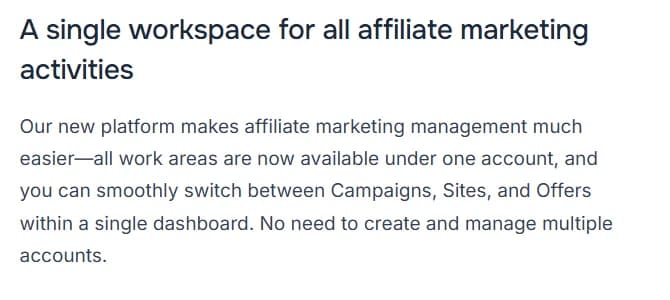
That's the one-account build. The other is one group with several brands and logins, where the link shows only in the fine print. The hybrid label covers both:
- RollerAds + CpaRoll. Buys traffic: Push, OnClick, Direct Click, In-Page Push; CPA offers: 300+, in-house deals; Publisher monetization: Sites, domains; One account or one group: One account, 3 wallets; What restricts traffic: External link may need approval.
- PropellerAds + Monetag + Zeydoo. Buys traffic: PropellerAds; CPA offers: Zeydoo; Publisher monetization: Monetag; One account or one group: One group, 3 sign-ups; What restricts traffic: Monetag 2.10: no propellerads.com traffic.
- Adsterra + CPA Network. Buys traffic: CPM, CPC, CPA; CPA offers: Private, up to 200 offers; Publisher monetization: Yes; One account or one group: Separate logins; What restricts traffic: Offer rules list allowed sources.
- HilltopAds. Buys traffic: Yes; CPA offers: None found; Publisher monetization: Yes; One account or one group: One account, same email; What restricts traffic: None found.
- Offerwall.Ad. Buys traffic: CPA campaigns; CPA offers: Network and direct; Publisher monetization: Offerwalls; One account or one group: One account, separate balances; What restricts traffic: Not stated.
- Push.House + Partners.House. Buys traffic: Push.House; CPA offers: CPA.House, 3000+ offers; Publisher monetization: Partners.House; One account or one group: Cross-promoted brands; What restricts traffic: Sources fixed per program.
- Mobidea. Buys traffic: Managed, for advertisers; CPA offers: Yes, plus Smartlink; Publisher monetization: Via Smartlink; One account or one group: One CPA network; What restricts traffic: Smartlink routes by EPC.
- ClickDealer. Buys traffic: ClickDealer 360 funds buyers; CPA offers: Yes, plus Smartlink; Publisher monetization: Via Smartlink; One account or one group: 2 account types; What restricts traffic: Smartlink Only accounts see no catalog.
The group model is clearest at PropellerAds: its terms define the trade name as entities "within the group of Propeller Ads Ltd," Monetag's terms use the same wording, PropellerAds' blog calls Zeydoo "Our own CPA network," and Zeydoo's publisher agreement names the same companies as your counterparty:

Adsterra keeps separate logins and runs its CPA network as a private product you join by application. HilltopAds lets you "work as an advertiser or a publisher with the same email address," and Offerwall.Ad keeps both workflows "under one account." Partners.House, the publisher program "by Push.House," links to a CPA.House catalog whose homepage redirected elsewhere when we checked. Mobidea and ClickDealer grew from the other end: CPA networks that monetize raw traffic through a smartlink, with ClickDealer 360 funding media buyers outright. Different wiring, same idea: one company on both sides of the deal.
How a hybrid ad network makes money on both sides
A full-cycle platform earns in 3 places: the traffic spread (the advertiser pays per click or per 1,000 impressions, the publisher gets a share), the offer margin (the advertiser pays per action, the affiliate gets less) and the data. The platform sees which offers convert on which zones and GEOs across every account and can put its own products where the numbers are best. No terms we read grant that right explicitly, and none forbid it.
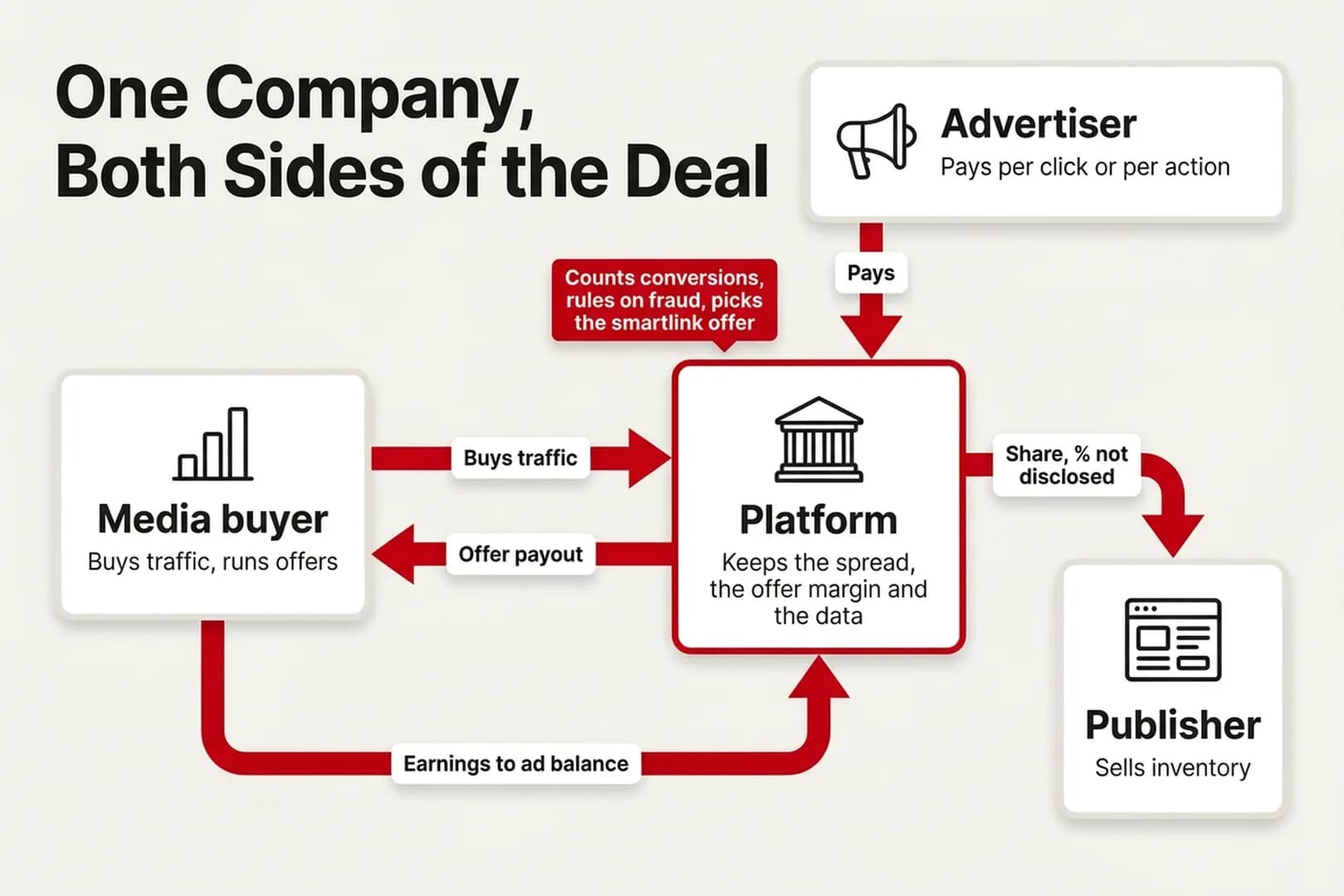
On paper these companies are agents. RollerAds "acts as an intermediary," Adsterra "acts as an agent between you and Advertisers," and Zeydoo and Monetag act "as a third party for advertisers." An agent lives on a cut of the flow, and no contract we read gives its size. Adsterra pays publishers a share of fees "less Adsterra's commission, as determined by Adsterra from time to time":

Mobidea's push terms say its commission "will be freely determined by MOBIDEA and at its sole discretion." The only published number is Monetag's "up to 80%" of the revenue from a publisher's inventory, with no floor and no definition of revenue.
CpaRoll adds a line worth reading twice. A February 2026 RollerAds case study says "when you run any CpaRoll offer on our platform, your payout isn't subject to margin." Taken at face value, the platform then earns on the clicks you buy to run the offer. Read the other way, the same offer carries a margin on outside traffic, and nobody publishes how much. That's my reading, not RollerAds' wording.
Why don't they run the offers themselves? They partly do
My first question had a hidden premise: that the platform doesn't run offers. It partly does. CpaRoll sells "In-house products by RollerAds," managed "directly by our team." PropellerAds' blog quotes the Zeydoo team on "10 + in-house products," and ClickDealer 360 lists "O&O products."
Platforms also buy their own traffic and publish the results. In a June 2026 case study, RollerAds ran a built-in Opera CPI offer on its own OnClick traffic in Brazil for 15 days: $755 in revenue, $439.02 in cost, ROI 71.97%. The whitelist came "based on insights from our account manager" and wasn't shared. The February case ran 3 CpaRoll sweepstakes offers on US push for 3 days at ROI 54.24%. Both are self-published demos with tiny samples: workflow tutorials, not proof that the offers pay.
So why sell traffic instead of running everything in-house? No document says, so this is my reading. An agent earns on every click whether your campaign wins or loses, while the buyer carries the risk of the test. A crowd of buyers testing creatives, GEOs and bids generates data no in-house team could afford, and the platform sees it in aggregate. Selling shovels beats digging: the oldest model in this trade, not a pyramid.
The question that matters comes next: when a platform runs its own campaigns and sells you traffic for the same offers, who gets the best zones? No terms we read forbid it or set a rule for it. That gap is widest where the platform picks the offer for you.
Smartlinks: who picks the offer, and profitable for whom
With a smartlink you hand over the traffic and the platform decides where each visitor goes. Only Mobidea writes the rule into its contract:
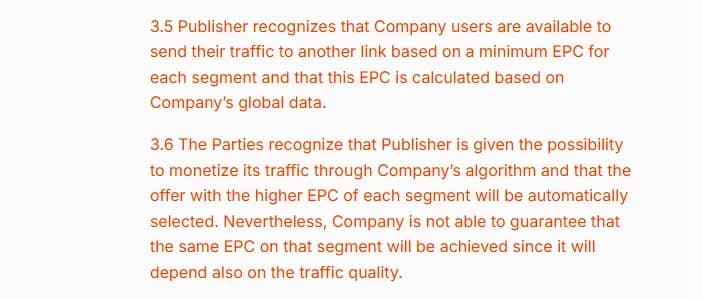
"The offer with the higher EPC of each segment will be automatically selected," with EPC "calculated based on Company's global data," meaning numbers pooled across the network. The others say it in marketing copy: "Adsterra finds the most relevant offer with the highest payout"; at ClickDealer "The most profitable path is determined"; Monetag's "optimization team will choose the most profitable offers."
Nobody says profitable for whom. The best-EPC offer for you and the best-margin offer for the network can coincide, and with an undisclosed margin you can't see when they don't. I once worked with a network that switched my traffic to its own links on weekends. A smartlink makes routing the platform's call by design, which is fine only while you measure what each decision paid.
Lock-in: no tuned offers, but soft walls and hard clauses
My second suspicion was that offers tuned to the platform's traffic flop elsewhere, so you're stuck. No document says an offer is technically tied to one source; RollerAds claims its offers "also deliver great results on other traffic sources," without data. What the documents show is lock-in by economics and access. If the payout carries no margin inside, the same offer may pay less outside: my fear in a narrower, checkable form. And some offers are open inside but gated outside:
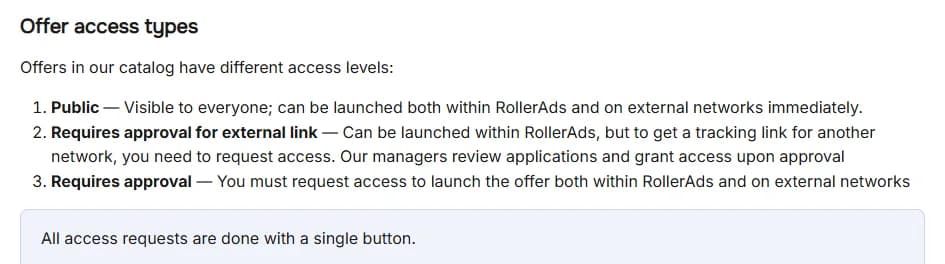
In the middle tier, the external link waits until "Our managers review applications." Add in-house deals "available only within the RollerAds ecosystem," "extra perks when buying traffic within our ecosystem," a one-click launch, the manager's whitelists and earnings that flow to the ad balance: each saves time, and each makes leaving cost more.
The hard lock lives in the terms. It isn't unique to full-cycle platforms; it just weighs more when one company holds every role. The RollerAds Platform is "the only official counter" (6.1), and PropellerAds gives advertisers 3 calendar days to dispute its stats, after which "services shall be deemed rendered." PropellerAds, Zeydoo, Monetag and Mobidea each "make all determinations about fraudulent activity in its sole discretion," and at ClickDealer "proof of any share of traffic being fraudulent is reason enough to forfeit the whole commission."
If Adsterra cancels your account under its terms, "you surrender your right to receive payment of any balance," and ClickDealer may amend its agreement "for any reason, or for no reason at all." Then comes the exit fee:
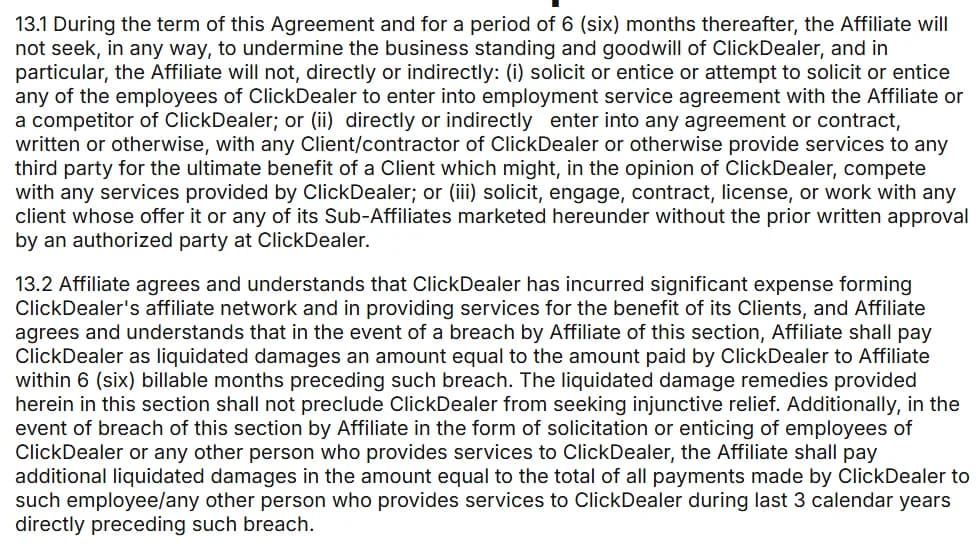
That's 6 months without the advertisers you met there, or a bill equal to 6 billable months of what ClickDealer paid you. Zeydoo bans re-brokering its offers "at any time after the termination" too.
These clauses protect the platform's seat in the middle, and none forces you to buy its traffic. The clearest sign of a group running its brands as one closed system is in Monetag's terms:
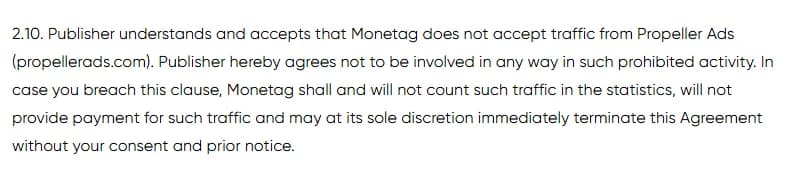
My reading: you can't buy traffic on the group's ad network and sell it back to its monetization brand. So my second claim holds in a softer form than I put it: not tuned offers, but gated access, perks for staying and exit costs in writing.
Is a full-cycle ad network a pyramid scheme? Not by the FTC test
The word has a legal meaning. The FTC's guidance on multi-level marketing cites its Koscot decision: a pyramid is "characterized by the payment by participants of money to the company" for the right to sell a product and for recruiting rewards "which are unrelated to the sale of the product to ultimate users."
Nothing in the documents fits. Nobody pays for the right to sell: new RollerAds users get "automatic access to the Offers section." The money comes from advertisers paying for real users' clicks and actions, and referral programs pay a single level: 5% of referred publishers' revenue at Adsterra and Monetag, a percentage set "at the sole discretion of RollerAds." No downline, no entry fee. I've lost money with a network that collected referrals, then closed and vanished with the money. Painful, and still not a pyramid: it was a network that stopped paying.
What smelled to me was the loop: you buy traffic from the platform, earn on its offers and move the earnings back to its ad balance. Circulation inside one ledger isn't recruitment. The proper name is conflict of interest, which the UK's CMA defines as "situations where the intermediary can potentially gain by taking actions that adversely affect the advertiser or publisher on whose behalf it is acting."
The big-league version has been to court. On April 17, 2025, a US federal court found that Google broke antitrust law in ad tech, yet treated two-sided ad networks as an ordinary product. Networks, in testimony the court quotes, "typically represent[] both the interests of the publisher or media, as well as the marketer or the advertisers." The offence was monopoly power, tying and rigging auctions Google took part in. Without monopoly power, the court wrote, favoring its own exchange "might have been a permissible design choice." On September 5, 2025, the European Commission fined Google EUR 2.95 billion and went after the conflict itself:
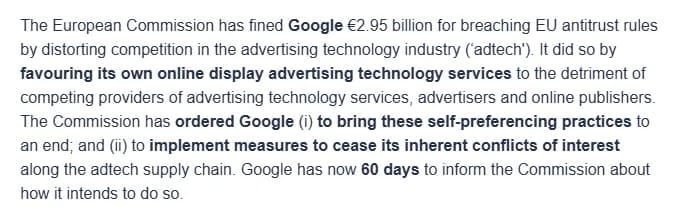
There are 2 lessons for a media buyer. By the court's logic, a small network favoring its own products is a design choice, not an antitrust case. And the US remedies of September 2026, as the DOJ describes them, target verification and exit: AdWords cannot bid preferentially into AdX "because of Google's ownership of those tools," publishers can export their own data to switch providers more easily, and a monitor stays for 6 years. The CMA's test is the same: harm grows where parties "have limited ability to verify the information they receive" and shrinks when they can compare and switch. Verify, compare, switch: that's the test for your platform too.
How to work with a full-cycle platform without becoming its fuel
Nobody will appoint a monitor for your account, so the job is yours:
- Run the platform's top offer on outside traffic via its external link, and compare conversion rate, EPC, approval rate and hold with the same offer inside.
- Price the same vertical, GEO and payout model at 2 independent CPA networks, GEO by GEO: in RollerAds' own help example, one CPS offer pays $0.40 in the US and $0.04 in its lowest tier.
- Put your own tracker in the chain as a second counter, reconcile daily and dispute inside the window.
- Split traffic between the smartlink and a direct offer on the same GEO, and compare what each paid.
- Withdraw at the minimum instead of moving earnings to the ad wallet.
- Cap the platform's share of your turnover at what you could lose in a single email.
- Read the non-circumvention, forfeiture and amendment clauses before you scale, and screenshot them with the date.
The price: outside traffic and a tracker cost money, and some offers won't give you an external link without approval, which is an answer too. If balances start freezing, my rule is the one I use with any network: questions to the manager in writing, money withdrawn, traffic paused until the answers come.
A full-cycle platform suits a newer buyer who values speed: one login, automatic access to offers, a one-click launch and a manager's whitelists remove a lot of setup. An experienced team should keep it as one channel among several, because only someone with outside traffic and a second network can check the referee.
Checklist: what to do
Questions and answers
What is a full-cycle ad platform?
A company where you buy traffic, run CPA offers and monetize your own inventory under one account or one corporate group: RollerAds with built-in CpaRoll offers, or PropellerAds, Monetag and Zeydoo with separate sign-ups.
Is a full-cycle ad network a pyramid scheme?
Not by the FTC's Koscot test: nobody pays for the right to sell, and the referral programs we found pay a single level, 5% at Adsterra and Monetag. The real issue is a conflict of interest.
What is a smartlink and who picks the offer?
A single link that sends each visitor to an offer the platform chooses. Mobidea's contract says it picks the higher-EPC offer per segment; Adsterra, ClickDealer and Monetag promise the "highest payout" or "most profitable" offer without saying for whom. Test it against a direct offer.
Can I run in-house offers on other traffic sources?
Sometimes. At RollerAds, Public offers run on external networks at once, others need a manager's approval for an external link, and some in-house deals stay inside its ecosystem. Check the access level before you buy traffic.
Is RollerAds (CpaRoll) safe to work with?
The documents show a working product: one account, 300+ offers, external links for public offers, payout minimums from $30. They also show the usual terms, including "the only official counter," and the RollerAds terms we read don't mention Offers or CpaRoll. Start small, track independently, withdraw often.
Author’s conclusion
My instinct was right about the direction and wrong about the name. There's no pyramid: advertisers pay, the platform takes a cut, referrals pay a single level. What there is, is a referee who also plays. It sells you traffic, hands you offers, counts the conversions, rules on fraud, picks the offer in a smartlink, runs its own products and keeps its cut private. The convenience is real, and so is the conflict.
My take: use the convenience, but never let a full-cycle platform be your only counter, your only network or the place your money sleeps. Who checks the referee? For Google, a court and a monitor for 6 years. For your account, nobody but you.
Lu Discover, Editor-in-chief
Sources for this article
- blog.rollerads.com — RollerAds: the full-cycle ad platform is now live (one account, Campaigns, Sites and Offers, wallets, 300+ offers; June 2, 2026)
- blog.rollerads.com — RollerAds case study: built-in Opera CPI offer on RollerAds traffic, 15 days, ROI 71.97% (June 23, 2026); the February 11, 2026 case "Perfect match with 54% ROI" with the "isn't subject to margin" line is on the same blog
- offers.rollerads.com — CpaRoll is part of the RollerAds ecosystem: in-house products, extra perks for buying traffic inside
- help.rollerads.com — RollerAds Help Center: offer access types, plus articles on payout options by GEO, transfers between roles, access for new users and payout minimums
- rollerads.com — RollerAds Terms and Conditions (intermediary 2.2, only official counter 6.1, referral program 5.7)
- propellerads.com — PropellerAds Terms and Conditions, last updated July 21, 2026 (group definition, 3-day dispute window, fraud at sole discretion)
- propellerads.com — PropellerAds blog: best CPA networks, "Our own CPA network, Zeydoo" and its in-house products (June 15, 2023)
- zeydoo.com — Zeydoo Publisher Agreement, last updated August 5, 2026 (contracting parties, third party for advertisers 6.2, fraud 8.1, re-brokering ban)
- monetag.com — Monetag Publisher Agreement, last updated August 14, 2026 (clause 2.10, 6.2, 8.1), plus the help center's "up to 80%" revenue share, the smartlink blog and the referral terms
- adsterra.com — Adsterra publisher terms (managed, 29.06.2026: revenue share definition; CPA, 1.07.2026: agent 5.5, re-brokering 4.9, balance surrender), plus Smartlink, CPA Network and referral pages
- mobidea.com — Mobidea terms (smartlink clauses 3.5 and 3.6, commission at sole discretion, fraud 8.1)
- clickdealer.com — ClickDealer publisher terms (fraud proof 9.2, forfeiture 9.3, non-circumvention 13.1 and 13.2, amendments 16.2), plus Smartlink and ClickDealer 360 pages
- hilltopads.com — HilltopAds Help Center: advertiser and publisher roles with the same email (June 15, 2026)
- offerwall.ad — Offerwall.Ad: publisher offerwall and advertiser CPA campaigns under one account
- partners.house — Partners.House by Push.House: publisher program and ecosystem links
- ftc.gov — FTC: Business Guidance Concerning Multi-Level Marketing (Koscot definition, no percentage-based test)
- ag.ny.gov — United States v. Google LLC, E.D. Va., Memorandum Opinion of April 17, 2025 (two-sided ad networks, p. 55; permissible design choice, p. 99)
- ec.europa.eu — European Commission: Google fined EUR 2.95 billion over adtech self-preferencing and conflicts of interest (September 5, 2025)
- justice.gov — DOJ: Department of Justice Again Wins Substantial Relief Against Google (ad tech remedies, September 16, 2026)
- assets.publishing.service.gov.uk — UK CMA: Online platforms and digital advertising market study, Appendix M, intermediation and conflicts of interest (2020)
Companies in this article
- RollerAdsTraffic sourceNot rated yet
- PropellerAdsTraffic sourceNot rated yet
- AdsterraTraffic sourceNot rated yet
- HilltopAdsTraffic sourceNot rated yet
- MobideaAffiliate networkNot rated yet
- ClickDealerAffiliate networkNot rated yet
- Push.HouseTraffic sourceNot rated yet






Related stories
 Top list
The Affiliate Rich List 2026: Who Owns the Networks, and What It's Worth
 Guide
GuideHow Much Budget Do You Need to Test an Offer? What $100 Can and Can't Tell You
 Case fact-check
Comments
0 commentsNo comments yet.
Add a comment