

$8,690 on Crypto in Google Ads at 121% ROI: Fact-Checking a Case That Sells Accounts

Contents 14
A media buyer posts a case: Google Search, crypto offers from 2 direct brokers, $8,690 in revenue, $4,750 net and 121% ROI between April and June 2026. Google is the hardest place to run grey crypto, so a profitable case from there gets read, saved and copied.
This is our review of the case for media buyers who run, or plan to run, grey verticals on Google Ads: the author's text in translation, our own math on top of his numbers, Google's crypto rules as they stand today, and what the case doesn't show. Editorial fact-check: 1/5.
Short version: the numbers add up, and nothing proves them. The "screenshots" are typed text, the GEO, offers and keywords are withheld, and the author turns out to sell the very accounts the case credits for the profit. Below: the setup, the money, the 2 tricks, the policy reality and who the author actually is.
Who wrote the Google Ads crypto case and what it claims
The author posts as t3rozz and introduces himself as Vlad, a media buyer. He published the case in Russian on August 21, 2026, as "Case: $8,690 on crypto in Google Ads, ROI 121%." We translated it in full; every quote below is our translation.
His backstory: "I started on the platform back at the end of 2025, but spun my wheels for a long time: read manuals, farmed accounts by the guides, and kept catching 'Circumventing systems,' back to square one." His team works nutra, gambling and crypto. He tried YouTube, App campaigns, Search and Display, until the team lead set the task: "train on crypto offers from Search until I'm in profit, and no experiments."
Then the turning point: "Tired of endless farming on my own, I bought accounts and white pages from 'google_hubx'. My colleagues have been buying there since 2024 and always praised the quality." And the thesis of the whole case: "accounts decide 80%, cards 10%, proxies 10%. The rest is details that barely matter."
Our take: Circumventing systems is the Google policy that covers cloaking and multiple account abuse, and it's the ban he says he kept getting. The rest of the case does the same thing on accounts someone else farmed. Remember the shop's name: it comes back at the end.
The setup: bought accounts, Octo, residential proxies, Keitaro
"Let me say it right away: you can't save on consumables with Google, you just won't launch," he writes, and lists what he used:
- 6 accounts and white pages from @google_hubx;
- the Octo antidetect browser;
- US virtual cards;
- residential proxies from luxproxy, "1 proxy per account, never changed";
- Keitaro as cloak and tracker, "a classic";
- any foreign domain and hosting, plus Cloudflare.
For research he skipped spy tools: he connected through a VPN to the target GEO and checked by hand what was running in Google's results.
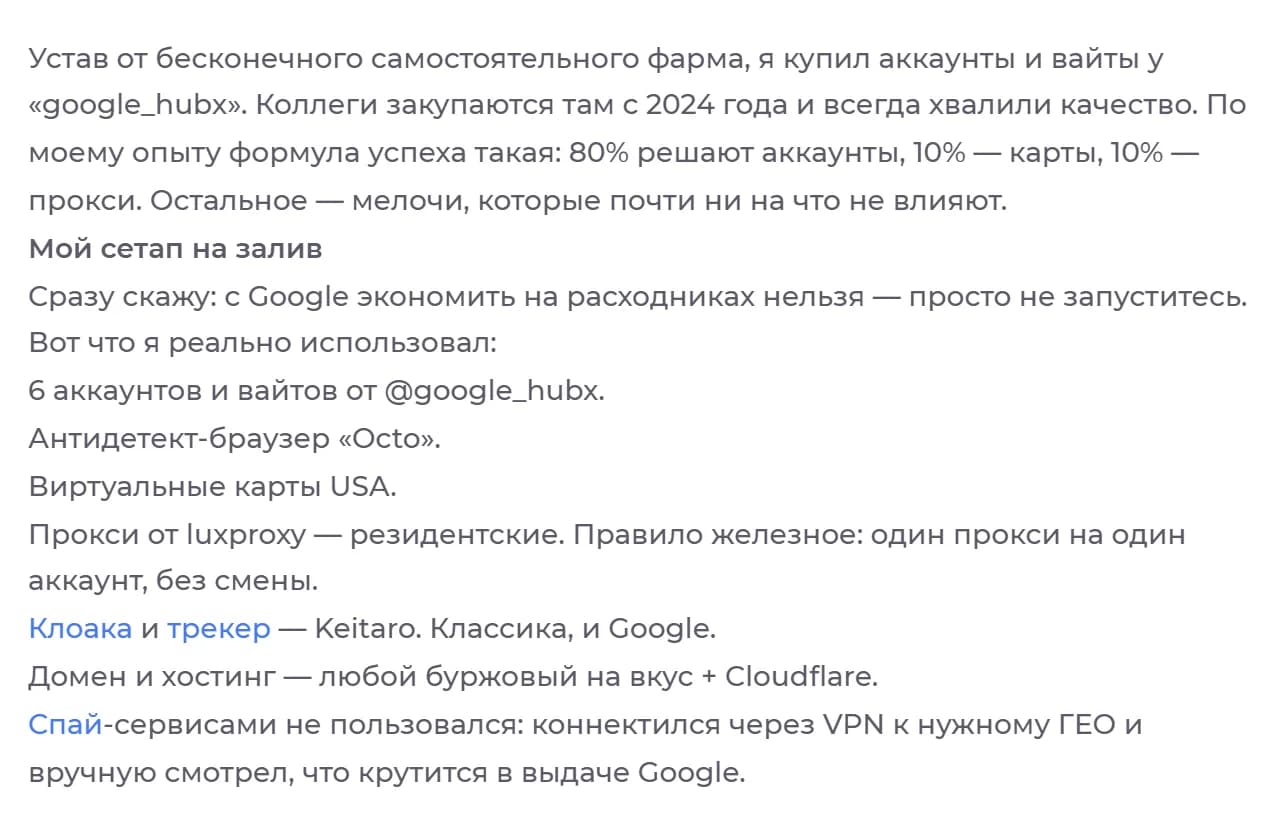
Our take: this is the standard grey Google stack, and naming every piece is the strongest part of the case. A separate antidetect browser profile and a fixed proxy for each account is basic hygiene, not a secret. The catch sits in the word "cloak." Showing Google's reviewers a white page and people the offer is cloaking under Circumventing systems, and the policy is blunt: accounts are "suspended upon detection and without prior warning." In this setup every account is a consumable with a timer.
The VPN research is a sound habit, and there's a free complement: Google's own Ads Transparency Center shows the ads any advertiser has run, filtered by region.
Not shown: the card provider, the white pages, the cloak settings and what any of it cost.
2 direct crypto brokers and 171 deposits
He works with 2 brokers directly, both "adequate advertisers" he has worked with "for a long time": "Honestly, I don't understand why you'd give margin to an affiliate network if you can agree with the advertiser directly and work without a middleman."
- Advertiser 1: April 1 to May 31, 2026, 68 deposits, $3,540.
- Advertiser 2: May 1 to June 30, 2026, 103 deposits, $5,150.
Our math: 171 deposits over 91 days is about 2 a day. Advertiser 2 works out to exactly $50 per deposit: 103 × $50 = $5,150. Advertiser 1 averages $52.06, not a round figure, so either the payout changed mid-period or it isn't a flat CPA. The case never names the model.
The only reply under the post, 3 days later, asked exactly that: "Was it CPA or CRG with the broker? If CPA, feel free to add another 30% to the profit, which the broker shaved off." As of October 3, 2026, it has no answer. Under CRG, a conversion rate guarantee, the broker pays per lead and the affiliate promises a minimum share of leads that deposit. Under CPA you're paid only for the deposits the broker counts, which is where shaving suspicions start. If you suspect a broker of undercounting, our conversion shortfall tester checks whether the gap is bigger than chance.
Not shown: broker names, GEO, the payout model, and a single screenshot from an advertiser dashboard or a payment.
Our take: a direct advertiser saves the network's margin and takes away the network's protection: nobody to chase an unpaid invoice or argue a shave for you. With no names, "direct" can't be checked at all.
The tracker stats that aren't there
"Stats from the tracker: I goofed and forgot to create a flow, and ran traffic directly for a long time, so the numbers in the tracker are noticeably lower than in the advertisers' stats. I won't disclose the GEO and keywords: the setup is live, I plan to scale."
Our take: in Keitaro, the cloak lives in a flow: a filter that sends bots and reviewers to the white page and people to the offer. A campaign that ran "directly," with no flow, either wasn't cloaked through Keitaro, which contradicts his own setup, or the sentence exists to explain why there's no tracker screenshot. Either way, the tracker is the only dataset that ties clicks to deposits, and it's exactly what's missing.
"The setup is live, so no GEO" is normal in cases. But without GEO and keywords, none of the numbers below can be checked against real prices in that market.
The Google Ads "screenshots" are typed text
Under the heading "Screenshots from Google Ads accounts," the post lists 3 accounts. As text.
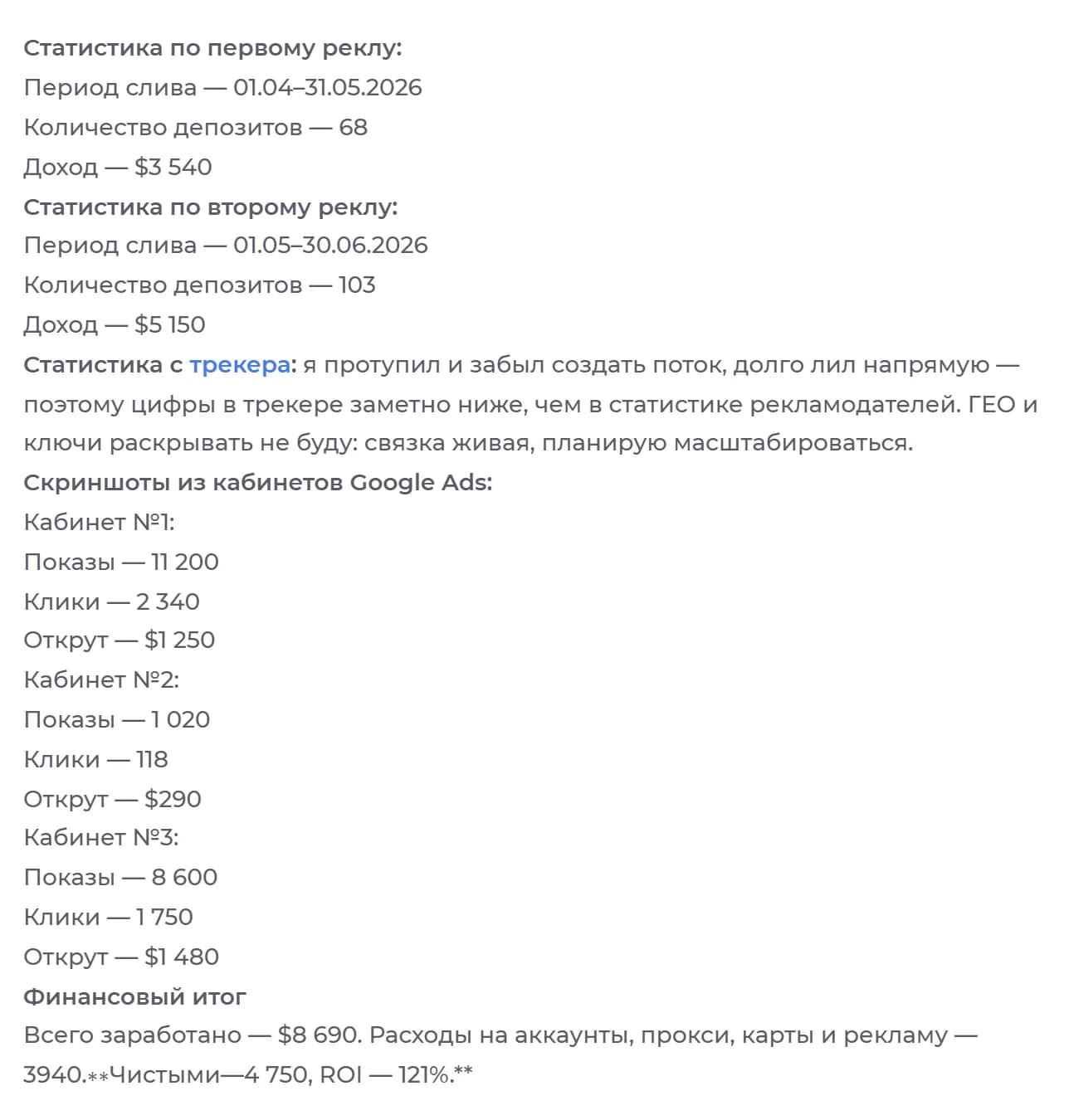
We checked: other case posts on the same site show attached screenshots to logged-out visitors, so nothing here is hidden behind a login. This post has 0 images.
- Account 1 — 11,200 impressions, 2,340 clicks, $1,250 spend. CTR 20.9%, CPC $0.53
- Account 2 — 1,020 impressions, 118 clicks, $290 spend. CTR 11.6%, CPC $2.46
- Account 3 — 8,600 impressions, 1,750 clicks, $1,480 spend. CTR 20.3%, CPC $0.85
- Total — 20,820 impressions, 4,208 clicks, $3,020 spend. CTR 20.2%, CPC $0.72
Our math: the CTR is the odd number. LocaliQ's 2026 benchmarks put the average search CTR at 6.64% across industries and 9.83% for finance and insurance. These accounts claim 20.2%, 3 times the average, on grey keywords behind a white page. A CPC of $0.72 is about 1/5 of the $3.39 finance average.
Clicks that cheap and that eager usually come from brand or navigational queries, and in grey crypto that often means bidding on exchange names, with trademark and impersonation trouble of its own. That's our read, not the case's: it hides the keywords.
Account 2 is the outlier: 118 clicks at $2.46 each, 3.4 times the overall average, and the case doesn't say whether it was banned.
Not shown: dates per account, campaign types, keywords, the conversions column, and the other 3 of the 6 accounts he bought. If they died before spending, he doesn't say so. If they spent, that spend isn't in the total.
$8,690 revenue, $3,940 costs: the 121% only holds on paper
The result, in his words: "Total earned: $8,690. Costs for accounts, proxies, cards and ads: $3,940. Net: $4,750, ROI 121%."
Our math: the arithmetic is clean. $8,690 minus $3,940 is $4,750, and $4,750 / $3,940 is 120.6%, so 121% checks out. Ads took $3,020, leaving $920 over 3 months for accounts, white pages, proxies and cards. At the shop's own price list, which we found in its Telegram channel, 6 accounts and 6 white pages cost $240.
What's left out: Octo, where 6 profiles need the €29-a-month Starter plan; Keitaro, from €40 a month billed yearly; domains and hosting. That's roughly $250 over 3 months, and it takes ROI from 121% to about 107%. Run your own version in our ROI calculator.
Per deposit, the case implies:
- cost per deposit: $17.66 in ad spend, $23.04 all-in;
- revenue per deposit: $50.82;
- EPC: $2.07 against a $0.72 CPC;
- click to deposit: 4.06%.
The last number is the one I'd question first. LocaliQ's finance and insurance conversion rate is 2.64%, and those conversions are mostly leads and calls, not money in. A 4% click-to-deposit rate on cloaked traffic would be 1.5 times the average finance lead rate. It fits if "deposits" are really registrations or leads, which would also fit $50 payouts better than first-time deposits would. Either way, the label and the numbers don't sit together comfortably.
A formatting glitch that tells a story: in the original, the final line reads "3940.∗∗Net—4 750, ROI — 121%.**" (we translated the 1 Russian word). The dollar signs are gone, the bold markers turned into math asterisks and the spaces collapsed. That's what text with 2 dollar amounts looks like after it passes through an interface that renders anything between dollar signs as a formula, which AI chat windows do. It doesn't prove the numbers are invented. It suggests the post was drafted or polished in an AI chat and pasted, and in a case with no screenshots, the text is all the proof there is.
The 2 tricks: grey keywords on day 3, white ads alongside
"I noticed a pattern: if you mix in grey keywords only on day 3 of spend, accounts live noticeably longer. And if you run white ads in parallel with the grey campaign, the account's life stretches to a month or more."
Our take: both are warm-up rituals: give the account a clean start and a clean neighbor. They may buy a few days. The case has no data to show it: no lifetime per account, no comparison, and 3 accounts over 3 months is about a month each, which is simply the baseline.
Google doesn't judge campaigns in isolation. Under Circumventing systems it weighs "your ad, website, accounts, and third-party sources," and its 2025 Ads Safety Report credits Gemini-based systems that read signals like account age, behavior and campaign patterns. Google suspended 24.9 million advertiser accounts in 2025, 4 million of them tied to scams. A white campaign next to a grey one doesn't change what the grey one is.
The author also disagrees with himself. A day before the case, in a post on Google Ads changes, he wrote that by February 2026 "classic account warm-up practically stopped working," and that App campaigns had become "the main channel for grey verticals" because Search had tightened. The next day he published a profitable grey case on Search built on a warm-up trick.
Google Ads crypto rules in 2026: why this setup needs a cloak
Google's crypto policy splits the vertical 3 ways:
- prohibited everywhere: ICOs, DeFi trading protocols, ads for buying, selling or trading crypto, and destinations that "aggregate or compare issuers of cryptocurrencies," including "aggregators or affiliate sites containing related content or broker reviews";
- allowed with a license and Google certification, in approved countries only: exchanges, software wallets, hardware wallets and coin trusts. In the EU, since April 23, 2025, that means a MiCA license as a crypto-asset service provider; Indonesia opened in February 2026 for exchanges licensed by its financial regulator;
- CFDs and forex, if the "broker" sells crypto as derivatives: complex speculative financial products, licensed providers only, in eligible countries, with Google's approval.
On top of that, Google requires financial services verification in 42 locations, including the UK, most of the EU, Australia, India and Brazil.
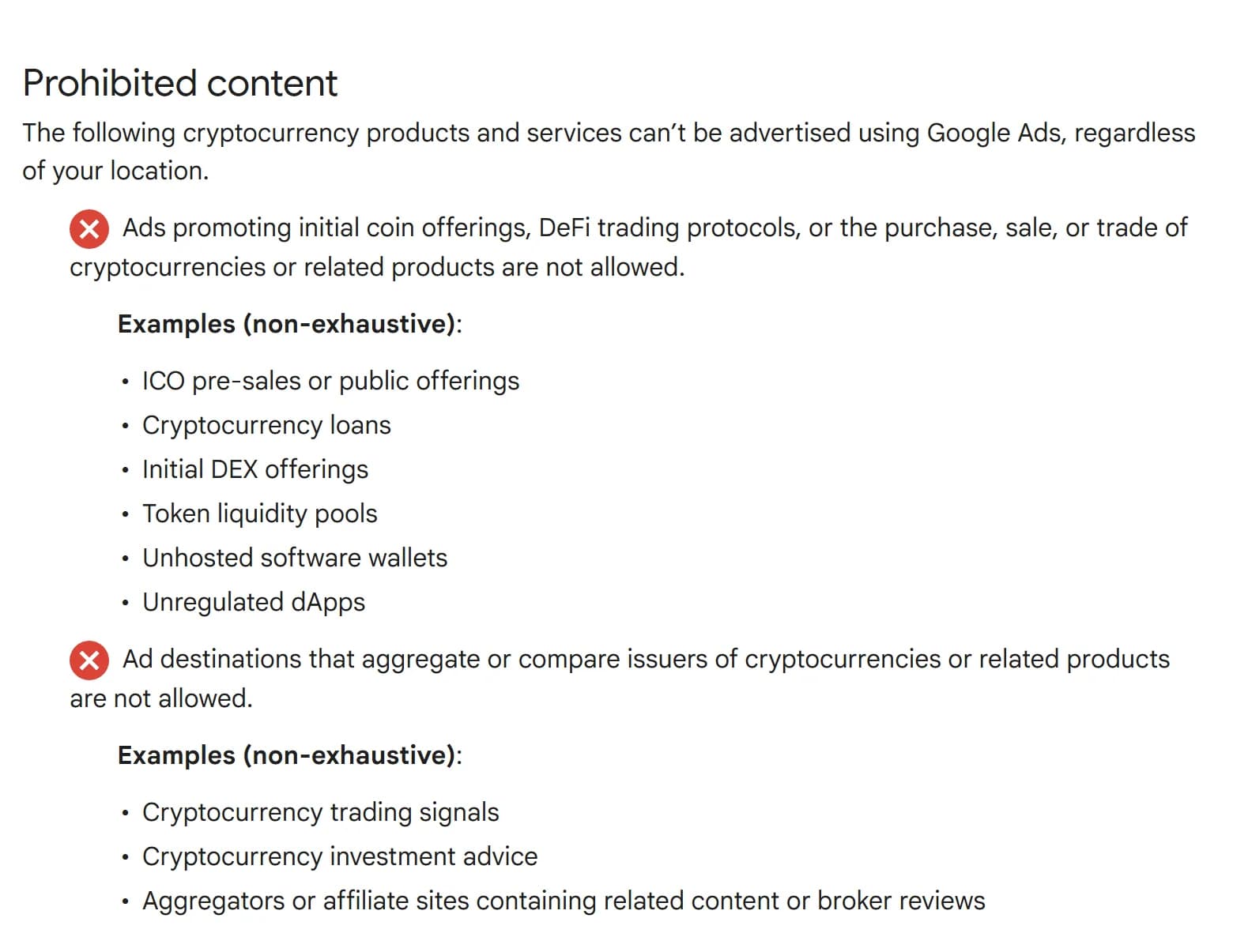
Our take: an affiliate can't hold the broker's license, so it can't get the broker's certification either. A setup like this exists only behind a cloak, and the same policy names the multi-account approach as a violation: "Using several accounts, either gradually or all at once, to promote products or services for which you lack the necessary Google Ads certifications." So is "submitting false information as part of our verification programs."
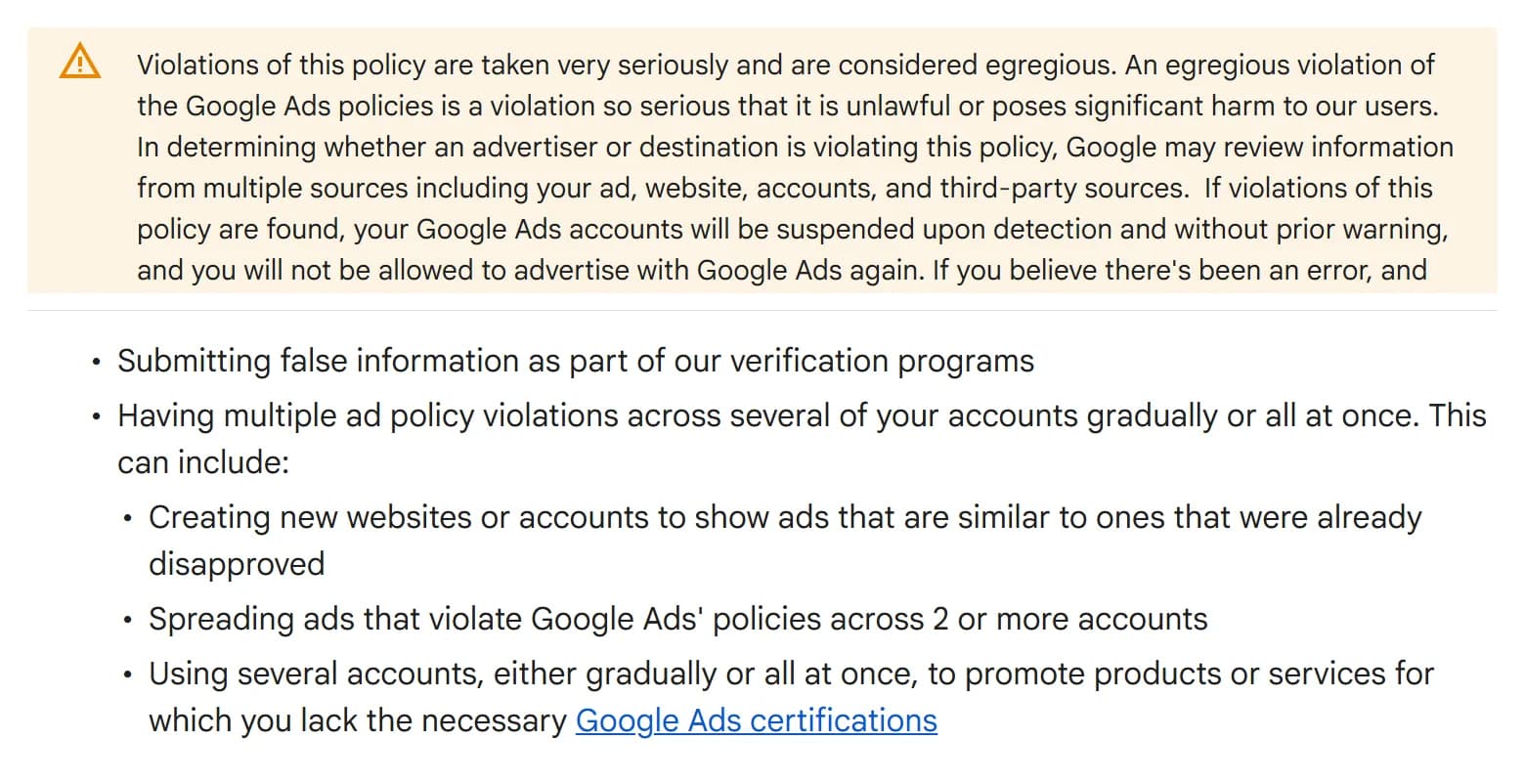
Which brings us to "verified" accounts. The shop sells farms "with verification passed on documents." Not your documents. Google's advertiser verification puts the verified name and location into ad disclosures and the Ads Transparency Center, so somebody's identity ends up next to grey crypto ads. That's a risk for the person on the documents and a weak spot for the buyer, because a suspended account that asks for reverification can't pass it.
Who is t3rozz: the customer who is also the seller
Our scan flagged the author as a new account, so we read everything he has posted publicly. His profile page is login-only; his posts are not.
- The account was registered on May 25, 2026. At our check: 23 messages, 0 reactions.
- May 26 to June 16: a thread promoting a Telegram job channel, which he bumped himself 8 times with "up."
- August 19: a thread in the "for sale" section, "Farms for Google Ads with verification": "We sell farms with verification passed on documents, details in tg @google_hubx." 53 views, 0 replies.
- August 20: "Changes in Google Ads arbitrage, August 2026," which opens with "There's not much specific about August in open sources, but here are the key changes," the way a chatbot answers a question, and ends with "BUY VERIFIED FARMS, WHITE PAGES in Tg: @google_hubxx."
- August 21: the case, in which he is a happy customer of google_hubx.
- September 2: a vacancy, "Team Lead of Farm Google ADS."
- September 22: an announcement of a new Telegram channel about Google media buying, "we share our experience."
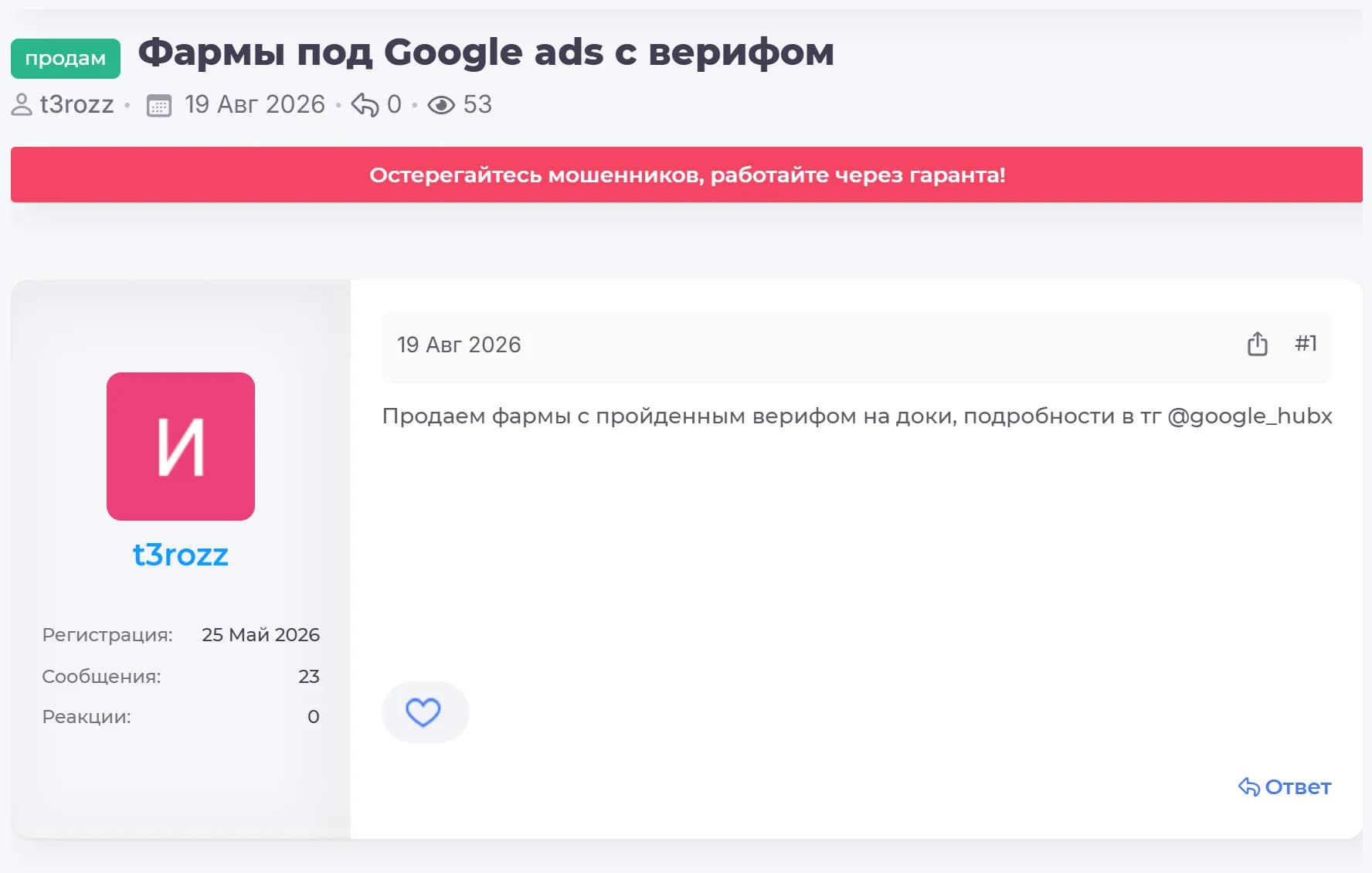
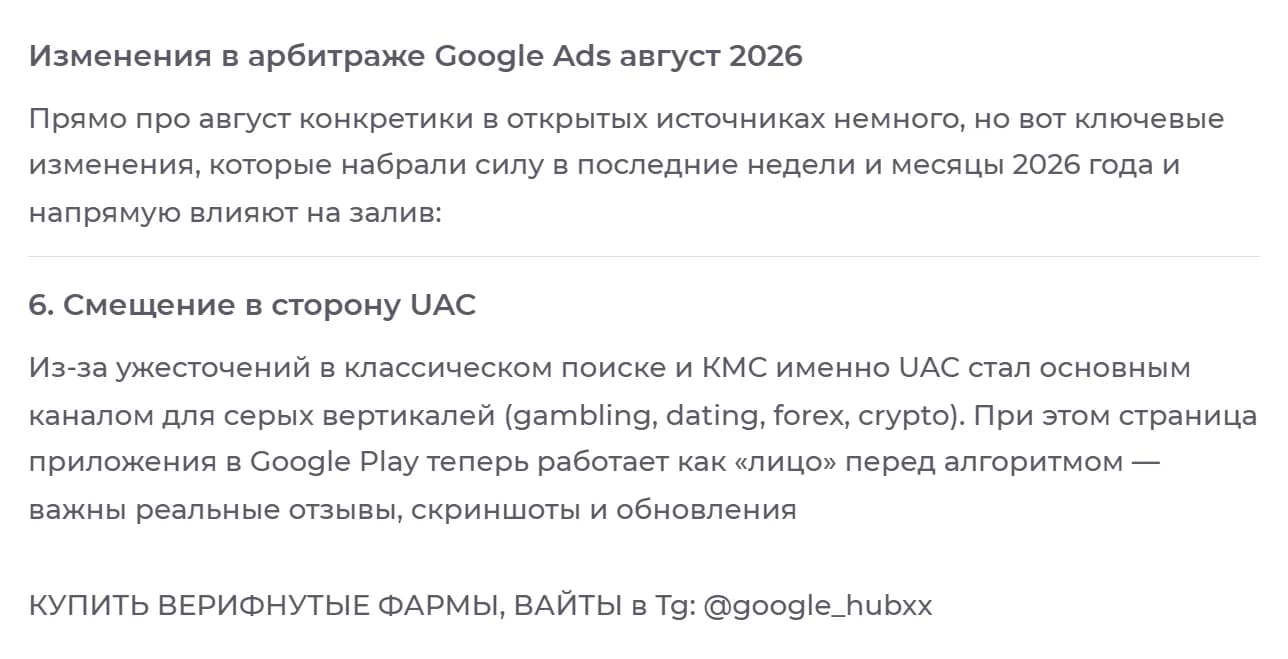
The shop behind those handles runs a Telegram channel called Google hub. It was created on August 19, 2026, the same day as the for-sale thread, and had 1 subscriber when we checked on October 3. It sells "Google Ads farms" with verification, a manual farm of 7+ days, a rented phone number and 2FA for $35, "transfer to Octo," white pages at $5 each and "Google moderator services," with @google_hubx as support.
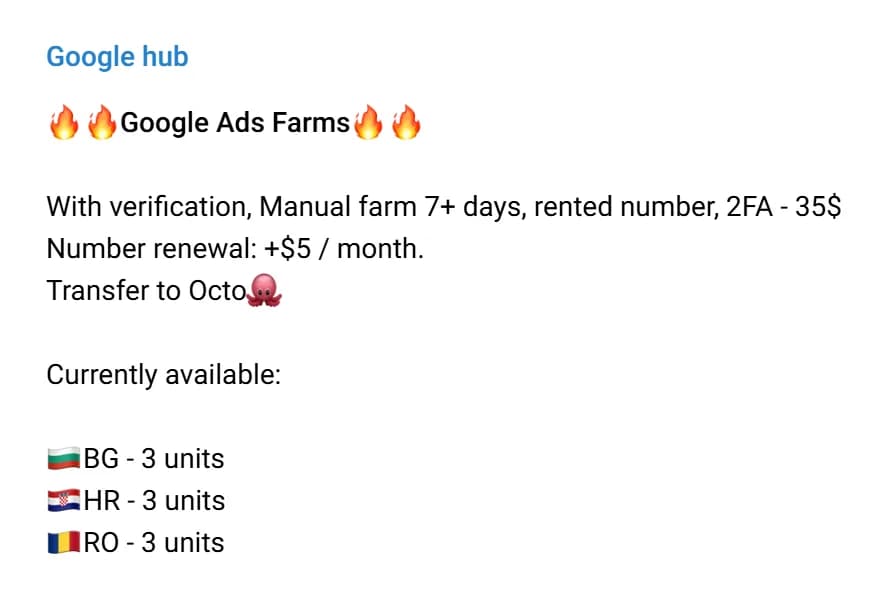
"My colleagues have been buying there since 2024," says the case. The shop's public channel is 2 days older than the case. And the Telegram contact t3rozz gives for job applications displays the name "Ghub."
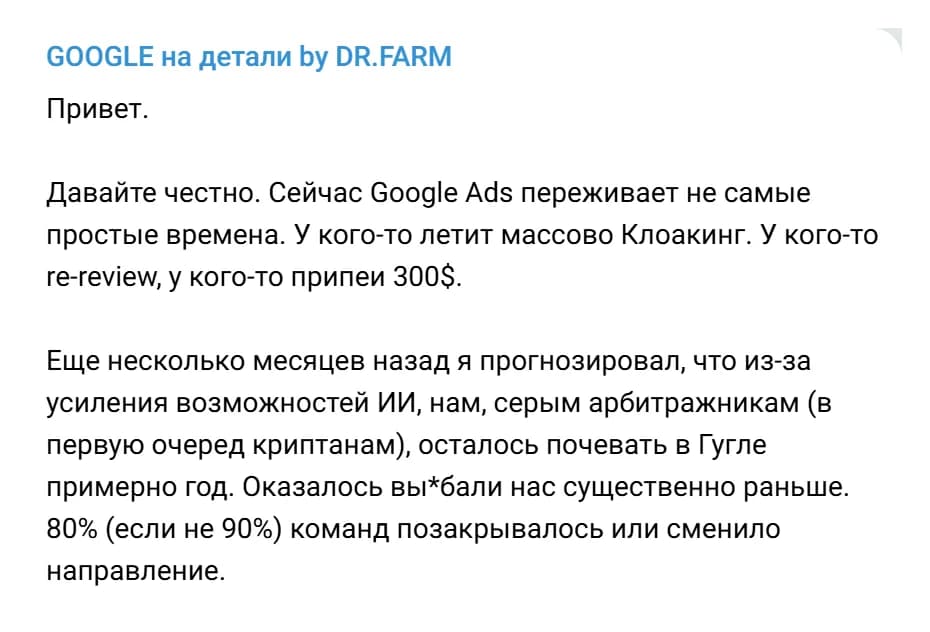
The channel he announced in September lists @google_hubx in its description as "white pages from professionals." Its first post, on September 17, is worth reading next to a case that promises to scale: "A few months ago I predicted that, because of stronger AI, we grey media buyers (crypto first of all) had about a year left on Google. Turns out they got us much sooner. 80% (if not 90%) of teams have closed down or changed direction."
Our take: this case is an advertisement. Not a sloppy case with an ad in it: its conclusion is the shop's sales pitch. "Quality consumables decide. I lost a ton of time farming on my own and only got into profit after buying trusted accounts. Don't save on consumables." The author sold under that handle 2 days earlier and never says so. Nothing here proves the $8,690 is invented. It proves the author had a reason to write the case whether it happened or not, and he hid that reason.
Fact-check: what the author showed and what they hid
We rate every case on 10 points: what an outsider needs to judge the result and repeat it. Most case studies are selectively true rather than fake. This one is a sales page wearing a case's clothes.
- Setup: period, GEO, offer, model — Partial. Dates for both advertisers are given. GEO, keywords, brokers and the payout model are hidden, and the "CPA or CRG?" question under the post is still unanswered.
- Author and independence — Hid. A 3-month-old account. 2 days before the case, the author posted a for-sale thread for the shop he praises as a customer, and the case never mentions it.
- Finances — Partial. Revenue, costs, profit and ROI reconcile: $8,690 minus $3,940 is $4,750, or 121%. Only 3 of 6 accounts appear, spend isn't split by advertiser, and the tracker and antidetect subscriptions are left out.
- Proof — Hid. 0 images. The "screenshots from Google Ads accounts" are typed numbers, and the missing tracker stats are explained away.
- Source and targeting — Partial. Google Search, 3 accounts with impressions, clicks and spend. No keywords, match types, bids, campaign settings or dates per account.
- Tools — Showed. Octo, luxproxy residential proxies, Keitaro, Cloudflare, US virtual cards and the account shop are named. The card provider isn't, and the author sells for the shop.
- Creatives — Hid. No ad texts, no headlines, nothing from the white campaign that supposedly kept accounts alive.
- White pages and landing pages — Hid. White pages "from @google_hubx," never shown. No broker landing page, no prelander.
- Consumables — Partial. 6 accounts and white pages from the shop he sells for, with no prices in the case: we found $35 per account and $5 per white page in the shop's channel. No lifetime per account beyond "a month or more."
- Repeatability today — Hid. GEO and keywords are withheld, the setup depends on cloaking, which Google punishes with a permanent ban, and a month later the channel he announced wrote that 80-90% of grey teams on Google had closed or switched.
Score: 1/5. At first glance this case looks like a 4: named tools, 2 advertisers, 3 accounts and numbers that add up to the dollar. But adding up is the 1 thing an invented case always does. There are no screenshots, no tracker data, no GEO, no offer and no keywords, the CTR and conversion rate sit far above market norms, and the conclusion is the slogan of a shop the author sells for and doesn't disclose. On our scale, an ad for the author's own product with no proof behind it is a 1.
Checklist: what to do
Questions and answers
Can you advertise crypto on Google Ads in 2026?
Only as a licensed exchange or wallet certified by Google in approved countries. In the EU that means a MiCA license, and Indonesia opened in February 2026. Other ads for buying, selling or trading crypto are prohibited, and so are affiliate sites with broker reviews.
Can affiliates run crypto broker offers on Google Ads?
Not openly. Google bans destinations that compare crypto issuers, including affiliate sites with broker reviews, and certification requires a license the affiliate doesn't hold. Cases like this one run through cloaking, which Google answers with a permanent ban, without warning.
Are bought "verified" Google Ads accounts safe to use?
No. The Circumventing systems policy bans false information in verification and using several accounts to promote products you lack certification for. A farm "verified on documents" carries somebody else's identity, and that name shows up in the Ads Transparency Center next to your ads.
What CTR and CPC are normal for Google search ads?
LocaliQ's 2026 benchmarks give a 6.64% average CTR and a $5.42 CPC across industries, and 9.83% at $3.39 for finance and insurance. A 20% CTR at $0.72 a click on grey crypto keywords needs an explanation this case doesn't give.
How do you spot a hidden ad in a case study?
See who gets the credit for the profit, then check the author: account age, other posts, for-sale threads and every Telegram handle in the text. If the credited shop and the author share a handle, a price list or a launch date, you're reading an ad.
Author’s conclusion
At first glance this case is the kind people save: named tools, 2 advertisers, 3 accounts and numbers that reconcile to the dollar. Read it as an editor and it comes apart in order: no screenshots, no tracker, no GEO, no offer, a CTR 3 times the market, a deposit rate above what finance sees for leads, and an author who sells the accounts his case says made the money. Grey crypto on Google Search may still pay for someone in 2026. This case doesn't show it, and the channel the author promotes says most teams have stopped trying.
My advice: treat any case that credits a single shop, service or network for the profit as an ad until the author shows dashboards with dates and conversions. Before you buy accounts for crypto on Google, read the crypto and Circumventing systems policies: without a license and certification every account is a consumable that ends in a permanent ban, and "verified" means verified on someone else's documents. If you test anyway, budget for the accounts you'll lose, count every subscription in your ROI and keep your own tracker stats from the first click.
Lu Discover, Editor-in-chief
Our verdict on this case
At first glance this case looks like a 4: named tools, 2 advertisers, 3 accounts and numbers that add up to the dollar. But adding up is the 1 thing an invented case always does. There are no screenshots, no tracker data, no GEO, no offer and no keywords, the CTR and conversion rate sit far above market norms, and the conclusion is the slogan of a shop the author sells for and doesn't disclose. On our scale, an ad for the author's own product with no proof behind it is a 1.
Our fact-check of the public case: what the numbers show, what is missing. Scores are never for sale.
Sources for this article
- fb-killa.pro — t3rozz: Case: $8,690 on crypto in Google Ads, ROI 121%, with the only reply (August 21 and 24, 2026)
- fb-killa.pro — t3rozz: Farms for Google Ads with verification, for-sale thread (August 19, 2026)
- fb-killa.pro — t3rozz: Changes in Google Ads, post ending with an ad for verified farms and white pages (August 20, 2026)
- fb-killa.pro — t3rozz: Team Lead of Farm Google ADS, vacancy (September 2, 2026)
- fb-killa.pro — t3rozz: announcement of his Telegram channel (September 22, 2026)
- fb-killa.pro — t3rozz: job-channel thread bumped 8 times (May 26 to June 16, 2026)
- t.me — t3rozz: Google hub, the shop's Telegram channel: created August 19, 2026, prices for farms and white pages
- t.me — t3rozz: the Telegram channel he announced, first post on grey teams leaving Google (September 17, 2026)
- support.google.com — Google Ads: Cryptocurrencies and related products (prohibited and restricted content, approved locations)
- support.google.com — Updates to Cryptocurrency Advertising Policy in the EU (MiCA, effective April 23, 2025)
- support.google.com — Updates to Financial products and services policy (Indonesia, February 2026)
- support.google.com — Google Ads: Financial products and services (complex speculative financial products)
- support.google.com — Financial services verification (list of 42 locations)
- support.google.com — Google Ads: Circumventing systems (cloaking, multiple account abuse, advertiser verification)
- support.google.com — Google Ads: Advertiser verification (ad disclosures and the Ads Transparency Center)
- blog.google — Keerat Sharma: 2025 Ads Safety Report (April 16, 2026)
- localiq.com — 2026 Search Advertising Benchmarks (June 1, 2026)
- octobrowser.net — Octo Browser pricing
- keitaro.io — Keitaro pricing
- adstransparency.google.com — Google Ads Transparency Center
Related stories
 Case fact-check
Adult Comics Test Diary: $99.79 on HilltopAds and TrafficJunky, 27 Sign-ups, 0 Sales
 Case fact-check
Raketech's Q2 2026: Revenue -17.6% Under an 'EBITDA Improvement' Headline, Fact-Checked
 Case fact-check
Comments
0 commentsNo comments yet.
Add a comment