
Adult Comics Test Diary: $99.79 on HilltopAds and TrafficJunky, 27 Sign-ups, 0 Sales

Independent and reader-supported. Some links here are affiliate links: if you sign up through them, we may earn a commission at no cost to you. It never changes our scores or verdicts. Affiliate disclosure
Contents 13
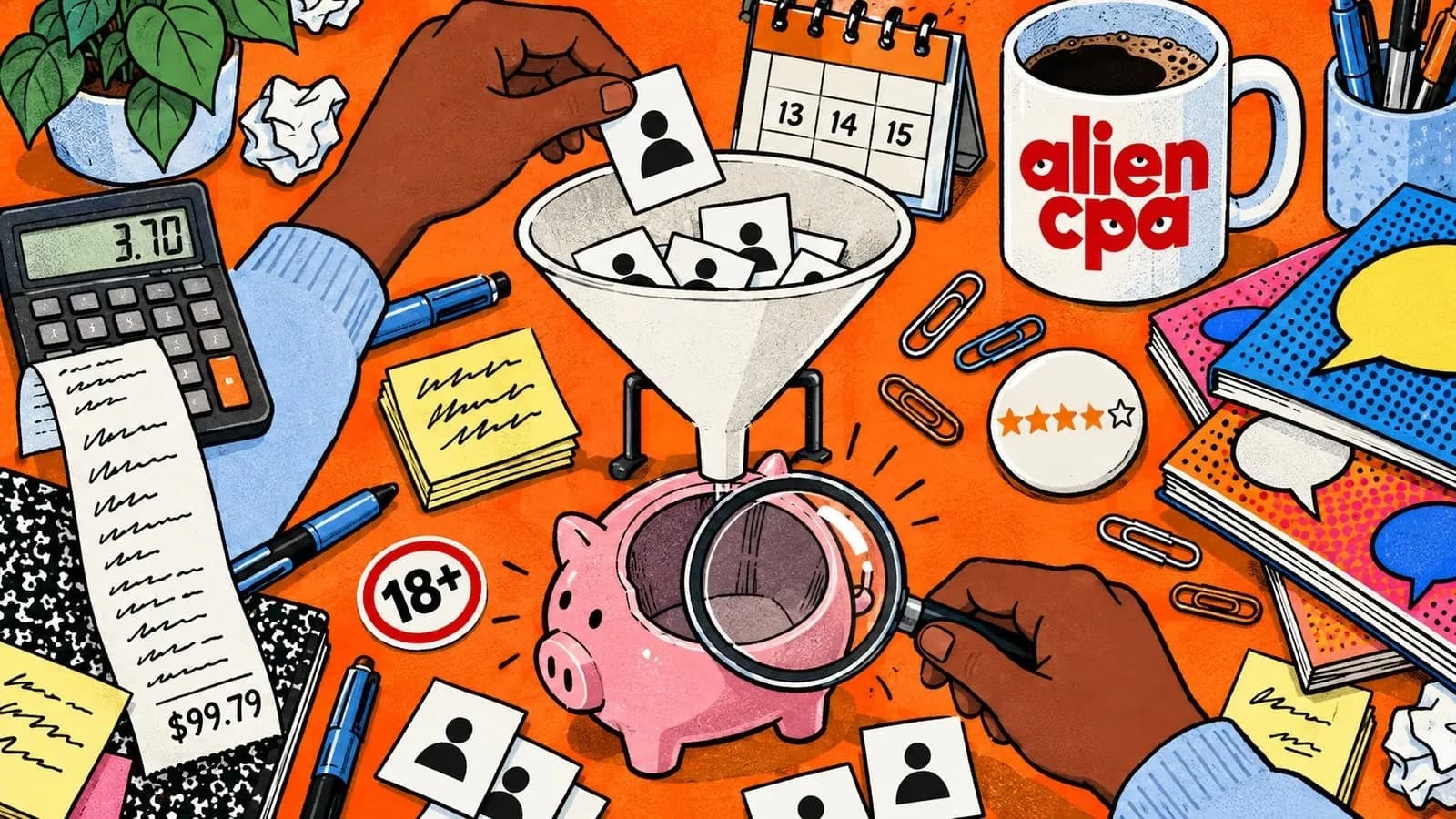
I spent $99.79 over 2 days testing an adult comics offer on 2 ad networks. I got 27 sign-ups, 0 sales and a clear answer: with this offer, these sources and this price per sign-up, the campaign could not pay off, so I stopped it.
This is the full diary, with every number from 3 dashboards, the creatives that ran, the mistakes I made along the way and the math that ended the test. It isn't a "how I made $10,000" story. It's an anti-case, and I'd rather you learn from my $99.79 than spend your own. Editorial fact-check: 4/5 (my own score for my own test, explained at the end).
Disclosure: I paid for this test myself. aliencpa has no commercial relationship with CPAmatica, HilltopAds or TrafficJunky. Some links to the networks are referral links, for readers who want to repeat the test and do it better than I did.
Why I tested adult comics
I found the vertical while reviewing a spy tool. 2 new adult formats kept showing up in the creatives: interactive porn comics and AI dating. I went through the dating affiliate programs looking for an offer to test and picked comics at CPAmatica.
CPAmatica wasn't a random pick. I've known this affiliate program for years. I've met its managers and tech people at conferences and meetups, and in private conversations they've told me how they work with traffic and which of their offers are their own products and which come from advertisers. I can't link to any of that, it's talk over coffee, not a public statement. But it's why I trusted the manager's word on this offer.
The offer works like this, according to the affiliate manager:
- the visitor lands on a page with a comic and reads 3 episodes for free;
- to keep reading, they register;
- then they choose a subscription: $9.99 a week, $14.99 a month, $24.99 for 3 months or $41.99 for 6 months.
The affiliate gets paid per sale (PPS): $25 for the user's first purchase in the US; in other countries the payout was $8. Registrations are free for the advertiser and pay me nothing.
The setup: 1 offer, 2 networks, a small budget
I launched at night, when every support team was asleep, and with a small budget. The plan was to see whether the offer converts before spending real money. I didn't plan to spend more than $200 on the whole test.
- Format — Mobile popunder (Smart CPM) and mobile banner (CPC), $20 a day. Display banners 300x250 and 300x100
- GEO — US. US
- Bid — Smart CPM $4.50, banner CPC $0.10. Network-recommended CPM bids by spot
- Targeting — Non-Mainstream traffic, high and medium activity. Keyword targeting: comics, cartoon, animated, 3D and similar
- Tracking — Postback on sales, sub IDs for zone and creative. Postback on sales, sub IDs for spot and keyword
CPAmatica has a manual step: the postback needs the manager's approval, and the manager builds the tracking links. That cost me autonomy, but the manager answered within an hour at night, picked the offer, prepared links with sub IDs and sent a pack of creatives for different formats. I didn't have to dig into the affiliate program's settings at all. Taking ready-made creatives from the manager is a normal way to start: for a first test you don't have to draw your own.
A reply within an hour at night is the exception, not the rule. More often you're left alone with your offer and your traffic. Here 2 managers helped at once, and it made the launch much easier.
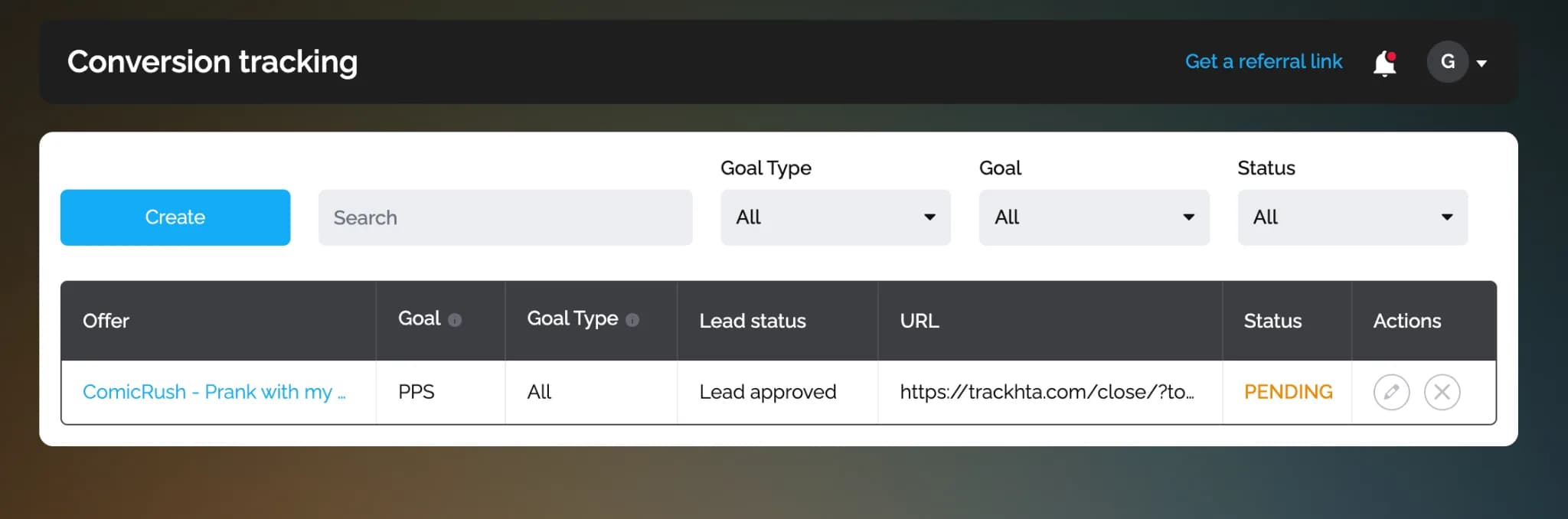
Night 1 on HilltopAds: everything is green, nothing moves
By morning both HilltopAds campaigns were approved and active, and neither had a single impression. The network's estimator had promised about 6,000 clicks at my bid.
This wasn't my first HilltopAds campaign. Earlier I ran payday loans to Colombia there, and traffic was even slower. This time the manager confirmed the problem in our chat: "I really don't see traffic on the campaigns. I'll check with the tech team, there may be a technical error." He also recommended moving banners from CPC to CPM, where there are more sources, including the network's direct ones.
An hour after that conversation the popunder started. Then I found the setting I had gotten wrong: pacing. On Evenly, HilltopAds spread my $20 daily budget across 24 hours so thin that impressions crawled. When I switched to ASAP, it spent the whole day's budget fast, and the campaign sat switched off for the rest of the day.
Neither extreme is a fair test. Next time I'd run ASAP with a higher daily cap, or Evenly with a budget big enough to buy real volume. The banner stayed on CPC and got 11 impressions in 2 days. I didn't follow the manager's advice to move it to CPM, so that result is on me.
TrafficJunky: rules first, traffic second
TrafficJunky setup is very formal, and to me its moderation felt as strict as Facebook's. Over half a day it rejected more than 30 of my creatives, because I hadn't read the rules. The note on one of them said it plainly: "Consent and the ability to consent is required for all creatives." That's on me, not on the network.
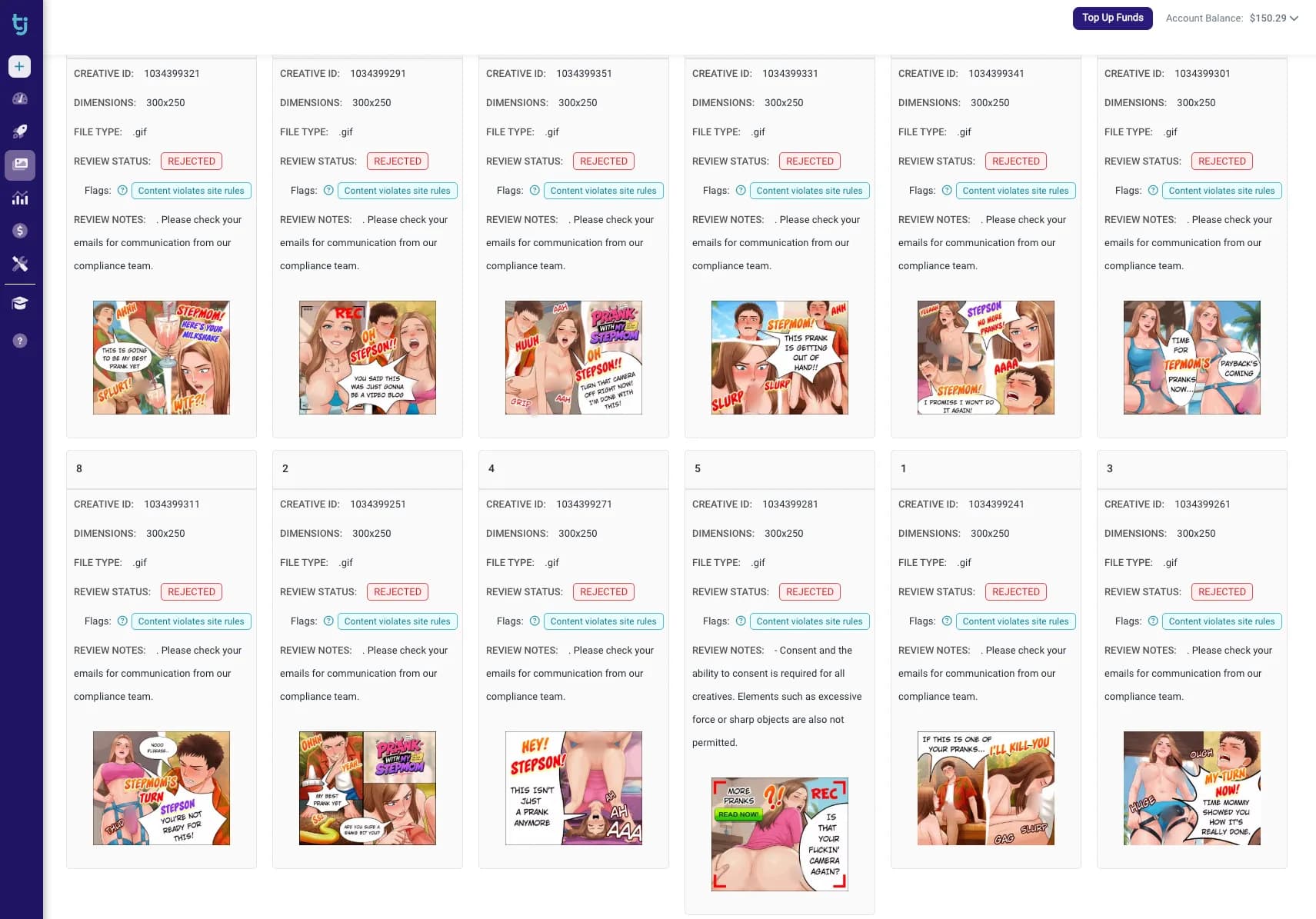
A note on the offer itself: the comic's hook is a hidden camera and a woman saying no. TrafficJunky was right to reject those creatives, and I wouldn't run them again. If you test this vertical, pick stories where consent is clear. The rules require it anyway.
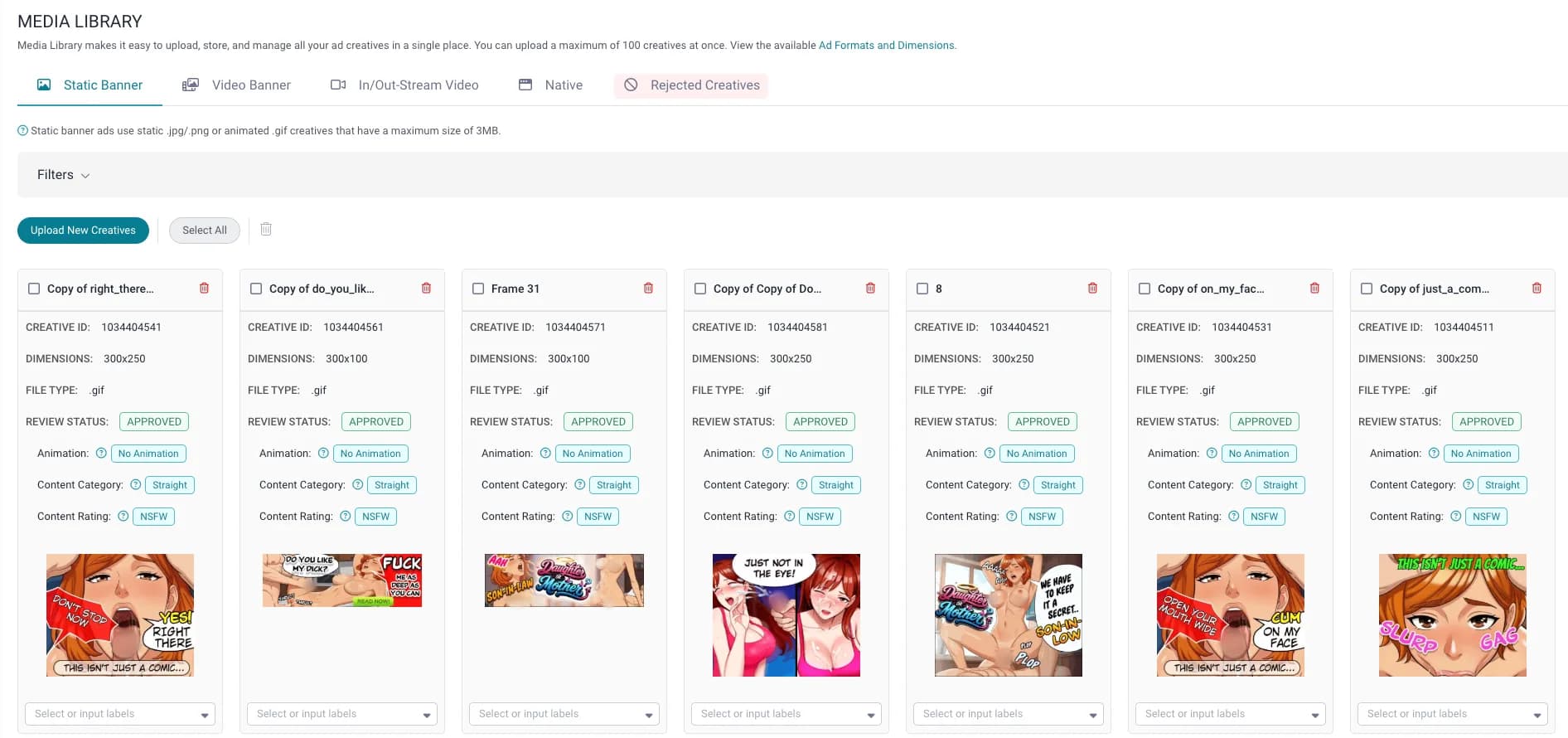
The CPAmatica manager sent a new batch, and 7 creatives passed. The first batch took about 3 hours to review, the last about 1 hour. These are the 7 that ran for the whole test: a different story, with lines where consent is clear, like "Yes! Right there" and "Don't stop now".
The campaign started about an hour after approval, and the first registration came in almost immediately. 2 things I liked: the placement whitelists and blacklists are fully transparent, and the auto-rules are easy to set up.

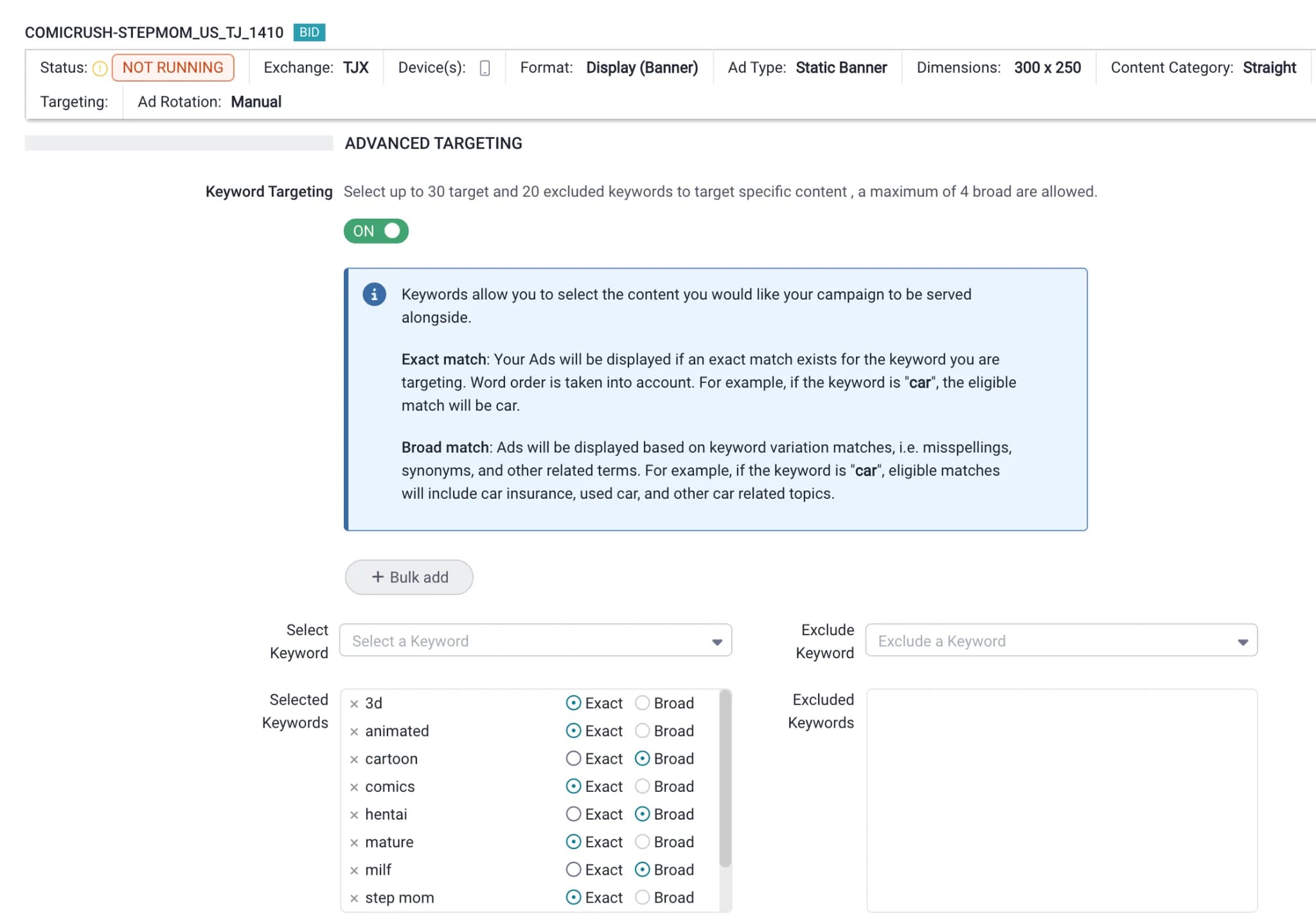
1 trap to know about: TrafficJunky notes that state-level taxes may apply to impressions delivered in the US and are invoiced monthly. They are not in the spend figures below.
And 1 postscript. A couple of hours after I stopped the campaigns, TrafficJunky banned the same 7 creatives that had passed moderation and run for 2 days. Approval isn't permanent: a creative that got through can end up banned later. Keep checking the status of your ads, not just the stats.
The numbers after 2 days
These are the final screenshots from all 3 dashboards for October 13-15, after I stopped the campaigns. I split registrations by traffic source in CPAmatica, which reports in Eastern European time.
- Spend. HilltopAds (popunder): $40.29. TrafficJunky (banners): $59.50. Total: $99.79.
- Traffic. HilltopAds (popunder): 15,447 popunder impressions. TrafficJunky (banners): 1,811,120 impressions, 421 clicks. Total: about 15,868 visits sent.
- Sign-ups. HilltopAds (popunder): 9. TrafficJunky (banners): 18. Total: 27.
- Cost per sign-up. HilltopAds (popunder): $4.48. TrafficJunky (banners): $3.31. Total: $3.70.
- Sales. HilltopAds (popunder): 0. TrafficJunky (banners): 0. Total: 0.
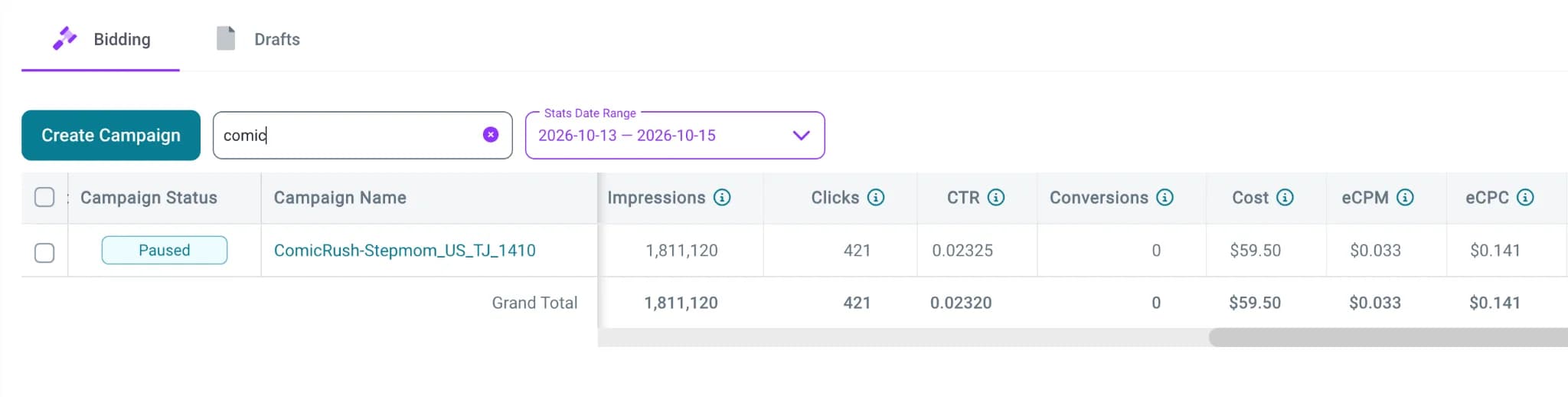
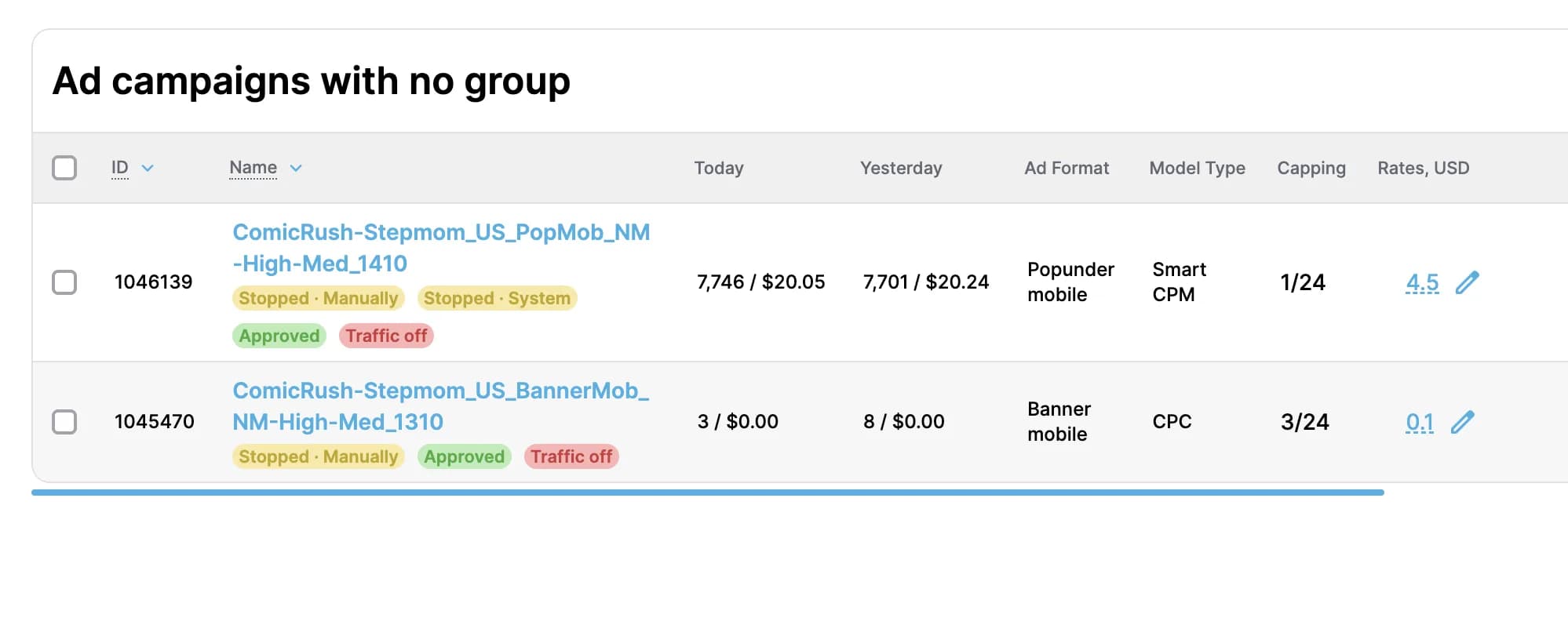
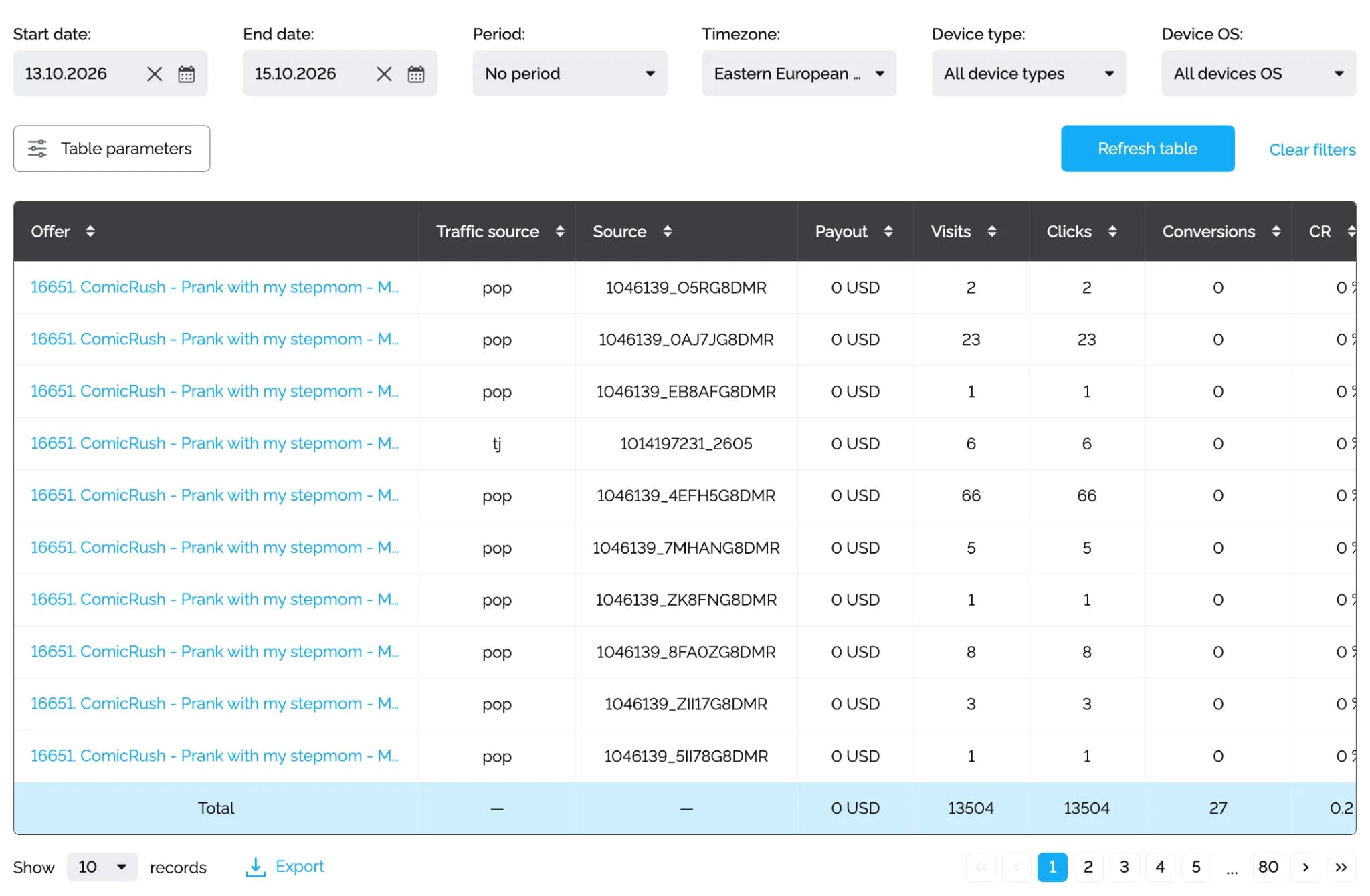
Why HilltopAds shows 0 clicks while CPAmatica shows thousands of visits: popunders have no clicks. Every impression is the landing page opening in a new window, so the network counts impressions and the affiliate program counts visits. The networks sent about 15,868 visits; CPAmatica counted 13,504, about 15% fewer. Some loss between a network and an affiliate program is normal: pages that close before the tracker loads, blocked redirects, bots.
TrafficJunky turned 421 clicks into 18 sign-ups, about 4.3%. HilltopAds needed about 1,700 popunder impressions per sign-up. Both networks delivered once the setup was right: HilltopAds spent its daily budget fast on ASAP, and TrafficJunky brought sign-ups from the first hours.
Why 27 sign-ups and $0 is math, not bad luck
I asked the CPAmatica manager 2 questions I should have asked before launch. What share of sign-ups pay on this offer, and how soon? The answers: about 3-5% on average, and 97% of buyers pay on the first day. The attribution window is at least 90 days, but late sales are rare.
That turns the result into arithmetic:
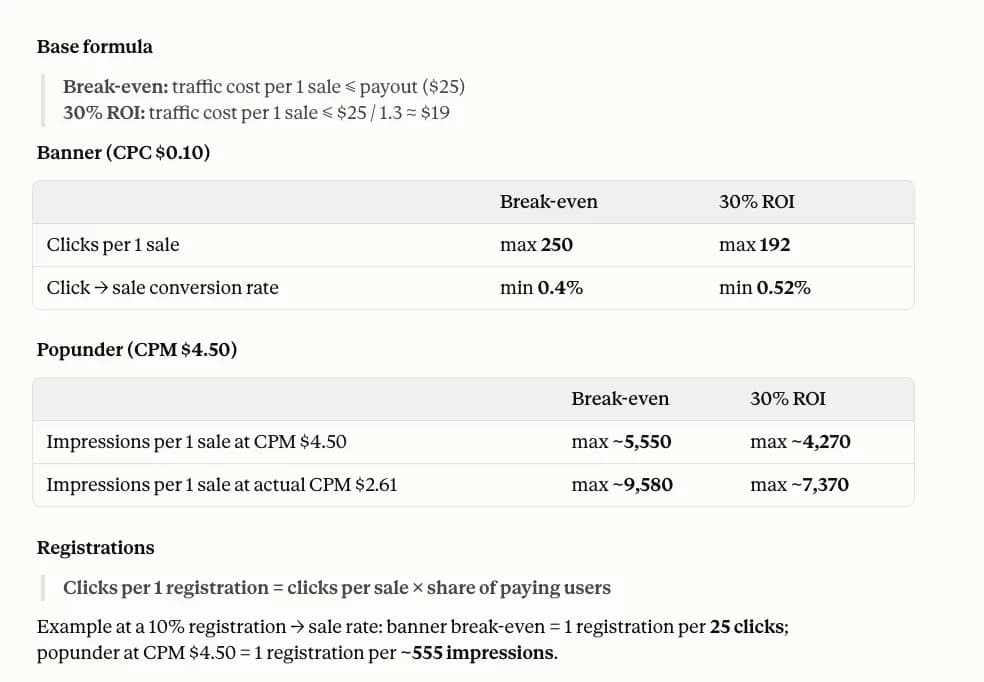
- Break-even cost per sign-up = payout × share of sign-ups that pay. At $25 and 3-5%, that's $0.75-1.25. I paid $3.70, 3-5 times more.
- Cost of 1 sale = cost per sign-up ÷ share that pay. At $3.70: about $123 at 3%, $74 at 5%, $37 even at 10%. The payout is $25.
- Chance of 0 sales from 27 sign-ups = (1 − share that pay)^27. It's 44% at 3%, 25% at 5% and about 6% at 10%. So 0 sales is a normal outcome at the manager's rates, and 10% is something this traffic almost certainly doesn't deliver.
That's why I stopped at about $100 and not at the $125-250 I usually set for testing a network (5-10 payouts). More budget would buy more sign-ups at the same price, not a different answer. In my experience, cutting zones and creatives saves tens of percent, not 3-5 times. And the $25 payout on a $9.99 first subscription is already generous: the advertiser earns on renewals, so there's no room to raise it much.
How an AI assistant helps with launch and optimization
An AI assistant won't run a test for you, but it takes a lot of routine off your hands. I picked the offer and the networks, set up both campaigns, chose the bids and the budget and talked to both managers. I used Claude where a second pair of hands is faster than me:
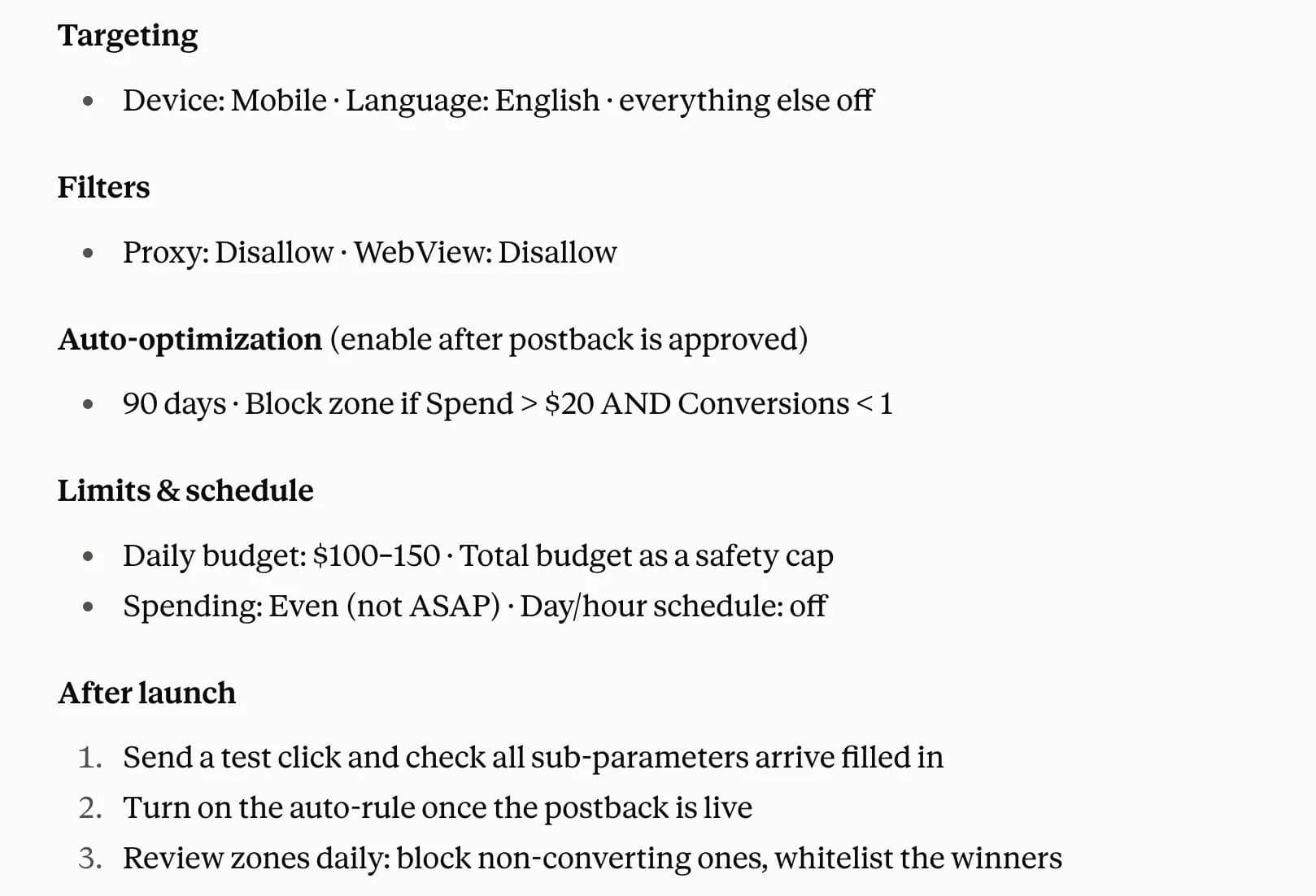
- Targeting. On a network that's new to you, it quickly suggests a starting setup: devices, language, traffic channels, which traffic to switch off (proxy, WebView) and an auto-rule for zones that spend without converting. You still check it against the network's estimator and your own budget.
- Tracking links. It builds a link with every sub ID in one go, zone, creative, keyword and site, plus the postback template. That's where 1 typo costs you a day of blind stats.
- Recalculating the numbers. Paste in the figures from the dashboards, and in a minute it recalculates cost per sign-up, break-even clicks and impressions per sale and the chance of 0 sales, every time the numbers change.
- Showing where the ads work better. Give it stats by zone, creative or keyword, and it highlights where sign-ups come cheaper and what to cut.
It also catches traps you'd notice too late. With my postback firing only on sales, it pointed out that a TrafficJunky rule like "spend over $25 and 0 conversions" can't see registrations, so it pauses sources that bring sign-ups but no sales yet.
The decisions stay with you. Its plan had Evenly pacing at $100-150 a day; I set $20, because the whole test had a $200 ceiling. Which offer, which network, how much to spend and when to stop was my call.
What I'd do differently
I broke my own rule. I believe adult should be run on pay-per-registration offers. It wasn't part of this test, it's just how I think. On top of that, I didn't plan to spend more than $200 on the test, and that alone pointed to a registration offer.
The comics offer caught me with a ready-made kit and an easy launch: the manager gave me everything, the networks approved my campaigns and sent them live, Claude helped with targeting and links. And then my greed kicked in. Why run old dating offers at $2-3 per registration when this one pays $25 per sale? Even that was only half true: $25 is the US payout, in other countries it was $8. Greed plus the urge to launch right now, and I rushed and put everything live as it was. I let it slide and skipped the planning that would have shown an obvious miscalculation.
Someone will say $99.79 isn't a case at all, not even a real expense. Maybe. But I'm grown up enough not to burn money just to look good. Here's what it bought me:
- A pay-per-sale offer needs more time and more money for the test. 1 sale costs the price of a sign-up divided by the share of sign-ups that pay. Ask the manager for that share before launch, and you know the test budget before you spend a cent.
- Creatives for a paid product should name the action and the price. Then the people who click at least know the comic will cost money. Without it you pay for curiosity.
- Collect whitelists and blacklists on a registration offer first. Ideally, you come to a PPS offer with your own lists. I could have built them on a CPL offer: with a small budget and a low bid, find the placements with a live audience for my categories, hentai, manga, stepmom stories, and partly pay back the traffic along the way. Then run the PPS offer on those placements only.
- Read the network's ad rules before uploading creatives, not after the rejections.
- Set pacing on purpose. Not Evenly with a tiny budget, not ASAP without an hourly plan. And run banners on CPM where the network says the volume is.
Should I have stopped at $99.79 or run it to the end? I think stopping was right. Tests should follow a plan, not random steps. After all, affiliate marketing isn't a casino: luck and freebies don't work here.
If you come in with a big budget, ask the network about a managed service. In private conversations, managers of several ad networks told me big advertisers can get one, up to buying out a placement or a whole GEO. I have no records of those talks, so take it as hearsay. Casino brands, for one, are a normal client for TrafficJunky: its rules allow gambling ads where local law permits, and its own blog runs an iGaming section.
If you want to repeat this test and do it better, here's TrafficJunky through my referral link.
Fact-check: what I showed and what I didn't
We rate every case on 10 points: what an outsider needs to judge the result and repeat it. Here I'm grading my own test with the same scale we use for everyone else.
- Setup: period, GEO, offer, model — Showed. October 13-15, 2026, US, adult comics subscription offer from CPAmatica, $25 per first purchase.
- Author and independence — Showed. I'm the editor of aliencpa, and testing offers and networks with my own money is part of the job. No financial obligations to CPAmatica, HilltopAds or TrafficJunky, nothing to sell; referral links are disclosed.
- Finances — Showed. Spend by network, sign-ups, cost per sign-up, $0 revenue, ROI -100%. TrafficJunky's US state taxes are not included.
- Proof — Showed. Final screenshots from all 3 dashboards for the same dates, after the stop.
- Source and targeting — Showed. Formats, bids, keywords, budget and pacing, including what I set wrong.
- Tools — Showed. CPAmatica sub IDs and postbacks, the networks' own stats and auto-rules, Claude as an assistant. No tracker: I didn't use one, and direct links with sub IDs did the job.
- Creatives — Showed. The 7 creatives that ran on TrafficJunky, the rejected batch and the reason. They came from the affiliate manager. Only explicit details are blurred.
- Landing pages and funnel — Partial. I didn't walk the funnel to the payment page: the user journey and prices are the manager's words. It wouldn't have changed the result, since a subscription offer doesn't work without whitelists and creatives that name the price.
- Costs beyond media — Showed. Self-serve networks, no accounts or other paid tools.
- Repeatability today — Partial. The setup can be repeated in an evening, but it's better repeated on ready whitelists and blacklists. Take the lessons from this test, not a to-do list.
Score: 4/5. The money, the screenshots, the settings and the creatives that ran are all open, mistakes included. The gaps are small: I didn't walk the funnel to the payment page, and 27 sign-ups is a small sample. It's a test diary to learn from, not a playbook to copy.
Checklist: what to do
Questions and answers
Why did I get registrations but no sales?
On this offer only 3-5% of sign-ups pay, according to the affiliate manager. From 27 sign-ups you'd expect about 1 sale, and the chance of getting none is 25-44%. The real problem was the price: at $3.70 per sign-up, 1 sale costs $74-123 against a $25 payout. My creatives also didn't say the comic is paid, so part of those sign-ups were curiosity clicks.
Why does my popunder campaign show 0 clicks?
Popunders don't have clicks. Each impression opens the landing page in a new window, so the network reports impressions while your affiliate program reports visits. Compare impressions with visits, not with clicks.
Why is my campaign approved but getting no impressions?
Check your bid against the network's estimate, your pacing and your daily budget, then ask the manager. In my case the HilltopAds manager confirmed there was no traffic and took it to the tech team; after that, switching from Evenly to ASAP made the biggest difference.
Why did TrafficJunky reject my adult creatives?
Mine broke the consent rule: TrafficJunky requires consent and the ability to consent in all creatives, and doesn't allow excessive force or sharp objects. Read its rules page before you upload.
Can approved creatives get banned later?
Yes. A couple of hours after I stopped my campaigns, TrafficJunky banned the 7 creatives that had passed moderation and run for 2 days. Check creative statuses during and after a campaign, not only at launch.
How much should I spend to test an offer?
I usually budget 5-10 payouts per network. A pay-per-sale offer needs more time and money, so on a small budget start with a registration offer and collect your placement lists first. And if the break-even math already shows the sign-up price is several times too high, stop early: more budget buys more of the same answer.
Author’s conclusion
This test didn't make money, and it wasn't supposed to make a fortune. It answered 1 question for $99.79: can a $25 pay-per-sale comics offer pay off on HilltopAds popunders and TrafficJunky banners at my settings? No. The sign-ups were real, but 3-5% paying users can't cover $3.70 per sign-up.
My advice: do the math before the money. Ask the manager what share of sign-ups pay, multiply it by the payout, and compare the result with the price per sign-up your sources can give. If it's 3 times off, change the offer or the payout model, not the budget. And if you want a pay-per-sale offer on a small budget, come to it with your own whitelists, built on a registration offer first.
Lu Discover, Editor-in-chief
Our verdict on this case
The money, the screenshots, the settings and the creatives that ran are all open, mistakes included. The gaps are small: I didn't walk the funnel to the payment page, and 27 sign-ups is a small sample. It's a test diary to learn from, not a playbook to copy.
Our fact-check of the public case: what the numbers show, what is missing. Scores are never for sale.
Sources for this article
- trafficjunky.com — TrafficJunky Rules and Regulations: consent requirement for creatives, gambling advertisements by country and state law (last updated July 23, 2026)
- blog.trafficjunky.com — TrafficJunky blog, iGaming section
Companies in this article
- CpamaticaAffiliate networkNot rated yet
- HilltopAdsTraffic sourceNot rated yet
- TrafficJunkyTraffic sourceNot rated yet

Related stories
 Top list
The Affiliate Rich List 2026: Who Owns the Networks, and What It's Worth
 Guide
GuideHow Much Budget Do You Need to Test an Offer? What $100 Can and Can't Tell You
 Comparison
Comments
0 commentsNo comments yet.
Add a comment