

How Much Budget Do You Need to Test an Offer? What $100 Can and Can't Tell You

Independent and reader-supported. Some links here are affiliate links: if you sign up through them, we may earn a commission at no cost to you. It never changes our scores or verdicts. Affiliate disclosure
Contents 10
On the second morning of my last test, I had 27 sign-ups, $99.79 spent and $0 earned. And I was asking the question every beginner asks before a first campaign: how much do I have to spend before I know whether an offer works?
There is a real answer, and it isn't a dollar figure. It depends on the payout, on the funnel step you can measure and on 1 number you get from the affiliate manager. I could have worked it out before I spent a cent. Here's the math, what $100 can and can't tell you, what 10 ad networks ask before your first impression, and a test plan that keeps a small budget honest.
Count your test budget in payouts, not dollars
The same $100 is a big test for one offer and a coin flip for another. What matters is how many conversions it buys at break-even. At break-even you spend exactly 1 payout per conversion, so divide the budget by the payout: $100 is 20 payouts on a $5 lead offer, 4 on a $25 sale and 1 on a $100 deposit.
Then work with 2 thresholds:
- Kill test, 3 payouts: enough to tell a dead setup from an unlucky one.
- Rough read, 10 payouts: enough to see roughly where your cost per conversion sits against the payout.
- $5 — $15. $50
- $25 — $75. $250
- $100 — $300. $1,000
My own rule for testing a network is 5-10 payouts. For the $25 adult comics offer in my test diary, that meant $125-250 per network. I stopped well below it, and the next 2 sections explain why that was the right call.
Why 0 sales on a small budget proves less than you think
If a setup exactly breaks even, every payout you spend buys 1 expected conversion. Conversions arrive at random, so you can still end up with none. The chance is e^-N, where N is the number of payouts spent (a Poisson approximation, accurate enough for this job).
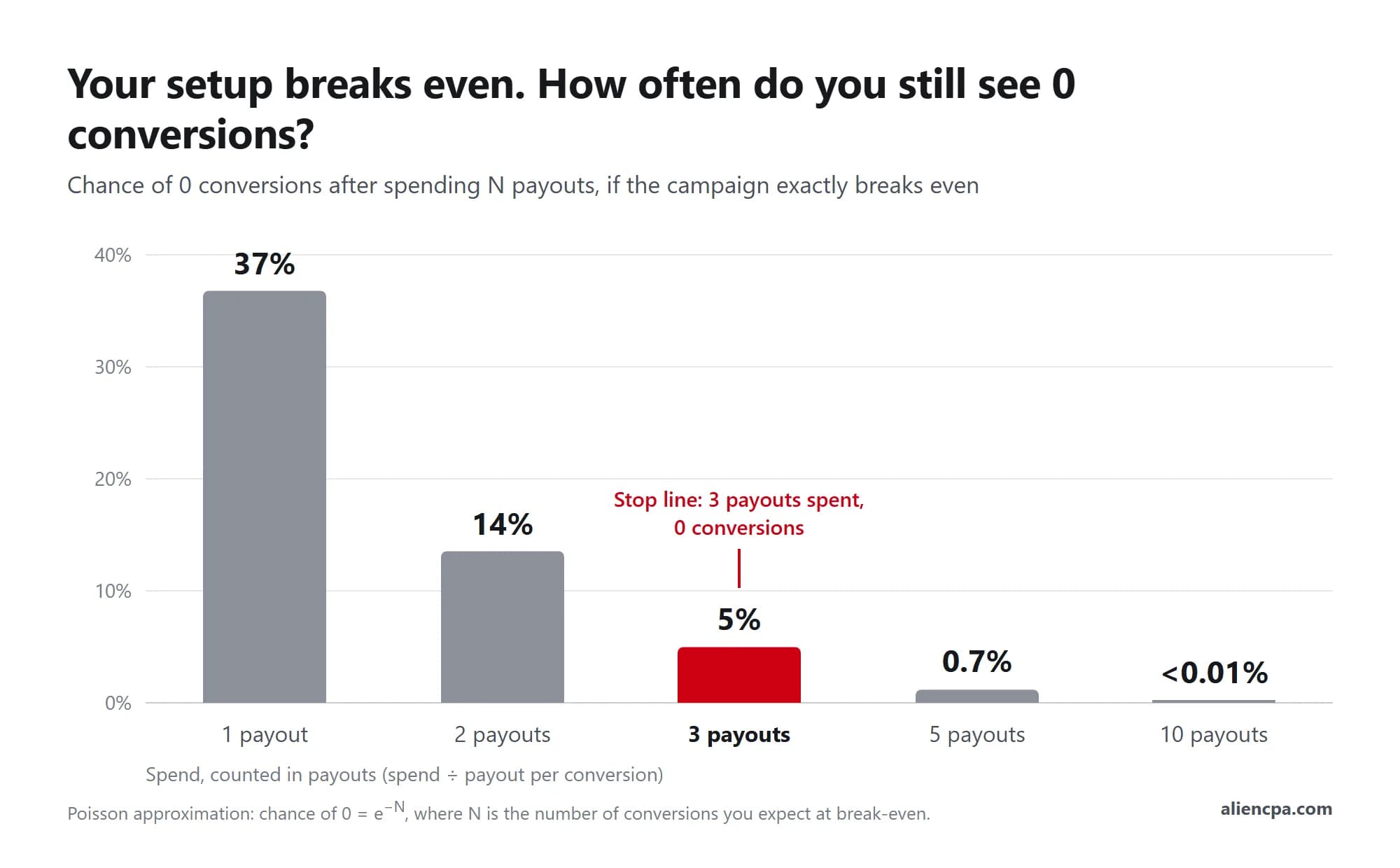
- 1 payout spent, 0 conversions: happens 37% of the time even on a break-even setup. It tells you nothing.
- 2 payouts: 14%. Suspicious, not conclusive.
- 3 payouts: 5%. If the setup really broke even, you'd see this about 1 time in 20. Stop or change something.
- 5 payouts: under 1%.
1 conversion doesn't prove much either. A rough error margin on any measured rate is 1 divided by the square root of the events you counted: about ±45% at 5 conversions, ±32% at 10 and ±18% at 30. That's why ad networks want volume before their algorithms act: ExoClick's Smart Bid FAQ says it typically takes around 30 conversions to start optimizing efficiently.
My test is a clean example of a budget that couldn't answer the sales question. $99.79 on a $25 payout is 4 payouts in total, and I split it: $40.29 on HilltopAds, or 1.6 payouts, and $59.50 on TrafficJunky, or 2.4. Neither network reached the 3-payout line on its own. If 0 sales had been my only signal, I'd have learned nothing. It wasn't, because I could measure the step before the sale.
Measure the cheap step, not the expensive one
On a small budget you can't wait for sales, but you can price the step that comes before them. Every funnel has cheaper, more frequent events before the payout: clicks, landing page visits, sign-ups, installs. You get many more of them per dollar, so their price settles fast.
The formula that ties them to the payout:
Max cost per step = payout × share of that step that turns into a paid conversion.
The share is the only number you can't calculate yourself, so ask the affiliate manager before launch. I asked after the test. On the comics offer, about 3-5% of sign-ups pay, and 97% of buyers pay on the first day.
Here's my test against that formula, at a $25 payout with 3-5% of sign-ups paying:
- Sign-up — $3.70. $0.75-1.25
- TrafficJunky click (4.3% of clicks signed up) — $0.141. $0.03-0.05
- HilltopAds popunder, per 1,000 impressions (1 sign-up per ~1,700) — $2.61. $0.44-0.73
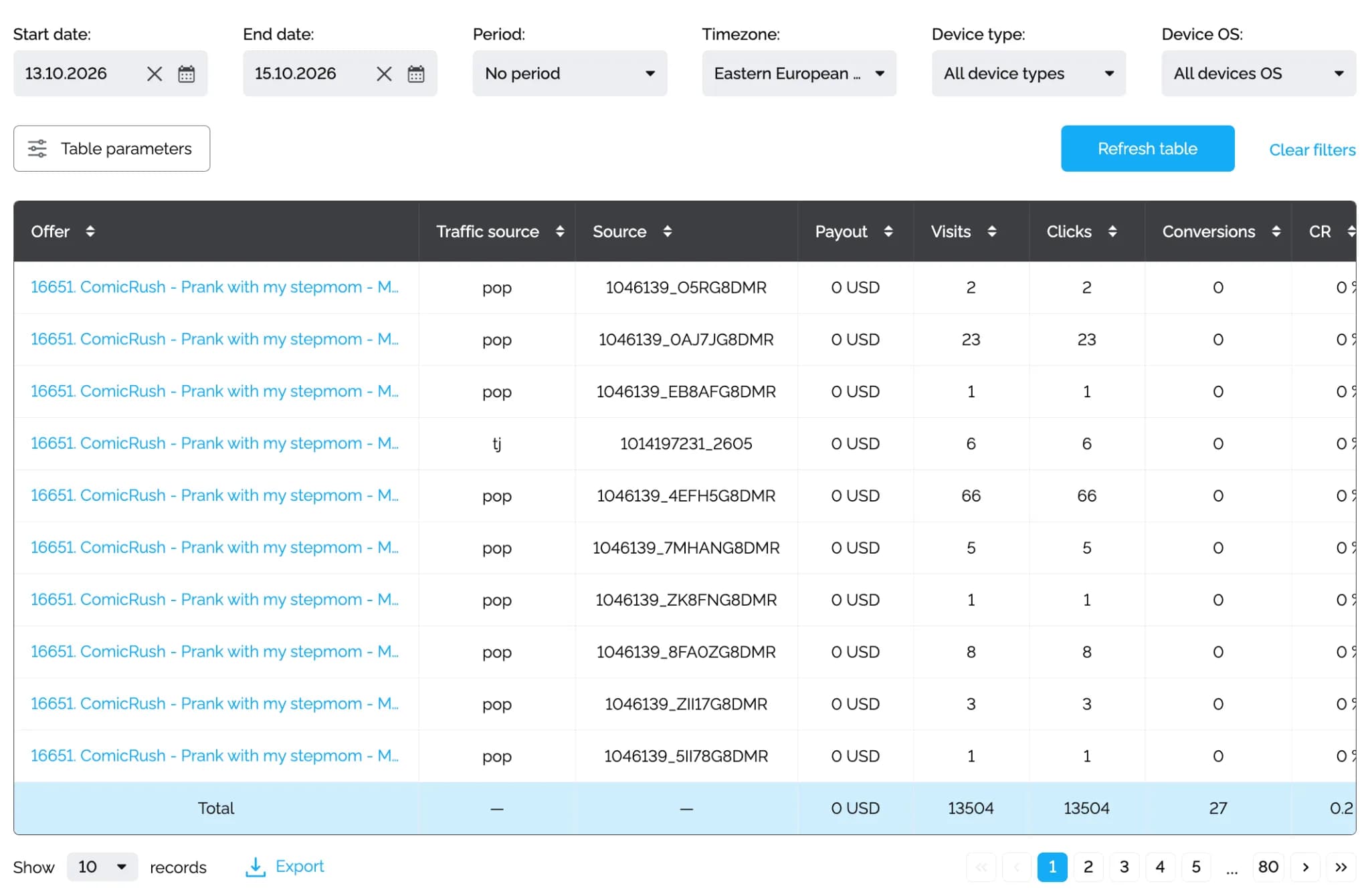
27 sign-ups were enough to trust that verdict. By the same ±1/√N rule, my real price per sign-up was somewhere between $3.00 and $4.40. Even the best case was 2.4 times above break-even, and the worst almost 6 times. That's why I stopped at $100 instead of buying another $150 of the same answer.
What $100 can test, and what it can't
A small budget is a smoke test of the setup, not a profit test. On $100 you can learn:
- whether the source delivers traffic at your bid at all. My HilltopAds campaigns were approved and showed 0 impressions until the manager took them to the tech team;
- whether tracking works: the postback fires, sub IDs arrive, and the network and the affiliate program roughly agree;
- whether your creatives pass moderation. TrafficJunky rejected my first batch under its consent rule, and getting new creatives approved took hours;
- what a click, a visit and a sign-up cost from this source;
- whether you're within reach of break-even or several times off.
What $100 usually can't tell you:
- whether a pay-per-sale offer with a $25+ payout makes money, unless the step before the sale is very cheap;
- which zones, placements or creatives win. Comparing variants takes dozens of conversions each, not a few in total. For a test order that respects a small budget, see our broad-to-narrow creative testing framework;
- lifetime value on RevShare, which arrives over months.
Choose a payout model your budget can measure
The earlier the paid event sits in the funnel, the more a small budget can tell you. With the same traffic and the same $100, the payout model decides whether you get an answer at all. Here's what my $99.79 bought, read through 3 models:
- Per sign-up (CPL or SOI) — 27. Yes, roughly: price known within about ±19%
- Per sale (CPA, $25, 3-5% of sign-ups paying) — about 1 expected (0.8-1.4). No
- RevShare — Revenue arrives over months. Not inside a test
At $3.70 per sign-up, an offer paying $4-5 per registration would have been in profit on paper. That's the cheapest lesson from my test. For a first campaign on a small budget, pick an offer that pays early in the funnel, or test a pay-per-sale offer by pricing the step before the sale, with the paying share from the manager in hand.
The entry ticket: what 10 ad networks ask before your first impression
On many self-serve networks, $100 is the minimum deposit, not a test budget. I checked each network's own help pages and terms in October 2026:
- HilltopAds — $100 for most payment methods, EUR 500 by wire; minimum daily campaign budget $20. Not stated
- PropellerAds — From $100, depending on the payment method. Not stated
- Adsterra — $100 by card, Paxum or PayPal; $200 via Inxy; $1,000 by wire. CPA test budget: $100 for the US, France and Germany, $10-50 for other GEOs
- Clickadu — $100. Not stated
- Galaksion — $50. Not stated
- MGID — $100. Recommends depositing at least $650
- RichAds — $150. Not stated
- ExoClick — 200 EUR or USD; EU advertisers without a valid VAT number lose 21% of each top-up to VAT. Smart Bid needs around 30 conversions to optimize
- TrafficStars — Not published. $500 as a starting point; more than $100 for Tier-1 and Tier-2 tests; $50 minimum for CPA tests
- TrafficJunky — Not published; ID or company verification before you can add funds. Not stated
What that means for a small budget:
- Don't split it across networks. Each network wants its own deposit, and each gets fewer payouts of spend. Put the whole test into 1 source, 1 format and 1 GEO.
- Unspent money stays on the balance. Read the refund terms before you deposit more than the test needs.
- Media isn't the only cost. Payment fees, VAT and local taxes come on top: TrafficJunky, for one, charges local taxes on impressions delivered in Washington State.
- The minimum daily budget sets your pace. I ran HilltopAds at $20 a day, which turned out to be exactly its minimum daily limit. On Evenly pacing, which the docs describe as reaching the limits "gradually... throughout the day", impressions crawled. On ASAP, "as quickly as possible", the $20 was gone in about 2 hours and the campaign sat idle until the next day.
A $100 test plan, step by step
- Ask the affiliate manager 3 questions before launch: what share of sign-ups (or leads, or installs) pay, how soon they pay, and which sources and formats work on this offer.
- Calculate the break-even price of every step you can measure: a sign-up, a click, 1,000 impressions.
- Pick 1 network, 1 format and 1 GEO, and put the whole budget there.
- Write your stop rules before launch, in dollars and in steps: stop at 3 payouts of spend with 0 conversions, or after 20-30 sign-ups that cost 2 times break-even or more.
- Watch the first hour: spend, impressions and a test conversion through the postback.
- If there are no impressions after 1-2 days, ask the network manager, try another format on the same network, then move to another source.
- Decide by the gap. Below break-even: continue to 10 payouts. Up to about 1.5 times above: cut zones and creatives and retest. 2 times or more: stop and change the offer or the payout model. In my experience, cleaning zones and creatives saves tens of percent, not multiples.
Checklist: what to do
Questions and answers
Is $100 enough to start affiliate marketing with paid traffic?
It's enough for a smoke test on a self-serve network with a $50-100 minimum deposit, and to price clicks and sign-ups. It isn't enough to prove that a pay-per-sale offer with a $25+ payout makes money. Pick offers that pay early in the funnel, or price the step before the sale.
How many conversions do I need before I judge an offer?
About 3 payouts of spend tell a dead setup from an unlucky one. About 10 conversions give a rough cost per conversion, give or take 30%. Around 30 is where networks such as ExoClick say their bidding algorithms start to optimize efficiently.
When should I stop a campaign with no conversions?
When you've spent 3 payouts with 0 conversions. If the setup really broke even, that would happen only about 5% of the time.
Should I split my test budget between 2 ad networks?
Not on a small budget. Each network needs its own minimum deposit and gets fewer payouts of spend, so neither can give you an answer. Test 1 source first.
What should I ask the affiliate manager before testing an offer?
What share of sign-ups or leads pay, how soon after sign-up they pay, and which sources and formats work on the offer. The first answer gives you the break-even price of a sign-up.
Author’s conclusion
$100 is enough to learn a lot about a setup and almost nothing about the profit of an expensive conversion. Count the budget in payouts, measure the cheapest step you can, and get the paying share from the affiliate manager before launch. My $99.79 test showed it: 27 sign-ups gave a clear answer that 0 sales never could.
My advice: before you spend your first dollar, write 3 numbers on a sticky note: the payout, the share of your measurable step that pays, and the break-even price of that step. If the source can't get near that price within the first 20-30 events, no budget will fix it. Change the offer or the payout model instead.
Lu Discover, Editor-in-chief
Sources for this article
- hilltopads.com — What payment methods are available: minimum deposits by method (June 16, 2026)
- hilltopads.com — API campaign management: $20 minimum daily budget, ASAP and Evenly pacing
- propellerads.com — Terms and Conditions, section 4.5 (last updated July 21, 2026)
- adsterra.com — Adsterra minimum deposit and CPA test budgets by GEO (May 22, 2026)
- clickadu.com — Advertiser terms, section 3.4 (last updated March 20, 2026)
- galaksion.com — Deposit
- help.mgid.com — MGID's pricing and billing model
- richads.com — Push notification advertising (updated October 14, 2026)
- docs.exoclick.com — Advertiser payments: minimum payment and VAT
- docs.exoclick.com — Smart Bid FAQs: no minimum budget, around 30 conversions to optimize
- trafficstars.com — What budget should I start with
- trafficjunky.com — FAQ: verification before adding funds, Washington State taxes
Companies in this article
- HilltopAdsTraffic sourceNot rated yet
- TrafficJunkyTraffic sourceNot rated yet
- PropellerAdsTraffic sourceNot rated yet
- AdsterraTraffic sourceNot rated yet
- ClickaduTraffic sourceNot rated yet
- GalaksionTraffic sourceNot rated yet
- MGIDTraffic sourceNot rated yet
- RichAdsTraffic sourceNot rated yet
- ExoClickTraffic sourceNot rated yet
- TrafficStarsTraffic sourceNot rated yet





Related stories
 Top list
The Affiliate Rich List 2026: Who Owns the Networks, and What It's Worth
 Case fact-check
Adult Comics Test Diary: $99.79 on HilltopAds and TrafficJunky, 27 Sign-ups, 0 Sales
 Comparison
Comments
0 commentsNo comments yet.
Add a comment