

An AI Astrology Bot on Facebook Ads: $300, 77 Unpaid Invoices and 0 Sales, Fact-Checked

Contents 12
"Here's the snag: there are no sales." That's how a Telegram channel called "Sliva: In search of a business model for $100" summed up its latest experiment on August 18, 2026: an AI astrology bot sold to Spain through Facebook ads. $300 spent, 221 people started the bot, 200 saw the offer, 77 asked for an invoice, and 0 paid.
This is our review of the series for affiliates and solo builders selling cheap digital products through chat bots: the author's posts in translation, our math on his numbers, the payment rules that apply to Telegram bots, and what the case leaves out. It's an anti-case, so the score rates how honestly and in detail the failure is analyzed. Editorial fact-check: 3/5.
Short version: the funnel is shown step by step, the failure is admitted in plain numbers, and the author even flags his own sales pitch as manipulation. But he never finds the cause, his spend, click prices and starts don't reconcile, and the likeliest culprit, how the bot took money, never comes up.
Who ran the experiment
The channel was created on July 1, 2026, and had 335 subscribers when we checked. Its author doesn't give a name; his first post describes "10 years in traffic," offline shops, an ad agency and media buying teams. The format is the channel's premise: test a business idea on a small budget "instead of you." The astrology bot ran in posts 49 to 58, from July 29 to August 18. Every quote below is our translation.
He sells nothing in this series: no course, no paid channel, no referral link. Later posts promote affiliate programs for a different project of his, a relocation site.
Our take: that independence is the case's best feature. Nobody here is selling the method, which is why the failure is told without spin.
The product: a free chart and a paid reading
The format, in his words: "Telegram bot + traffic from Facebook + a simple, cheap product + a Western GEO (I chose Spain)." The model: "a free product, generating the natal chart itself, and payment for the reading."
How it was built:
- the natal chart image comes from a ready-made astrology API;
- the reading is written by AI per user, about 15 A4 pages in 5 blocks: general, who you really are, love and sex, career and money, your demons;
- the style came from transcripts of a popular Russian astrology TV show fed to Claude, so the bot talks "like a tipsy girlfriend at a bachelorette party." The Spanish text is a translation and, he admits, "sounds a bit off";
- the flow: a mini-reading after 1 minute, "red flags" after 3 minutes, an offer at 4.90 euros for the personality and love sections, and a push after 30 minutes with a 3.90-euro price.
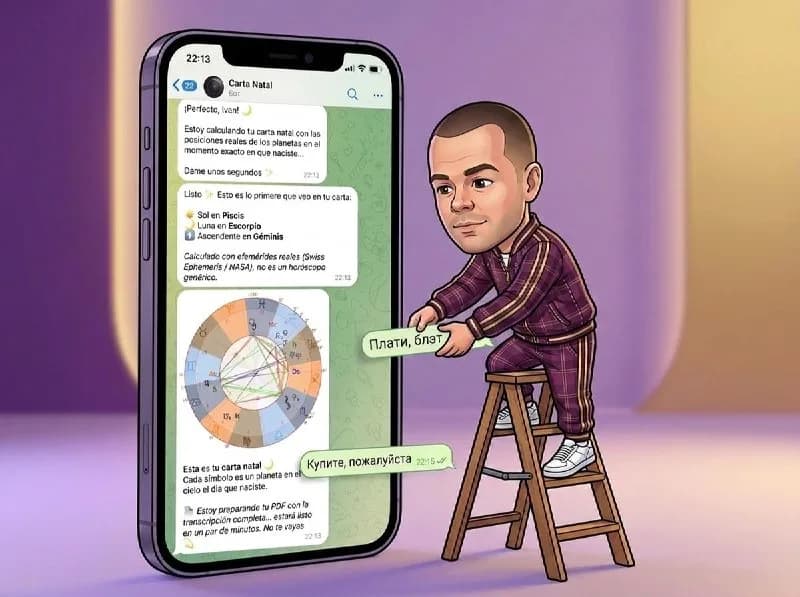
The "red flags" step is the hook: the bot hints that it found "SOMETHING SPECIAL" in the chart, with a red circle emoji, and asks for money to reveal it. The author's own judgment: "Manipulation in its purest form," and "I caught some discomfort and a red flag for myself."
Our take: a free, personal, instant result followed by a paid "but there's more" is a standard low-ticket funnel. The pressure step is the part to question, and the author did. A cold user who gets a warning about their love life 3 minutes after meeting a bot is as likely to leave as to pay.
The economics on paper
His plan: "the typical impulse purchase in Spain is 20-25 euros, I thought a click would cost about 20 cents, a purchase 1 in 100 (yes, lol). So spend is $20 per sale, set the price at 30, ROI 50%, we live."
He tried 2 price structures: "I lost on both options, first head-on, then in parts." Head-on was the full reading at 29 euros. In parts was a ladder of 4.99, 9.99 and 14.99. The bot that produced the final stats asked 4.90.
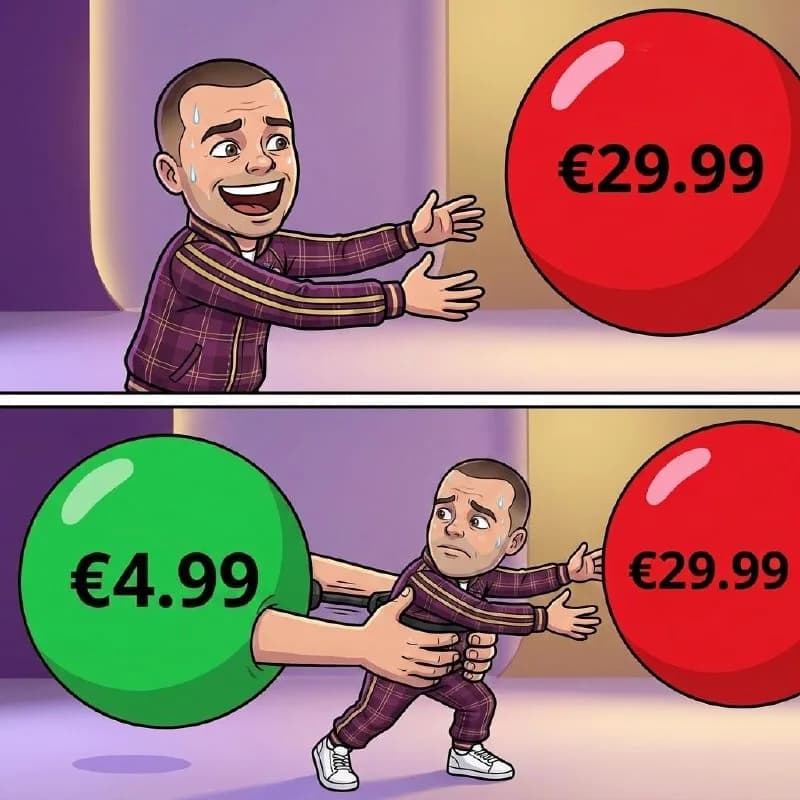
Our math: at 20 cents a click and 1 sale per 100 clicks, a sale costs $20 in ads. At 30 euros that's a decent margin. At 4.90 euros the same funnel needs 1 sale per 25 clicks just to cover ad spend, 4 times the conversion his plan assumed. Cutting the price by 6 times without changing the funnel made break-even 6 times harder.
The creatives: a static that flopped and a $10 AI video
The static ad was copied from a spy tool: "What do your date and time of birth reveal about your strengths and your money flow? Discover your natal chart." Result: "clicks at $1.5-2, CTR at 1-2-3%, which is no good at all."

The replacement was an AI-generated "UGC" video, made from "2 lines of prompt" in about 5 minutes: "the price of it all is $10. Ordering something like this on Fiverr would cost about $70." Result: "clicks at 0.12-0.17 and a high rate of transition to subscription almost without losses."
Our math: the video cut the cost per click by 10 to 15 times. That's the 1 clear win in the case.
Our take: a fake customer in a creative is still a fake customer, generated or filmed. Cheap AI UGC buys attention, and in this funnel attention wasn't the problem: the clicks arrived and didn't pay.
The result: 200 offers, 77 invoices, 0 payments
The final stats, from the post that followed the verdict:
- Total. Starts: 221 starts. Saw the offer: 200 offers, 90.5%. Paid: 0.
- Facebook, with click ID. Starts: 46 starts. Saw the offer: 36 offers, 78.3%. Paid: 0.
- Other sources. Starts: 175 starts. Saw the offer: 164 offers, 93.7%. Paid: 0.
"And here's a picture of my pain: 77 unpaid invoices." "6 payments are my own tests." The verdict: "I wasted $300 so you don't have to."
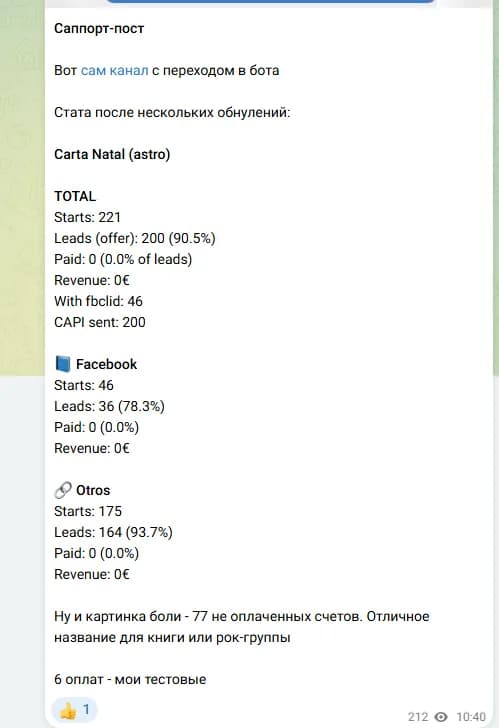
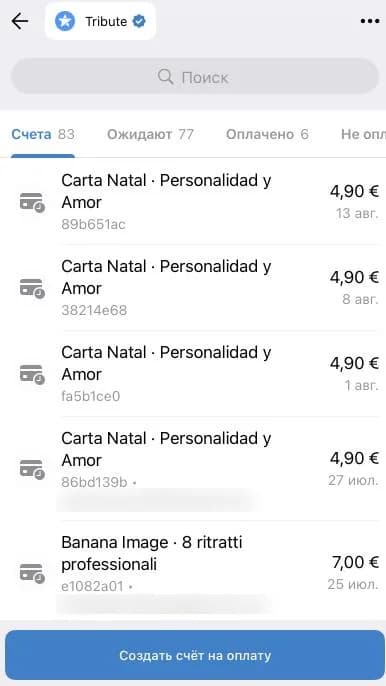
Our math: $300 in, 0 out: ROI -100%, before the API, AI and video costs. 77 invoices from 200 offers is 38.5%: more than 1 in 3 people who saw the price asked to pay. Then 0 of 77 did. 77 × 4.90 = 377.30 euros of intent that never turned into money.
3 things don't reconcile. At the UGC price of $0.12 to $0.17 a click, $300 buys roughly 1,800 to 2,500 clicks, against 221 starts. Only 46 starts carry a Facebook click ID, so 79% came from somewhere else, probably the channel, which makes $300 per 46 tracked starts $6.52 each. And the stats are "after several resets," so the totals may not cover the whole spend. The invoice list also mixes in 1 invoice from his earlier photo bot.
What he thinks went wrong
"What's wrong with the astrobot I still haven't figured out. Maybe it needs a more elaborate sale, maybe there were glitches with the payment provider (though there are no errors in the logs and all test payments went through), maybe the product is crap or nobody needs it, or the value is zero, or people don't believe it."
He also ran the bot through a Telegram channel for 3 days: "about 90% of visits to the channel converted into bot activation. And most reached the first payment and bailed at the most critical moment." He gave up the channel because "I believe in astrology so little that I can't run a channel with interest." His previous project, a photo bot, ended the same way: "users drop off at the most critical moment: at the payment stage."
Our take: the pattern is the finding, and he states it without seeing it. 2 different bots, 2 different products, the same break: people reach the payment and stop. 77 people asking for an invoice is not "nobody needs it." Something happens between the invoice and the money, and the posts never test it.
The cause he didn't check: how Telegram wants bots to take money
The payment provider was a third-party service, chosen in an earlier post because "10% on international cards is the cheapest solution." The invoices were in euros.
Telegram's own rules for bots are explicit. Its Bot Payments documentation for digital goods and services: "Payments for digital goods and services must be carried out exclusively in Telegram Stars." The reason given is Apple's and Google's store rules, and the consequence is spelled out: "Telegram cannot display your bot or mini-app to mobile users if you attempt to sell digital goods and services via other currencies or through third-party payment providers."
Our take: an AI-written PDF reading is a digital product. Selling it for euros through a third-party provider inside a bot is exactly what that rule addresses, and most of this traffic came from Facebook on phones. We can't prove this is why 0 of 77 paid; the author's logs show no errors, and his own test payments went through. But it's the first thing we'd check: open the invoice on a phone, as a new user, in Spain, with a Spanish card, and see what happens. A payment step that works for the builder and fails for strangers is the most common reason a funnel with 38% intent closes 0 sales. Price, trust and the "red flags" pitch are all plausible too, and the case tested only price.
Fact-check: what the author showed and what they hid
We rate every case on 10 points: what an outsider needs to judge the result and repeat it. For an anti-case the score rates how honestly and in detail the failure is taken apart. Like most case studies, this one is selectively true.
- Setup: period, GEO, offer, model — Showed. Spain, Facebook, a free chart and a paid reading, prices from 3.90 to 29 euros, optimization on subscription. Exact dates of the ad run aren't given.
- Author and independence — Partial. An unnamed author with a self-described 10-year background. He sells nothing in this series.
- Finances — Partial. $300 spent and 0 revenue are stated plainly. No daily spend or click counts, and the spend doesn't reconcile with 221 starts.
- Proof — Partial. The provider's invoice list and the bot's stats. No Ads Manager or tracker screenshot.
- Source and targeting — Partial. Facebook, Spain, a subscription event sent through the Conversions API. No audiences, bids or placements.
- Tools — Showed. Claude, an astrology API, AI images and video, a tracker, the payment provider and its fee are all named.
- Creatives — Showed. The static ad is shown with its results; the AI video is described with its price and click cost.
- Bot and funnel — Showed. The full flow with timings, the pitch, the price ladder and the push message.
- Consumables — Hid. Ad accounts and pages: nothing.
- Repeatability today — Partial. The funnel can be rebuilt from the posts. It didn't work, and the cause wasn't found.
Score: 3/5. For an anti-case this is open and detailed: the funnel, the prices, the creatives, the stats and the author's own discomfort with his pitch are all on the page, with no product to sell. It stops at 3 because the analysis ends at "I don't know": the spend, clicks and starts don't add up, there's no ad-account proof, and the 1 step where every single buyer dropped, the payment, was never tested, though the platform's own rules point straight at it.
Checklist: what to do
Questions and answers
Can you sell digital products in a Telegram bot?
Yes, but Telegram's Bot Payments documentation says payments for digital goods and services must be made in Telegram Stars, to comply with Apple's and Google's store rules, and that Telegram may not show a bot that sells them through other currencies or third-party providers to mobile users.
Why do Telegram bot users drop off at payment?
In this case 77 of 200 users asked for an invoice and none paid. Common causes are a payment method that fails for real users on mobile, a price or trust problem at the last step, and an unfamiliar payment page. Test the payment as a stranger before you blame the product.
Do AI-generated UGC videos work for Facebook ads?
In this case an AI video made for $10 cut the cost per click from $1.50-2 to $0.12-0.17 against a static image. Cheaper clicks didn't produce sales, though: the funnel broke after the click.
Are astrology ads allowed on Facebook?
Astrology products can be advertised on Meta, and the author reports no rejections. General ad rules still apply, so check Meta's Advertising Standards for your copy and claims before launch.
Author’s conclusion
This is the kind of failure report the industry needs more of: a small budget, a real product, the whole funnel on the page, the numbers admitted and even the pitch called out as manipulation by the person who wrote it. It loses points where a failure report matters most: the cause. The spend, clicks and starts don't add up, there's no ad-account proof, and the 1 step where everyone dropped, the payment, was never tested, though Telegram's own rules for bots selling digital goods point straight at it.
My advice: when people ask for an invoice and don't pay, debug the checkout before the product. Buy your own offer on a phone, as a stranger, in the target country, and log every step after the button. If you sell digital goods inside Telegram, read its Stars rules first. Then test price and pitch one at a time, and count intent and sales separately, so a "no" from the payment page doesn't get mistaken for a "no" from the market.
Lu Discover, Editor-in-chief
Our verdict on this case
For an anti-case this is open and detailed: the funnel, the prices, the creatives, the stats and the author's own discomfort with his pitch are all on the page, with no product to sell. It stops at 3 because the analysis ends at "I don't know": the spend, clicks and starts don't add up, there's no ad-account proof, and the 1 step where every single buyer dropped, the payment, was never tested, though the platform's own rules point straight at it.
Our fact-check of the public case: what the numbers show, what is missing. Scores are never for sale.
Sources for this article
- t.me — Sliva: the astrology bot series: idea, build, pricing, funnel and the verdict, posts 49 to 56 (July 29 to August 18, 2026)
- t.me — Sliva: the final stats post: 221 starts, 200 offers, 0 paid, 77 unpaid invoices (August 18, 2026)
- t.me — Sliva: choosing a payment provider for the bots (July 17, 2026)
- t.me — Sliva: the earlier photo bot and the same drop-off at payment (July 27, 2026)
- core.telegram.org — Bot Payments API for Digital Goods and Services: payments must be made in Telegram Stars
Related stories
 Case fact-check
Raketech's Q2 2026: Revenue -17.6% Under an 'EBITDA Improvement' Headline, Fact-Checked
 Case fact-check
59% of Installs Were Bots: An Indie Developer's Google App Campaign, Fact-Checked
 Case fact-check
Comments
0 commentsNo comments yet.
Add a comment