

Glossary
Push network
A push network, or push advertising network, sells clicks on browser push notifications sent to people who subscribed on its publishers' sites. You bid per click, target by GEO, device, OS and subscription age, and pay only when someone taps the notification.
Also called: push ad network, push advertising network, push ads platform.
A push network, or push advertising network, is an ad network that sells clicks on push notifications. Its publishers collect push subscribers on their sites, the network keeps them in one base, and advertisers buy the right to send them a notification: an icon, a short title, a line of text and often a large image. You pay per click, and bids start at fractions of a cent.
I like push for one reason: the price is honest. The notification goes out to everyone you target, but you pay only when someone taps it, so you pay for interest, not for a banner that was merely shown. The catch is in how the notifications are sent, and I'll get to it below.
How a push ad network works
The whole chain has 4 links: the publisher, the network, you and the subscriber.
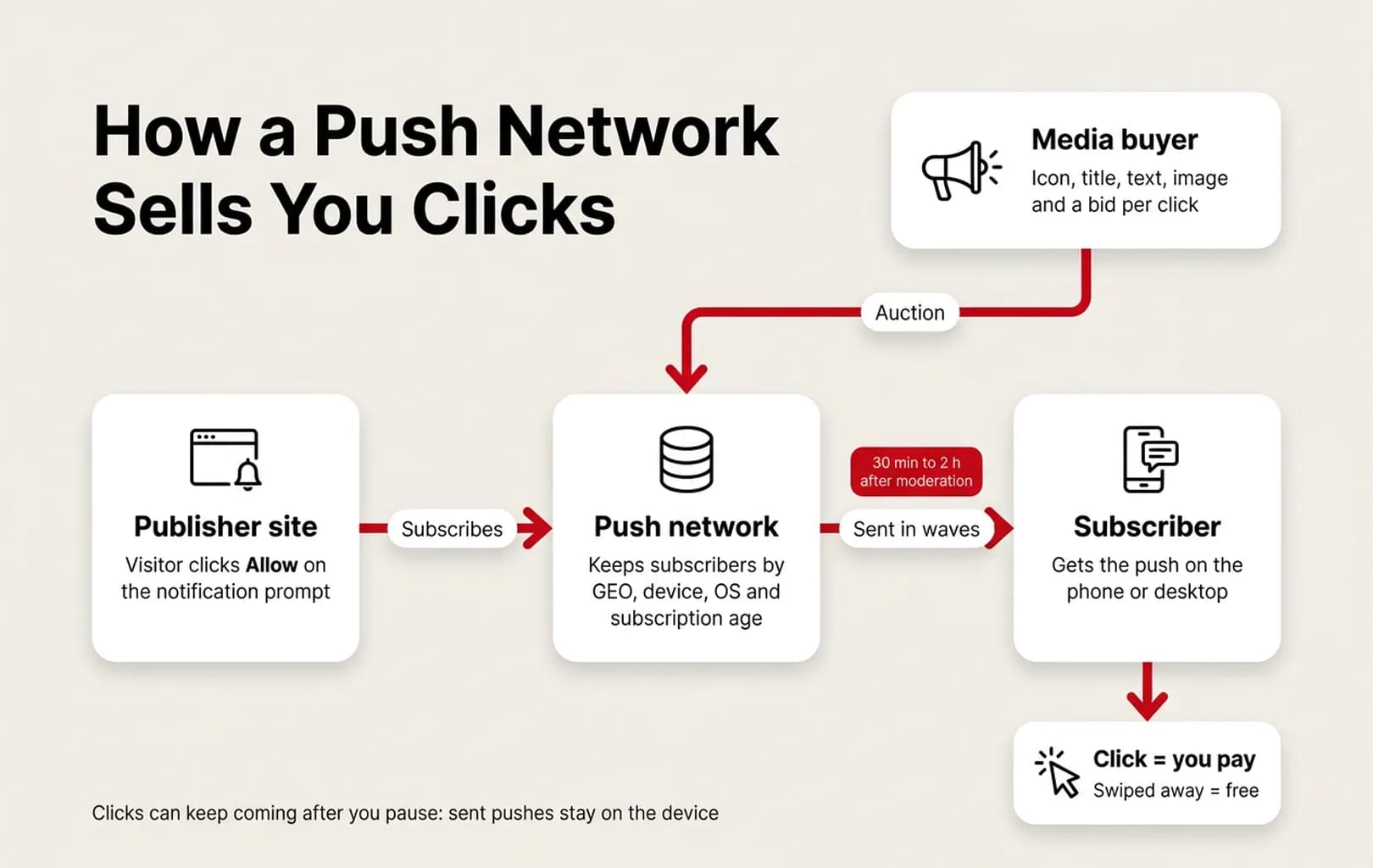
- A visitor on a publisher's site clicks Allow on the browser's notification prompt. The browser can now receive notifications from that site even when the site is closed, and the network adds the subscriber to its base with the GEO, device, OS, browser and date of subscription.
- You create a campaign: creatives, targeting, a CPC bid, budget and click limits. Moderation checks the creative and the landing page.
- After moderation the system usually needs 30 minutes to 2 hours to start sending, and it sends in waves, not all at once. Campaigns compete in an auction for every send, so a higher bid wins more of the base.
- The notification lands on the subscriber's phone or desktop. If they click, you pay and they go to your link. If they swipe it away, you pay nothing.
What a push ad looks like
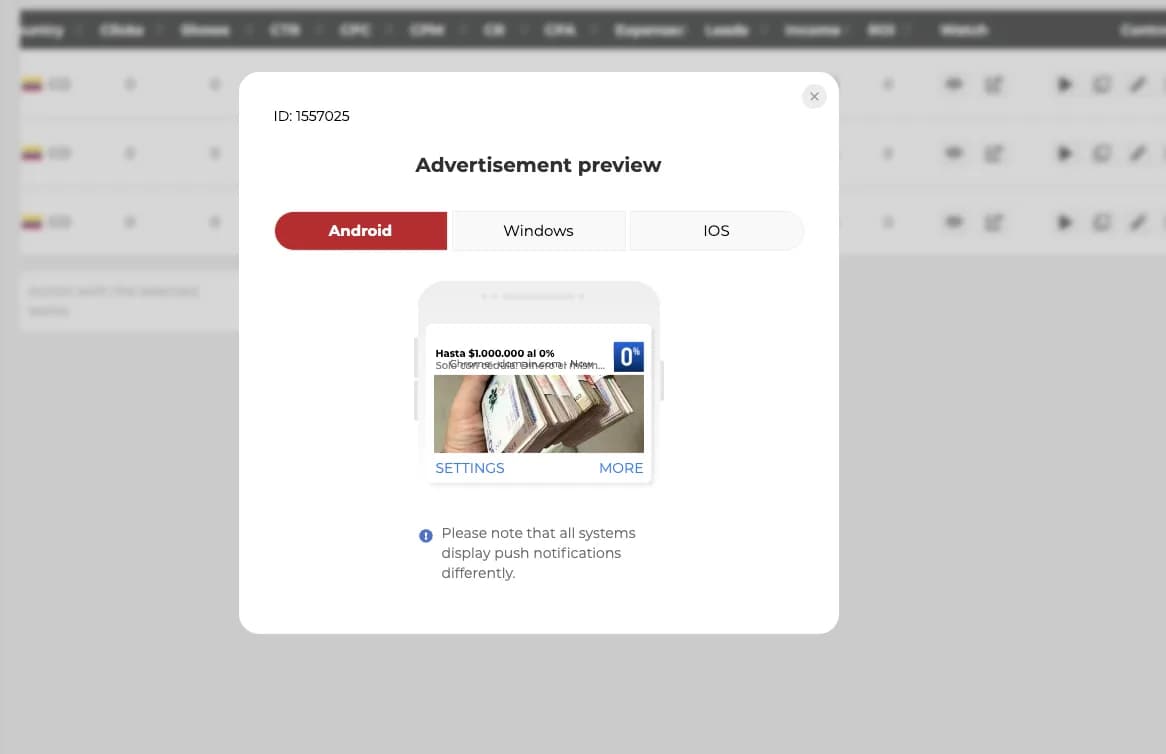
Below is a push from one of my campaigns on Push.House, a loan offer for Colombia, in the network's preview. A title, a line of description, a small icon on the right and a large image under them. Every system draws notifications differently, which is why push networks show separate previews for Android, Windows and iOS.
Main targeting options in a push network
Push networks target by the same basics as other traffic sources, plus one setting that only push has: subscription age.
- GEO: country, often city.
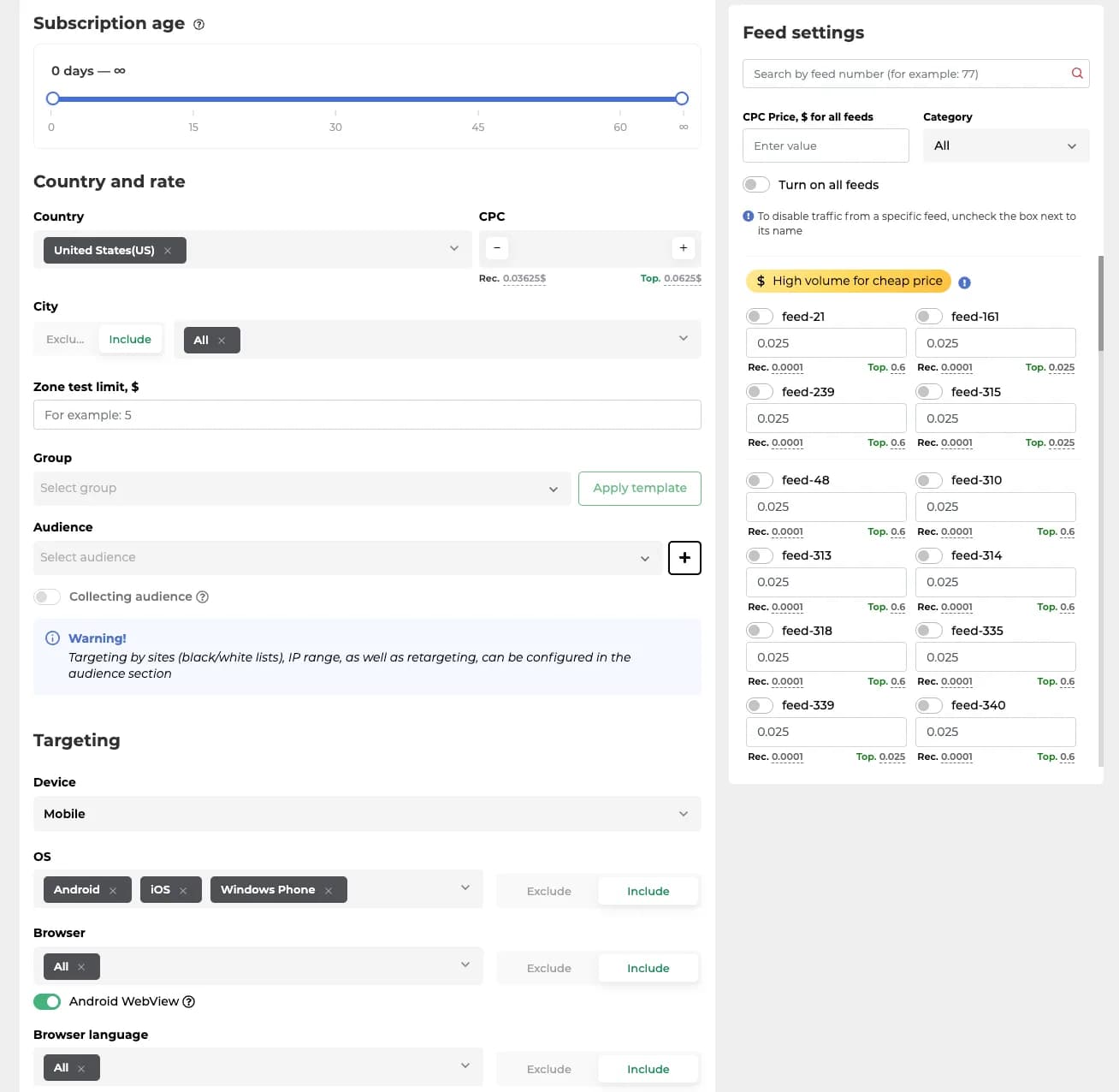
- Device, OS and browser: mobile or desktop, Android, iOS or Windows, browser and browser language. Some networks let you include or exclude Android WebView.
- Subscription age: how many days ago the subscriber clicked Allow. Fresh subscribers click more and cost more; old ones are cheap and tired. On Push.House it's a slider from 0 days to no limit.
- Traffic tiers: networks also sell their base in price tiers. Push.House shows 3 in the panel under traffic activity: Premium (high price, low volume), High (medium price, medium volume) and Medium (low price, high volume), and its 2024 guide defines them by subscription age: 0-4, 5-14 and 15+ days.
- Sources and feeds: the network's own sites plus partner feeds, each with its own bid and on/off switch. This is where your blacklists and whitelists live.
- Schedule and limits: hours and days of sending, daily and total budget, daily and total clicks.
What push traffic costs
Clicks are cheap because you buy attention, not impressions. Push.House lists a $50 minimum deposit and clicks "from $0.001", and on its public network volume page the minimum price in each of its 10 biggest countries was $0.002 when I checked in October 2026. Inside the panel, US mobile push showed a recommended bid of $0.03625 and a top bid of $0.0625. PropellerAds starts push at "CPC from $0.001", RichAds at $0.003-$0.005, depending on which of its pages you read, with a $150 minimum deposit. My own Colombia campaigns on Push.House ran at $0.00348 per click, with $10 a day and $30 in total as limits.
Cheap clicks don't mean a cheap test. A subscriber base is shared by many advertisers, and the oldest, most-clicked subscribers fill the cheapest bids. The first money goes to finding the feeds and sites that convert, and to switching off the ones that don't.
The overspend trap: you pay after you press Stop
Push is the one format where pausing a campaign doesn't stop the spending at once. The network sends the notifications, but it doesn't control when the subscriber opens them or how many subscribers will.
A push sent in the morning can sit on a lock screen and get clicked hours later, after the campaign is stopped or the limit is hit, and that click is billed. Push.House says it right under the budget fields: "There may be an overrun of the limit!"
Other networks write the same in their rules. Evadav's terms say costs "will continue for 12 more hours after the campaign reached its limit", and RichAds' FAQ warns that users "might click push notifications even days after they were initially sent", billed even if the campaign is paused.
What I do about it:
- Budget for the overrun: don't set the limit equal to all the money you have for the test.
- Collect blacklists of the feeds and sites where the audience was subscribed, after every test cycle.
- Plan the date and time of sending with the schedule, so the waves go out when your offer converts and you can watch them.
Push vs in-page push
Most push networks now also sell in-page push: a banner that looks like a notification but shows only on the page the visitor is reading, with no subscription. It grew as classic push got harder. Since October 2025 Chrome removes notification permission from sites with very low engagement that send a lot of notifications, since January 2026 it rate-limits push from such sites, and on iPhones and iPads web push works only for web apps added to the Home Screen, from iOS 16.4.
- Subscription: classic push goes only to users who clicked Allow; in-page push needs no subscription.
- Where it shows: classic push lands in the notification center and on the lock screen, even when the site is closed; in-page push shows only on an open page, during the visit.
- iPhone and iPad: classic push reaches only Home Screen web apps, from iOS 16.4; in-page push works in any browser.
- Pricing: both are bought mostly on CPC.
Examples of push ad networks
Classic subscription push is no longer sold everywhere: Adsterra moved its push traffic to the in-page version, and HilltopAds sells only in-page push. These networks still sell it in 2026:
- PropellerAds: classic and in-page push in one buying interface, clicks from $0.001, CPM, CPC, SmartCPC or CPA Goal.
- RichAds: $150 minimum deposit, clicks from $0.003-$0.005, sources sorted into Premium, Standard, Remnant and New.
- Push.House: $50 deposit, segments by subscription age: Premium 0-4 days, High 5-14 days, Medium 15 days and older.
- Evadav: $100 minimum payment, push bids from $0.001, subscription age targeting.
- RollerAds: $50 deposit, push on CPC, subscription age among the targeting options.
- Kadam: $100 first deposit, push on CPC, CPM or CPA Target, subscription age for classic push.
- Galaksion: $50 deposit, push alongside popunder, native and on-page notifications.
Looking for a platform? See our rating of the best push ad networks in 2026, with minimum deposits, bids and targeting for each.
Related terms: Push notifications, Push subscription, Ad network, CPC, Bid, Blacklist, Whitelist.
Questions and answers
What is a push advertising network?
An ad network that sells clicks on browser push notifications. Its publishers collect subscribers who clicked Allow on their sites, and advertisers bid per click to send those subscribers a notification with an icon, title, text and image.
Are push networks good for beginners?
Yes, with one condition. Deposits are low, clicks cost fractions of a cent and creatives are quick to make. But budgets overrun after you stop a campaign, and old subscribers fill cheap bids, so a beginner should start with small limits, one GEO and a blacklist after every cycle.
What verticals work best with push traffic?
Offers with one simple action: sweepstakes, loans and other finance, dating, gambling and betting, utilities and nutra. Those are the verticals push networks build their own pages around, and my Colombia campaigns were a loan offer. Expensive or complicated offers rarely convert from a notification.
How much does push traffic cost?
On the networks' own pages bids start at $0.001-$0.005 per click and deposits at $50-$150. Real prices depend on GEO, device, subscription age and tier: US mobile push in the Push.House panel had a recommended bid of $0.03625 when I checked, while my Colombia campaigns ran at $0.00348.
Why did my push campaign spend more than its limit?
Because the pushes were already sent. The network controls when notifications go out, not when subscribers click them, and clicks on pushes sitting on a device are billed after the limit is hit or the campaign is paused. Set limits below your real budget.
Should I buy push or in-page push?
Classic push reaches subscribers after they leave the site and lands on the lock screen; in-page push needs no subscription and works on iPhones. Test both on the same offer if the network sells both, and compare cost per conversion, not CTR.
Sources
- Push.House advertiser panel: campaign settings, feed bids, budget limits and the overrun warning, ad preview (my account, October 2026)
- Chrome for Developers: Push API rate limits (January 6, 2026)
- WebKit: Web Push for Web Apps on iOS and iPadOS (iOS 16.4, Home Screen web apps)
- Push.House: CPC model, $50 minimum deposit, clicks from $0.001
- Push.House blog: subscription segments Premium 0-4 days, High 5-14 days, Medium 15+ days (October 1, 2024)
- Evadav terms of use: $100 minimum payment (4.3), costs continue for 12 hours after the limit (5.6)
- Evadav advertiser FAQ: push bids from 0.001, subscription period targeting
- RichAds FAQ: $150 minimum deposit, push CPC from $0.003, clicks days after sending billed even when paused (March 3, 2025)
- RichAds: push notification advertising guide, CPC from $0.005
- PropellerAds: push and in-page push CPC from $0.001
- PropellerAds help: pricing models by format
- RollerAds: $50 minimum deposit, push on CPC, subscription age targeting
- Galaksion: $50 minimum deposit
- Kadam: first deposit $100
- Adsterra: web push vs in-page push, push traffic moved to in-page
- Chrome: automatic notification permission removal for low-engagement sites (October 10, 2025)