

Humboldt Merchant Services FTC Case: 1,000 Shell Merchants That Kept Nutra Trials Taking Cards

Contents 11
Stripe bans "reduced price trials with unclear or hidden pricing" by name, and Mastercard has had special rules for trial merchants since April 2019. So how did $4.95 nutra trials with a hidden rebill keep taking cards for years? On September 8, 2026, the FTC filed an 89-page complaint that answers it in unusual detail, with the processor's own emails.
The defendant is 5967 Ventures LLC, which does business as Humboldt Merchant Services. Humboldt is an ISO, a company that boards merchants onto a bank's card processing, and it called its nutra desk "Performance Marketing." The FTC says it opened "more than one thousand accounts" for shell companies between 2021 and 2023 and processed at least $139 million through them. A proposed order filed the same day bans the practices and requires Humboldt to pay $12 million; Humboldt neither admits nor denies the allegations.
I read the complaint and the order so you don't have to. Below: how the machine worked in 3 steps, what Humboldt knew, what the order bans, and the places where affiliates show up in it. Everything quoted comes from the filings; the paragraph numbers are the complaint's.
Who Humboldt is: an ISO with a "Performance Marketing" desk
Humboldt describes itself as a specialist in "tough to place" or "high risk" merchants (paragraph 4). It worked as a registered ISO of BMO Harris Bank, N.A. (19), which means it found and underwrote merchants for the bank's card processing and, in the FTC's words, "bears the primary risk of the business" (18). We explain who carries what in that chain in our guide to high risk merchant accounts.
Its most profitable line was nutra: "merchants selling nutraceutical supplements and assorted gadgets on the Internet, often through 'free'-trial offers," where many consumers were "enrolled automatically into subscription plans" (4). Inside Humboldt these were "nutra" or "Performance Marketing" accounts. In 2017 they brought in about 80% of its profits, and its profits grew from about $7.5 million in 2014 to over $80 million in 2017 (49).
A high-risk ISO can make money even when its merchants blow up, and the complaint shows 2 reasons why. Humboldt held reserves on every Performance Marketing account, so the merchant's own money covered trailing chargebacks (44). Its risk team put the economics in one line in 2022: "We may go through 100 bad accounts to get 10 good accounts, but we make money on all those accounts." And most accounts came through external sales agents paid "residuals," a share of Humboldt's profits on the accounts they referred (45). The top 2, Arc and Merchant Focus, brought over 70% of the volume from its main agents between 2020 and 2023 (98).
Step 1: shell companies and $750-a-month straw signers
A merchant account needs a business and a person who signs for it. According to the complaint, an organization called Reseller Consultants supplied both. It recruited people "by promising they can earn $750 dollars a month without having to use any of their own money" by becoming "resellers" for "advertisers" (112). Most of those advertisers were "in the nutra space (skin care, diet products, muscle products, etc)" (109).
Each signer formed an LLC, opened a mailbox at a UPS store and a business bank account (112). The advertisers built the websites and filed the applications, and if a bank or ISO called, the signer was coached through the call (114). A signer described the deal to Humboldt in 2021 while it was trying to collect an overdue balance: "they had him set up an LLC at the bank and a box at the post office, and they kept over drafting his account. They were to pay him 750.00 per month for the use of the account" (113).
The shells were easy to spot if you looked. Their names were 3 unrelated words, starting with the signer's first initial (116), and Humboldt's own managers sent Arc a spreadsheet of the pattern in October 2021:
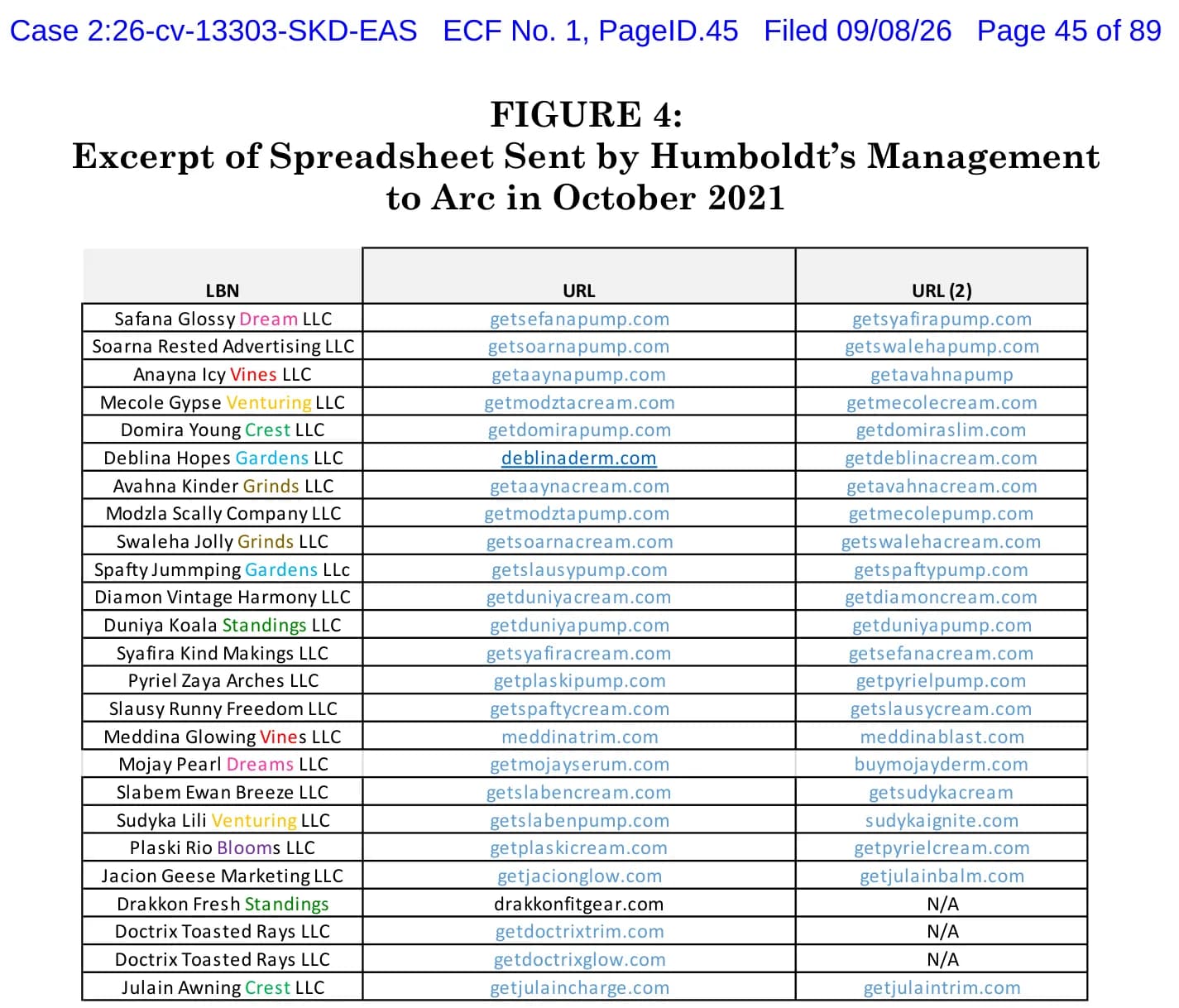
In August 2022 a manager wrote to Arc's owner again about "these 'Get', 'buy' or 'try' commonalities in the DBA and URL's" (106). Humboldt kept opening Arc's accounts "even after Arc refused to identify the sources of shell accounts" (107). The typical application, per the FTC, was a new LLC at a UPS mailbox, with fulfillment, customer service, CRM and "advertising or affiliate marketing" all outsourced, and a cap of $100,000 a month (102). Most were closed in under a year (103).
Step 2: trials renamed "travel packs"
Mastercard's rules for negative-option trials, in force since April 2019, require trial merchants to be coded MCC 5968, registered by the acquirer and to get each cardholder's explicit consent before charging after the trial (35). Right after, Humboldt started receiving "travel pack" applications from the same agents whose accounts Mastercard had closed (73).
A travel pack application pointed to a "bank page," a front site the real customers never saw (74). It sold "a one-day dose or two pills of a nutraceutical supplement, or 0.02 ounces of a skin cream" at $4.99 or $6.95, the price points of introductory trials, dressed up as a straight sale (75-76). The complaint shows one:
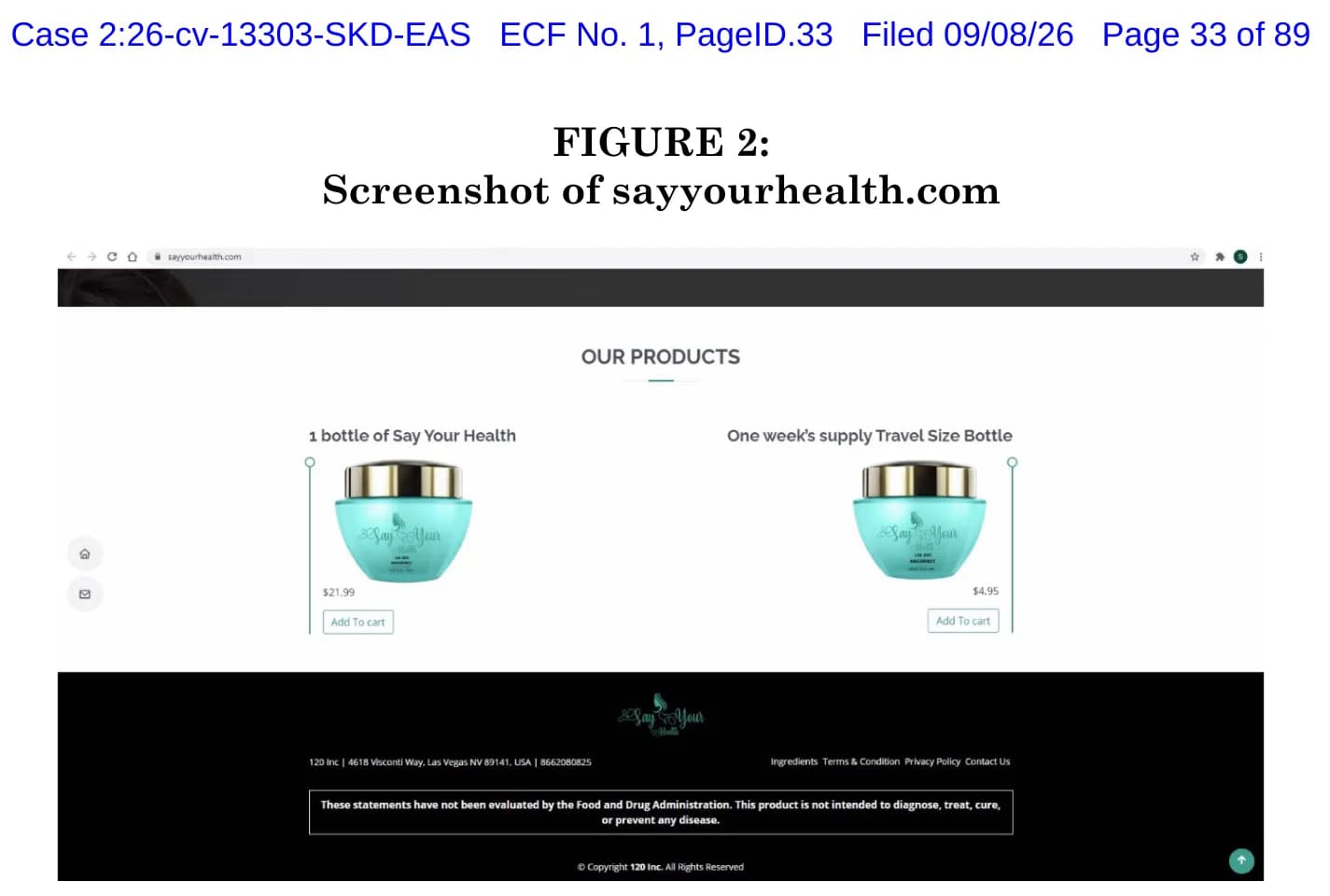
By 2020 Humboldt's management decided to approve travel packs, after another executive texted that "we have to hit [the 2020] plan" (78). Its staff told merchants how to word the pages: "Travel Size verbiage," not "Sample size," which "implies Trial" (83), and in December 2022, "Replace the word trial on products to travel (ex. NO2-Trial, protein powder trial)" (84). Internal risk notes from August 2021 say travel-pack-only accounts were "commonly used to hide trials" (85).
The accounts were boarded under MCC 5499, convenience and specialty food, or 5977, cosmetic stores, instead of 5968. After 2019 Humboldt registered no trial merchants with Mastercard at all (80-81). Its president noted the "benefit": 5499 "has historically had higher [approval] ratios" (81).
Step 3: a better BIN for a better approval rate
The last piece was the bank ID number, the BIN, under which the transactions reached issuers. Humboldt's president wrote in September 2020 that "many issuers have labeled" Humboldt "as having a 'bad BIN'," and that a sister company's BIN at the same bank "outperforms HMS by 34%" (87). From October 2020, nutra accounts moved onto that sister BIN, owned by NAB, formerly North American Bancard (88):
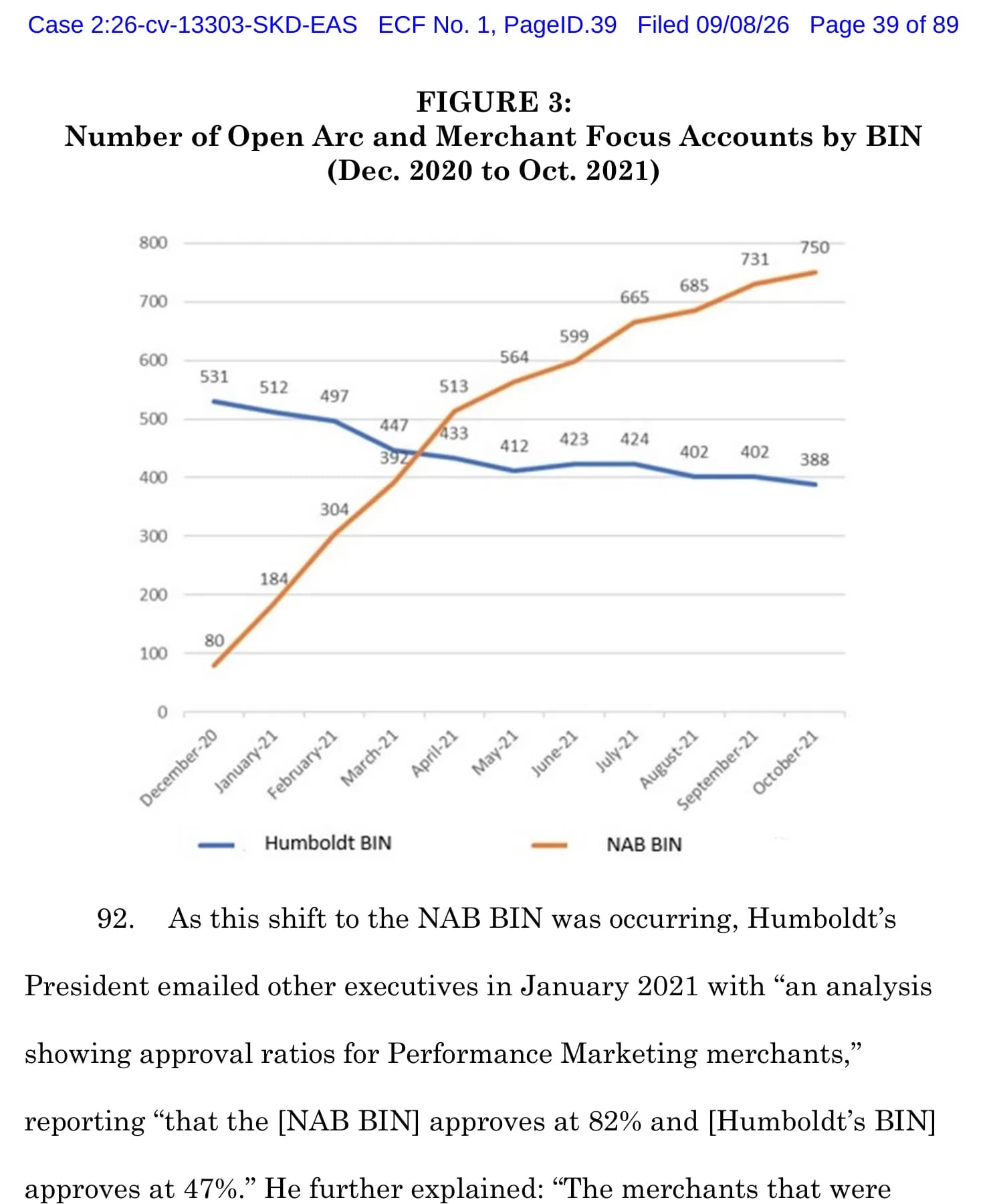
Approval rate is the number every trial advertiser watches, and the merchants routed their traffic by it. Humboldt's president wrote that merchants choose where "to route transactions" based on "approval ratio metrics [they receive] from the CRMs," the tools that spread transactions across MIDs at different processors (93). Arc's owner told a sub-agent: "if we can get the higher approval ratios, you know guys will use those MID's first." The reply: "approvals rates seem to be the name of the game right now" (94).
The result, by mid-2021: Humboldt's nutra accounts on the NAB BIN ran chargebacks of over 7%, against 0.08% for the rest of that BIN and card-brand lines of 0.9% and 1.5% (7, 96). Meanwhile Humboldt raised its own per-account chargeback limit from 5% to 9%, as long as monthly counts stayed under the networks' triggers (90).
What Humboldt knew: the underwriter's 2019 email
The FTC's strongest exhibit is internal. Mastercard flagged "load balancing" and "card sharing" across thousands of Humboldt accounts in reviews from 2017 to 2019 (5). In April 2019, a senior underwriter wrote to the manager overseeing risk:
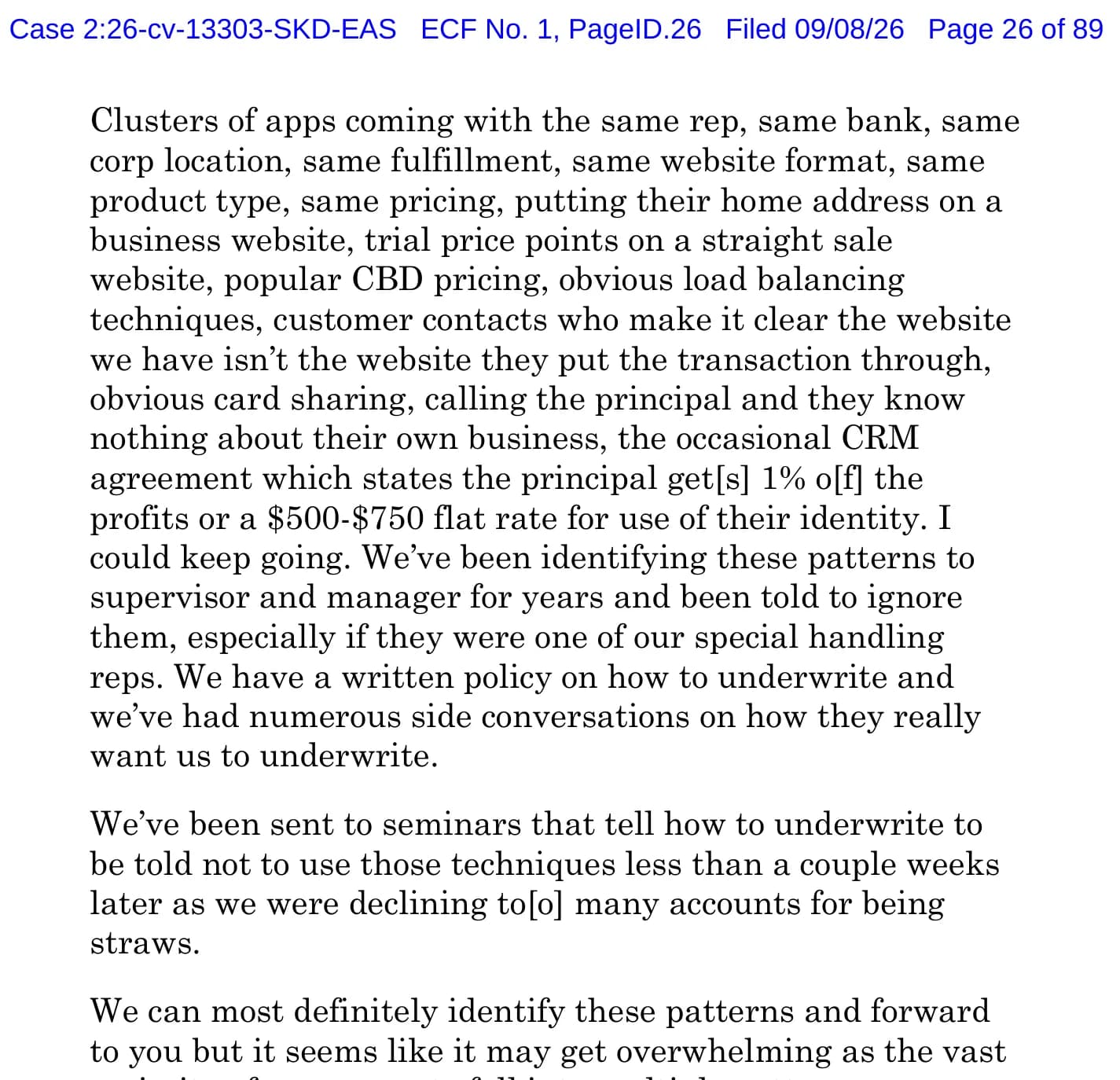
"Calling the principal and they know nothing about their own business" and "a $500-$750 flat rate for use of their identity" describe the straw signers 2 years before Reseller Consultants' accounts started arriving in bulk. The same underwriter reported that underwriting decisions had been shared with sales partners, which helped merchants "restructure submissions" (59). Humboldt, per the FTC, kept opening these accounts until around the end of 2023, after learning of the FTC's investigation (8).
The Humboldt numbers, from the complaint
- Shell accounts opened, January 2021 to 2023 — More than 1,000. 108
- Processed through them, January 2021 to January 2024 — At least $139 million. 117
- Chargebacks, nutra accounts on the NAB BIN, mid-2021 — Over 7%, against 0.08% for the BIN overall. 96
- Chargebacks by dollar, Arc and Merchant Focus accounts, December 2020 to December 2023 — Over 12% each. 99
- Issuer decline rate on those accounts — About 76% and 64%. 101
- Approval rate, NAB BIN against Humboldt's BIN, January 2021 — 82% against 47%. 92
- Humboldt's profits — About $7.5 million (2014) to over $80 million (2017). 4, 49
- Pay promised to straw signers — $750 a month. 112
- Monetary judgment — $12 million, held in escrow, not suspended. Order, section VII
The top chargeback reasons were Visa 10.4, "Other Fraud-Card Absent Environment," and Mastercard 4837, "No Cardholder Authorization" (100). In plain words: people saying they never agreed to the charge.
What the Humboldt order bans, and who else was charged
The proposed stipulated order bans credit card laundering and processing for straw companies, MATCH-listed merchants, past defendants in consumer-protection cases, and new or trial-billing e-commerce clients whose only address is a UPS store, PO box or virtual office (sections I and II.A). It also names the evasion tactics one by one:
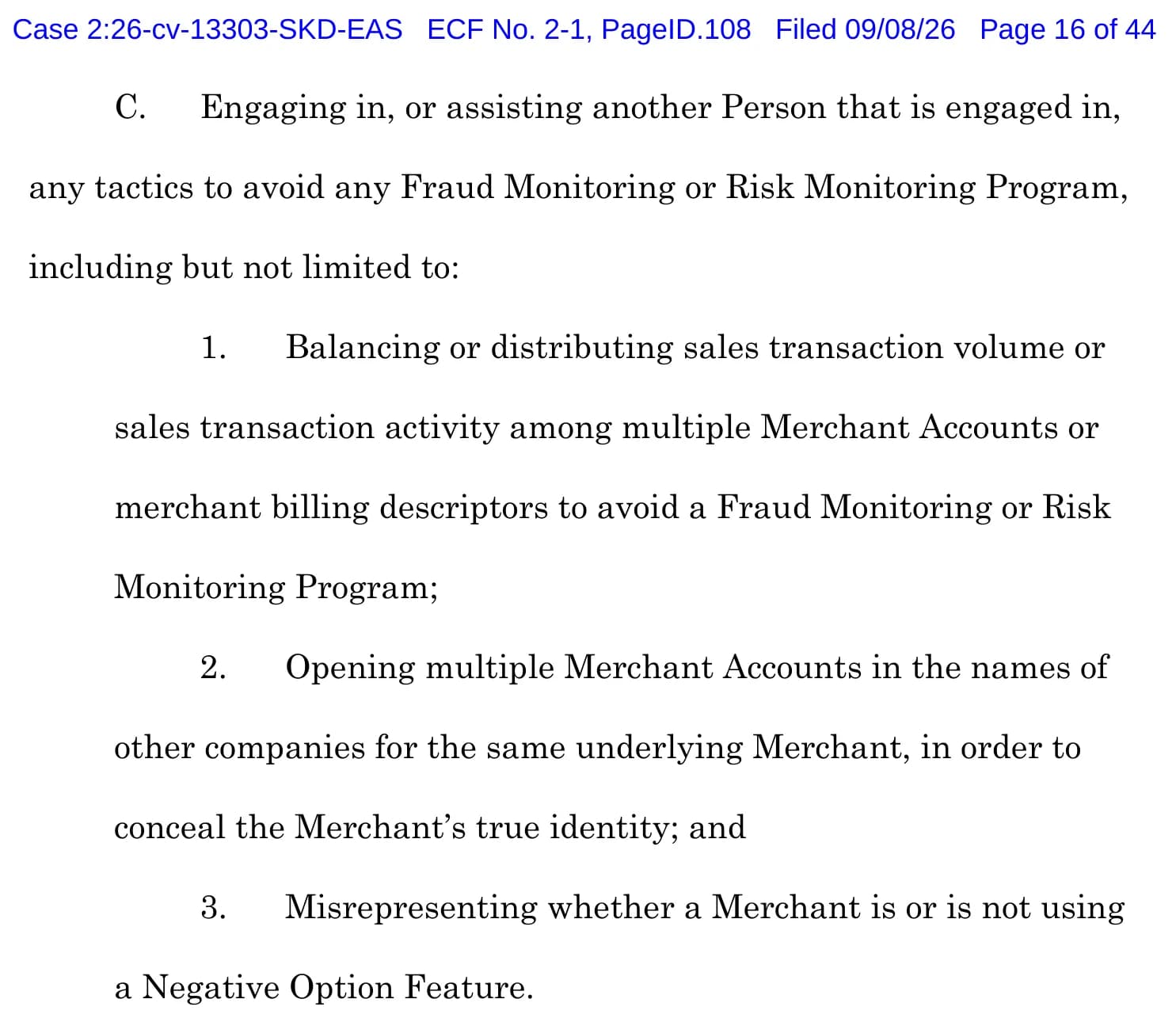
Humboldt must also investigate any client that runs over 1.0% and more than 50 chargebacks in a month, in 2 of 6 months (section IV.E). The $12 million goes to the FTC, to be used first for consumer redress (section VII).
The scheme reached further than one ISO. Reseller Consultants was shut down at the Justice Department's request in a sealed fraud case filed in December 2023, United States v. CB Surety LLC (2, 115). One of its "advertisers" was Legion Media, which the FTC sued in June 2024 and shut down that September (110-111). Its own complaint says Legion "have taken over $200 million dollars from consumers," and lists Humboldt among 5 processors and ISOs it used to open accounts (65).
Where affiliates show up in the Humboldt case
No affiliate network or media buyer is a defendant here. But affiliates appear in the filings 3 times, and each one matters.
The traffic. The Legion Media complaint says the defendants "pay affiliate networks to promote their products online, including through advertisements on Facebook," some claiming the products were "used or sponsored by various celebrities or were featured on the television show 'Shark Tank'" (Legion complaint, 35). The Humboldt complaint quotes a 2018 BBB report: "[m]any fake free trial offers use affiliate networks to advertise their products" (37).
The approval rate. If you've run CC-submit or trial offers, you've watched approval rates swing for reasons nobody explained. This complaint is one explanation: in 2021 the same merchants approved at 82% on one BIN and 47% on another, and CRMs routed traffic to whichever MIDs approved best. Your conversions were riding on a MID the advertiser could lose any week.
The paperwork. From now on, Humboldt must collect "representative examples of all forms of available advertising and marketing" from risky clients, including "affiliate or direct marketing campaigns," and the URLs of every page consumers see:
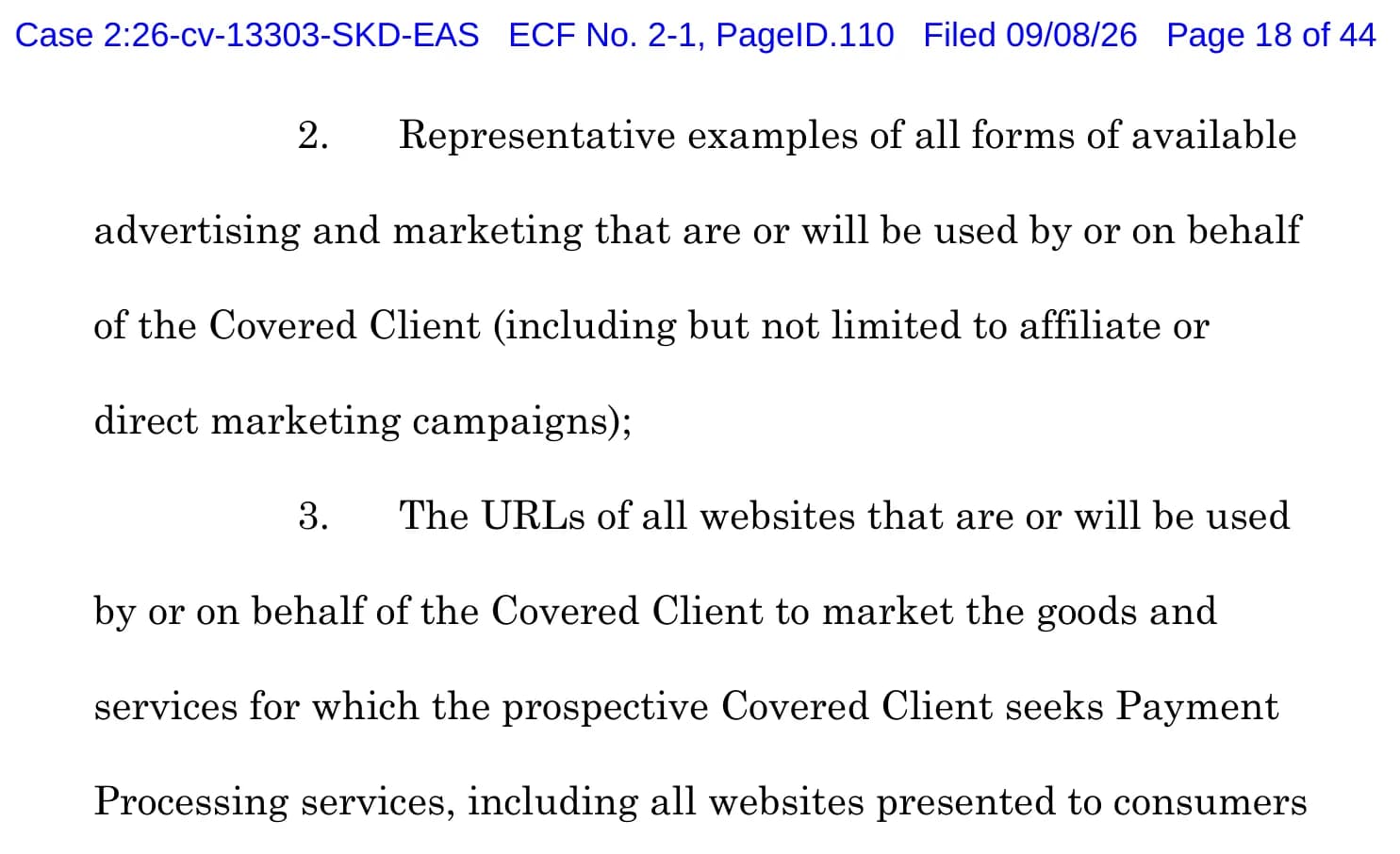
That's Humboldt's order, not an industry rule. But FTC orders tend to become the checklist other processors' lawyers copy, and it means your pre-lander and creatives can end up in the advertiser's merchant file.
Checklist: what to do
Questions and answers
What is Humboldt Merchant Services?
Humboldt Merchant Services is the trade name of 5967 Ventures LLC, a Delaware company with an office in Tempe, Arizona. It's an ISO that boards high-risk merchants for card processing, and it worked as a registered ISO of BMO Harris Bank, according to the FTC.
What did the FTC accuse Humboldt of?
Of knowingly processing for more than 1,000 shell merchants used for unauthorized billing, mostly nutra trials. The complaint says Humboldt ignored warnings, boarded trials as "travel packs" under lower-risk MCCs and moved accounts to a sister BIN for higher approvals.
What is load balancing in payment processing?
Spreading a single merchant's sales across several merchant accounts so that none of them crosses the networks' chargeback triggers, such as 100 chargebacks a month. Mastercard told Humboldt that in most instances it "serves no legitimate business purpose," and the Humboldt order bans it.
What is a straw signer?
A person paid to put their name on a company and a merchant application for a business they don't run. In this case, recruits were promised $750 a month to form an LLC, open a UPS mailbox and a bank account, which the real "advertisers" then controlled.
What is a travel pack in nutra?
A front for a trial offer: a page selling a tiny "travel size" product at a trial price as a one-off sale, so the account isn't classed as a negative-option merchant under MCC 5968. Humboldt's own notes said such accounts were "commonly used to hide trials."
Did Humboldt admit wrongdoing?
No. In the proposed stipulated order, Humboldt neither admits nor denies the allegations, but agrees to the bans and to pay $12 million, which its counsel holds in escrow. The order takes effect once the court enters it.
Author’s conclusion
The Humboldt complaint is the best answer I've seen to a question affiliates ask quietly: how do offers that every rulebook bans keep paying out? Not by magic. By an ISO that earned 80% of its profits from them, straw signers at $750 a month, trials renamed travel packs, and a cleaner BIN that turned a 47% approval rate into 82%.
My take for affiliates: an offer's approval rate is partly a fact about its payments, not your traffic. When a trial offer approves unusually well, ask whose MID it's riding on, withdraw often, and keep your own funnel clean enough to survive a processor reading it.
Lu Discover, Editor-in-chief
Sources for this article
- ftc.gov — FTC v. 5967 Ventures LLC d/b/a Humboldt Merchant Services, complaint, E.D. Mich. No. 2:26-cv-13303, filed September 8, 2026 (paragraphs cited in text)
- ftc.gov — Stipulated order for permanent injunction and monetary judgment, FTC v. 5967 Ventures LLC (sections I-IV, VII)
- ftc.gov — FTC press release: FTC Takes Action Against Payment Processor Humboldt Merchant Services (September 8, 2026)
- ftc.gov — FTC case page: Humboldt Merchant Services
- search.ftc.gov — FTC v. Legion Media LLC, complaint, M.D. Fla. No. 8:24-cv-01459, June 17, 2024 (paragraph 35 on affiliate networks; over $200 million; processors used)
- stripe.com — Stripe Prohibited and Restricted Businesses (negative option marketing and reduced price trials with unclear or hidden pricing)
Related stories
 Guide
GuideIs a Payment Processor Legit? 6 Checks Before You Route a Single Transaction
 Guide
GuideAccept Payments Without a Business: 4 Routes That Work, and Why One Word Can Cut Off a Skincare Store
 Guide
Guide
Comments
0 commentsNo comments yet.
Add a comment