

Merchant Account Declined or Closed? What the Underwriter Saw, and Why Nobody Tells You

Contents 10
In December 2025 a business owner posted in r/PaymentProcessing under the title "Merchant Account: Denied by Bank No Reason Given." They ran 2 storefronts and processed "just under 1 million per year" through Square, and their bank pitched a merchant account that could save them "as much as 7k per year in fees." The bank turned them down, said a notice would follow, and "no notice electronic or by mail ever arrived."
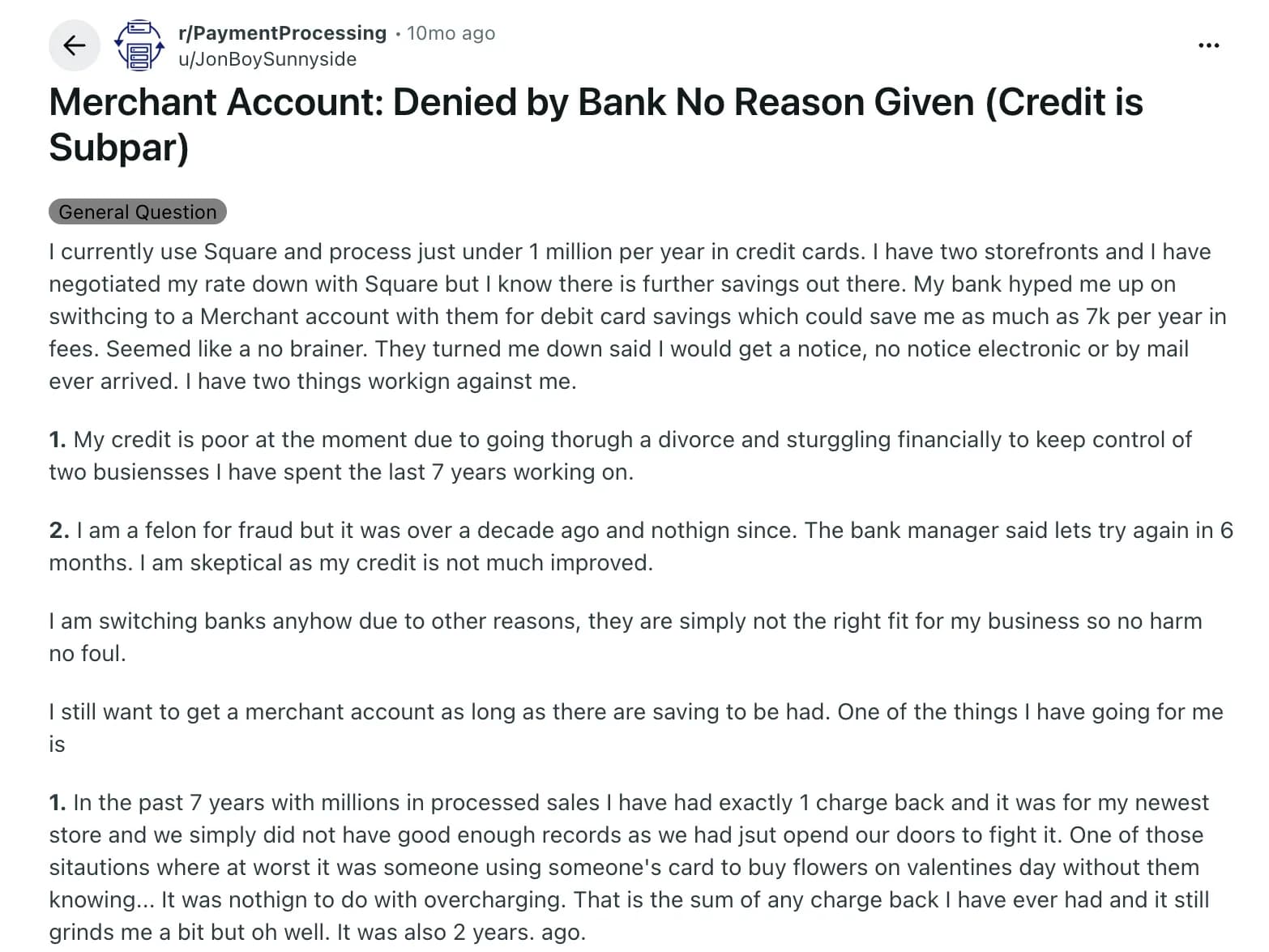
They listed what might be working against them: poor credit after a divorce, and a fraud conviction from "over a decade ago," with nothing since. And what should work for them: "In the past 7 years with millions in processed sales I have had exactly 1 charge back."
The replies are a map of this whole topic. Most came from accounts flagged "Verified Agent," and at least 6 offered to help by DM. One said: "Have a brother or family member sign for the Account and call it a day." Another: "You felony isn't a problem if you aren't MATCH listed." A third warned against sending lots of applications, because "your info will end up on Mac alert for every underwriter to see." Nobody, including the bank, gave a reason. Below: what the underwriter actually reads, why a declined or closed merchant account rarely comes with an explanation, and which of those replies is right and which is fraud.
Declined and closed are 2 different decisions
A decline happens before your first payment, when an underwriter reads your file. A closure happens after, when monitoring sees something in your numbers. Which one you meet first depends on the door you used.
A bank or a dedicated merchant account provider underwrites first: the Reddit poster met the decline. A payment facilitator such as Square, Stripe or Shopify Payments says yes in minutes and reviews you afterward, so you meet the closure. The same poster had processed through Square for 7 years without a problem, which is the payfac model working as intended.
The file and the numbers overlap, so fixing one helps with the other. But the remedies differ: a decline is answered with a better file, a closure with an appeal and, often, patience while your money sits on hold.
There's a third "declined" that has nothing to do with your account: a declined payment. In July 2026 a WooCommerce store owner asked why card payments failed while PayPal worked:
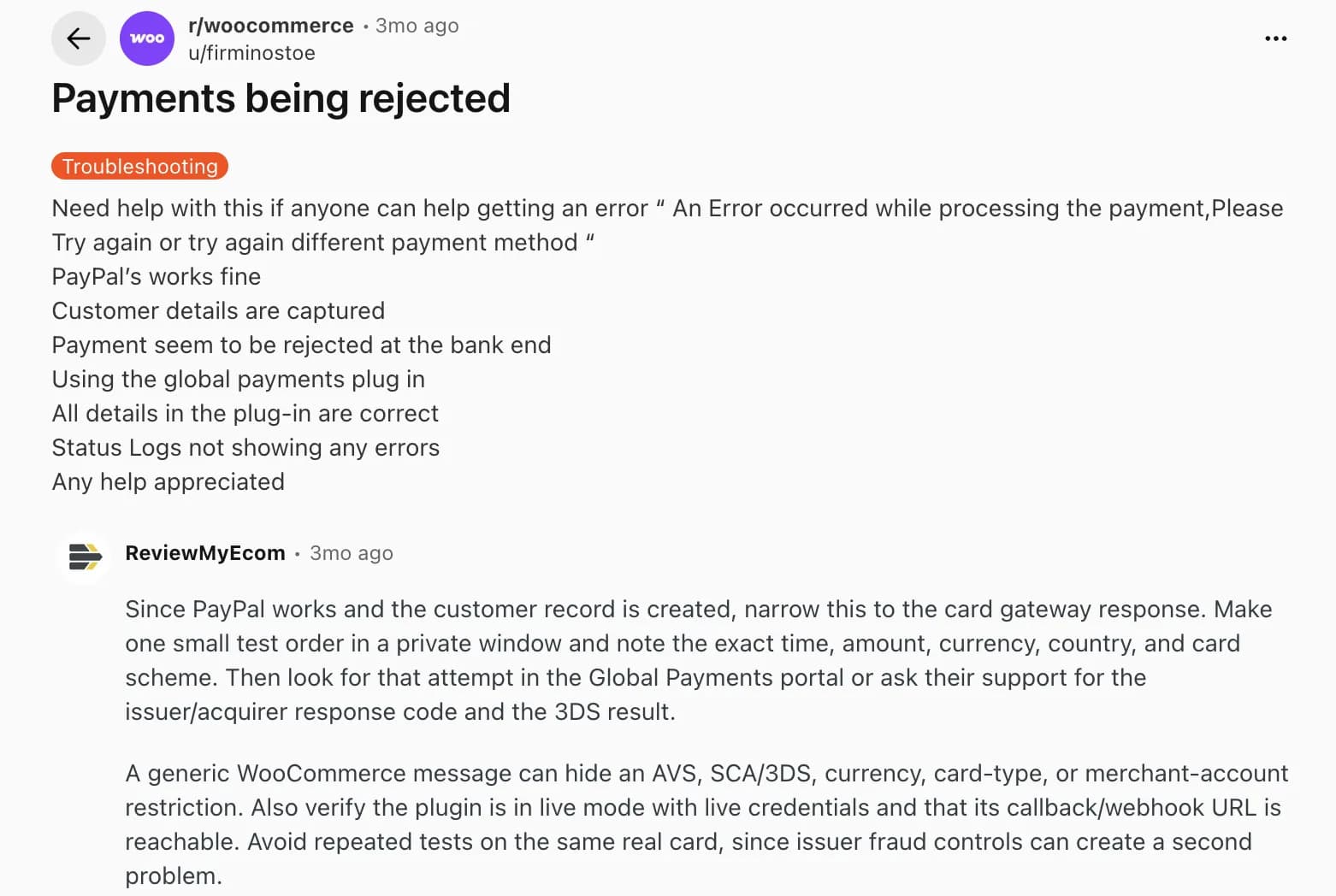
That's an authorization decline, decided per transaction by the card issuer or the gateway's rules, and the account itself is fine. The fix starts in the gateway's logs and response codes, not in an application file.
What the underwriter reads: owners, business, site, product, numbers
The underwriter's question is simple: if this merchant can't pay its chargebacks, will we be left paying them? Everything in the file serves that question.
The owners. ID, address and, in the US, personal credit. PayPal says its reserve decisions weigh "your business and/or personal credit history." Criminal records and past terminations matter because they predict losses, which is why the Reddit poster's old conviction and divorce-era credit could outweigh 7 clean years.
The business. Registration documents, bank statements and, if you have them, processing statements from a previous provider. Processing history is the strongest evidence you can bring: it shows real refund and chargeback rates instead of a forecast.
The site. Reviewers read your website before your financials. Stripe publishes its checklist, and it reads like the list of reasons applications stall:
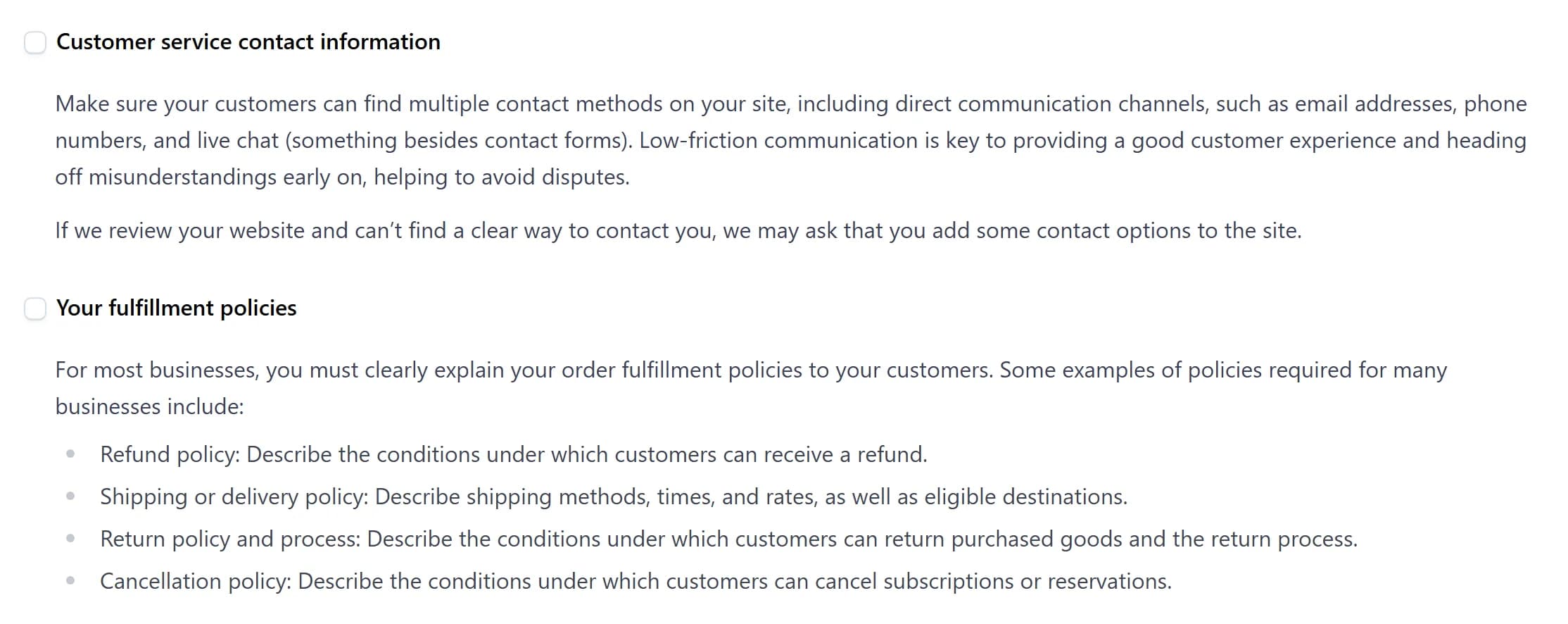
The same checklist asks for a clear description of what you sell, the currency, your privacy policy, any promotion or trial terms, and HTTPS. A site that doesn't match the application, a different product, brand or price, is a refusal on its own.
The product. Your category and its MCC decide which lists apply. We covered the prohibited lists and Visa's high-risk codes in our guide to high risk merchant accounts, and why skincare and supplements trip them in Accept Payments Without a Business.
The numbers. Expected monthly volume, average ticket and how much is card-not-present. They must fit the business: a high-risk ISO notes that numbers that "do not coincide with the type of business you operate" get applications "flagged or declined." The Reddit poster had a red flag of their own here, since one store took orders "almost entirely keyed in over the phone."
Why nobody tells you the reason
Because in most of the world they don't have to, and often they can't. PayPal's user agreement says it outright: its decisions about holds, limitations and reserves "may be based on confidential criteria that are essential to our management of risk," it "may be restricted by regulation or a governmental authority from disclosing certain information," and you agree "we have no obligation to disclose the details." Stripe's services agreement lets it close an account "at any time" in its general terms, and with 30 days' notice in its regional terms.
Part of the silence is the law itself: anti-money-laundering rules forbid tipping off a customer about some suspicions. Part of it is the card networks: a provider that names a MATCH hit or a scheme flag discloses data it doesn't own.
The UK has just changed this for small customers. Since April 28, 2026, a payment provider ending an open-ended contract signed on or after that date must give 90 days' notice and explain why:
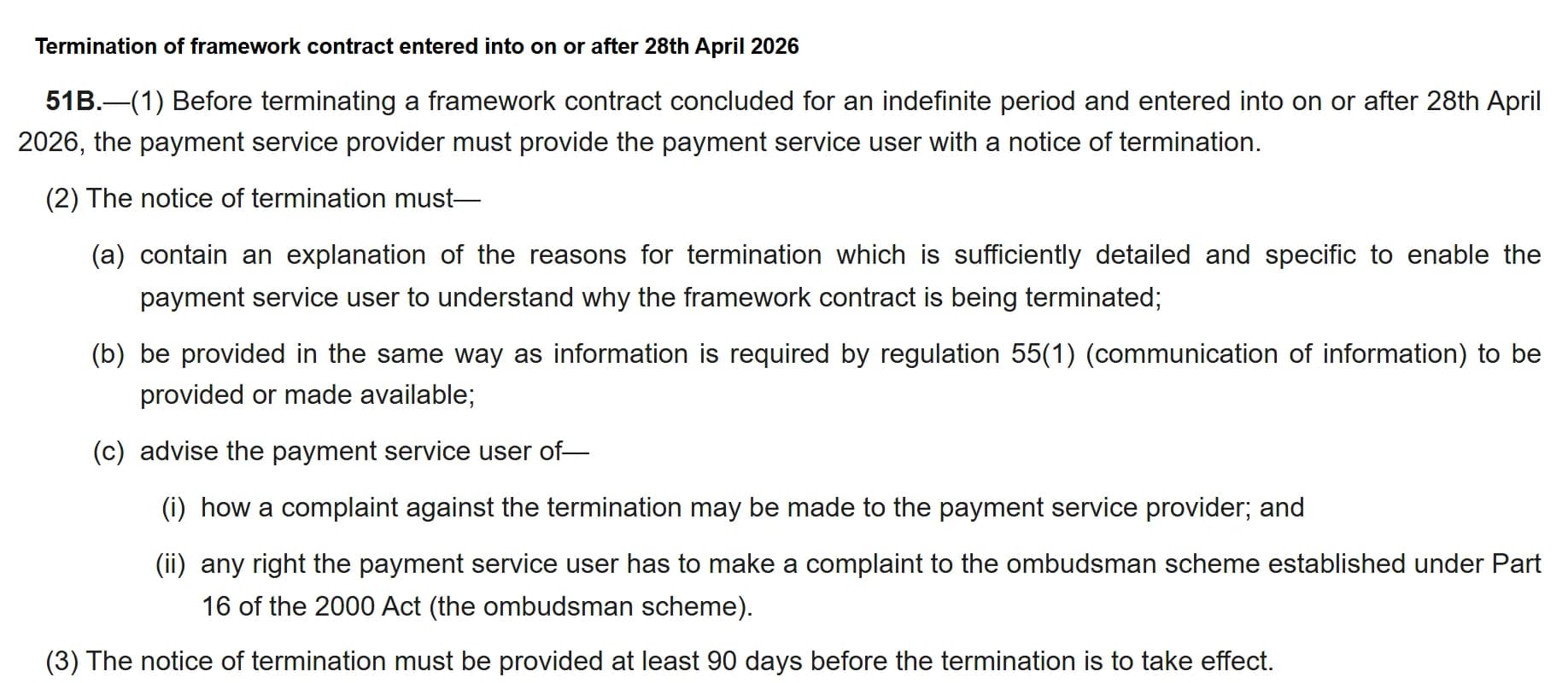
It covers consumers, micro-enterprises and charities; bigger businesses can contract out. There are exceptions: no notice at all where due diligence can't be completed or there's suspicion of serious crime, and no 90-day wait where the customer gave incorrect information when signing up. It also covers terminations, not refusals to onboard. In the US and the EU we found no general duty for a payment provider to explain a merchant decline.
MATCH: the list, and the inquiries nobody mentions
Of the replies, 2 were about Mastercard's MATCH database, and both had a point:
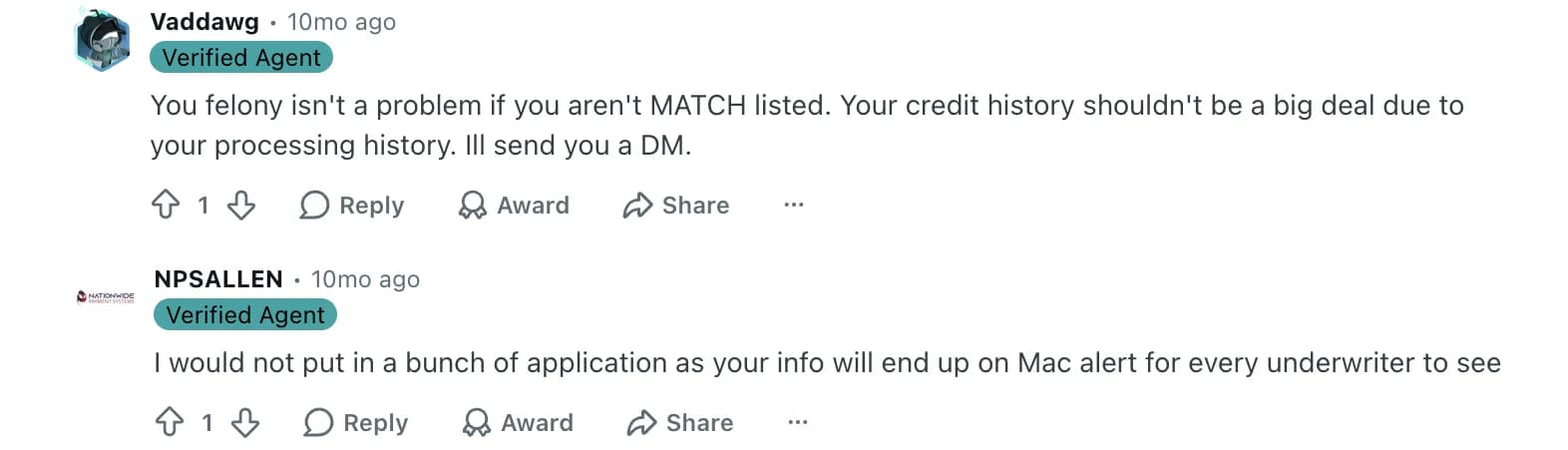
MATCH is the list of merchants terminated for cause, and acquirers must check every applicant against it. Being on it is close to disqualifying; Stripe says a listing "generally disqualifies" a merchant. What goes in is personal as well as corporate:
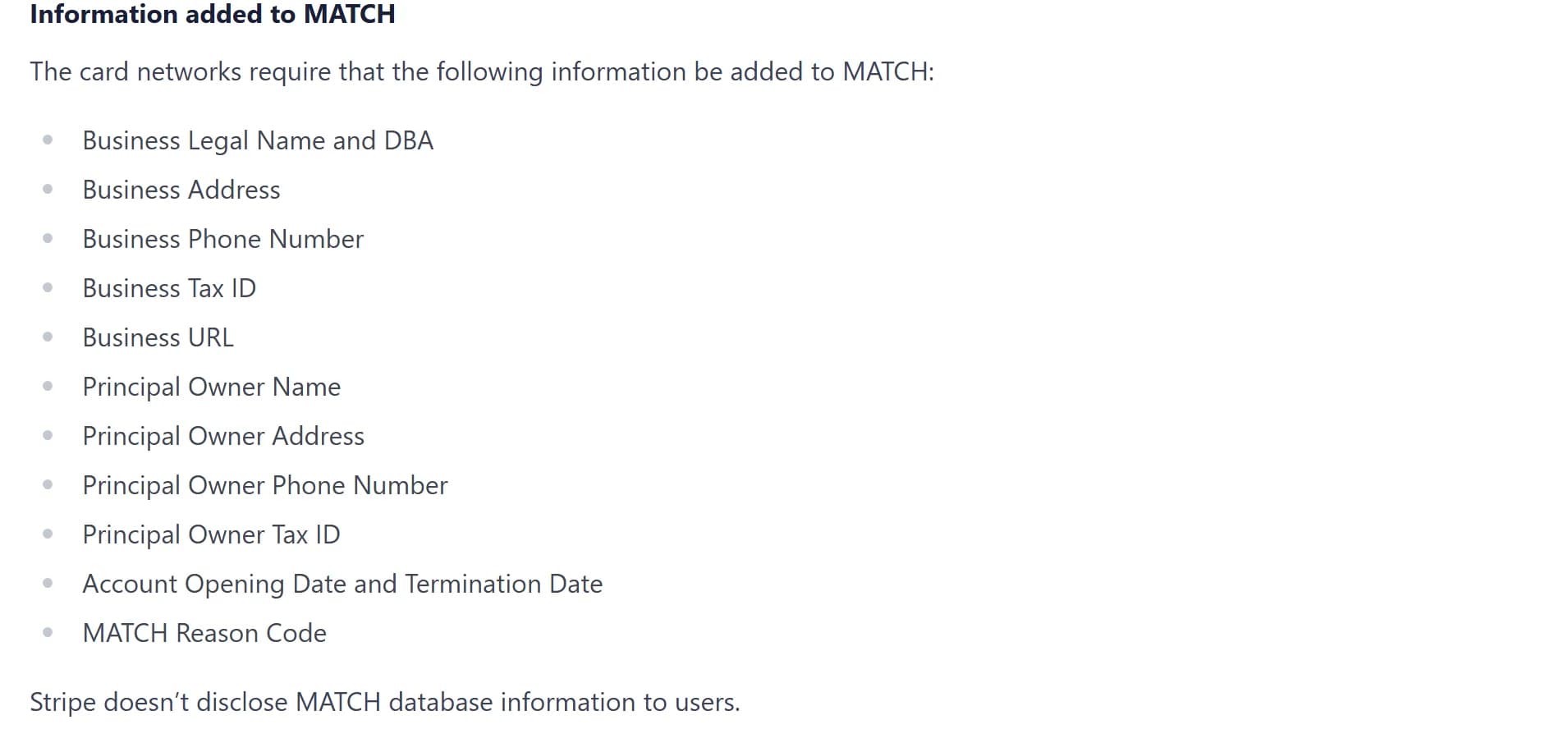
A listing lasts 5 years, and only the acquirer that filed it can remove it, in narrow cases such as an error. If you don't know whether you're listed or by whom, Stripe's documentation says you can email Mastercard at matchbusinessowner@mastercard.com for your listing details.
The "Mac alert" warning is the part most merchants never hear. Every check leaves a trace: according to a 2023 Green Sheet explainer, an acquirer's inquiry compares a new applicant with MATCH data "as well as any other inquiries pulled during the past 360 days," so "an underwriter knows whether a merchant was MATCHed and how many other acquirers recently reviewed an application from that merchant." To an underwriter, 10 applications in a month look like a merchant nobody wanted.
Closed after approval: holds, reserves and appeals
When a payfac closes an account, the money in it doesn't leave with you. In November 2023 a seller of Pilates reformers wrote in the Shopify Community that after 3 orders of $9,000-10,000 each, "Shopify Payments flagged our business as high risk, suspended payments and is now holding $28,000 for 120 days." Stripe closed their account within 48 hours of Shopify.
The terms rarely give a number. Shopify's say a processor "may elect to continue to hold any funds deemed necessary" for chargebacks, disputes and refunds. PayPal's are the exception: it may hold a balance "for up to 180 days if reasonably needed to protect against the risk of liability," and longer under court orders or regulatory requirements. Notice what triggered the Shopify case: a new store, a high ticket and a sudden jump in volume, all at once.
Appeals exist and sometimes work. Square, for one, says appeals of a compliance deactivation are "typically reviewed within 48 hours," and if approved, "any held funds will be released." Whatever the provider, answer with documents, not adjectives: invoices from suppliers, proof of delivery, refund records, and what you changed on the site.
The Reddit advice that's actually fraud
The advice came twice, both times from accounts flagged "Verified Agent":
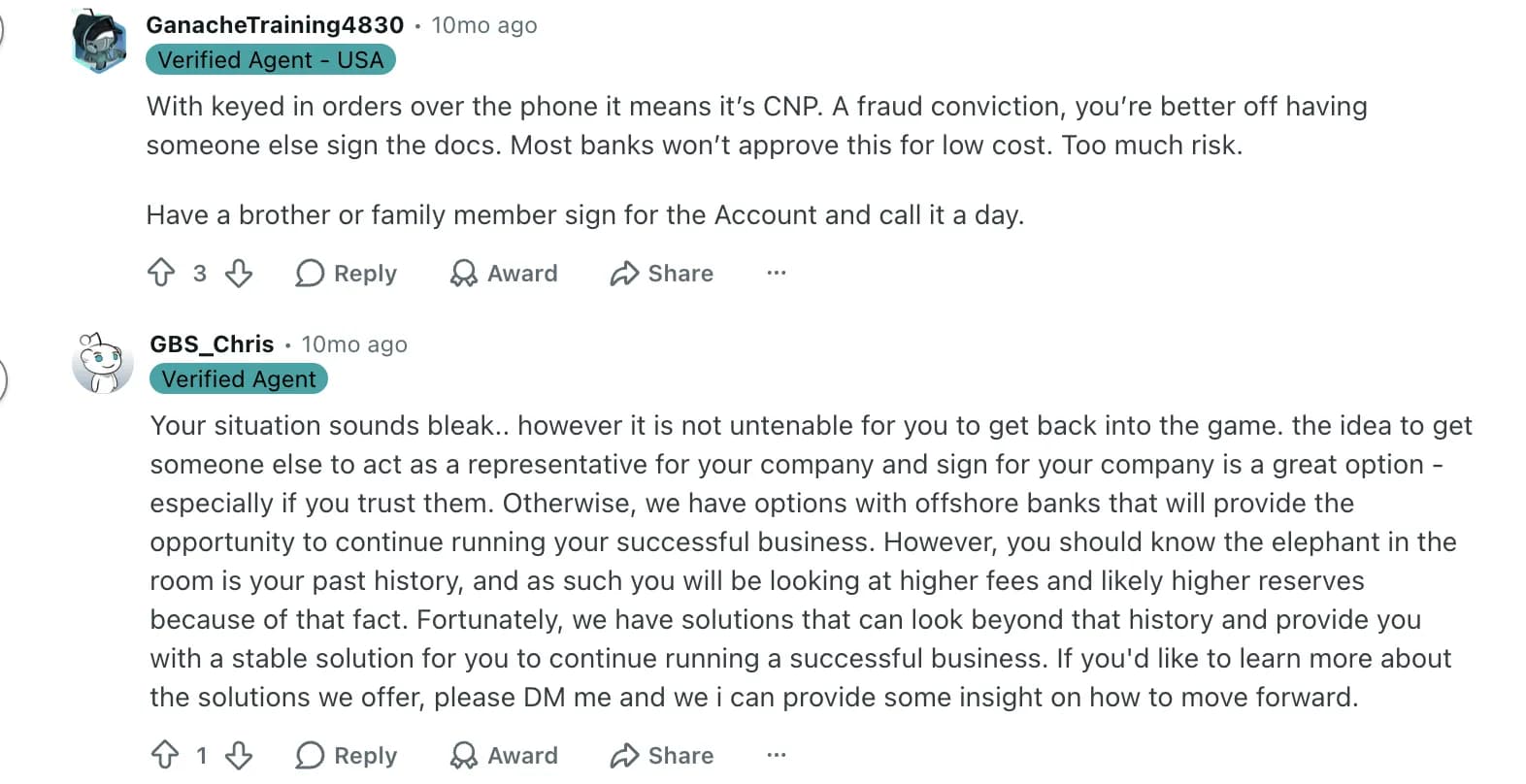
"Have a brother or family member sign for the Account and call it a day" sounds like a workaround. It's the core of a federal case filed this September, where the person who signs is called a straw signer. In September the FTC said Humboldt Merchant Services opened more than 1,000 accounts for shell companies fronted by straw signers paid $750 a month, and the Justice Department had shut down the organization recruiting them in a bank and wire fraud case; we broke the case down here.
A relative signing for a business they don't run puts a false owner on the application, and every check that follows, the credit pull, MATCH, the identity check, is then about the wrong person. PayPal's terms ban opening accounts "using information that is not your own." The UK rules let a provider skip the 90-day notice when the customer "provided incorrect information." And if the account goes wrong, the chargebacks and the MATCH entry land on the person who signed.
The honest version of the same idea exists: bring in a real partner who actually co-owns and runs the business, and disclose both of you.
What to do after a merchant account is declined
- Ask for the reason in writing. You may not get it, but a written answer sometimes names the fixable part, and in the UK it's now a right for small businesses when an account is closed.
- Fix the file before you reapply. Contacts, policies, product descriptions and prices that match the application, and a site that matches the business.
- Check MATCH first. If you were ever terminated by a processor, find out whether you're listed before applying anywhere.
- Apply once, deliberately. Choose a provider that takes your category, send a complete file and wait for the answer. Inquiries are visible for 360 days.
- Bring evidence. Processing statements, bank statements and supplier invoices outweigh any explanation.
- Have a plan B ready. A high-risk ISO, a marketplace, or a merchant of record for digital products. Don't route volume through someone else's account.
Checklist: what to do
Questions and answers
Why was my merchant account application denied?
Usually for something in the file: the owner's credit or history, a product on the provider's prohibited list, a website missing contacts or policies, numbers that don't fit the business, or a MATCH listing. Providers rarely say which, because outside the UK they don't have to.
Can a bank refuse a merchant account without giving a reason?
Yes, in most countries. PayPal's terms say its decisions may rest on confidential criteria it has no obligation to disclose. In the UK, providers closing a contract signed since April 28, 2026 must now explain the termination to consumers, micro-enterprises and charities, but that rule doesn't cover refusals to onboard.
How do I find out if I'm on the MATCH list?
Ask the acquirer that closed your account, or, if you don't know who filed a listing, email Mastercard at matchbusinessowner@mastercard.com for your listing details. Listings last 5 years and are removed early only in narrow cases such as an error.
How long can PayPal or Shopify hold my money after closing my account?
PayPal's user agreement allows holds of up to 180 days, longer under court orders or regulatory requirements. Shopify's terms give no fixed period and let the processor hold what it deems necessary; a merchant in the Shopify Community reported $28,000 held for 120 days.
Can someone else sign my merchant account application?
Not for a business they don't own and run. A straw signer puts false information on the application, which processors and regulators treat as fraud; it's the mechanism behind the FTC's 2026 Humboldt case. Bring in a real partner and disclose them instead.
Author’s conclusion
The Reddit poster did nothing wrong in 7 years and still got a no, because a merchant account is a bet on the future and the bank reads the past of the people, not only the business. That feels unfair, and outside the UK it comes without an explanation. But the file is knowable, and most of it is in your hands.
My advice: treat the application like an audit you prepare for, not a form you fill in. Clean the site, bring statements, check MATCH, apply once, and ignore anyone who offers to put a relative's name on your business. That advice gets accounts opened right up until the day it gets them on MATCH.
Lu Discover, Editor-in-chief
Sources for this article
- reddit.com — r/PaymentProcessing: "Merchant Account: Denied by Bank No Reason Given (Credit is Subpar)" (December 11, 2025) and replies
- reddit.com — r/woocommerce: "Payments being rejected" (July 21, 2026) and replies on gateway response codes, AVS and 3DS
- docs.stripe.com — Stripe website checklist (contacts, fulfillment policies, description, privacy, promotions, security)
- paypal.com — PayPal: Account reserves (business and/or personal credit history)
- instabill.com — Instabill: Top 4 reasons your merchant account application was declined (volume and ticket mismatch, MATCH)
- paypal.com — PayPal User Agreement, last updated September 14, 2026 (holds up to 180 days; confidential criteria; information that is not your own)
- stripe.com — Stripe Services Agreement, last updated September 28, 2026 (termination at any time; 30 days' notice in regional terms)
- legislation.gov.uk — The Payment Services and Payment Accounts (Contract Termination) (Amendment) Regulations 2025, SI 2025/688, in force April 28, 2026 (regulations 51A-51D)
- legislation.gov.uk — The Payment Services Regulations 2017, regulation 40 (contracting out for non-consumers other than micro-enterprises and charities)
- docs.stripe.com — Stripe: Terminated merchant files, MATCH and VMSS (data added, 5 years, removal, matchbusinessowner@mastercard.com)
- greensheet.com — The Green Sheet, January 2023: MATCH inquiries over the past 360 days
- community.shopify.com — Shopify Community: Shopify Payment / Stripe suspension, high value items (November 2023; $28,000 held for 120 days)
- shopify.com — Shopify Payments Terms of Service, US (termination and continued holding of funds)
- squareup.com — Square: Appeal a compliance deactivation of your Square account
- ftc.gov — FTC press release on Humboldt Merchant Services (September 8, 2026)
- ftc.gov — FTC v. 5967 Ventures LLC (Humboldt), complaint (straw signers, $750 a month; United States v. CB Surety LLC)
Related stories
 Guide
GuideIs a Payment Processor Legit? 6 Checks Before You Route a Single Transaction
 Guide
GuideAccept Payments Without a Business: 4 Routes That Work, and Why One Word Can Cut Off a Skincare Store
 Analysis
Comments
0 commentsNo comments yet.
Add a comment