
How to Start an Affiliate Program: The Minimum Checklist for Small Sellers

Contents 11
On October 1, a seller asked r/Affiliatemarketing for advice. They photograph real flowers, pressed flowers and leaves, cut them out themselves and sell them as transparent PNGs on their own site. They do all the marketing alone and are "kind of hitting a wall with that." The plan: let people promote with their own links for 30% per sale.
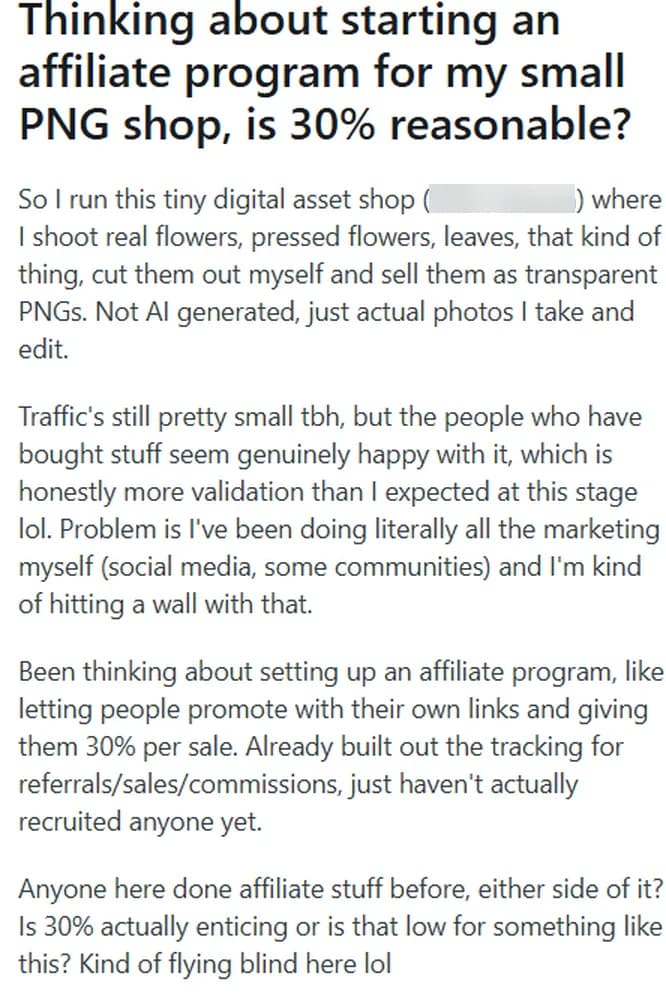
The key line comes before the question: "Already built out the tracking for referrals/sales/commissions, just haven't actually recruited anyone yet." Tracking is the part of an affiliate program software can sell you. The hard part is terms a careful affiliate will sign and people to sign them, and no subscription includes either. Nobody in the thread answered the 30% question.
I've spent 10 years on the affiliate side, reading program terms for the places where someone might not get paid. Below: why network software is the wrong size, the 8 parts a minimum program needs, how to pay and stay legal, the cheapest setup by platform, OnlyFans included, and where the first affiliates come from.
Affiliate program software: why network platforms are the wrong size
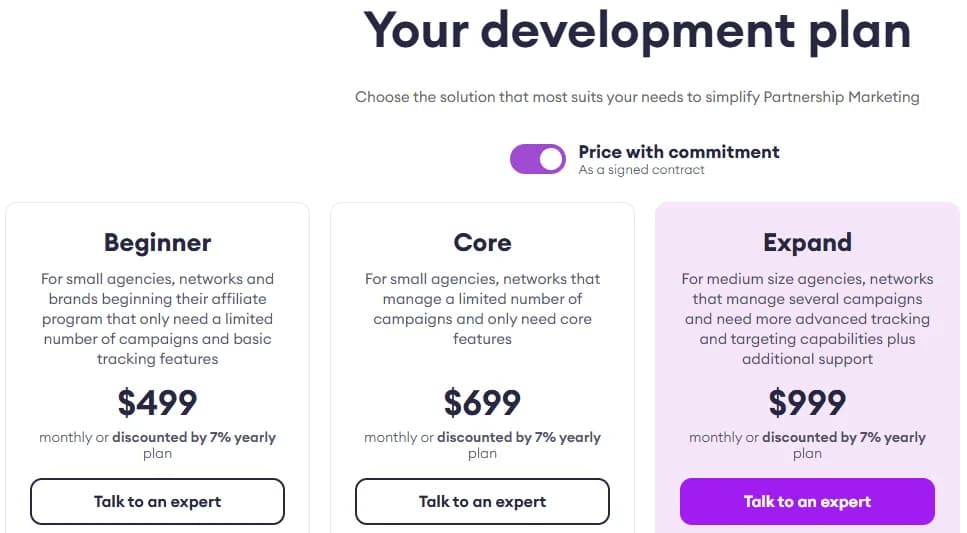
The obvious move is to buy a platform. My guess, before we checked, was that the 10 to 15 platforms on this market, Affise and SOFTSWISS Affilka among them, start above $1,000 a month. For most entry plans that's wrong. Affise's Beginner plan is $499 a month on a signed contract and $625 without one, for 7,000 conversions and 50 offers; its first tier near $1,000 is Expand at $999. TUNE does clear the bar: $1,500 a month, paid annually.
Others publish no price at all. Affilka offers a demo and calls itself software "designed for the iGaming industry." Everflow shows a quote form that asks how much you pay affiliates each month, and its pricing page requires "a 6-month commitment."
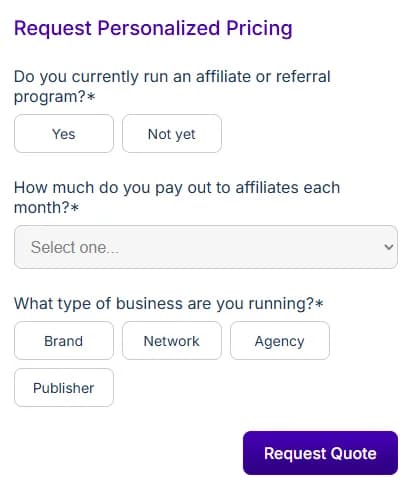
So the number was off, but the point holds: these tools are built for affiliate networks and large brands, with conversion quotas in the thousands and annual or 6-month commitments. A flower-cutout shop needs 8 working parts, and none requires a sales call:
- A signup page with a clear approval rule.
- A unique link per affiliate, plus a code for places where nobody clicks.
- Order capture: who sent the buyer, when, which order, how much, what status.
- A written cookie window and attribution rule.
- Terms: commission base, hold, payout threshold and date, banned methods.
- A promo kit with disclosure instructions.
- A dashboard where affiliates see their own clicks, sales and statuses.
- A payout routine, with tax forms collected first.
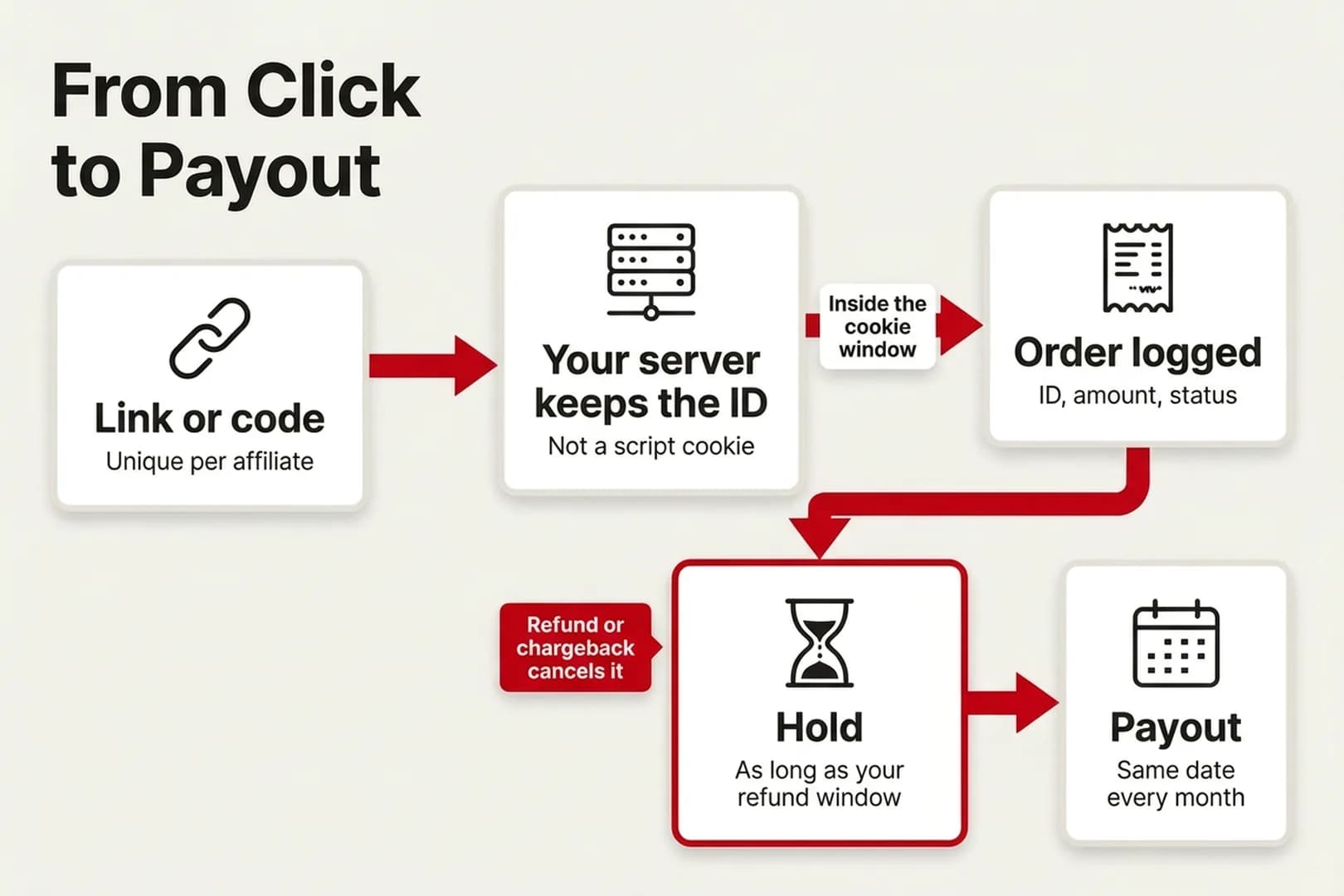
What an affiliate program must track: link, order, status
Parts 2 to 4 answer the question every affiliate asks: did my sale count? An affiliate link is your normal URL with an affiliate ID added. Your system keeps that ID until checkout and records for every sale:
- the affiliate ID from the link, or the code the buyer typed;
- the click time, to check that the order fell inside the window;
- the order ID, the amount and the commission base;
- the status: paid, refunded, canceled or charged back.
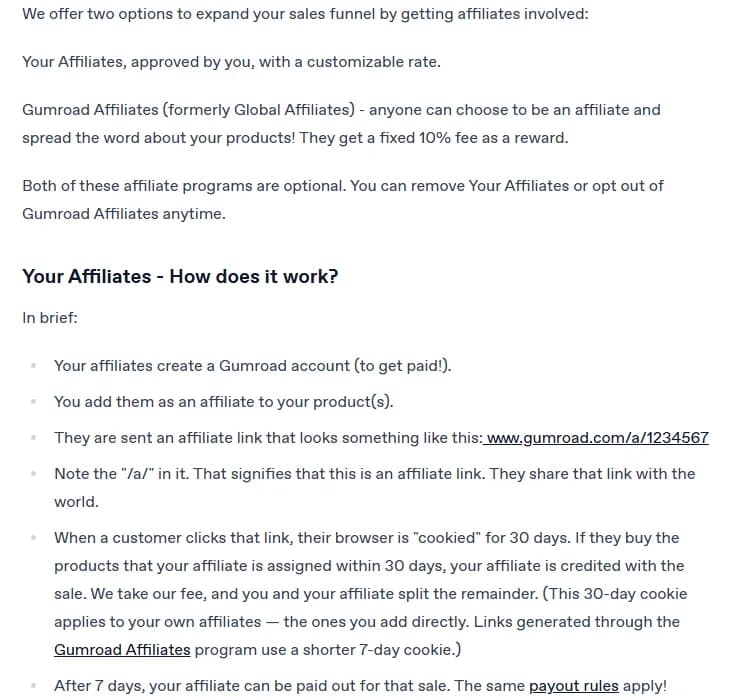
A cookie window is how long after a click a purchase still counts: Gumroad gives 30 days to affiliates you add yourself. The attribution rule decides who wins when 2 affiliates touched the same buyer; Gumroad uses last-click attribution, crediting "the affiliate whose link was clicked on most recently." Settle the link-versus-code case in writing too.
Codes matter: nobody clicks a link in a podcast, but a code survives it, and it's your backup when the cookie disappears. WebKit, the engine behind Safari, deletes script-written cookies after 7 days without user interaction with the site. When it detects a click ID passed in a link and picked up by JavaScript, it caps the cookies that script creates at 24 hours. A 30-day window written by a tracking script can shrink to a day.
The fix is server-side capture: your server reads the click ID or affiliate ID from the incoming URL, stores it with the session or account and attaches it to the order. On a hosted platform that's the platform's job; on your own site, ask the plugin vendor where the click is stored before promising a window.
What to prepare for affiliates before you recruit
Tracking tells you who sold; whether anyone sells depends on what an affiliate finds on your program page. From the affiliate side, I trust a program when I can answer 5 questions without writing to anyone: what counts as a paid sale, how long approval takes, when I get paid, where I see my numbers, and who answers when something looks wrong. I've had a program hand me a pay-per-lead offer and then refuse to pay, so the definition of a paid conversion is the first line I look for.
Have these ready before the first invitation:
- Signup page. Name, email, where they'll promote, payout email, approval rule. I came into this business from UX design: cut the form to what you need to pay someone.
- Terms page. A single page in plain words: everything in part 5, plus when you can close an account and what happens to the balance.
- Link and code, issued automatically on approval.
- Promo kit. Product facts, prices, claims affiliates may not make, and images and creatives they may post. For the PNG shop, that's a few sample cutouts with the license in a single line.
- Disclosure wording to place next to the link.
- Dashboard and a contact who replies within a stated time.
In a network that contact is the affiliate manager; here it's you. Skip sub-affiliate tiers and leaderboards, which serve programs with hundreds of affiliates. Network terms lean on "sole discretion"; write down exactly when a sale is void, and careful affiliates notice.
How to pay affiliates: hold, schedule and tax forms
Payment terms start with the base. A commission per sale is a percentage of something: the full price, the price before tax and shipping, or what's left after fees. Gumroad pays a share of "the total sale amount (including sales tax and shipping)." Pick your base and print it.
Then the hold, the wait before a sale becomes payable. Match it to your refund window plus a margin, so you never pay commission on money you send back. Shopify Collabs holds commissions 30 days by default, adjustable within 1–90 days, and cancels them on canceled and fully refunded orders. A chargeback, a card payment reversed by the buyer's bank, can land after any hold, so write that the commission reverses too.
Then the date and the method: monthly on a fixed date above a stated minimum, by PayPal or bank transfer, is enough for a small program. Built-in payouts cost extra: 2.9% on automatic Collabs payments, 5% for bank and 8% for card payouts at PromoteKit. As an affiliate I'll accept a long hold that was written down; a payment date that slides is what makes me stop sending traffic.
Taxes, if you're a US business. Collect Form W-9 from US affiliates and Form W-8BEN from non-US ones before the first payout. For payments made after December 31, 2025, you file Form 1099-NEC for each person paid at least $2,000 in a year, up from $600. If a US affiliate gives you no taxpayer ID, backup withholding is 24%.
Card and third-party network payments are reported by the processor on Form 1099-K instead; which of your payout methods counts is a question for your accountant. Outside the US the forms differ, and the rule doesn't: paperwork first, money second.
Affiliate disclosure, cookie consent and fraud: the owner's minimum
Running a program makes you the advertiser. The FTC says advertisers "need to have reasonable programs in place to train and monitor members of their network," and offers a fallback: "If regular monitoring is too much for you, you should probably switch to pre-approval of posts."
Wording matters too: consumers "might not understand" what "affiliate link" means, while "paid link" right next to the link "should be an adequate disclosure." Put that phrase in the promo kit. In the UK, the CAP Code makes "both the business and the affiliate marketer" responsible, even when the affiliate made the ad alone.
Selling to the EU or UK adds consent. France's regulator, the CNIL, says trackers used to bill affiliate operations are not exempt from it, so your cookie banner has to cover the affiliate tracker. Visitors who refuse it can still be credited through a code.
Fraud in a small program is rarely clever. Ban these in the terms and watch for them:
- Self-referrals: affiliates buying through their own link. Compare affiliate names and payout emails with buyers.
- Coupon leaks: a code lands on coupon sites and earns on buyers already at checkout. Collabs lists "discount code leaks" as a violation; cap uses per code.
- Refunds after payout: the hold prevents them, as long as it matches your refund window.
- Brand bidding and cookie stuffing: ads on your shop's name, and cookies dropped on people who never saw a recommendation.
The response to all 4 is the same: void the commission, explain why in writing, close the account if it happens again.
The cheapest affiliate setup for where you sell
Where you already sell decides most of the setup. Prices at the time of writing:
- Own Shopify store. Cheapest route: Shopify Collabs; UpPromote or GoAffPro free plans. What it costs: Collabs free, 2.9% on automatic payments; UpPromote free to $3,000 in referral sales a month. What it won't do: Collabs takes no new creator signups: invite your own.
- WooCommerce. Cheapest route: SliceWP free core. What it costs: $0; Pro lists at $229 a year. What it won't do: Affiliate coupons and PayPal payouts need Pro.
- Gumroad / Payhip. Cheapest route: Built-in affiliates. What it costs: No extra fee (Gumroad's 10% + $0.50 is split with the affiliate; Payhip's Free plan takes 5%). What it won't do: Gumroad affiliates need an account; Payhip payouts are manual.
- Lemon Squeezy. Cheapest route: Built-in affiliates. What it costs: 3% per referred order on top of 5% + $0.50. What it won't do: Pays affiliates itself, after a 30-day hold.
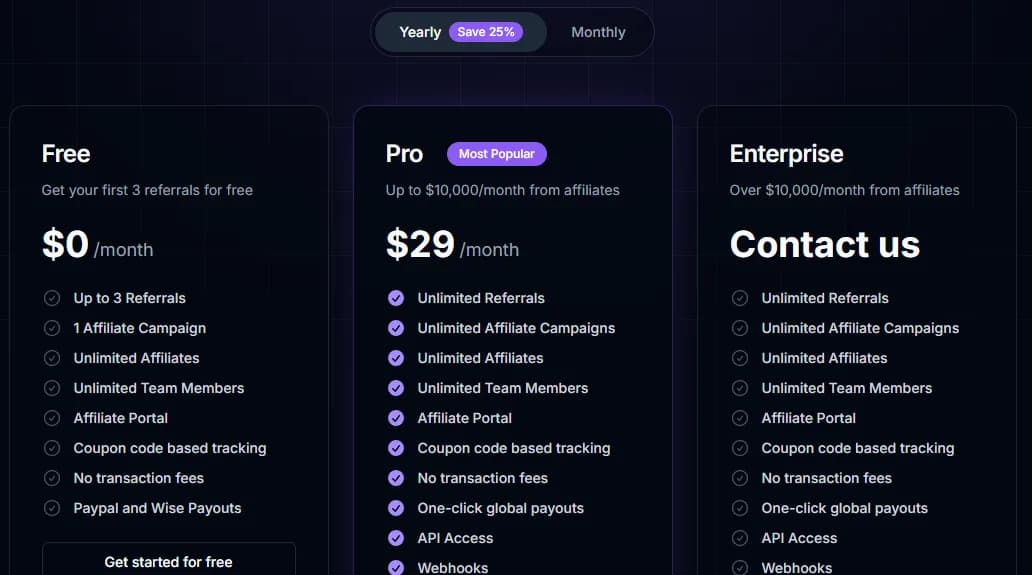
- Stripe-billed SaaS. Cheapest route: PromoteKit. What it costs: Free for 3 referrals, then $29 a month billed yearly. What it won't do: One-click payouts add 5–8%.
- Etsy. Cheapest route: Promo code per promoter. What it costs: $0. What it won't do: No way to pay a promoter inside Etsy.
- OnlyFans / Fansly / Fanvue. Cheapest route: Tracking link per promoter. What it costs: $0. What it won't do: Measure, don't pay; Fanvue's beta pays creators only.
Gumroad's built-in route has a second layer: a marketplace program that pays any promoter a fixed 10% with a 7-day cookie, which you can switch off.
The free SliceWP core tracks commissions and builds payout lists you pay by hand. PromoteKit's free plan already includes coupon tracking and PayPal and Wise payouts, enough to test with your first affiliates.
Etsy is the odd one out. You can make a promo code per promoter in Sales and Discounts, but Etsy can't pay that promoter, and the Etsy pages we read don't say whether paying one outside the platform is allowed. Share & Save gives you 4% back only on links you share yourself.
OnlyFans affiliate program: what creator platforms let you track
Now the creator who posts all day, won't run ads and pays a manager to find promoters. A link per promoter replaces the bookkeeping half of that job: who brought which subscribers and what they're owed.
OnlyFans' help center doesn't describe tracking links; its official blog does, as links that show "how many visitors become subscribers." There's no payout function, and the help center says OnlyFans "does not work with or endorse any agencies, managers or third parties." Its referral program pays 5% of a referred creator's earnings for 12 months, up to $50,000, and nothing for fans. OnlyFans also bans promoting an account with Google Ads, a rule your promoters inherit.
Fansly documents the most: claims, follows, subscriptions and revenue per tracking link. The limits are no payout tool and the line "a user can be linked to multiple Tracking Links," so 2 promoters can claim the same fan unless your agreement names a winner.
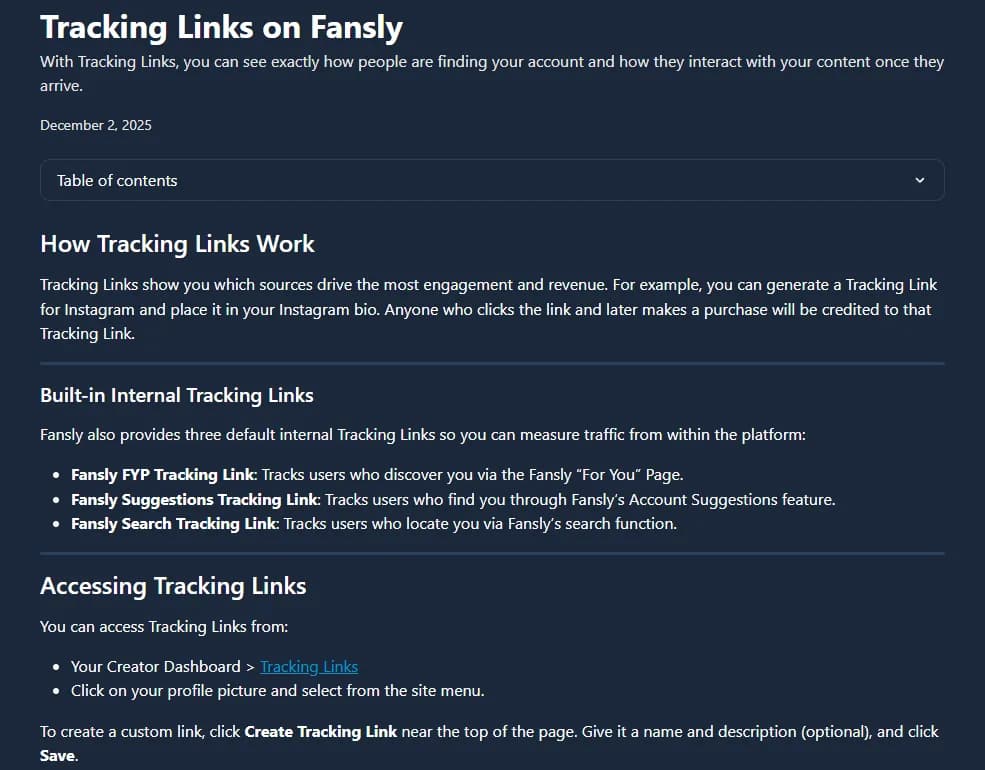
Fanvue has the only native product, in beta and access-limited. A creator offers 5–50% to other creators, paid only on fans new to that creator and only from their first paid renewal, with up to 5 active links and a $50,000 cap per link.
So a creator's minimum program is a tracking link per promoter, a written agreement with the rate, the window and the tie-break rule, and payment outside the platform on a fixed date from the platform's stats. OnlyFans says its relationship is with you, not with a third party: keep the agreement in writing and the login to yourself.
Where affiliates come from, and why 30% isn't a pitch
Is 30% reasonable? I know of no primary benchmark, so this is my reasoning, not a market rate. A digital file costs almost nothing to sell again, so the commission comes out of nearly pure margin. Gumroad lets sellers set 1–75%, and takes 30% itself when its Discover marketplace finds you a customer. An affiliate at 30% costs what the marketplace does, and reaches an audience the marketplace doesn't.
The percentage still recruits nobody, because affiliates think in what a click earns them, their EPC, and that depends on your price and conversion rate, which a new program can't show yet. In mid-September the same subreddit had a Gumroad seller with "30% commission on most products" and zero affiliates. The best reply: "Your first good affiliates will most likely come from you finding them, not the other way around."
Start with people who already like the product. The PNG seller's buyers "seem genuinely happy," so invite them one by one, then people who use files like these in work they publish. A reply in the flower thread suggested paying niche sites a flat fee for a month instead, and as a first test that's fair. You pay either way, and you learn which audiences deserve a commission.
Checklist: what to do
Questions and answers
How do I start an affiliate program for my small business?
Turn on the affiliate tool of the platform you sell on (Shopify Collabs, Gumroad, Payhip, Lemon Squeezy) or a free plan, write a page of terms and a promo kit, and invite your own customers first.
How much commission should I offer affiliates?
There's no universal benchmark. Compare it with what a new customer costs elsewhere: Gumroad takes 30% when its marketplace finds you a buyer and lets you set 1–75% for your own affiliates. Then check what a click would earn an affiliate at your price.
Do I need affiliate software?
Not network software: Affise starts at $499 a month and TUNE at $1,500. A small seller can start at $0 with built-in tools or free plans and pay once the program outgrows them.
How do I pay affiliates and handle taxes?
Pay after a hold that matches your refund window, on a fixed date, by PayPal, bank transfer or a tool's payouts. US businesses also collect W-9 or W-8BEN and, for payments after December 31, 2025, file Form 1099-NEC for anyone paid $2,000 or more in a year.
Can an OnlyFans creator run an affiliate program?
Not inside OnlyFans: there's no payout tool, and its referral program pays only for referred creators. A creator can give each promoter a tracking link and pay outside the platform; Fansly reports revenue per link, and Fanvue has a beta affiliate feature.
Author’s conclusion
The flower seller built it in the usual order: tracking first, terms later, affiliates someday. Software is cheap now, and for most sellers it's already inside the platform they use. What no platform sells is the page an affiliate reads before spending their audience on you, and the habit of paying on the date you promised.
My advice: write the terms before you touch a setting, match the hold to your refund window and never move a payout date. Then send the link to your happiest customers yourself, and let 30% be the reason they say yes, not the reason they hear about you.
Lu Discover, Editor-in-chief
Sources for this article
- reddit.com — r/Affiliatemarketing: "Thinking about starting an affiliate program for my small PNG shop, is 30% reasonable?" (October 1, 2026); the Gumroad thread "How do you actually find affiliates for Gumroad digital products?" (September 13, 2026) is in the same subreddit
- affise.com — Affise pricing: Beginner $499 a month with a signed contract, $625 without, 7,000 conversions; Expand $999
- tune.com — TUNE pricing for advertisers: Scale plan $1,500 a month, paid annually
- everflow.io — Everflow pricing: personalized quote form and 6-month commitment
- affilka.com — SOFTSWISS Affilka: demo request, affiliate software designed for the iGaming industry
- help.shopify.com — Shopify Collabs merchant payments help (30-day default hold, 1–90 days, 2.9% fee), community guidelines and the creator signup pause, plus the Collabs, UpPromote and GoAffPro listings on apps.shopify.com
- wordpress.org — SliceWP plugin page (free core, premium add-ons for coupons and PayPal Payouts), with Pro pricing on slicewp.com
- gumroad.com — Gumroad Help: affiliates on Gumroad (1–75%, commission base, 30-day and 7-day cookies, last click, 7-day payout), plus Gumroad pricing (10% + $0.50, 30% via Discover)
- payhip.com — Payhip pricing (Free plan 5% fee, affiliates on every plan) and help on affiliates (PayPal payouts by the seller)
- docs.lemonsqueezy.com — Lemon Squeezy docs: affiliate fees for merchants (3% per referred order) and affiliate payouts (30-day hold)
- promotekit.com — PromoteKit pricing: Free for 3 referrals, Pro $29 a month, one-click payout fees
- help.etsy.com — Etsy Help: Share & Save (4% back, trackable links, promo code links)
- onlyfans.com — OnlyFans help center and Terms (agencies and managers, relationship with the creator, Google Ads ban), Referral Program Terms (5% for 12 months, $50,000 cap) and the official blog post on Campaigns tracking links (April 20, 2023)
- help.fansly.com — Fansly Help: Tracking Links on Fansly (claims, follows, subscriptions, revenue; December 2, 2025)
- help.fanvue.com — Fanvue Help: Affiliates, earn commission by promoting other creators (beta, 5–50%, $50,000 cap, 5 links; August 31, 2026)
- webkit.org — WebKit Tracking Prevention: 7-day cap on script-writeable storage, 24-hour cap after link decoration
- ftc.gov — FTC: Endorsement Guides, What People Are Asking (training and monitoring, pre-approval, "paid link" vs "affiliate link")
- asa.org.uk — CAP/ASA advice: online affiliate marketing (business and affiliate both responsible)
- cnil.fr — CNIL cookies and trackers FAQ, question 13: affiliate billing trackers are not exempt from consent
- irs.gov — IRS Instructions for Forms 1099-MISC and 1099-NEC ($2,000 threshold, 1099-K for card and third-party network payments), plus About Form W-9, W-8BEN instructions and Topic 307 on 24% backup withholding
Related stories
 Comparison
Best Antidetect Browser for Android 2026: Cloud Phones, Android Apps and Emulated Profiles
 Top list
Best iPhone Antidetect Browser 2026: Real WebKit Apps, Emulated iPhones and Cloud iPhones
 Top list
Comments
0 commentsNo comments yet.
Add a comment