

417K Search Clicks, $77.16 in 18 Months: A Nigerian Lottery SEO Site, Fact-Checked

Independent and reader-supported. Some links here are affiliate links: if you sign up through them, we may earn a commission at no cost to you. It never changes our scores or verdicts. Affiliate disclosure
Contents 12
"My anti-case #1: a lottery site." On August 30, 2026, an affiliate SEO who writes a Telegram channel about affiliate SEO posted the numbers for his Nigerian lottery results site: about 1,000 visitors a day, 417,000 Google clicks, and $77.16 in total income over roughly 18 months.
This is our review of the post and its follow-ups for affiliates who build SEO sites in tier-3 markets: the author's story in translation, our math on his numbers, the Nigerian market context, and what the case doesn't show. It's an anti-case, so the score rates how honestly and in detail the failure is analyzed. Editorial fact-check: 3/5.
Short version: the failure is told plainly, the affiliate income adds up to the cent, and the Search Console chart backs the traffic. But there's no site, no costs and no deposit data, and the cause, which his own description points to, is never named: people searching for lottery results want numbers, not a casino.
Who wrote it
The channel is "Naumov on Affiliate SEO," about 1,320 subscribers as of November 2026. Its author introduced himself as Kirill in his first post in 2023 and lives in Spain. He has run review sites for health products in Europe since 2017, more than 300 sites by his count, and moved into gambling in spring 2025. His channel is candid about the bad years: "a couple of Google updates in 2023-2024 cut 90% of the traffic on my sites, taking 90% of the profit with them." Every quote below is our translation from Russian.
He sells nothing with this case. The channel's first post: "I have no goal or wish to sell you anything on this channel." It takes ads through a contact in its header, and a free WordPress plugin he published carries referral links.
Our take: an experienced SEO, new to gambling, publishing his own failure with no product attached. That's the right person to learn from, and the right reason to read his numbers closely.
The idea: a portal for Nigeria's cult lottery
"That's how I came across Baba Ijebu. It's a cult Nigerian lottery with 1.5M searches a month. It has a super-awful official site, where you couldn't even buy tickets online before." Most of those searches, he noticed, were for results and predictions, "so the decision was to build a mini-portal for all the brands."
The business plan, in his words: "Launch the first site, send the traffic to the lottery sections of casinos, make money off poor gambling Nigerians and reinvest the profit into buying up the awful portals."
How it was built: "With AI I wrote scrapers of the results from each official lottery site, then, based on the schedule and the types of games, I made random number generators, aka 'data-based predictions.'"
Our take: the build is smart and cheap: scrape results that the official sites present badly, publish them faster and cleaner, and let Google do the rest. Note the 2 words that matter for monetization. The audience wants "results," and the "predictions" are random numbers. That's a crowd that came for a number, and the site gave them one, invented.
The traffic: 417K clicks from Google
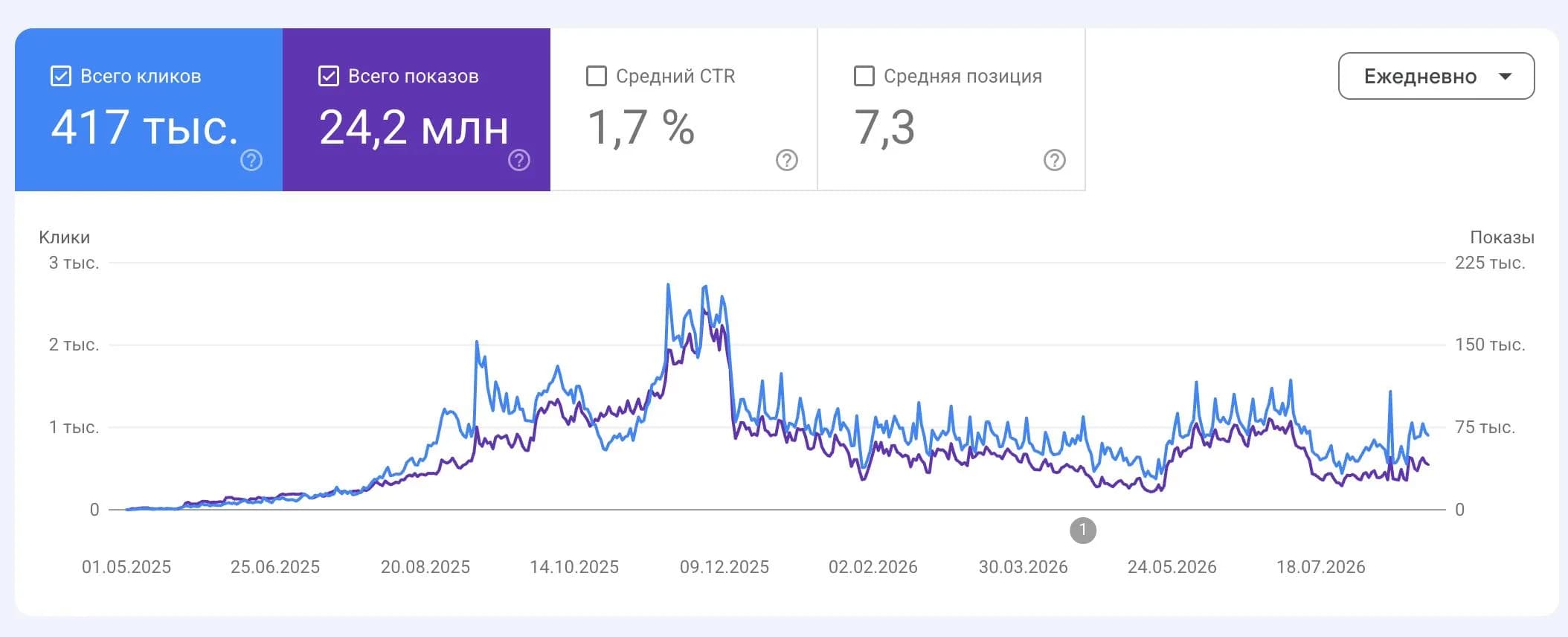
"The traffic came almost right away and settled at around 1,000 visitors a day (at the peak, 2,500)."
The post opens with his Google Search Console screenshot, in a Russian interface. For May 1, 2025, to August 2026 it shows 417K total clicks, 24.2M total impressions, an average CTR of 1.7% and an average position of 7.3. Clicks climb from August 2025, peak at about 2,700 a day in December 2025 and then hold around 1,000 a day.
Our math: 417,000 clicks over the chart's roughly 16 months is about 26,000 a month and 860 a day, in line with "around 1,000." 24.2M impressions at 1.7% CTR and position 7.3 means the site was visible but rarely first. Against his 1.5M monthly searches, 26,000 clicks a month is about 1.7% of the demand.
The money: $77.16, 99% of it from 2 programs
"I tried many affiliate programs, tested different approaches (banners, buttons, links), tried sending to crash games." The result, as his table gives it:
Program | Conversions | Income |
|---|---|---|
1win | 520 registrations | $47 RevShare |
A mobile lottery subscription agency | 81 subscriptions | $29.56 |
Melbet | 3 registrations | $0.45 RevShare |
1xBet | 1 registration | $0.15 RevShare |
"Total: $77.16 of income in 1.5 years of the site's work." And the counterfactual: "Even blindly sending it to popunders, I'd have made $300-400."
Our math:
- the table adds up: $47 + $29.56 + $0.45 + $0.15 = $77.16;
- 1win and the subscription agency are $76.56, or 99.2%; Melbet and 1xBet brought 60 cents together;
- 524 registrations from 417,000 clicks is 0.126%, 1 registration per 800 clicks;
- 1win paid $0.09 per registration on RevShare, which means almost none of those 520 people deposited and lost money;
- per 1,000 clicks the site earned $0.185; per day, $0.14; per month, about $4.30;
- his popunder estimate of $300 to $400 works out to $0.72 to $0.96 per 1,000 clicks, which is 4 to 5 times more. That's his guess, with no network named.
Not shown: costs. No domain, hosting, AI tokens or hours for this site. Elsewhere in the channel he puts his AI article cost at about $0.40 a piece before he switched to batch requests, and his total API spend at $30 to $50 a month across all sites. At those rates, a year of content alone could exceed the $77.
Why it didn't pay: intent, not partners
The author doesn't diagnose it beyond "I tried many affiliate programs" and "no empire got built." His own description of the site points to the causes:
- Intent. People search "Baba Ijebu results" to check a ticket they already bought from a street agent. They're not shopping for a casino. 0.126% registering is what a mismatch looks like.
- Audience. Baba Ijebu is played through agents' kiosks with small stakes. A registration at an online casino is a long step from there, and $0.09 per registration says few took it.
- Deal type. He took RevShare on people who mostly didn't deposit, so he earned a share of almost nothing. With a CPA on first deposits, even a handful of FTDs would have beaten the whole 18 months, if any existed.
- Monetization last. The plan assumed the traffic would convert to casino lottery sections. Nothing in the posts shows that was tested before the site was built.
Our take: this is the classic informational-traffic trap. A results site is a great traffic machine and a bad affiliate machine, because the visitor's job is done the moment they see the number. Sites like this usually earn from display ads, which pay for every page view, intent or not; the author's own "popunders would have paid more" says the same thing.
The site that survived the Google update
On September 3, about 2 weeks after Google's August 2026 spam update started on August 18, he listed what grew: "the damn lottery site" and an old nutra review site. Everything else that made good money fell, he wrote, including his nutra store sites in 12 countries, Nigeria among them, and the MENA region.
Then he reused the engine. Anti-case #2, on September 18: a Venezuelan version for the Animalitos lottery, on a subdomain of the same Nigerian site, with the engine adapted to the new type of game. 10,000 clicks in 4 months, 9 registrations, $0, because Animalitos "is not present in any casino with an affiliate program that I know." A September 28 post adds that an affiliate program he applied to on July 27 answered 2 months later.
Our take: the second anti-case repeats the first, faster. The engine works; the monetization question comes last again. That's the most useful lesson in the series, and the author shows it rather than states it.
Nigeria: a market that's real, regulated by states
Nigeria's online gambling market is large and mostly mobile. Its regulation moved in 2024: on November 22, the Supreme Court nullified the National Lottery Act of 2005, leaving lotteries and gaming to the states. Lagos has the most developed regulator, the Lagos State Lotteries and Gaming Authority, and on May 7, 2025, a forum of more than 20 states adopted a framework for recognizing each other's licenses. Baba Ijebu itself is Premier Lotto, founded in 2001 and sold mostly through agents' street kiosks, with stakes from as little as ₦5.
Check the license state by state. Since the Supreme Court ruling, gambling licenses in Nigeria are issued by the states. Before you send Nigerian traffic, check which state licenses each brand you promote, and expect the biggest lottery brands to sell through their own agents rather than through affiliate programs.
The author's site sent traffic to international casino brands; whose licenses those are in Nigeria the post doesn't say.
Fact-check: what the author showed and what they hid
We rate every case on 10 points: what an outsider needs to judge the result and repeat it. For an SEO anti-case, the source becomes search traffic, the creatives become the content, and the score rates how honestly the failure is taken apart. Like most case studies, this one is selectively true.
Point | Status | What we found |
|---|---|---|
Setup: period, GEO, offer, model | Partial | Nigeria, lottery results and "predictions," about 18 months, RevShare and mobile subscriptions. No domain, launch date or placements. |
Author and independence | Showed | A public channel with a long history of open losses, selling nothing with this case. |
Finances | Partial | Income by program adds up to $77.16. No costs at all, so no ROI. |
Proof | Partial | A real-looking Search Console chart. No affiliate dashboards. |
Traffic and targeting | Partial | SEO, 1,000 visitors a day, 417K clicks, 1.7% CTR. No queries, pages or rankings. |
Tools | Partial | AI-written scrapers and generators. No tools, hosting or CMS named for this site. |
Content | Partial | Scraped results and random "predictions," described but not shown. |
Site and placements | Hid | No site, no screenshot of a banner or button. |
Costs and consumables | Hid | Domain, hosting, AI and time: nothing for this site. |
Repeatability today | Partial | The concept is clear, and the site was still growing in September 2026. The author doesn't say what he'd do differently beyond "popunders." |
Score: 3/5. For an anti-case this is honest: the income table adds up, the traffic is shown, the author's motives and mistakes are on the page and nothing is for sale. It stops at 3 because the site, costs and deposit data are missing, and the analysis ends at "no empire." The cause, results-seekers who never wanted a casino, is right there in his own description, and he doesn't name it.
Checklist: what to do
Questions and answers
Can you make money from a lottery results website?
Mostly from display ads, not affiliate links. In this case 417,000 Google clicks to a Nigerian results site earned $77.16 from betting programs in about 18 months, 0.126% of visitors registered, and the author estimated popunders would have paid 4 to 5 times more.
What is Baba Ijebu?
Baba Ijebu is the popular name of Premier Lotto, a Nigerian lottery founded in 2001 and sold mostly through street agents, with stakes from as little as ₦5. The author of this case estimated its searches at 1.5M a month, most of them for results and predictions.
Why does informational traffic convert badly for affiliates?
Because the visitor's need ends on your page. Someone checking lottery results got what they came for; a casino offer asks them to start something new. Monetize informational pages with ads, and put affiliate offers where the searcher is choosing what to buy.
Is gambling legal to promote in Nigeria?
Gambling is regulated at state level since the Supreme Court nullified the National Lottery Act on November 22, 2024. Lagos has the most developed regulator, and more than 20 states recognize each other's licenses under a framework adopted in May 2025. Check each brand's license before promoting it.
RevShare or CPA for tier-3 betting traffic?
If your audience rarely deposits, CPA on first deposits usually pays more, because RevShare is a share of losses that never happen. In this case 520 registrations on RevShare earned $47, $0.09 each.
Author’s conclusion
This is a refreshingly honest anti-case: a working SEO machine, 417,000 clicks, a table that adds up to the cent, and a total of $77.16 posted without excuses. The engine was the success. The failure came first, at the idea stage: a site for people who want lottery numbers, monetized with casino registrations they didn't want, on a revenue share of deposits they never made. The author's second anti-case repeats the pattern on a new lottery, which tells you the lesson hasn't been named yet.
My advice: before you build traffic, decide who pays for it. For results, scores, schedules and other "check the number" queries, plan for display ads and treat affiliate offers as a bonus. Test 1 placement on 1 page before you build 1,000. If you go after betting audiences in tier-3 markets, prefer CPA on deposits, check local licensing, and count every cost, because $4 a month leaves no room for any.
Lu Discover, Editor-in-chief
Our verdict on this case
For an anti-case this is honest: the income table adds up, the traffic is shown, the author's motives and mistakes are on the page and nothing is for sale. It stops at 3 because the site, costs and deposit data are missing, and the analysis ends at "no empire." The cause, results-seekers who never wanted a casino, is right there in his own description, and he doesn't name it.
Our fact-check of the public case: what the numbers show, what is missing. Scores are never for sale.
Sources for this article
- Kirill Naumov — My anti-case #1: a lottery site, the case (August 30, 2026)
- Kirill Naumov — what grew and what fell 2 weeks after the August 2026 Google update (September 3, 2026)
- Kirill Naumov — anti-case #2: Animalitos on the same engine (September 18, 2026)
- Kirill Naumov — on an affiliate program's 2-month silence (September 28, 2026)
- Kirill Naumov — Google updates cut 90% of traffic in 2023-2024 (August 8, 2026)
- Kirill Naumov — first post: review sites since 2017, living in Spain, nothing to sell (November 30, 2023)
- Kirill Naumov — managing a network of 300+ sites (March 31, 2025)
- Kirill Naumov — first gambling income, from late March 2025 (May 8, 2025)
- Kirill Naumov — BotSubmit, a free WordPress plugin with his referral links (January 12, 2026)
- Kirill Naumov — $30 to $50 a month on the ChatGPT API for all sites (March 19, 2026)
- Kirill Naumov — about $0.40 per AI article before batch requests (August 18, 2026)
- Google Search Status Dashboard — August 2026 spam update, started August 18, 2026
- Adeola Oyinlade & Co — Navigating Nigeria's new gaming laws: a 2026 regulatory guide (June 26, 2026)
- pwc.com — Supreme Court verdict on the National Lottery Act
- stearsng.com — Baba Ijebu, Lagos' red boxes and the women who man them (July 2, 2018)
Companies in this article
- 1win PartnersAffiliate networkNot rated yet
- Melbet AffiliatesAffiliate networkNot rated yet


Related stories
 Top list
12 Best Gambling Affiliate Networks in 2026: Casino, Betting and iGaming Programs Compared
 Case fact-check
Random Olive's October 2026 Income Report, Fact-Checked: $2,397, 95% From Affiliate Links
 Case fact-check
Comments
0 commentsNo comments yet.
Add a comment