

Affiliate Marketing Tax in the UK 2027: What You Pay, When to Register and What HMRC Sees

Contents 11
Your first commission from an affiliate network feels like free money. HMRC sees it as income from a small business you now run, from the first pound.
This guide covers the whole UK picture for 2026/27: when commissions are tax-free, when you have to register, what you actually pay at 3 income levels, the VAT line that catches media buyers, and what happens if you say nothing. Every number comes from GOV.UK or HMRC, checked on November 25, 2026. US readers: this is UK law only.
Part of our UK series for affiliates: the rules for affiliate ads in the UK, VAT and location fees on Facebook, Google and TikTok ads, and tax on payouts in crypto.
Your side income in 2026/27 | What to do |
|---|---|
£1,000 or less, before costs | Usually nothing |
Over £1,000 | Register by 5 Oct 2027, pay by 31 Jan 2028 |
Ads bought abroad near £90,000 a year | Check VAT registration |
Turnover over £50,000 (£30,000 from 2027) | Quarterly updates: Making Tax Digital |
Do UK affiliates pay tax on commissions?
Yes, and it doesn't matter where the network is. A commission from Awin, a CPA payout from a network in Cyprus and a revshare payment in dollars are all income from the same activity. HMRC calls it "trading income": money you earn by regularly doing something to make a profit.
HMRC's own test is common sense. Its manual lists 9 "badges of trade". The 2 that fit affiliates are "profit-seeking motive" and "the number of transactions": "systematic and repeated transactions will support 'trade'". Putting links on a site every week to earn commission is exactly that.
It's not only cash. HMRC's guide for content creators says you "must include the value of any gifts or services you received from promoting products online", because they "count as income". Ad revenue from a blog or YouTube channel counts too. All of it adds up into 1 figure: HMRC's own example adds £800 from content to £500 from selling crafts and gets £1,300, over the line.
For many people, a side hustle is a valuable source of extra income. If you're earning more than £1,000 a year from your side hustle it's important to understand your tax responsibilities, and HMRC wants to make that as straightforward as possible.
Paid in dollars or euros? Convert to pounds. Your tax return is in sterling. HMRC's business manual accepts the exchange rate on the day of each payment, or a monthly average "provided that exchange rates do not fluctuate significantly". Pick 1 method and keep it all year. Paid in USDT? That has its own rules: see our guide to crypto payouts and UK tax.
The £1,000 trading allowance, and the £3,000 coming in April 2027
Up to £1,000 a year is tax-free and you don't have to tell anyone. GOV.UK puts it plainly: "If your annual gross trading income is £1,000 or less, from one or more trades you may not have to tell HMRC." Gross means before any costs. £1,200 in commissions with £900 of ad spend is still over the line, even though you kept £300.
Above £1,000 you choose: the allowance or your real costs, not both. "You cannot deduct any other expenses or allowances if you claim the allowances." So:
- earned £2,500, spent £300 on hosting and tools: take the allowance, pay tax on £1,500;
- earned £2,500, spent £1,800 on ads: deduct real costs, pay tax on £700.
Register even below £1,000 if you made a loss. A media buyer who spent £3,000 on ads and earned £800 back has a loss. You can only use it against future profits if it's on a tax return. GOV.UK lists 4 reasons to register below the line, and a loss is the first.
From 6 April 2027 the line moves to £3,000. HMRC's policy paper of October 28, 2026 says: "This measure increases the amount of the trading allowance from £1,000 to £3,000." The Self Assessment reporting threshold for this income rises with it. The government expects about 100,000 people to stop having to report.
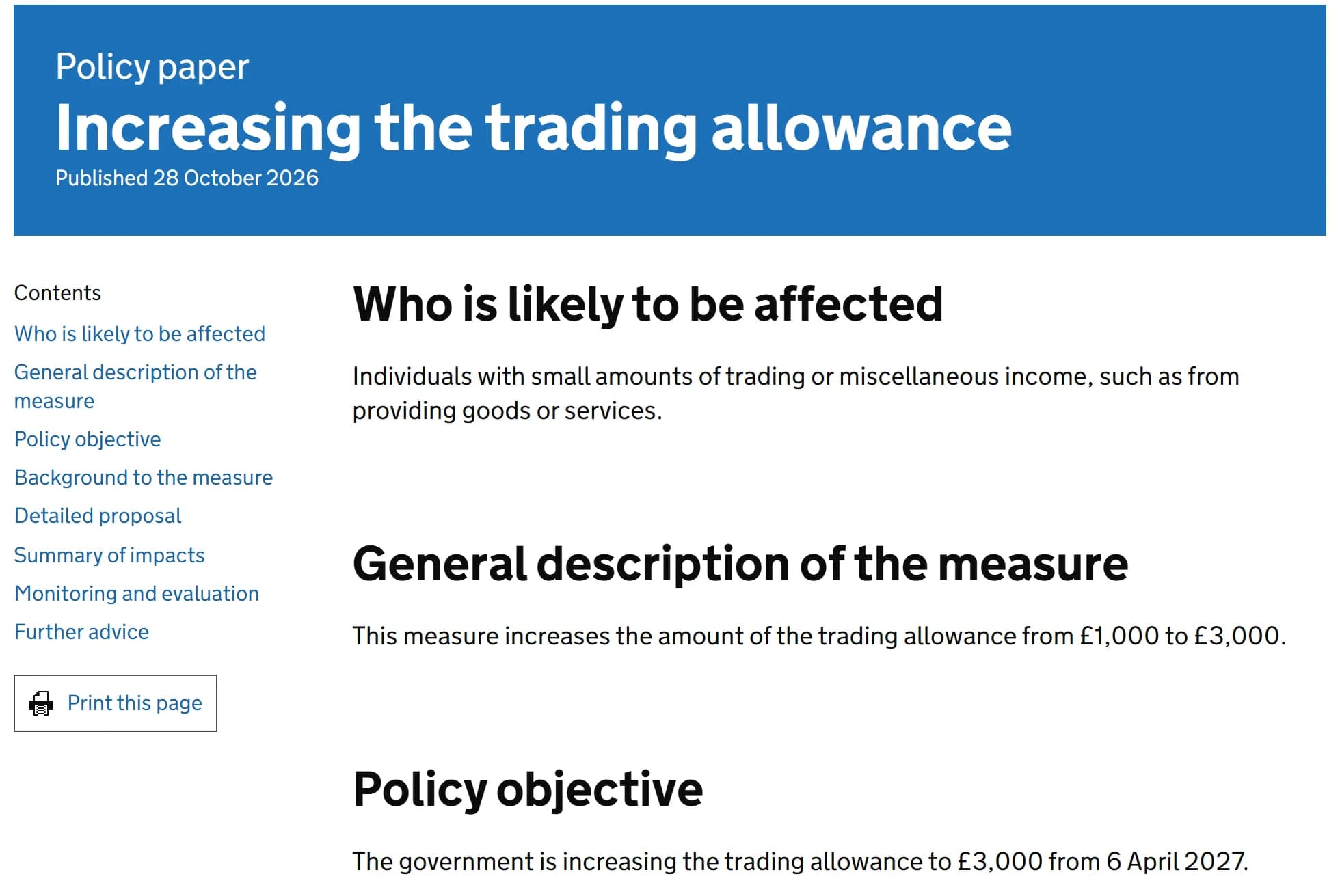
The £3,000 doesn't apply yet. It starts with the 2027/28 tax year and still has to pass in Finance Bill 2026-27. For money you earn until 5 April 2027 the line is £1,000. HMRC's side hustle guide answers the rumour head-on: "I heard that I don't need to do anything until I'm earning over £3,000?" "That's not true."
How much tax you pay: 3 affiliates, 3 bills
You pay 2 things on profit: Income Tax and Class 4 National Insurance. Profit is commissions minus costs. For 2026/27 in England, Wales and Northern Ireland:
Profit band | Income Tax | Class 4 NI |
|---|---|---|
Up to £12,570 (Personal Allowance) | 0% | 0% |
£12,571 to £50,270 | 20% | 6% |
£50,271 to £125,140 | 40% | 2% |
Over £125,140 | 45% | 2% |
The Personal Allowance shrinks by £1 for every £2 of income over £100,000 and is gone at £125,140. Scotland has its own Income Tax bands; National Insurance is the same.
The allowance is per person, not per job. If a salary already uses your £12,570, every pound of affiliate profit is taxed from the first pound. That's the side hustler in the chart below.
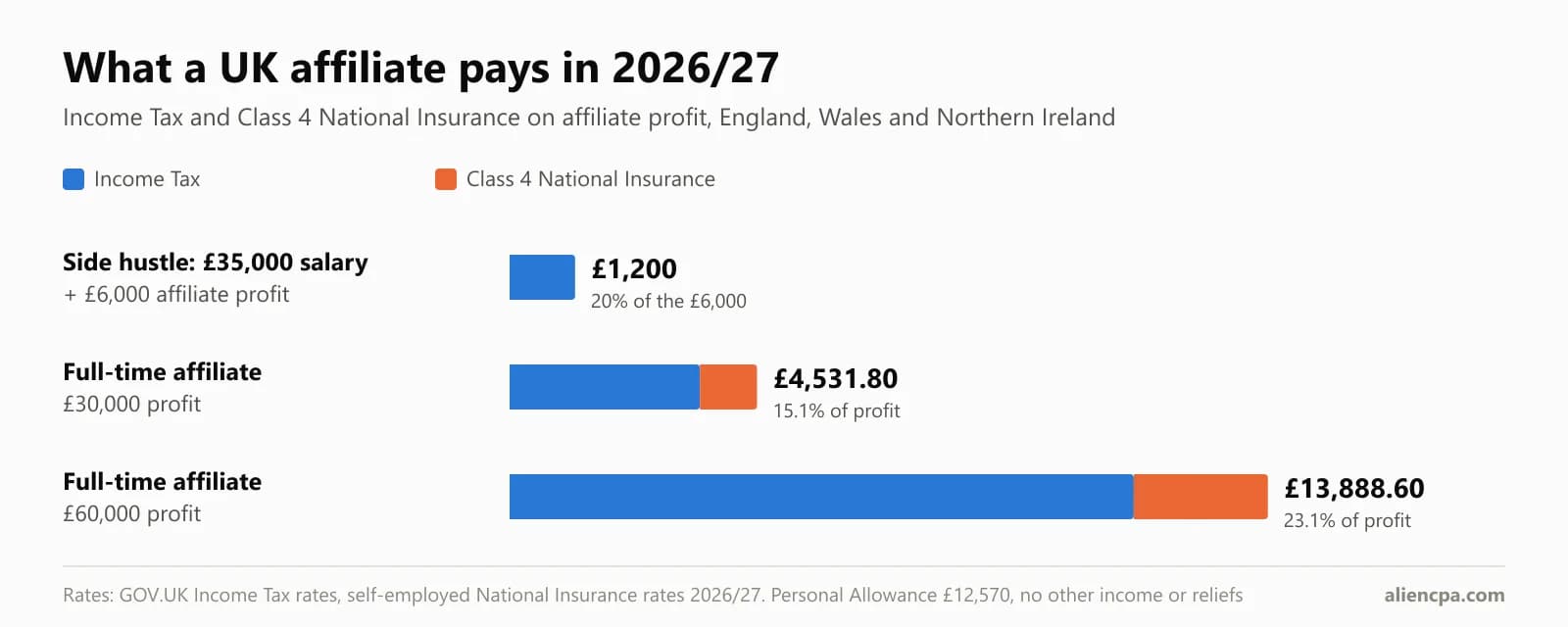
Here's the £30,000 case line by line. Profit £30,000. Income Tax: (£30,000 − £12,570) × 20% = £3,486. Class 4: (£30,000 − £12,570) × 6% = £1,045.80. Total £4,531.80, about 15p of every pound of profit.
Class 2 is no longer a bill. If your profit is £7,105 or more, Class 2 contributions "are treated as having been paid to protect your National Insurance record". Below £7,105 you can pay £3.65 a week voluntarily to keep your State Pension record going.
Registering and the dates that matter
Register as a sole trader once you pass £1,000. It's an online form on GOV.UK, and HMRC then sends you a Unique Taxpayer Reference (UTR). The deadline is 5 October after the tax year ends. Started in, say, November 2026? The tax year ends on 5 April 2027, so you register by 5 October 2027.
File and pay by 31 January. The online return and the tax for 2026/27 are both due by 31 January 2028. Paper returns are due earlier, by 31 October.
Filing early puts you in control – you will know exactly what you owe, can plan your payments, and avoid the stress of the January rush. You don't need to pay immediately when you file – you have until 31 January to settle your tax bill.
The first January hurts because of "payments on account". If your bill is £1,000 or more, HMRC asks for advance payments toward next year: 2 instalments, "each payment is half of the tax you owed last year", due 31 January and 31 July. They include Class 4. In your first year you pay last year's full bill and the first advance on the same day.
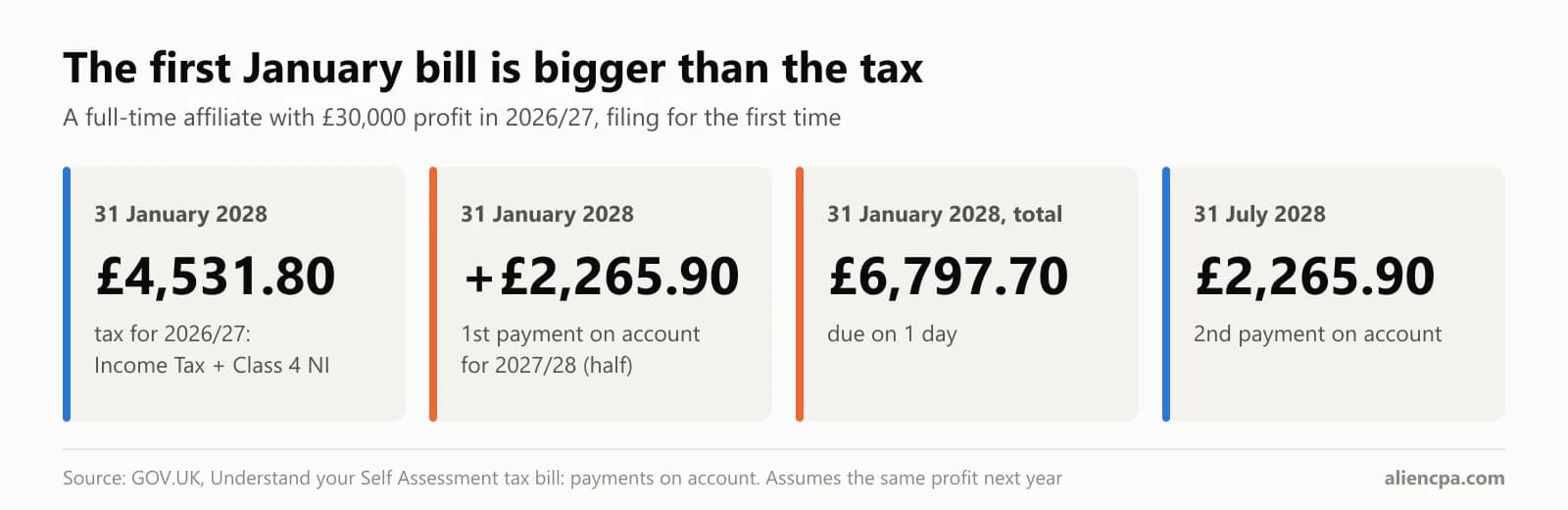
My rule for this: move 25-30% of every payout to a separate account the day it arrives. At £30,000 profit the real rate is 15%, but the January double payment makes the first year feel like 23%.
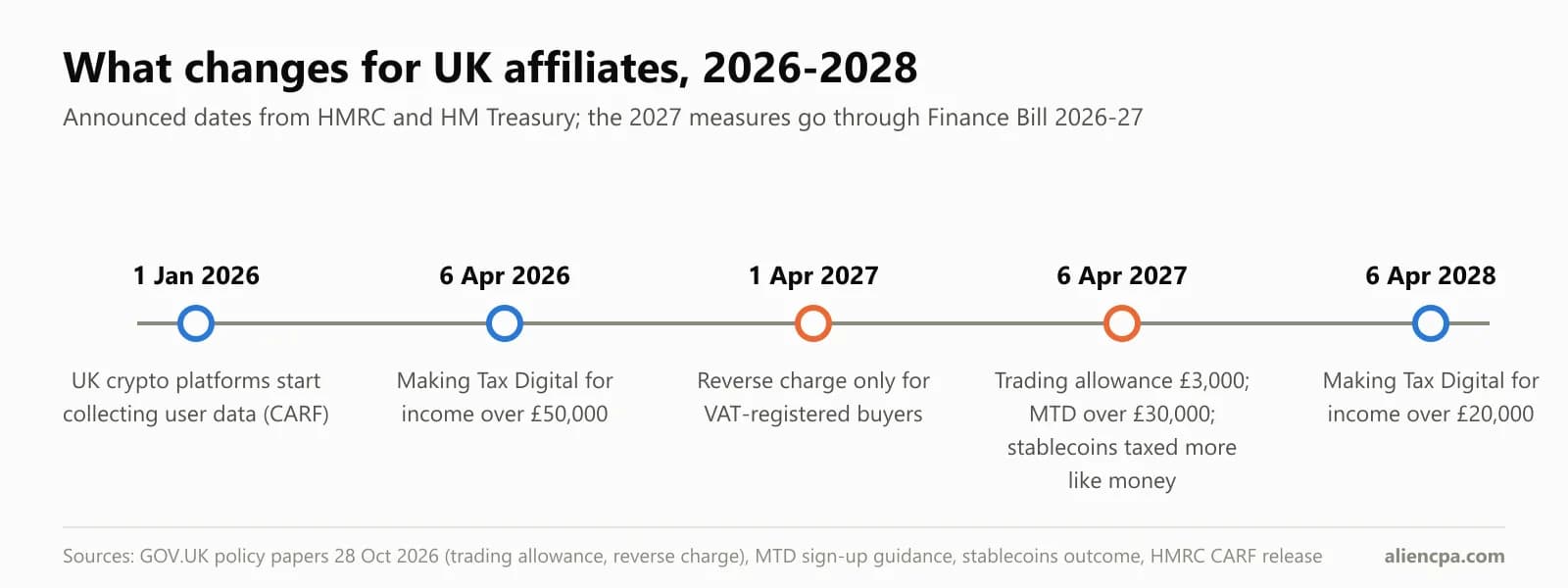
Making Tax Digital counts turnover, not profit. From 6 April 2026 sole traders with "qualifying income" over £50,000 have to keep digital records and send quarterly updates through compatible software. The line drops to £30,000 from April 2027 and £20,000 from April 2028. HMRC defines it as income "before expenses (also known as turnover)". A media buyer with £60,000 in commissions and £50,000 of ad spend has £10,000 profit and is still in.
What you can deduct
Anything you spend wholly to earn the commissions. HMRC's list of allowable expenses names "advertising or marketing, for example website costs". For affiliates that covers:
- ad spend on Meta, Google, TikTok and ad networks, including location fees and VAT you can't reclaim;
- trackers, antidetect browsers, proxies, spy tools, hosting, domains, themes, writers and designers;
- the business share of your phone and internet;
- a share of home costs if you work from home: HMRC's example is 1 office room out of 4, so a quarter of the electricity bill.
Personal use doesn't count. HMRC: "You cannot claim for any non-business use of premises, phones or other office resources." Keep invoices from every platform and tool; HMRC can ask for them.
Costs only help if you're over the line. Under £1,000 gross there's nothing to deduct from. Between £1,000 and your real costs, compare: real costs or the flat £1,000, whichever is bigger.
VAT: the £90,000 line media buyers don't see coming
Most affiliates never need VAT. You register when your "taxable turnover" for the last 12 months goes over £90,000, and commissions from networks abroad usually don't count. For services to businesses, the rule is that "the supply is made where the customer belongs". A network in Cyprus or the US is outside the UK, so its commission is "out of scope" of UK VAT. Commissions from a UK-based network do count.
But the ads you buy from Ireland count toward the £90,000. Meta's ad terms say Meta Platforms Ireland provides its self-serve ads to anyone outside the US and Canada, and Google Ads accounts are served by Google Ireland. For a business that isn't VAT-registered, HMRC's Notice 741A says the value of such services "must be added to the value of your own taxable supplies" when you check the threshold, and "even if you make no taxable supplies yourself, you may still be required to register". A media buyer who spends £8,000 a month on Meta crosses £90,000 in month 12 on ad spend alone.
From 1 April 2027 it changes again. The government will make the reverse charge apply "only when the purchasing business is actually registered for VAT". If you're not registered, Meta and Google will have to charge you 20% UK VAT. We walk through both changes, with a £10,000 example, in our guide to VAT and location fees on Facebook, Google and TikTok ads.
Sole trader or limited company?
A company changes what you pay, not whether you pay. The company pays Corporation Tax on its profit: 19% up to £50,000, 25% over £250,000, with marginal relief in between. You then take a salary and dividends. Dividends above a £500 allowance are taxed at 10.75%, 35.75% or 39.35% in 2026/27.
The cost is paperwork. Setting up online costs £100 at Companies House from February 2026, plus a £50 confirmation statement every year, company accounts and a payroll if you take a salary. Most accountants charge more for a company than for a sole trader's return. At small profits the savings rarely cover that; at higher, steady profits it's worth a proper calculation with your own numbers.
What HMRC sees, and what happens if you say nothing
HMRC knows people skip it, and why. In research HMRC published in 2023, 1 in 10 people in the UK were working in the hidden economy, and 65% of them were "largely unaware they should be registered for tax". Asked why they didn't declare, 35% said the income was "too small to matter" and 32% said it was "not worth the time".
More data reaches HMRC every year. Since 1 January 2024, platforms where you sell goods or services, such as freelance marketplaces, may have to collect your details and report them to HMRC. Since 1 January 2026, UK crypto platforms collect user data under the Cryptoasset Reporting Framework, and HMRC receives it from 2027. Networks that pay you by bank transfer leave a trail in your bank account either way.
Missing the deadline is the cheap mistake. For a late return: £100 straight away, then £10 a day after 3 months up to £900, then 5% of the tax or £300, whichever is greater, at 6 months and again at 12 months. Paying late adds 5% of the unpaid tax at 30 days, 6 months and 12 months, plus interest. HMRC's late payment interest is 8.00% from November 24, 2026.
Not registering at all is the expensive one. HMRC calls it "failure to notify". The penalty is a share of the tax you should have paid, and it depends on why it happened and whether you told HMRC before it asked:
Why you didn't register | You told HMRC first | HMRC found you first |
|---|---|---|
A genuine mistake, within 12 months | 0% to 30% | 10% to 30% |
A genuine mistake, after 12 months | 10% to 30% | 20% to 30% |
You knew and chose not to | 20% to 70% | 35% to 70% |
You knew and hid it | 30% to 100% | 50% to 100% |
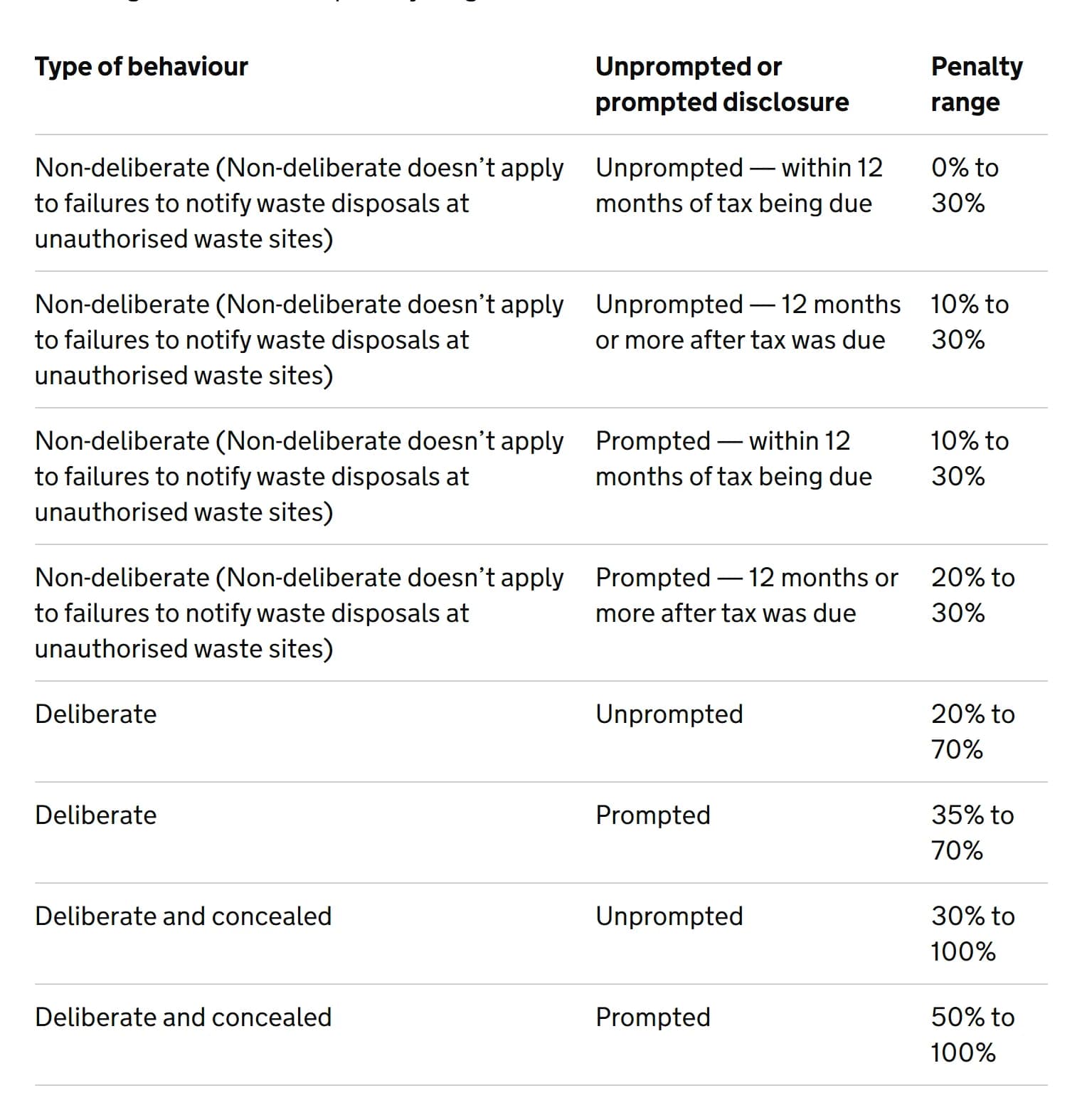
And HMRC can go back a long way. Normally 4 years. 6 years if you were careless. 20 years if it was deliberate, and 20 years for failure to notify, unless you had a reasonable excuse.
The fix is to go first. A genuine mistake that you report yourself within 12 months can cost 0% in penalties: you pay the tax and interest. HMRC's guide How to make a voluntary disclosure explains the routes; if you only need to start, register for Self Assessment now and declare the past year on your first return.
We know many people are turning their hobbies and interests into successful businesses and we're here to help them understand their tax obligations. Nobody wants an unexpected tax bill, so anyone with a side hustle should check HMRC's straightforward guide and make sure they're getting their tax right.
Checklist: what to do
Questions and answers
Do I have to pay tax on affiliate income in the UK?
Yes, if all your side income is over £1,000 a year before costs. It's trading income: you register for Self Assessment and pay Income Tax and Class 4 National Insurance on profit. From 6 April 2027 the tax-free allowance rises to £3,000.
How much can I earn from affiliate marketing before paying tax in the UK?
£1,000 a year in gross trading income is tax-free and doesn't need reporting in 2026/27. Above that, your profit is taxed, but if you have no other income the £12,570 Personal Allowance still applies, so the first £12,570 of profit is free of Income Tax.
Will HMRC know about my side hustle?
Often, yes. Selling platforms can report sellers to HMRC since 2024, UK crypto platforms collect user data from 2026, and every network payout leaves a trail in your bank account. Telling HMRC yourself before it asks keeps penalties at the lowest level, 0% for a genuine mistake reported within 12 months.
Do I pay UK tax on commissions from a US network paid in dollars?
Yes. If you live in the UK, your worldwide income is taxable here. Convert each payment to pounds at the rate on the day or a monthly average, and use the same method all year. The commission is usually outside UK VAT because the network is abroad.
Is affiliate marketing self-employment?
For most people, yes: HMRC treats regular affiliate work done for profit as a trade, so you're a sole trader. If you run it through your own limited company, the company pays Corporation Tax and you're taxed on salary and dividends.
Do I need a VAT number as an affiliate?
Only if your taxable turnover over 12 months goes above £90,000, or you choose to register. Commissions from networks abroad don't count toward it, but ads bought from Meta or Google in Ireland do, if you're not registered. From 1 April 2027 unregistered buyers will be charged 20% VAT on those ads.
Author’s conclusion
UK tax for affiliates is simpler than it looks: commissions are trading income, the first £1,000 is free (£3,000 from April 2027), and above that you register by 5 October, pay by 31 January and keep paying in advance. A full-time affiliate on £30,000 profit pays about £4,500 a year. The surprises come from 3 places: the first January with its payment on account, Making Tax Digital counting turnover, and ad spend from Ireland counting toward the £90,000 VAT line.
My advice: register the month you pass £1,000, save 25-30% of every payout in a separate account, and keep every invoice, from the network statements to the Meta receipts. If you're a media buyer, add up your last 12 months of ad spend today and compare it with £90,000.
This is general information, not tax advice. For a company, a partnership or income from several countries, talk to a chartered accountant.
Lu Discover, Editor-in-chief
Sources for this article
- gov.uk — Increasing the trading allowance: from £1,000 to £3,000 from 6 April 2027, Finance Bill 2026-27, published 28 October 2026
- gov.uk — Tax-free allowances on property and trading income: £1,000 gross, no expenses with the allowance, when to register below £1,000
- gov.uk — Income Tax rates and Personal Allowances, 2026/27
- gov.uk — Self-employed National Insurance rates, 2026/27: Class 4 6% and 2%, Class 2
- gov.uk — Payments on account: half of last year's tax, 31 January and 31 July, includes Class 4
- gov.uk — Self Assessment penalties: late filing and late payment
- gov.uk — HMRC factsheet CC/FS11, penalties for failure to notify: penalty ranges
- gov.uk — HMRC Compliance Handbook CH56100: time limits of 4, 6 and 20 years
- gov.uk — HMRC interest rates for late and early payments: 8.00% from 24 November 2026
- gov.uk — Check when to sign up for Making Tax Digital for Income Tax: £50,000, £30,000, £20,000
- gov.uk — Work out your qualifying income for Making Tax Digital: income before expenses
- gov.uk — Register for VAT: £90,000 threshold, taxable turnover includes reverse-charged services
- gov.uk — HMRC Notice 741A, place of supply of services: 5.7, unregistered customers and the threshold; 6.3, B2B general rule
- gov.uk — Reform of the B2B reverse charge for services from overseas, from 1 April 2027
- gov.uk — Expenses if you're self-employed: advertising, working from home, non-business use
- gov.uk — HMRC Business Income Manual BIM20205, badges of trade
- gov.uk — HMRC Business Income Manual BIM39510, exchange rates for accounts
- taxhelpforhustles.campaign.gov.uk — HMRC, tax rules for content creators: gifts count as income, single £1,000 allowance, "That's not true" on £3,000
- gov.uk — Selling goods or services on a digital platform: reporting since 1 January 2024
- facebook.com — Meta Self-Serve Ad Terms: Meta Platforms Ireland provides self-serve ads outside the US and Canada
- gov.uk — HMRC press release, Say "I do" to getting your side hustle tax right, 21 July 2026: Kevin Hubbard quote, hidden economy research
- gov.uk — HMRC press release, Side hustlers urged to get tax returns sorted now, 25 June 2025: Myrtle Lloyd quote
- gov.uk — HMRC press release, Love your side hustle? Make it tax official this Valentine's, 12 February 2025: Angela MacDonald quote
- gov.uk — Corporation Tax rates and dividends tax rates 2026/27
- gov.uk — Companies House fees from 1 February 2026: £100 incorporation, £50 confirmation statement
- gov.uk — How to make a voluntary disclosure to HMRC
Related stories
 Guide
VAT and Location Fees on Facebook, Google and TikTok Ads in the UK (2027)
 Guide
Best Affiliate Marketing Courses 2026: Free and Paid Courses, Checked Against Their Own Fine Print
 News
Comments
0 commentsNo comments yet.
Add a comment