

Paid in Crypto by an Affiliate Network: How UK Tax Works on USDT Commissions in 2027

Contents 11
Many CPA and iGaming networks pay in USDT. It's fast, there are no bank fees, and the money is on an exchange the next morning. For UK tax, though, that single payout creates 2 separate moments, and most affiliates only know about 1 of them.
This guide covers both, in pounds, with HMRC's own wording: what you owe when the coins arrive, what happens when you swap them, what to record, and what HMRC starts receiving from crypto platforms in 2027. Rules checked on GOV.UK and in HMRC manuals on November 25, 2026.
Part of our UK series for affiliates: affiliate marketing tax in the UK and VAT and location fees on Facebook, Google and TikTok ads.
Moment | For tax it's | You pay |
|---|---|---|
A network pays you USDT | Income, in £ on that day | Income Tax, Class 4 NI |
You swap or spend it | A disposal | CGT on gains over £3,000 |
You hold it | Nothing | — |
A crypto payout is income on the day it arrives
Being paid in USDT doesn't change what the money is. It's your affiliate income, the same as a bank transfer from the same network. HMRC's August 2026 release on crypto is direct: "Income Tax and National Insurance may apply to cryptoassets received through employment, self-employment, mining, staking or lending."
Value it in pounds on the day you receive it. Your tax return is in sterling, and HMRC's list of records you must keep for tokens you receive starts with the date, the number of tokens and the "value in pound sterling". If a network pays 1,000 USDT on 15 January and 1 USDT is worth £0.79 that day, you have £790 of income.
Then it joins everything else. The £790 goes into your trading income next to any payouts in pounds or dollars. The same rules apply: the £1,000 allowance (£3,000 from April 2027), registration by 5 October, payment by 31 January, Income Tax at 20%, 40% or 45% and Class 4 at 6% or 2%. All of that is in our guide to affiliate marketing tax in the UK.
Importantly, this isn't a new tax – if you make a profit when you sell, swap or transfer your crypto, tax may already be due.
Swap it later and the price change is taxed separately
When you swap, sell or spend the coins, that's a "disposal". HMRC lists 4: "selling them", "exchanging them for a different type of cryptoasset", "using them to pay for goods or services" and "giving them to another person". Turning USDT into USDC counts. Paying for a tool in USDT counts.
You only pay on the change since you received them. HMRC: "If you've paid Income Tax on any part of your cryptoasset token value, then you will not pay Capital Gains Tax on that amount. You'll only pay it on any gain you make after receiving them." Your cost for the coins is the £790 you already counted as income.
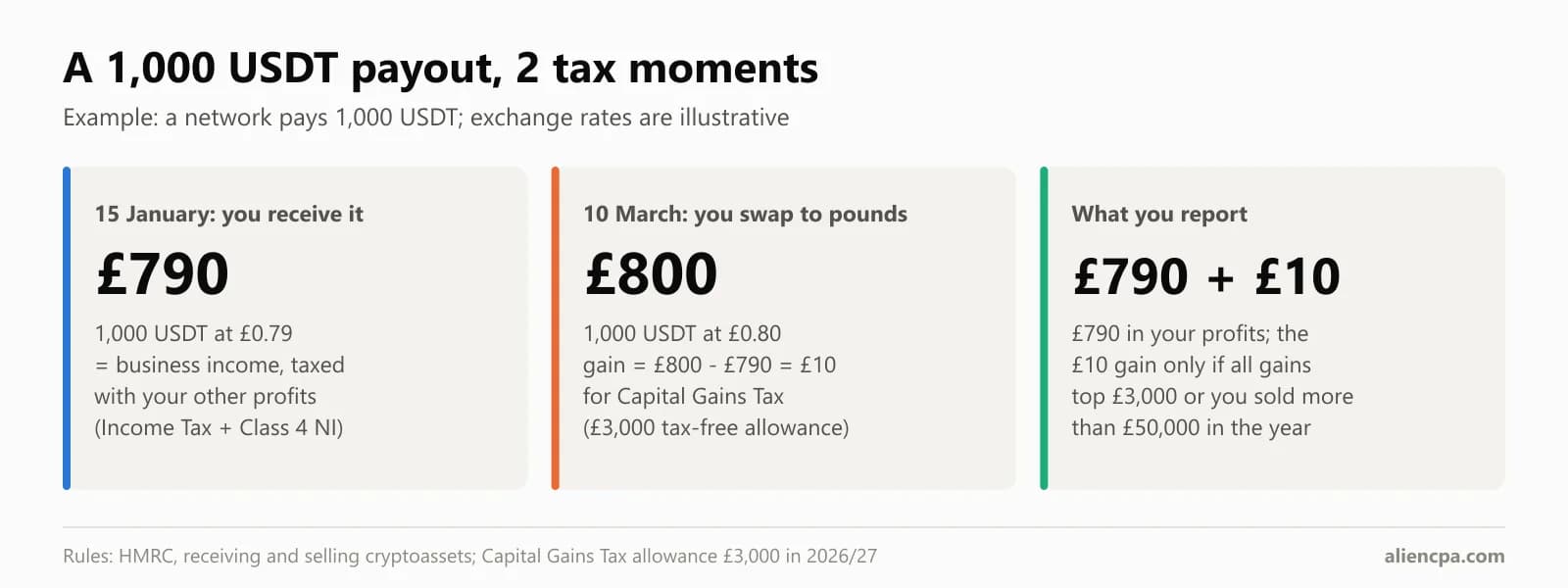
With stablecoins the gain is usually tiny, but it's not zero. A dollar stablecoin moves with the pound-dollar rate. Received at £0.79 and swapped at £0.80, 1,000 USDT gives a £10 gain; swapped at £0.77, a £20 loss.
Most affiliates owe nothing on this part. Capital Gains Tax applies only to total gains above the £3,000 tax-free allowance for 2026/27, at 18% within the basic rate band and 24% above it. You must report on your Self Assessment return if your gains top £3,000 or you sold assets for more than £50,000 in the year. Since 2024-25 the return has a separate cryptoasset section for this.
Report losses too. A loss reduces gains in the same year or later years, but HMRC needs to know about it first.
Pooling: the cost of coins you received at different prices
You don't track each coin separately. HMRC puts every type of token into its own "pool". When you receive USDT, you add its pound value to the USDT pool; when you swap some, you take out an average share of the cost.
Example. You receive 1,000 USDT at £0.79 (£790) and later 500 USDT at £0.75 (£375). The pool holds 1,500 USDT with a cost of £1,165, an average of about £0.777. Swap 1,000 USDT for £800 and your cost is £777, so the gain is £23.
2 rules come first. If you receive and swap the same token on the same day, those are matched with each other. If you swap and then get the same token back within 30 days, the swap is matched with the new tokens. HMRC's manual CRYPTO22200 sets out both.
Stablecoins: simpler rules from April 2027
The government has decided to treat stablecoins more like money. After a call for evidence in spring 2026, it announced that it "will make legislative changes to treat eligible stablecoins more like money for tax purposes". The change goes into Finance Bill 2026-27 and starts in April 2027.

What "eligible" means isn't settled yet. Respondents asked for dollar stablecoins to be included, "noting that USD-denominated stablecoins currently dominate UK usage", and HMRC says it will set out "its view of whether the largest stablecoins currently in use are eligible". Until that's law and USDT is on the list, keep treating every USDT swap as a disposal.
The income side doesn't change. Even after April 2027, a payout in stablecoins is still income worth its pound value on the day it arrives.
What HMRC will see: crypto platforms report from 2027
Since 1 January 2026, UK crypto platforms collect data on their users. It's the Cryptoasset Reporting Framework (CARF), an OECD standard. HMRC: "HMRC will receive data from 2027, helping to identify cryptoasset gains and income that have not been declared."
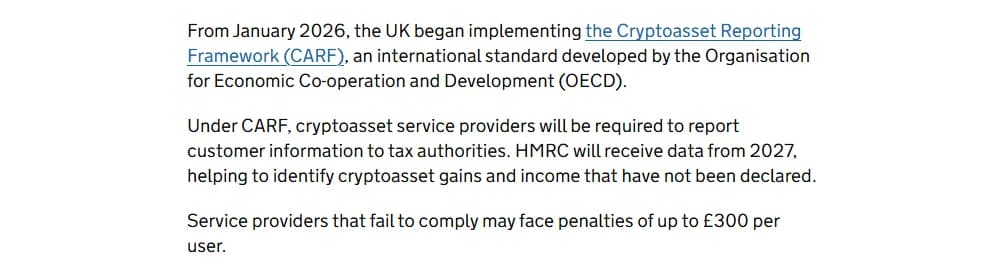
You have to give your exchange your details. HMRC's July 2025 release says users must provide personal details, including a National Insurance number or tax reference, "or face penalties of up to £300". Exchanges in other CARF countries share data with HMRC the same way.
HMRC already knows a lot. In 2024-25, 17,600 people reported crypto gains of £1.38 billion in total, and 240 of them declared more than £1 million each, according to HMRC's August 2026 figures.
Taxes are due on cryptoasset gains just like any other gains, and we want to make sure people making gains from crypto know about what taxes they owe.
These new rules coming into force from 1 January will give HMRC access to a much richer dataset on cryptoasset investors and their transactions.
The records to keep for every crypto payout
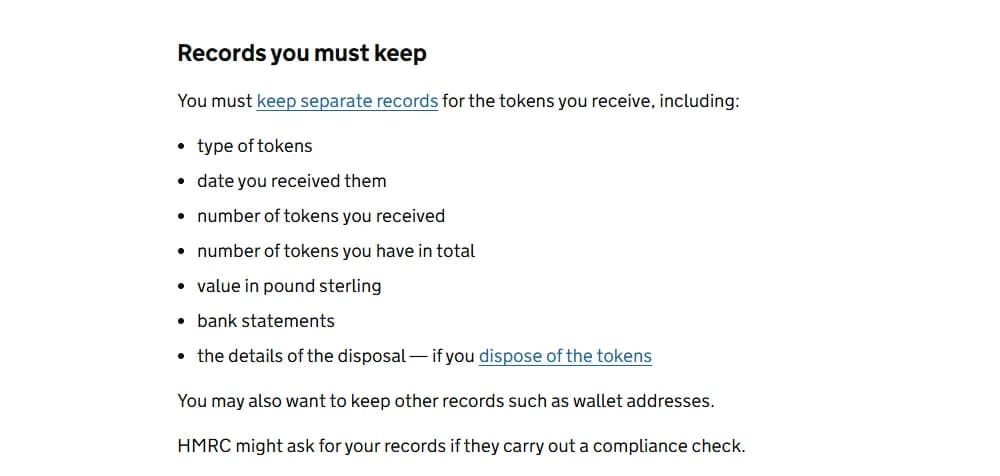
HMRC's list is the minimum. For tokens you receive: "type of tokens", "date you received them", "number of tokens you received", "number of tokens you have in total", "value in pound sterling", "bank statements" and "the details of the disposal". It adds that you "may also want to keep other records such as wallet addresses".
For an affiliate, I'd keep 1 row per payout:
Field | Example |
|---|---|
Date and network | 15 Jan 2027, payout from the network for December |
Tokens and network chain | 1,000 USDT, TRC-20 |
Rate and its source | £0.79, the exchange's GBP price at 12:00 |
Value in pounds | £790 |
Wallet and transaction hash | your deposit address, the hash from the network's statement |
Proof of what it's for | the network's payout statement or your invoice |
Ask the network for a statement in USD. Most networks show payouts in dollars in the dashboard. Save the monthly statement as a PDF: it links each transaction hash to commissions, which is what HMRC or your bank will ask about.
Getting the money into a UK bank
Cash out through a platform registered with the FCA. The FCA says "cryptoasset businesses must register with the FCA before starting any in-scope services" in the UK. A registered exchange with your verified identity gives you a clean trail from wallet to bank, and it's the same trail HMRC will see under CARF.
Expect your bank to ask where the money came from. Banks check large or unusual transfers from crypto platforms. The answer is the same paperwork as above: the network's statements, the exchange history and your tax return.
Haven't declared crypto payouts? Use the disclosure service
HMRC has a separate route for unpaid crypto tax. Its Crypto Disclosure Service covers income and gains from earlier years. HMRC's warning on that page: "If you do not contact us to declare your unpaid tax, you could be liable to additional interest and penalties." For the current or last tax year, declare on your Self Assessment return instead.
Going first is cheaper. The penalty for a genuine mistake you report before HMRC asks can be 0%, while hiding it can cost up to 100% of the tax on top. The full penalty table is in our guide to affiliate marketing tax in the UK.
As new international reporting rules come into force, it's more important than ever for people to check they are paying any tax owed.
Checklist: what to do
Questions and answers
Do I pay tax if an affiliate network pays me in crypto in the UK?
Yes. A payout in USDT or any other crypto is your affiliate income, valued in pounds on the day you receive it, and taxed with your other profits: Income Tax and Class 4 National Insurance above your allowances.
Is swapping USDT to pounds taxable?
It's a disposal for Capital Gains Tax. You pay only on the gain since you received the coins, and only if your total gains for the year are above £3,000. With stablecoins the gain is usually small, but you report it if your gains top £3,000 or your sales top £50,000.
Does HMRC know about my crypto?
Increasingly, yes. UK crypto platforms collect user data under the Cryptoasset Reporting Framework since 1 January 2026, and HMRC receives it from 2027. Exchanges in other CARF countries share data too.
What if I get a letter from HMRC about my crypto?
Don't ignore it. Compare your payout and swap records with what you declared, then correct anything missing: through the Crypto Disclosure Service for earlier years, or on your next Self Assessment return. Fixing it before HMRC opens a check keeps penalties at the lowest level.
Will stablecoins be tax-free in the UK?
Not exactly. The government plans to treat "eligible stablecoins more like money" for tax from April 2027, which would remove the small gains on swaps. Which stablecoins are eligible isn't decided yet, and payouts in stablecoins will still be taxable income.
What exchange rate do I use for a crypto payout?
The pound value on the day you receive the tokens. Use a reliable source, such as your exchange's GBP price at a fixed time, note the source, and use the same method for every payout.
Author’s conclusion
A USDT payout is ordinary affiliate income in pounds on the day it arrives: that's where almost all the tax is. Swapping it later is a separate disposal, but with stablecoins the gain is usually a few pounds and most affiliates stay under the £3,000 allowance. What's changed is visibility: UK platforms collect user data since January 2026 and HMRC gets it from 2027.
My advice: write down the pound value of every crypto payout on the day it lands, with the transaction hash and the network's statement, and cash out only through an FCA-registered platform. If you haven't declared past payouts, use the Crypto Disclosure Service before the 2027 data arrives.
This is general information, not tax advice. If you trade crypto on top of receiving payouts, or hold large amounts across years, talk to a chartered accountant.
Lu Discover, Editor-in-chief
Sources for this article
- gov.uk — HMRC press release, 240 crypto millionaires revealed in new government data, 27 August 2026: Income Tax and NI on crypto from self-employment, CARF, data from 2027, £300 per user, James Murray and John-Paul Marks quotes
- gov.uk — Check if you need to pay tax when you receive cryptoassets: records you must keep, value in pound sterling
- gov.uk — Check if you need to pay tax when you sell cryptoassets: disposals, no CGT on the value already taxed as income, pooling, cryptoasset section
- gov.uk — HMRC Cryptoassets Manual CRYPTO22200: section 104 pool, same-day and 30-day rules
- gov.uk — Capital Gains Tax rates 2026/27: 18% and 24%, £3,000 allowance
- gov.uk — Capital Gains Tax allowances: reporting if proceeds exceed £50,000
- gov.uk — Taxation of Stablecoins, government response: eligible stablecoins more like money from April 2027
- gov.uk — Reporting cryptoasset user and transaction data (CARF)
- mynewsdesk.com — HMRC press release, Crypto bros being forced to pay fair share of tax, 7 July 2025: details users must give, £300 penalty, Jonathan Athow quote
- gov.uk — Tell HMRC about unpaid tax on cryptoassets: Crypto Disclosure Service
- fca.org.uk — Cryptoassets AML/CTF regime: cryptoasset businesses must register with the FCA
- bdo.co.uk — BDO, New rules in 2026 will make it harder for crypto investors to evade tax: Dawn Register quote
Related stories
 Guide
The Media Buying Stack in 2026: Every Layer, What It Does and What It Costs
 Comparison
Incogniton vs GoLogin 2026: Which Mid-Range Antidetect Wins?
 Comparison
Comments
0 commentsNo comments yet.
Add a comment