

VAT and Location Fees on Facebook, Google and TikTok Ads in the UK (2027)


Contents 8
If you buy ads on Meta or Google to UK users, your bill now has 2 lines that aren't ad spend: a 2% fee for showing ads in the UK, and VAT that either appears on the invoice or doesn't, depending on a number in your account settings. From 1 April 2027 the rules on that VAT change.
This guide explains each line for UK-based affiliates and media buyers, platform by platform, with the official wording behind it. I checked every page on November 25, 2026.
Part of our UK series for affiliates: affiliate marketing tax in the UK, tax on payouts in crypto and the rules for affiliate ads in the UK.
Platform | VAT for a UK business | Fee on UK ads |
|---|---|---|
Meta | Reverse charge, no VAT on the bill | 2% |
Google Ads | Reverse charge, you self-assess | 2% |
TikTok Ads | 20% on the bill, even with a VAT number | None listed |
The 2% that isn't a tax: location fees and DST fees
Meta and Google charge 2% extra for every ad shown in the UK. It's not a tax you owe. It's the platforms passing on their own tax: the UK Digital Services Tax, 2% of what big tech groups earn from UK users. GOV.UK says that tax has "no direct impact on individuals"; it's the platforms that chose to bill it to advertisers.
Meta used to absorb it. Now you pay. Meta's help page:
When your ad is delivered to an audience in a jurisdiction with location-specific fees, such as a digital service tax (DST), a location fee will be added to your bill. This fee is separate from your campaign budget and will appear as a distinct line item on your invoice or transaction statement. Until now, Meta has covered these additional costs.
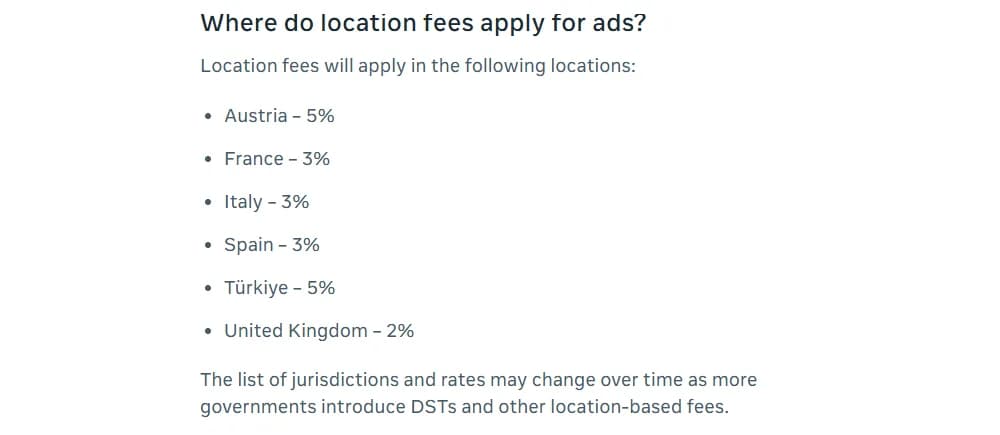
It follows your audience, not your company. Meta: location fees "are determined by where your audience is located and your ads are delivered (ad impressions), not your business location". A UK affiliate running ads to Germany pays no UK fee; a US company targeting London does.
Your budget doesn't include it. Meta adds the fee after delivery, so "the total amount that you're charged, including those fees, may exceed your ad budget". Its own example: $100 of ads in Italy plus a 3% fee is $103. And VAT, where it applies, "is calculated on top of the total campaign amount (ad delivery cost + location fee)".
So, these are fees that Meta had previously absorbed, but now they're passing them on to advertisers.
Google has done the same since November 2020. Its help page: "a 2% UK DST Fee will be added to your next invoice or statement for ads served in the United Kingdom". The fee is added once a month as a separate line per country, on top of any account budget, and taxes such as VAT are charged on top of the fee.
Check where your ads actually ran. Google warns that a campaign can reach the UK without targeting it, for example "because your business is in a location of interest" for those users, and it "will not refund" fees for impressions served under your settings. Meta lets you exclude fee countries at account level, but says it "cannot guarantee that such exclusions will actually reduce location fees". Since the UK is the main market for most UK affiliates, excluding it isn't the point; budgeting 2% more is.
There isn't much advertisers can do as the tier 1 markets (U.K. and France) drive a lot of volume so they will be forced to continue to spend there.
VAT on ads: the reverse charge in plain English
A UK business buying from Ireland charges itself VAT, then takes it back. That's the reverse charge. The ad platform doesn't put UK VAT on the invoice; you write 20% of the bill in 2 boxes of your VAT return, as VAT you owe (Box 1) and VAT you reclaim (Box 4). HMRC's Notice 741A: if you can reclaim it in full, "the reverse charge has no net cost to you".
Affiliates usually can reclaim it. Your commissions from networks abroad are outside UK VAT, but HMRC lets you recover VAT on costs linked to "supplies made outside the UK which would be taxable if they were made in the UK". Selling advertising services to a network is exactly that.
What you need: a UK VAT number in the ad account. It's the simplest proof that you're a business, and from April 2027 it's the only one that counts: HMRC says suppliers "will only need to check for their customers' VAT number". TikTok shows its path in its help centre: Billing → Invoice → Billing information → Manage → Edit billing info → Tax ID. Without a valid number, a platform may treat you as a consumer.
TikTok is the exception. Its help page for advertisers in the UK says that with a valid VAT number "your business will be charged with the standard UK VAT rate of 20% and you will receive a full tax invoice". Without one, you're "a final consumer": still 20%, and "the invoice will be available upon the customer's request". So on TikTok the VAT is on the bill either way; a VAT-registered business reclaims it on its return, everyone else pays it.

Not VAT-registered? Your ad spend counts toward £90,000
This is the trap for media buyers. You must register for VAT when your taxable turnover goes over £90,000 in any 12 months. Most of your commissions from networks abroad don't count. But the ads you buy from Meta or Google do, if you're not registered. HMRC's Notice 741A, paragraph 5.7:
If you belong in the UK but are not already UK VAT registered and you receive supplies of B2B general rule services from overseas suppliers (that are treated as supplied where the recipient belongs), the value of those supplies must be added to the value of your own taxable supplies when determining whether you should be registered for UK VAT. Even if you make no taxable supplies yourself, you may still be required to register if the value of general rule services received from overseas suppliers exceeds the registration thresholds.
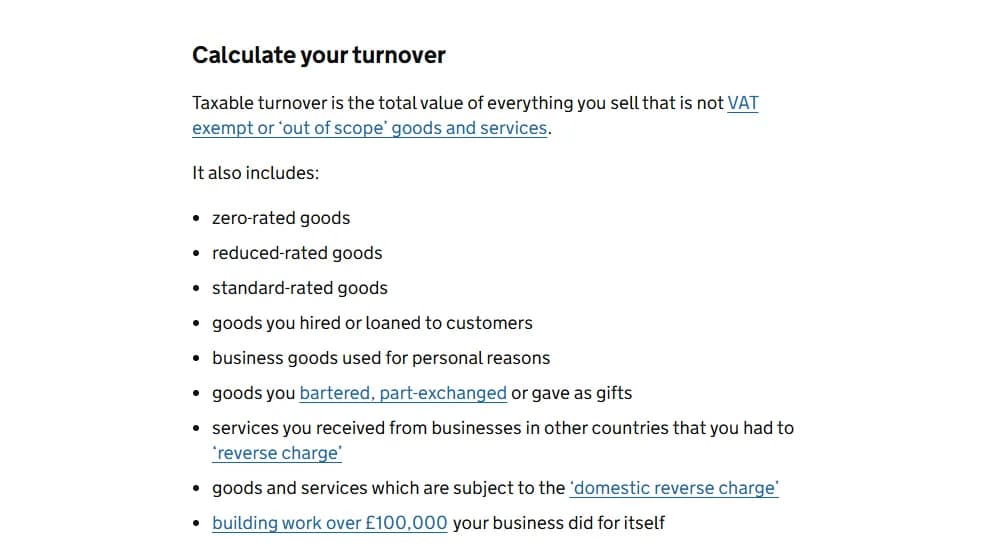
GOV.UK's own registration page lists it too. Taxable turnover includes "services you received from businesses in other countries that you had to 'reverse charge'".
What it means in money. Spend £8,000 a month on Meta and you pass £90,000 in month 12, even if your profit is £15,000 a year. You then have 30 days from the end of that month to register, and you're registered from the 1st day of the 2nd month after you went over.
Check it the way HMRC does: a rolling 12 months. Every month, add up the last 12 months of ad spend from abroad plus any income that counts as UK taxable turnover. If the total is heading for £90,000, registering voluntarily before you cross it is usually the cleaner option for a media buyer: the reverse charge then costs nothing.
What changes on 1 April 2027
Unregistered buyers lose the reverse charge. HMRC's policy paper of October 28, 2026: the reverse charge "only applies when the purchasing business is actually registered for VAT in the UK. Where the purchasing business is not VAT registered, the supplier will be required to charge VAT to the customer and account for it to HMRC." The change goes through Finance Bill 2026-27 and starts on 1 April 2027.
Why the government is doing it. It says the current rule lets "unregistered businesses gain a tax advantage by using an overseas supplier", and the change makes life simpler for overseas suppliers: they "will only need to check for their customers' VAT number".
For an unregistered UK media buyer, ads get 20% dearer. Today, if Meta bills you as a business, there's no VAT on a £10,000 UK campaign: £10,000 plus £200 location fee. From April 2027, the same campaign costs £12,240.
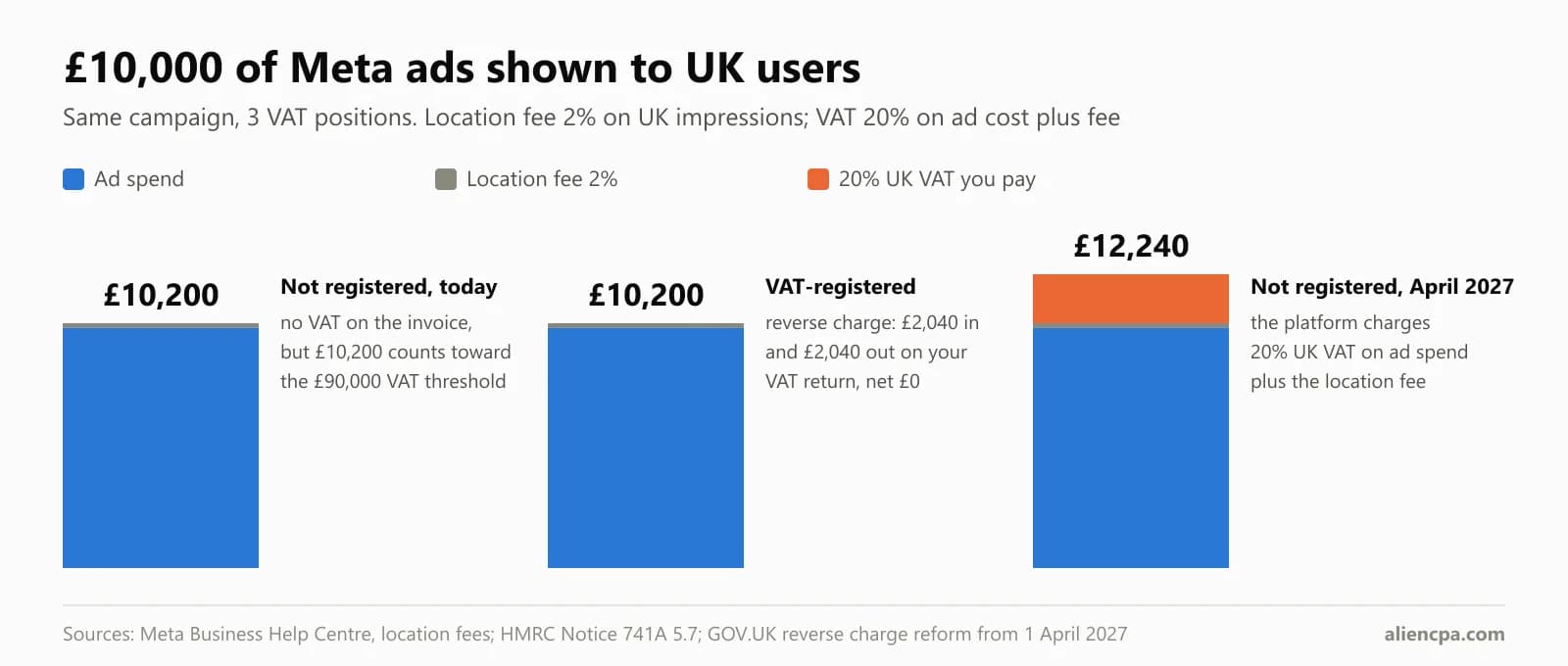
Your 2 options before April 2027:
- Stay unregistered and add 20% to your ad budget from April. Fine if you spend little.
- Register for VAT voluntarily. You keep the reverse charge on Meta and Google, reclaim TikTok's 20%, and file a VAT return every quarter. At £3,000 a month of ads, 20% is £7,200 a year: usually more than the cost of 4 VAT returns.
The rest of your tax picture, from the £1,000 allowance to Self Assessment dates, is in our guide to affiliate marketing tax in the UK.
Can you deduct ad spend and these fees?
Yes, for Income Tax. HMRC's list of allowable expenses for the self-employed names "advertising or marketing". The location fee and the DST fee are part of what you paid to advertise, and VAT you can't reclaim is part of the cost too. If you're VAT-registered and reclaim the VAT, you deduct the cost without it.
What can't be deducted. Ads for anything personal. If 1 ad account pays for 2 businesses, split the invoices between them.
Checklist: what to do
Questions and answers
Do you pay VAT on Facebook ads in the UK?
It depends on your status. A VAT-registered UK business buys from Meta Platforms Ireland under the reverse charge: you account for 20% and reclaim it, net £0. An unregistered business billed as a business pays no VAT today, but from 1 April 2027 Meta will have to charge it 20%.
What is the Meta location fee?
An extra charge Meta adds for ads shown to people in countries with digital services taxes: 2% in the UK, 3% in France, Italy and Spain, 5% in Austria and Türkiye. It depends on where the audience is, not where your business is, and it's billed on top of your budget.
Does Google Ads charge VAT in the UK?
Google Ads accounts are served by Google Ireland, and Google says it "can't charge VAT" to a billing address outside the EU, so a UK business self-assesses it under the reverse charge. Google adds a separate 2% UK DST fee for ads shown in the UK.
Why does TikTok charge 20% VAT even with my VAT number?
TikTok's UK help page says advertisers with a valid VAT number are charged the standard 20% and get a full tax invoice. A VAT-registered business reclaims that 20% on its VAT return; without a number you're treated as a consumer and pay it.
Does ad spend count toward the VAT threshold?
Yes, if you're not VAT-registered and buy from suppliers abroad such as Meta or Google in Ireland. HMRC says the value of those services "must be added" to your taxable supplies when you check the £90,000 threshold.
Can I claim VAT back on Facebook ads?
If you're VAT-registered, yes: under the reverse charge you record the VAT as both owed and reclaimed, so it costs nothing. On TikTok, where VAT is on the invoice, you reclaim it as input VAT.
Author’s conclusion
On Meta and Google, a UK advertiser now pays 2% on top of spend for UK impressions, and VAT depends on whether you have a VAT number in the account: with one, the reverse charge nets to £0. TikTok always puts 20% on the invoice. The quiet risk sits with unregistered media buyers: ad spend from Ireland counts toward the £90,000 VAT line, and from 1 April 2027 the platforms will charge those buyers 20% VAT outright.
My advice: add 2% to every UK budget now, and before April 2027 decide whether you register for VAT. Pull 12 months of invoices from Meta, Google and TikTok today and multiply the total by 20%: that's what staying unregistered will cost you every year from April 2027.
This is general information, not tax advice. If you also sell to UK consumers or run several businesses, talk to a VAT adviser.
Lu Discover, Editor-in-chief
Sources for this article
- facebook.com — Meta Business Help Centre, About location fees for ads on Meta technologies: rates, audience location, budget, VAT on the total, exclusions
- facebook.com — Meta Self-Serve Ad Terms: Meta Platforms Ireland provides self-serve ads outside the US and Canada
- support.google.com — Google Ads Help, Jurisdiction-specific surcharges: 2% UK DST fee since 1 November 2020, monthly line, taxes on top, no refunds
- support.google.com — Google Ads Help, Taxes in your country: served by Google Ireland, can't charge VAT outside the EU, self-assess
- ads.tiktok.com — TikTok Ads Manager, EU and UK: About Value Added Tax, advertisers located in the UK
- ads.tiktok.com — TikTok Ads Manager, How to add your VAT number
- gov.uk — HMRC Notice 741A, place of supply of services: 2.7 input tax recovery, 5.7 unregistered customers, reverse charge net cost
- gov.uk — HMRC manual VATPOSS14700, reverse charge and registration
- gov.uk — Register for VAT: £90,000, taxable turnover includes reverse-charged services, 30 days to register
- gov.uk — VAT on services from abroad: the reverse charge
- gov.uk — Reform of the business to business reverse charge for supplies of services from overseas, from 1 April 2027, published 28 October 2026
- gov.uk — Digital Services Tax: 2% on revenues of large groups, no direct impact on individuals
- gov.uk — Expenses if you're self-employed: advertising or marketing
- jonloomer.com — Jon Loomer, Meta Announces Location Fees (Plus 4 Updates), 12 March 2026
- digiday.com — Advertisers aren't happy about picking up Meta's European tax tab, 18 March 2026: Shamsul Chowdhury quote
Related stories
 Guide
Affiliate Marketing Tax in the UK 2027: What You Pay, When to Register and What HMRC Sees
 Guide
Best Affiliate Marketing Courses 2026: Free and Paid Courses, Checked Against Their Own Fine Print
 News
Comments
0 commentsNo comments yet.
Add a comment