
Self-Promotional Content in AI Search: Ahrefs' 9,886-Answer Experiment, Fact-Checked

Contents 13
Affiliate sites have lived on "best X" listicles for years. Now brands write their own, put themselves in the list and wait for ChatGPT to repeat it. Ahrefs tested whether that works: 34 self-promotional pages, 9,886 answers from ChatGPT, Gemini, Perplexity and Copilot, February to May 2026.
This is our review of the case for affiliate SEOs and media buyers who build "best of" and "alternatives" pages: the author's results, our own math on top of them, and what the case doesn't show. Editorial fact-check: 3/5.
Short version: the pages got a lesser-known conference into AI answers, mostly in 1 assistant, and barely moved a brand the AI already knew. Below: the setup, the 4 findings, where the numbers hold and where they don't, and how to run the same test on your own niche.
Who ran the Ahrefs experiment and what it tested
The author is Mateusz Makosiewicz, SEO & Marketing Educator at Ahrefs, with 15+ years in marketing. He published the case on the Ahrefs blog on July 6, 2026, as "Self-Promotional Content Works—Until It Backfires."
He starts from 2 earlier studies. Glen Allsopp's analysis of 750 ChatGPT prompts found "best X" blog lists were the most-cited page type, 43.8% on average. Lily Ray found that Google's AI Overviews cite such lists and still recommend a different brand. Both were snapshots, so this test adds time and 4 assistants.
The setup: 34 pages promoting 2 Ahrefs products, the AI visibility tool Brand Radar and the conference Ahrefs Evolve (October 12–13, 2026, San Diego). The pages were listicles, reviews and opinion pieces on 5 domains: ahrefs.com, bloggerjet.com, blog.timsoulo.com, medium.com and detailed.com.
Tracking ran in Ahrefs Brand Radar from February 7 to May 31, 2026, with February 7–12 as the baseline and the first pages live on February 13. The author separates 2 ways a page shows up: "Cited means the page is attached as a clickable source. Found means the engine pulled the page in behind the scenes, but did not credit it in the answer."
A conference mention counted only on the exact phrase "Ahrefs Evolve". For the tool pages, any "Ahrefs" counted, as long as it wasn't "Ahrefs Evolve".
Not shown: the 5 domains aren't neutral. BloggerJet was launched in 2011 by Tim Soulo, now Ahrefs' CMO, and revived in 2024 "under the Ahrefs banner," per its About page. blog.timsoulo.com is his personal blog, and detailed.com is Glen Allsopp's site, acquired by Ahrefs in September 2025. Only Medium is an outside platform, and the Brand Radar project in the author's own screenshot is named "Satellite blog post project."
Our take: in affiliate terms, this is a satellite network with years of history and a famous name behind it. In the author's screenshot the BloggerJet conference page shows DR 59 and an estimated 0 organic traffic: Copilot cited a page that, by Ahrefs' own estimate, gets no Google visits. You won't build that history next week, so read every result below as "aged satellites," not "fresh domains."
Our math: 9,886 answers over 114 days on 4 assistants is about 22 prompts, if every prompt ran daily for the whole window. The prompt list isn't published. We can see 6: "best SEO conferences 2026", "best marketing conferences 2026", "best AI SEO tools" and 3 "Scrunch alternatives" variants named in 1 chart.
The counting rule for tools is generous: an answer about SEO software that names Ahrefs Site Explorer counts as a win for the Brand Radar pages. Keep that in mind when you get to the 11% below. Of the 3 studies in the intro, 2 come from inside Ahrefs.
Result 1: Ahrefs Evolve went from 0 to 72 AI mentions
The cleanest result came from the conference. The author looked at slots where a given assistant, answering a given query, never mentioned Evolve during the baseline. After launch, Evolve "broke into 72 of those previously empty slots," and 82% of those mentions came in answers that cited one of the Ahrefs pages.
In his words, "the brand went from absent to present," with an Ahrefs page as the cited source in 4 cases out of 5. For Brand Radar the picture flipped: only 6% of new Ahrefs mentions came from answers citing the experiment's pages, and 94% came from third-party content.
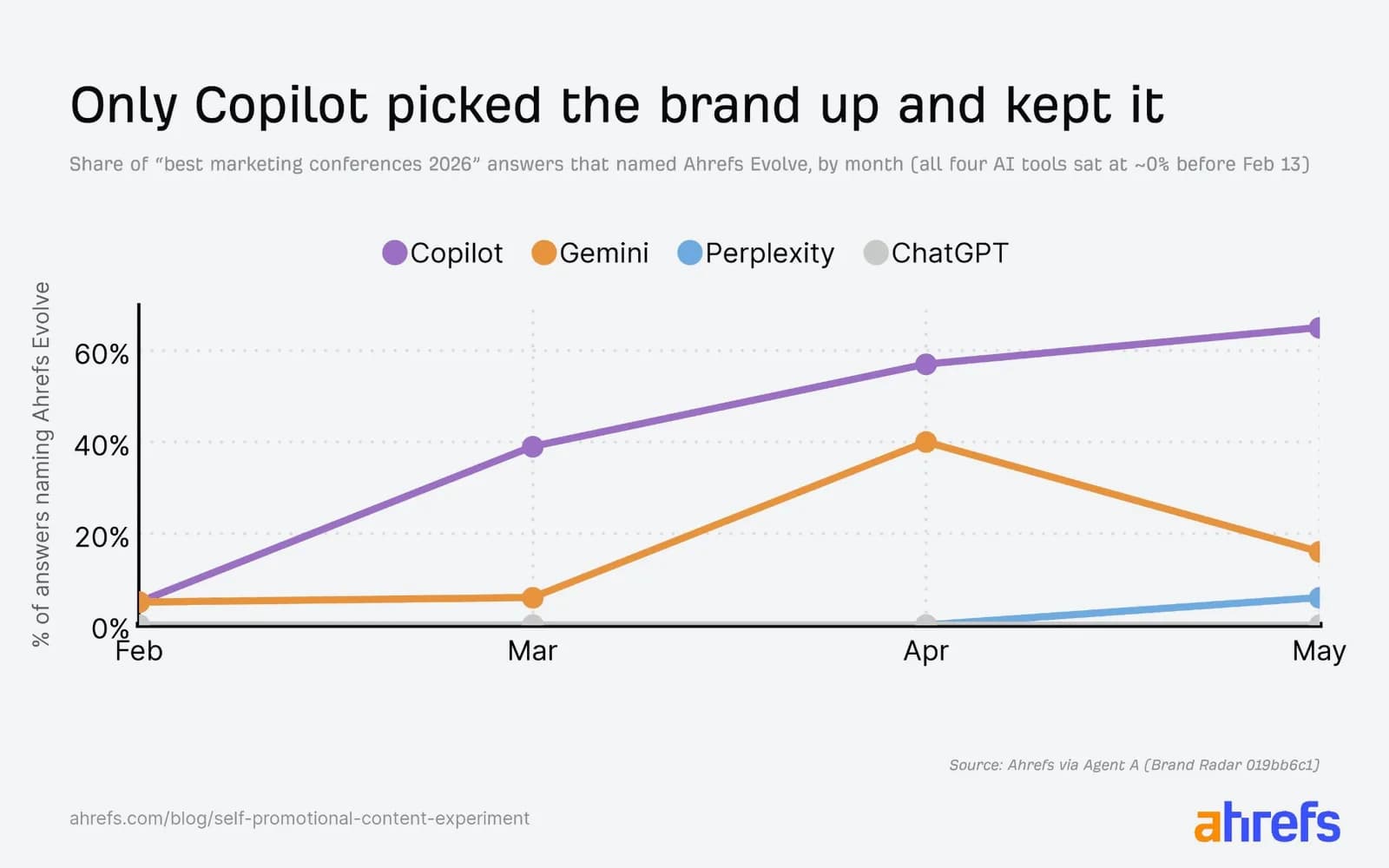
By assistant, Copilot did the heavy lifting: Evolve went from about 0 to 39% of Copilot answers in March, 57% in April and 65% in May. Gemini picked it up less steadily, Perplexity "barely moved," and ChatGPT never named Evolve for this query.
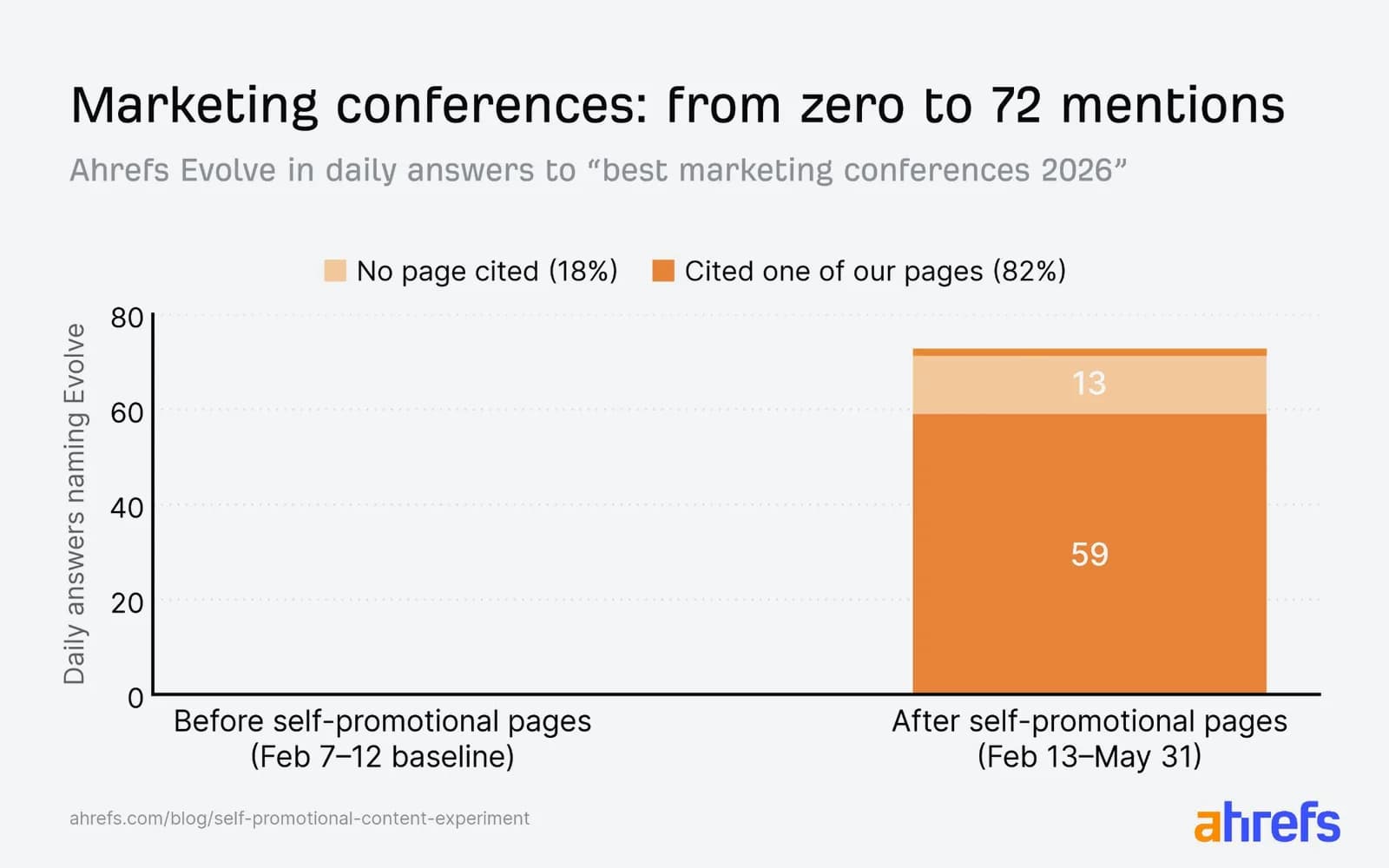
Our math: the 72 all come from 1 prompt, "best marketing conferences 2026". 114 days times 4 assistants is 456 daily answers, and 72 of 456 is 15.8%, exactly the share the author reports for this prompt later on. So the numbers reconcile, and "72 slots" means 72 daily answers, not 72 different queries. 59 of them cited an Ahrefs page, 13 didn't.
From the monthly chart, about 50 of the 72 came from Copilot, about 20 from Gemini, about 2 from Perplexity and 0 from ChatGPT. Read "AI assistants started recommending us" as "Copilot started recommending us."
Not shown: a control. Evolve 2026 had its own site, ticket sales and announcements running in parallel, so some lift could have come without the 34 pages. The baseline was 6 days, while the author's own data shows pages cited on about 1 day in 3. The 82% co-occurrence is the strong part: the AI read an Ahrefs page and named Evolve in the same answer. The size of the effect is the weak part.
Our take: if Copilot is where it works, watch Copilot. Bing Webmaster Tools has a free AI Performance report, in public preview since February 10, 2026, with citation counts per URL and the grounding queries behind them. It shows no clicks, but it costs nothing.
Result 2: AI cited the listicle and recommended a competitor
The author calls this "the most surprising result of the entire experiment." Among answers that cited a conference page, 43% never mentioned Evolve. "The AI used the page as a research source, then recommended other conferences instead. The page got the citation, but the competitor got the recommendation."
Tool pages backfired far less: only 11% of answers citing them failed to mention Ahrefs. The author ties the pattern to Lily Ray's work on Google's AI Overviews.
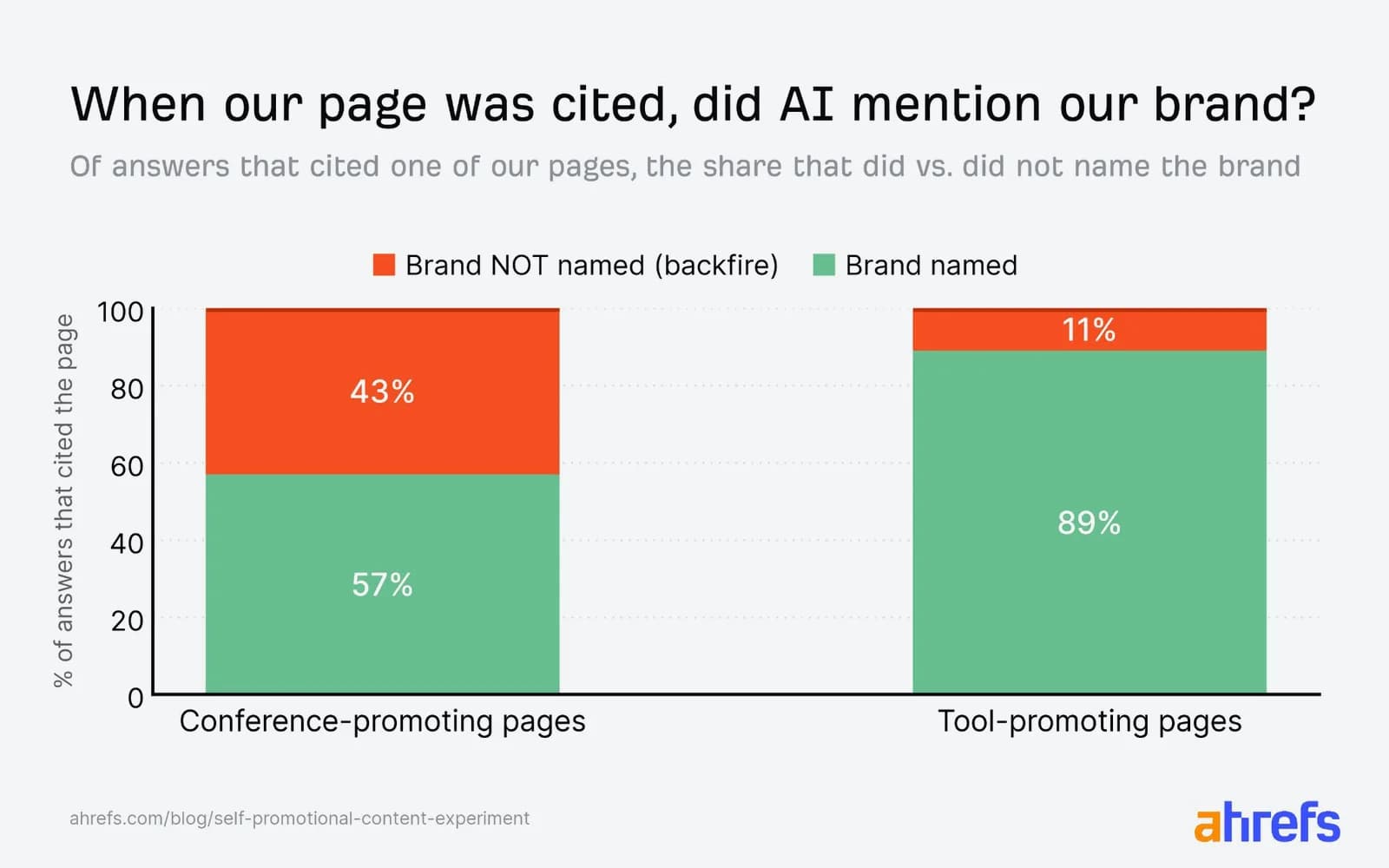
Our math: Lily Ray's numbers, published June 17, 2026 for 100 B2B "best [category]" queries, are worse. When a brand's own listicle was cited in an AI Overview, the brand was left out of the recommendation 69% of the time, 224 of 323 cases. Next to that, 43% looks mild. The case gives no count of answers behind its 43% and 11%.
Our take: the 11% doesn't prove self-promotion works for known brands. Ahrefs sits in almost every answer about SEO tools, and any "Ahrefs" counted. The pages didn't make the AI name Ahrefs; it would have named Ahrefs anyway.
For an affiliate, 43% is the key number of the case, read from the other side. A listicle works as a menu: the AI reads it and picks for itself. If your list carries your offers, the AI can send the user straight to the brand, with no click on your link, no cookie and no commission.
Result 3: AI citations flicker in and out
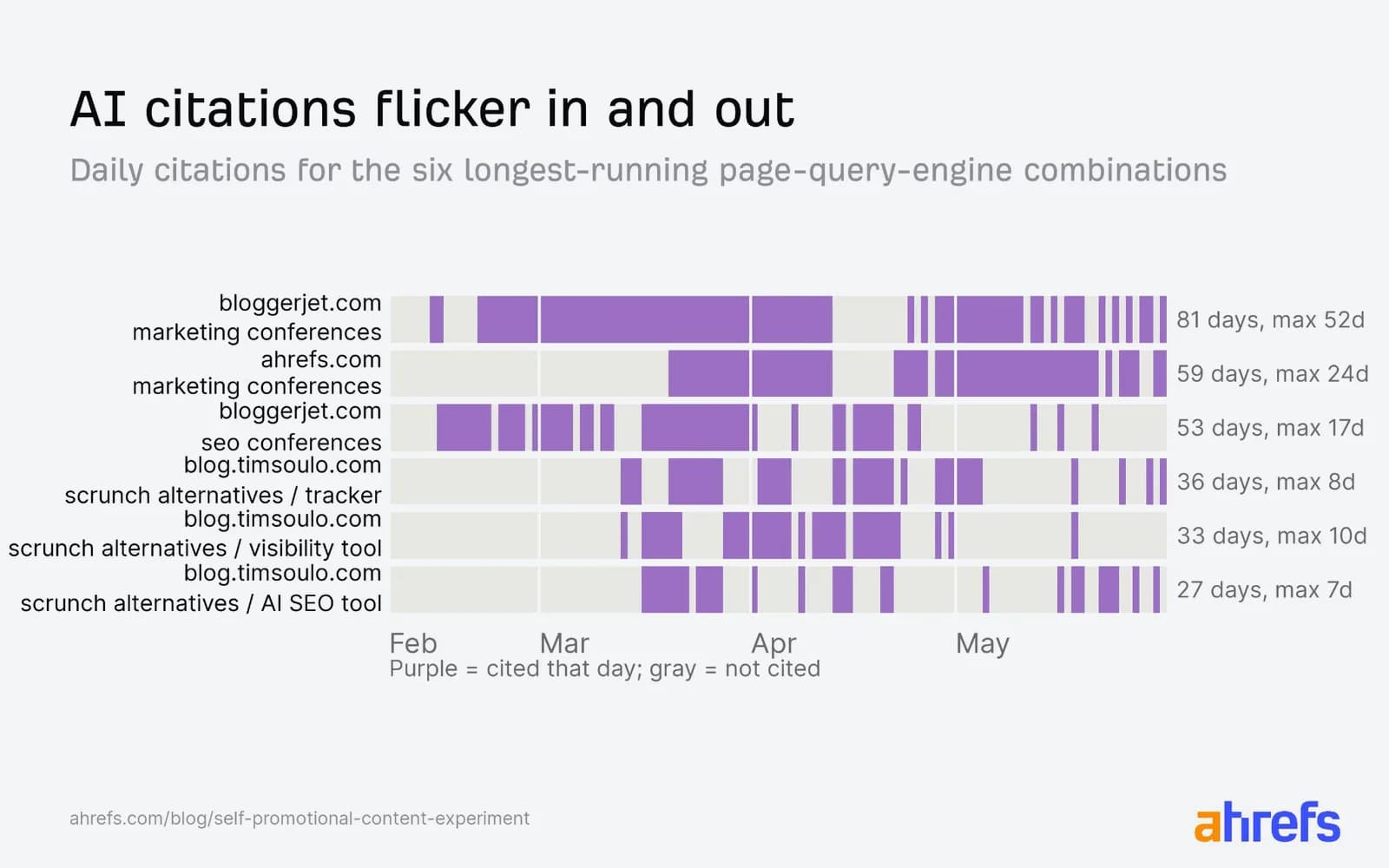
The common assumption is that a citation, once won, stays. The data says otherwise: in about 1 case in 4, a page was cited on 1 day for a query on an assistant and never again. Others "flickered in and out," vanishing for weeks and coming back with no changes to the page. Between a page's first and last citation, it was cited on about 1 eligible day in 3.
Strong domains didn't fix it: ahrefs.com pages held longer but still blinked. The durable ones were "nearly all on Copilot and in narrow, on-brand conference and 'alternatives' queries," and the record was a 52-day unbroken run. The author links this to an earlier Ahrefs study of 43,000+ keywords in Google's AI Overviews, where only about 54% of cited URLs carried over between consecutive checks.
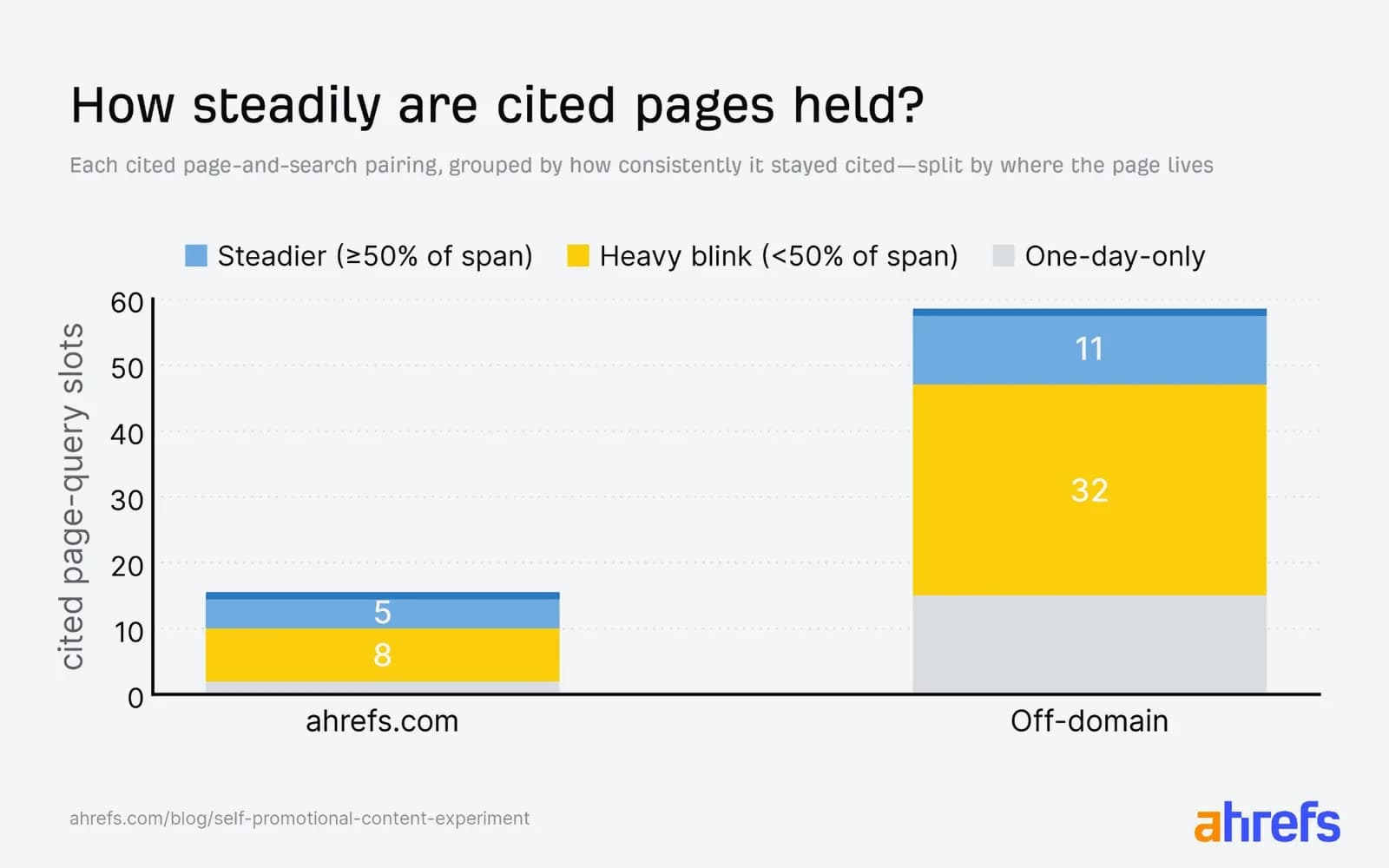
Our math: the stability chart shows how small the cited set was. About 73 page-and-query pairs were ever cited, 15 on ahrefs.com and 58 elsewhere. Roughly 17 were cited on 1 day only (23%, in line with the author's estimate), 40 on under 50% of their span, and 16 held steadier. On ahrefs.com, 1 pair in 3 was steady; on the satellites, 1 in 5.
The 52-day record belongs to the BloggerJet "marketing conferences" page on Copilot, a blog online since 2011.
Our take: an AI citation isn't a ranking. It's a slot that rotates daily. Measure the share of days you're cited over a month, never a single screenshot, and don't sell a client a screenshot as a result.
The hypothesis: brand gap, query fit and trust
The author's explanation: self-promotional content works best when "the brand is both a natural fit for the query and plausible enough to belong in the existing consensus." Evolve appeared in 66.4% of answers to "best SEO conferences 2026" and in 15.8% for "best marketing conferences 2026", so the same pages produced mentions more than 4 times as often for the on-brand query.
He also shows AI listing Evolve as a specialized SEO conference inside broad marketing answers, and gives a test for your own pages: "Would your brand look like a natural recommendation even if you hadn't written the page yourself?" He adds, fairly: "This isn't proof."
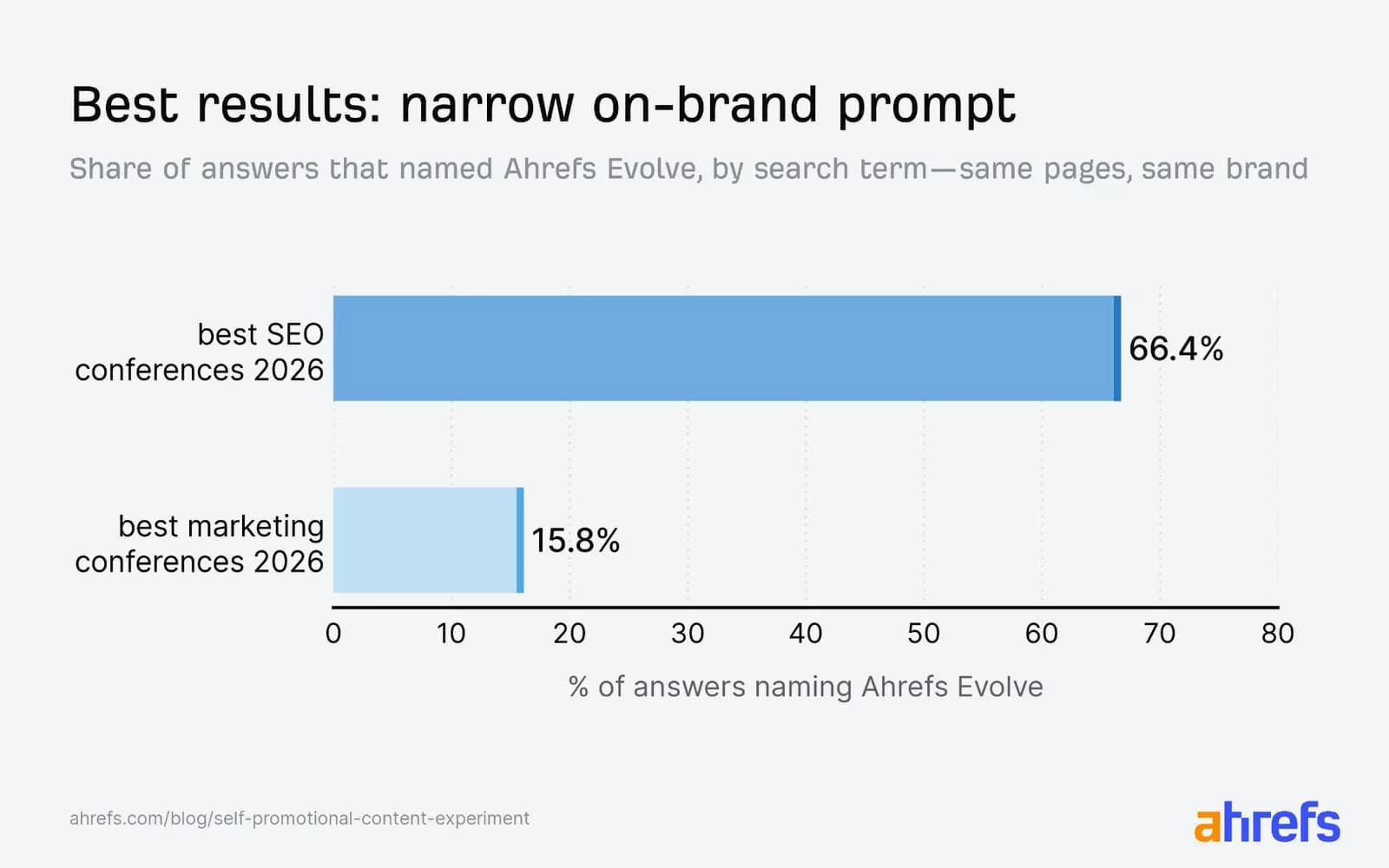
Our math: 66.4% of 456 answers is about 303 mentions against 72, a ratio of 4.2.
Not shown: the baseline for the SEO prompt. The 72 come from slots that were empty before launch; nothing says the SEO-conference slots were. Evolve had already run in 2024 and 2025 as an SEO-heavy event, so part of the 66.4% may predate the pages. The hypothesis is plausible, but the comparison mixes old presence with new.
Our check: on October 2, 2026, we asked logged-out ChatGPT "best SEO conferences 2026" in 2 separate runs. Both times it named Ahrefs Evolve and cited Ahrefs' own roundup, "25 SEO Conferences to Attend in 2026," published February 17 and updated September 23. For "best marketing conferences 2026", neither ChatGPT nor Perplexity named Evolve, 1 run each. Copilot asked us to sign in. That's an anecdote from a European IP, not data, but it points the same way as the case.
Our take: for affiliates, this is the useful part. A new offer or a small brand in a narrow query is where your own content can create the association. A big brand in a broad query is decided by the consensus of third-party pages, and that consensus is mostly us, the affiliates. Remember the 94%.
Found but not cited: where the backfire gets worse
Widen the lens from cited pages to every page the engine pulled in, and it gets darker. When a conference page was found but not cited, 74% of answers skipped Evolve, against 43% when it was cited. For tool pages the gap was small, 15% against 11%, which the author puts down to the volume of third-party pages already recommending Ahrefs.
He also writes that cited-or-found depends on the engine, not the page: "Perplexity left 76% of those pages uncited, while ChatGPT left 61% cited."
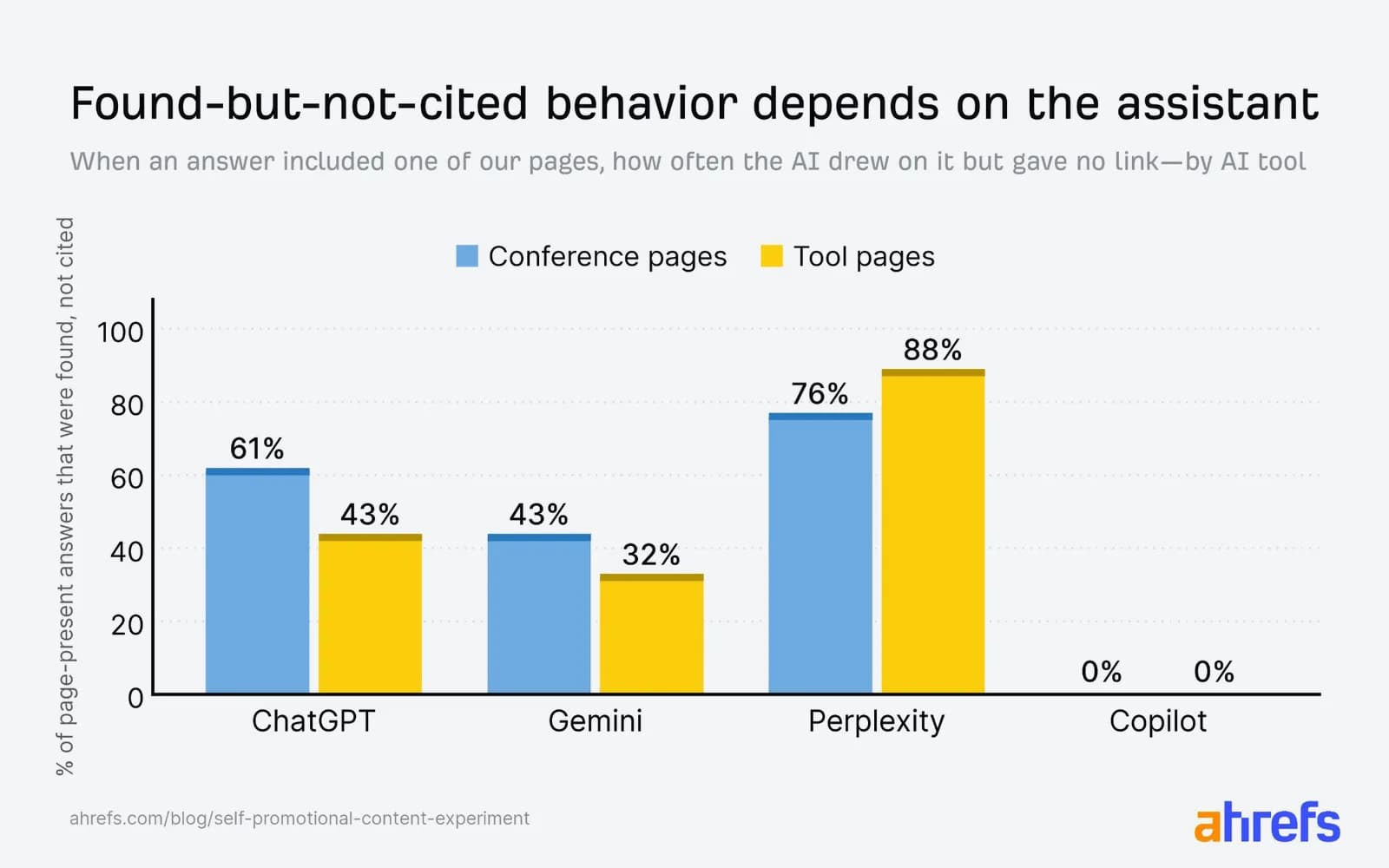
Not shown, plus a slip: the chart says ChatGPT left 61% of conference pages found but not cited, so uncited, not cited. Both ChatGPT and Perplexity leave most of these pages without credit, and the contrast the sentence draws isn't there.
The same chart shows 0% found-not-cited for Copilot on both page types. That looks like the tracker seeing no "found" layer in Copilot, not Copilot crediting everything it reads, and the case doesn't comment. It matters, because Copilot is where the effect was strongest.
Our take: "found" is the affiliate's nightmare in its purest form. Your page feeds the answer, your name isn't on it, and the brand you wrote about gets the user.
How the AI visibility tracking was set up, and what it costs
The case ends with a Brand Radar how-to: custom prompts for queries like "best SEO conferences 2026", a watchlist of the experiment's pages, and cited and found-in tracking. The data was analyzed with Letaido, Ahrefs' AI marketing platform, and the post closes with a ready-made Letaido prompt to set up the same project.
Our math: the case ran at about 2,600 checks a month, 22 prompts on 4 assistants daily. Ahrefs sells prompt-tracking packs from $50 a month for 2,500 checks, with extra checks at $0.02, so a test this size costs about $55 a month in tracking. Paid Ahrefs plans start at $129 a month and include 150 checks.
Not shown: the cost of the content. Who wrote the 34 pages, how long they took and whether AI drafted them isn't in the case. Neither is any business result: tickets, signups or clicks from AI answers.
Our take: this section is a product tutorial from the tool's maker, and the whole case doubles as a Brand Radar demo. That doesn't make the data wrong, and to its credit the case reports the backfire and the flicker instead of burying them. It does mean nobody outside Ahrefs has checked it.
The author's advice vs his own test pages
The author closes with rules for doing this "ethically":
- add yourself to the right contexts, but don't crown yourself;
- publish factual content where you have real expertise;
- don't badmouth competitors;
- fact-check by hand and keep comparisons current;
- budget for the "documentation tax," because stale pages feed AI wrong facts about you and your competitors.
The key line: "The problem starts when you position yourself as 'the best' or park yourself at the top of a list you wrote... Fill the gap accurately; don't manufacture a ranking."
Not shown: the test pages do exactly that. BloggerJet's list, the page Copilot cited on 81 days, opens with "Editor's pick: Ahrefs Evolve" ahead of 8 conferences in date order. Tim Soulo's "14 Scrunch AI Alternatives" puts Ahrefs Brand Radar at number 1 and calls it "the strongest option, in my opinion." The experiment never compared crowned and neutral placement, so "don't crown yourself" is the author's opinion, not a finding.
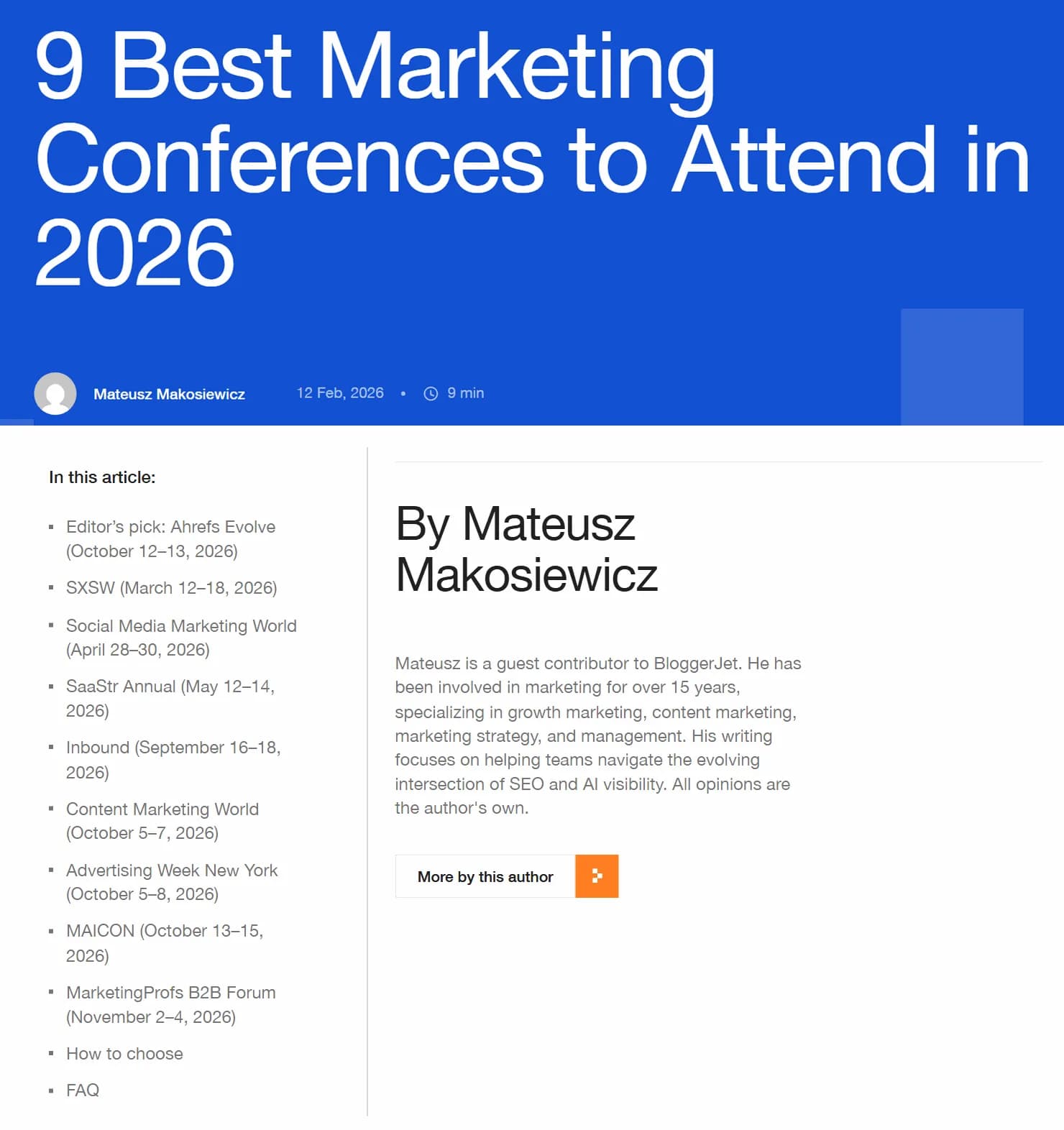
Disclosure is uneven too. Detailed's SEO-conference roundup says it outright: "Ahrefs is the parent company of Detailed." BloggerJet's article calls its author "a guest contributor" and says "All opinions are the author's own," without mentioning that he works at Ahrefs. Its About page does list Ahrefs staff, while promising "we do not use affiliate links or have any other affiliations with any of these tools."
Our take: AI assistants read the article, not your About page. If you run this play for your own offer or a client's brand, disclose it on the page itself. In the US, the FTC rule on reviews (16 CFR 465.6, in force since October 2024) bans a business from misrepresenting that a site it controls gives independent reviews of a category that includes its own products. A single line at the top of the page is the cheap fix.
And note what happened next. In July 2026, after the case went out, BloggerJet published 3 more "X vs Ahrefs Brand Radar" comparisons. The satellite is still working.
Fact-check: what the author showed and what they hid
We rate every case on 10 points: what an outsider needs to judge the result and repeat it. For an SEO experiment, the offer becomes the hypothesis, spend becomes the sample, and creatives become the tested pages. Like most case studies, this one is selectively true rather than fake.
- Setup: period, assistants, brands — Partial. Window, baseline, 4 assistants and both brands are given. Location, prompt count and page publish dates are not; the dates we found run from February 12, 1 day before the stated launch, to March 16.
- Author and independence — Partial. A named, public Ahrefs employee testing his employer's brands with his employer's tool, in a post that ends with a product tutorial.
- Data and sample — Partial. 9,886 answers and 34 pages are stated. Most percentages come without a count behind them, and there's no raw data.
- Proof: charts and screenshots — Showed. 9 charts plus live Brand Radar screenshots. The numbers reconcile (72 of 456 is 15.8%), with 1 text slip on ChatGPT.
- Prompts and measurement — Partial. Mention rules and the cited and found split are clear. Only 6 prompts are visible, and the "any Ahrefs" rule flatters the tool pages.
- Tools — Showed. Brand Radar setup step by step, plus the analysis assistant and a ready-made prompt.
- Tested pages — Partial. Formats and 4 example titles. No list of the 34 URLs and no test of crowned vs neutral placement.
- Domains and disclosure — Partial. 5 domains named. Their ties to Ahrefs and the uneven on-page disclosure aren't mentioned.
- Resources and cost — Hid. No content cost, hours or tracking budget, and no business result such as tickets or clicks.
- Repeatability today — Partial. The method can be repeated from $50 a month. The result rests on aged satellites, mostly 1 assistant and no control group.
Score: 3/5. The method, tools and timeline are on the table, and the numbers reconcile where we could check them, which is more than most vendor cases offer. But the prompt list, the page list, the counts behind most percentages, a control group and the baseline for the best query are missing, and the experimenter tested his employer's brands with his employer's tool. Solid, with key parts hidden: a 3, not a 4.
Checklist: what to do
Questions and answers
Does self-promotional content work in AI search?
Sometimes, for a while. In the Ahrefs test it got a lesser-known conference into up to 65% of Copilot answers for a broad query, barely moved ChatGPT or Perplexity, and did little for a brand the AI already knew.
Why does AI cite a listicle but recommend a competitor?
The AI treats a list as research, not a vote. Ahrefs saw its brand skipped in 43% of answers that cited its conference pages; Lily Ray saw 69% in Google's AI Overviews. Your list hands the AI the options, and the wider web decides which one it picks.
Which AI assistant is easiest to get into with your own pages?
In this experiment, Copilot: about 50 of the 72 new conference mentions came from it, and its citations lasted longest. ChatGPT never named the conference for the broad query.
How long do AI citations last?
Not long. About 1 in 4 cited pages showed up on 1 day only, and the rest were cited on about 1 day in 3 between their first and last appearance. The best run was 52 days.
Do I have to disclose that I own the site that ranks my product?
For US audiences, yes. The FTC rule (16 CFR 465.6) bans presenting a site you control as an independent reviewer of a category that includes your products, and the Endorsement Guides (16 CFR 255.5) require disclosing material connections. A clear line on the page covers it.
Author’s conclusion
The case is honest about its bad news: the backfire, the flicker and the engine split all come from the author's own charts, and the numbers add up where we could check them. What it sells harder than it proves is the effect itself: 1 prompt, mostly 1 assistant, a 6-day baseline, no control and satellites with years of history that most of us don't have. Ahrefs didn't learn how to get recommended by AI. It learned that AI will borrow your list and make its own pick.
My advice: use self-promotional and "alternatives" pages where the AI has a gap, meaning a new offer, a narrow query and a brand the AI doesn't know yet. Disclose who owns the page, put your money into third-party mentions for anything big, and measure the share of days cited in Copilot and ChatGPT for a month before you call it a win.
Lu Discover, Editor-in-chief
Our verdict on this case
The method, tools and timeline are on the table, and the numbers reconcile where we could check them, which is more than most vendor cases offer. But the prompt list, the page list, the counts behind most percentages, a control group and the baseline for the best query are missing, and the experimenter tested his employer's brands with his employer's tool. Solid, with key parts hidden: a 3, not a 4.
Our fact-check of the public case: what the numbers show, what is missing. Scores are never for sale.
Sources for this article
- ahrefs.com — Mateusz Makosiewicz: Self-Promotional Content Works—Until It Backfires (AI SEO Experiment), the case (July 6, 2026)
- bloggerjet.com — Mateusz Makosiewicz: 9 Best Marketing Conferences to Attend in 2026, test page on bloggerjet.com (February 12, 2026)
- detailed.com — Mateusz Makosiewicz: The Best Marketing Conferences of 2026, test page on detailed.com (March 16, 2026)
- detailed.com — Mateusz Makosiewicz: Hand-picked SEO conferences to attend in 2026, detailed.com, with the parent-company disclosure
- blog.timsoulo.com — Tim Soulo: 14 Scrunch AI Alternatives for Tracking Your Brand in AI Search (March 4, 2026)
- bloggerjet.com — About page: launched by Tim Soulo in 2011, revived under the Ahrefs banner in 2024, affiliations statement
- ahrefs.com — Si Quan Ong: 25 SEO Conferences to Attend in 2026 (published February 17, updated September 23, 2026)
- ahrefs.com — Si Quan Ong: Ahrefs Evolve 2025 recap (November 6, 2025)
- lilyraynyc.substack.com — Lily Ray: Why Calling Yourself the "Best" Could Be Helping Your Competitors Win in AI Search (June 17, 2026)
- ahrefs.com — Glen Allsopp: Do Self-Promotional "Best" Lists Boost ChatGPT Visibility? Study of 26,283 Source URLs (December 4, 2025)
- detailed.com — Glen Allsopp: Detailed has been acquired by Ahrefs (September 2025)
- ahrefs.com — Louise Linehan: AI Overviews Change Every 2 Days (November 11, 2025)
- ahrefs.com — Rebekah Bek: Ahrefs Brand Radar methodology: prompts run through the free public interfaces of the assistants
- ahrefs.com — AI prompt tracking: custom prompts and checks
- ahrefs.com — Ahrefs pricing: plans and custom prompt packages
- ahrefsevolve.com — Ahrefs Evolve 2026, October 12–13, San Diego
- blogs.bing.com — Introducing AI Performance in Bing Webmaster Tools Public Preview (February 10, 2026)
- ecfr.gov — 16 CFR 465.6: company-controlled review websites or entities
- ecfr.gov — 16 CFR 255.5: disclosure of material connections
Related stories
 Case fact-check
Adult Comics Test Diary: $99.79 on HilltopAds and TrafficJunky, 27 Sign-ups, 0 Sales
 Case fact-check
Raketech's Q2 2026: Revenue -17.6% Under an 'EBITDA Improvement' Headline, Fact-Checked
 Case fact-check
Comments
0 commentsNo comments yet.
Add a comment