

Multilogin vs Kameleo 2026: Pay for Profiles or for Browsers Running at Once?

Independent and reader-supported. Some links here are affiliate links: if you sign up through them, we may earn a commission at no cost to you. It never changes our scores or verdicts. Affiliate disclosure

Contents 10
Multilogin and Kameleo are the 2 premium antidetect browsers that look alike on a feature list and work nothing alike. Multilogin charges for profiles: 100 cost $40 a month, with unlimited team seats and Android phones in the cloud on real hardware. Kameleo charges for browsers running at the same time: 10 cost 59 EUR a month, profiles are unlimited, and the API comes with every plan, including the free one. One is built for teams working accounts by hand, the other for code.
I've used Multilogin in my own work; for Kameleo this comparison is built on what the company publishes. Everything below was checked on October 22 and 23, 2026: pricing pages, kernel release logs and release notes, help centers and developer docs, and both companies' terms. For the full picture, read our Multilogin review and Kameleo review.
Multilogin vs Kameleo at a glance
Checked October 23, 2026, with Chrome stable on 156:
- Company. Multilogin: Eyes of Wonder Software LLC; terms under UAE law. Kameleo: Outis Nemo Ltd, Budapest, Hungary.
- You pay for. Multilogin: profiles. Kameleo: browsers running at once; profiles unlimited.
- Cheapest paid plan. Multilogin: $11 for 10 profiles. Kameleo: 59 EUR for 10 browsers at once.
- 100 profiles, 3 people. Multilogin: $40, seats unlimited. Kameleo: 59 EUR, seats unlimited.
- Chromium kernel. Multilogin: Mimic 155, October 20. Kameleo: Chroma 156, October 21.
- Firefox kernel. Multilogin: Stealthfox frozen at 146. Kameleo: Junglefox on Firefox 153 ESR.
- Free plan. Multilogin: 5 cloud profiles, deleted after 7 idle days, no API. Kameleo: 2 browsers at once, unlimited local profiles, API, 300 minutes.
- API. Multilogin: from Pro 10, 50 to 100 requests a minute. Kameleo: every plan, 60 to 1,200 requests a minute, SDKs, Docker.
- No-code tools. Multilogin: Cookie Robot and bulk actions from Pro 50. Kameleo: none.
- Mobile. Multilogin: cloud Android phones on real hardware. Kameleo: emulated iOS and Android profiles on Chroma.
- Team roles. Multilogin: owner, manager, operator, starter. Kameleo: Admin, Analyst, Member.
- Activity log. Multilogin: "Soon". Kameleo: none found.
- Refunds. Multilogin: outages over 24 hours; others at its discretion. Kameleo: within 24 hours of activation, unless you had a promotion first.
Pricing: 2 different meters
Multilogin counts profiles; Kameleo counts browsers open at once. That one difference decides most of the comparison, so price your real work rather than the entry plan.
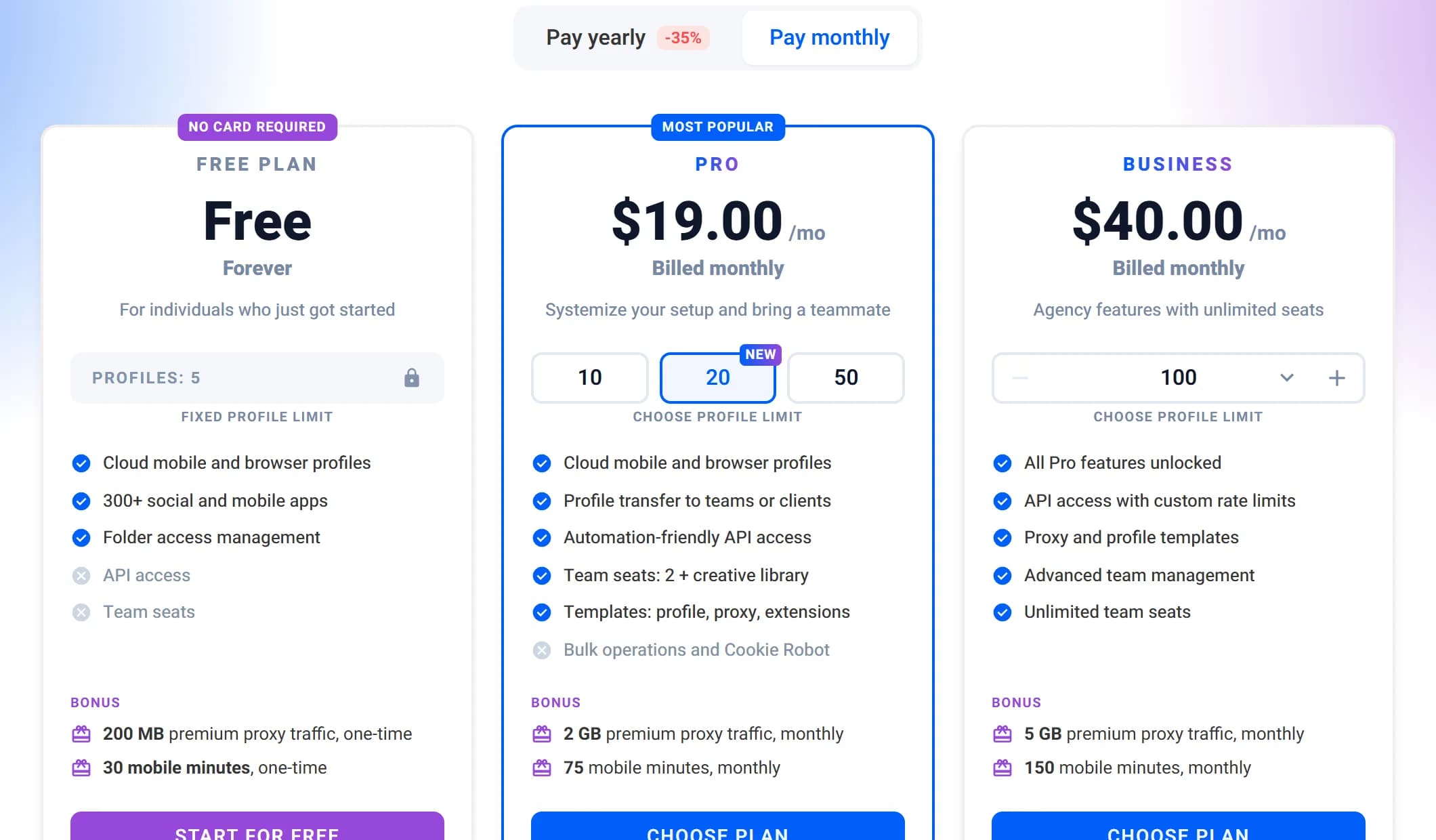
Multilogin: Pro costs $11 for 10 profiles, $19 for 20 and $29 for 50, with 1 or 2 seats. Business costs $40 for 100 profiles, $89 for 300, $115 for 500 and $185 for 1,000, all with unlimited seats. Paying yearly saves about a third, so Business 100 costs $26.67 a month. Every paid plan includes monthly proxy traffic, from 1 GB to 10 GB, and cloud phone minutes. Prices are in US dollars since May 21, 2026.
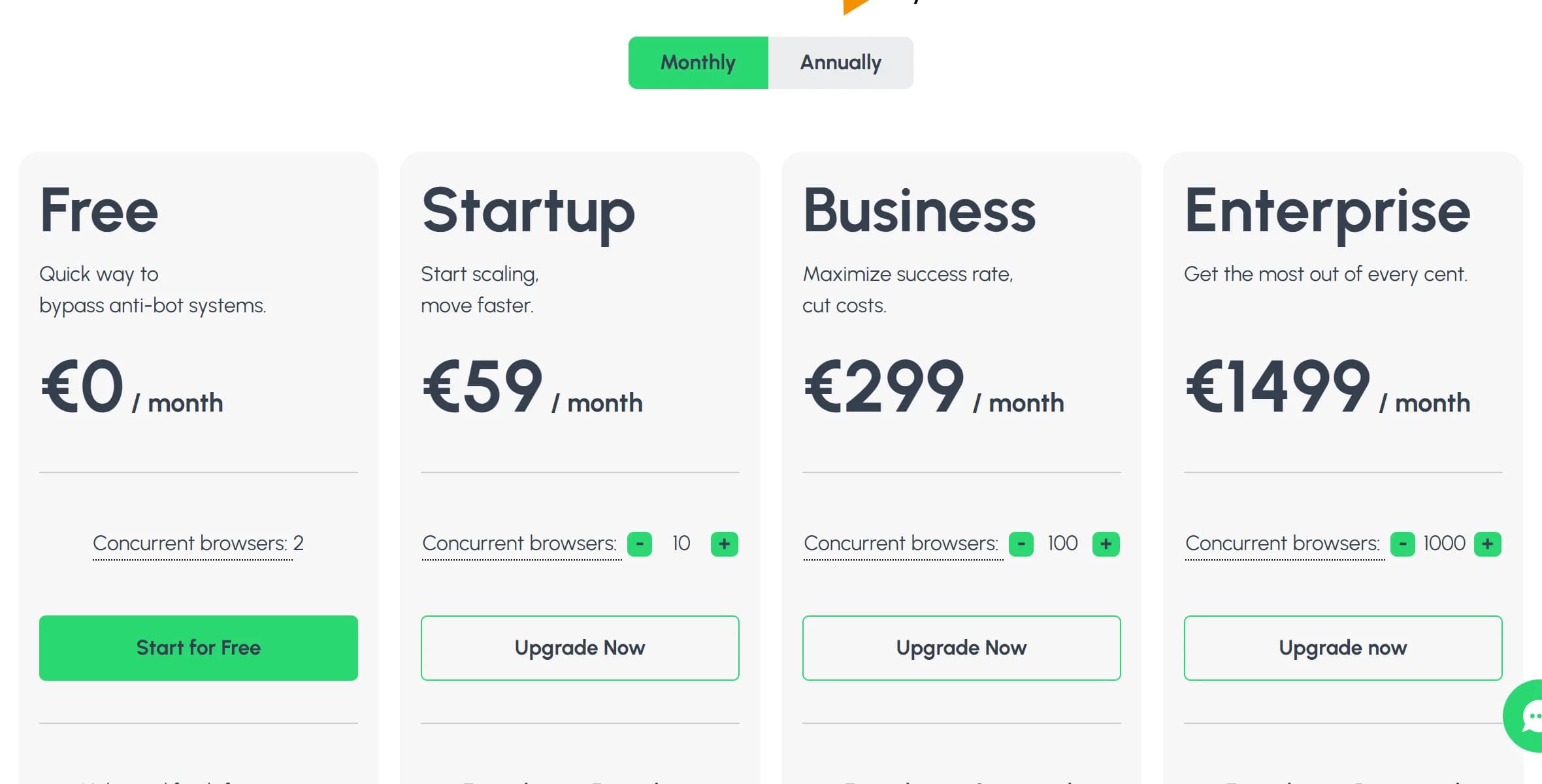
Kameleo: Startup costs 59 EUR a month for 10 browsers running at once, and every 10 more add 30 EUR: 20 cost 89 EUR, 30 cost 119 EUR. Business costs 299 EUR for 100 at once and Enterprise 1,499 EUR for 1,000. Local profiles are unlimited on every plan, and paid plans add 5,000 cloud profiles. Annual billing takes about 25% off, so Startup costs 45 EUR a month.
What that means in practice, monthly billing:
- 1 person, 10 profiles. Multilogin: $11. Kameleo: 59 EUR, or Free with 300 minutes of browser time.
- 3 people, 100 profiles, up to 10 open at once. Multilogin: $40. Kameleo: 59 EUR.
- 5 people, 300 profiles, up to 20 open at once. Multilogin: $89. Kameleo: 89 EUR.
- 10 people, 500 profiles, up to 50 open at once. Multilogin: $115. Kameleo: 179 EUR.
- 1 script, 1,000 profiles, 10 open at once. Multilogin: $185. Kameleo: 59 EUR.
The pattern: Multilogin is cheaper when many people keep many profiles open by hand; Kameleo is cheaper when you keep lots of profiles but open only a few at a time, which is how scripts and scrapers work. Seats are free in both on paid plans, so team size alone doesn't change the bill.
Kernel: predictable against fast lately
Multilogin follows Chrome by exactly 2 weeks. Its help center says the Mimic core "is usually released 1–2 weeks later" than Chrome and updates automatically when you launch a profile. With Chrome on a 2-week cycle, Mimic is always 1 version behind.
Kameleo promises 5 days and doesn't always keep it. Its kernel page says: "We ship Chroma within 5 days of each stable Chrome release." It did for 151, 152 and 156, but when Chrome moved to a 2-week cycle in September, Chroma 153 to 155 came 2 to 4 weeks late, before Kameleo caught up.
- 153. Chrome stable: September 8. Multilogin Mimic: September 22, 14 days. Kameleo Chroma: October 7, 29 days.
- 154. Chrome stable: September 22. Multilogin Mimic: October 6, 14 days. Kameleo Chroma: October 13, 21 days.
- 155. Chrome stable: October 6. Multilogin Mimic: October 20, 14 days. Kameleo Chroma: October 19, 13 days.
- 156. Chrome stable: October 20. Multilogin Mimic: not yet on October 23. Kameleo Chroma: October 21, 1 day.
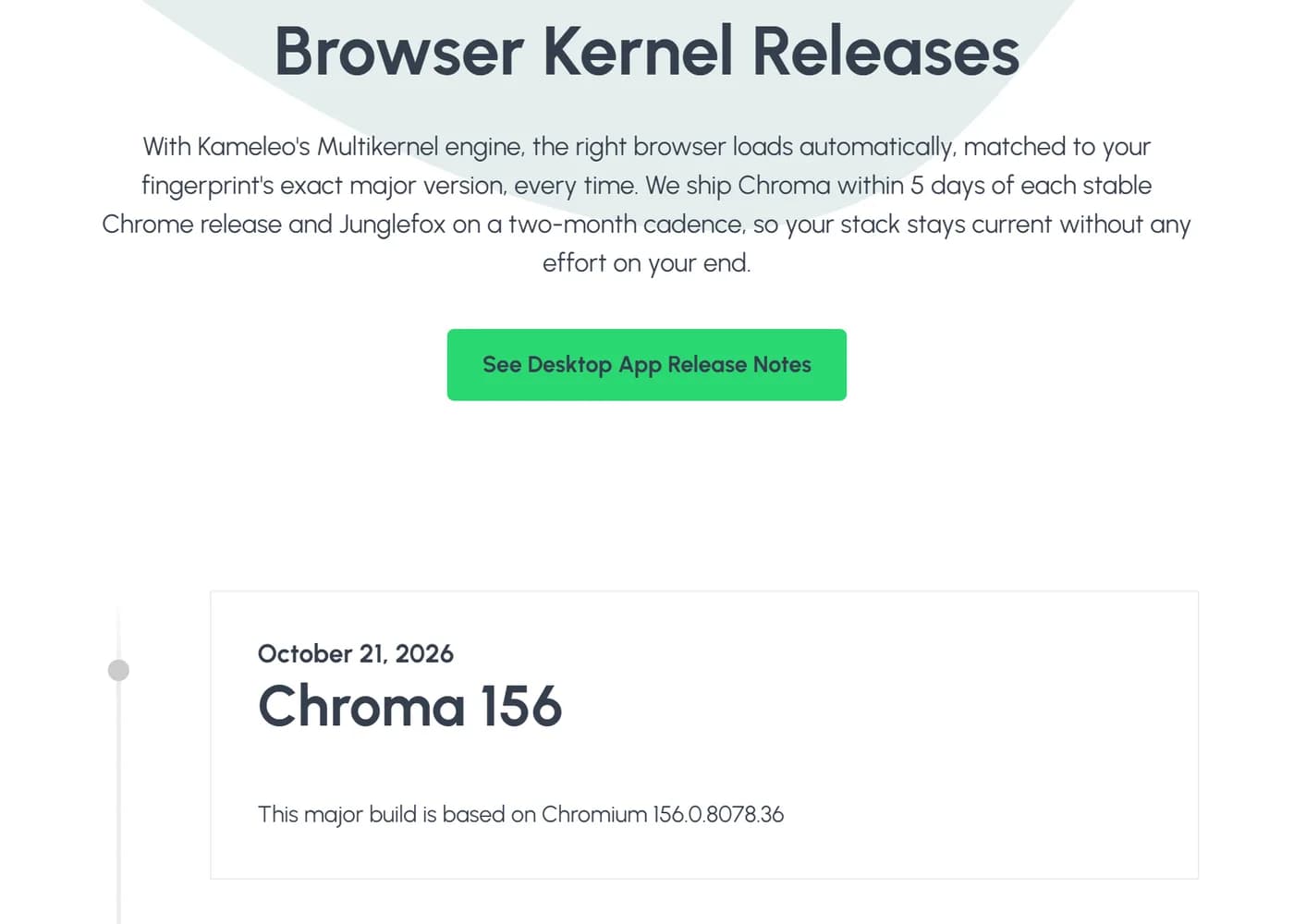
Kameleo also matches the engine to each profile. Its multikernel engine loads the Chroma version that matches the profile's fingerprint, so a profile that claims Chrome 155 runs on Chroma 155. On Firefox, Kameleo keeps going and Multilogin stopped: Junglefox runs Firefox 153, the current Extended Support Release, while Multilogin's Stealthfox stopped at 146 in December 2025 and is being phased out.
Mobile: real phones against emulated profiles
This is where they differ most, and the answers are opposite. Multilogin rents Android 10 to 16 phones in the cloud on real hardware, streamed inside its desktop app, for accounts that live in apps. Minutes are included in every plan, from 60 a month on Pro 10 to 450 on Business 300, and extra minutes cost from $0.0067 each in bulk, with a 2,000-minute pack at $16.80. An open-source AI agent controls the phones over ADB. Multilogin has deprecated its old Android browser profiles in favor of these phones.
Kameleo emulates phones inside its desktop browser. It offers iOS Safari and Android Chrome profiles that run on Chroma's mobile mode. Its developer docs say "WebKit-based kernels are not currently supported," so an iPhone profile is a Chromium engine claiming to be Safari, a contradiction a careful detector can look for. Android profiles on Chroma are the safer choice. The free plan runs 2 mobile browsers at once, Startup up to 30, and Kameleo has no cloud phones or mobile app.
So: for TikTok, Instagram or any account that lives in an app, Multilogin's phones are the tool. For mobile web accounts on Android Chrome, Kameleo's emulation can work. For iPhone accounts, see our iPhone antidetect guide.
Automation: Kameleo's home ground
Kameleo is built for code. Its local API and SDKs for Python, JavaScript and C# are on every plan, including Free, and work with Selenium, Puppeteer and Playwright, including Playwright on Junglefox. Limits rise with the plan: 60 requests a minute on Free, 120 on Startup, 600 on Business and 1,200 on Enterprise. Official Docker images run profiles on Linux and Windows servers, and since version 5.3.0 in September 2026 HTTP/3 and QUIC traffic tunnels through SOCKS5 proxies.
Multilogin covers the basics. The API and a CLI start on Pro 10, with examples for Puppeteer, Playwright and Selenium, but the limits are low: 50 requests a minute on Pro 10, 75 on Pro 20 and 100 on Pro 50 and Business. Neither has a no-code builder or a synchronizer; Multilogin adds Cookie Robot for warming accounts, bulk creation and cloning from Pro 50.
Teams and trust
Seats are free in both, roles differ. Multilogin includes unlimited seats from Business 100 and offers owner, manager, operator and starter roles with folder access and profile transfer to other workspaces; Pro plans have 1 or 2 seats and sell no extras. Kameleo's paid plans have unlimited seats and its free plan 3, with Admin, Analyst and Member roles and a session lock that stops 2 people opening the same profile. Neither has a team activity log today: Multilogin lists it as "Soon," and we found none at Kameleo.
Both were named in Check Point's October 2026 report on antidetect browsers misused for fraud and influence operations, alongside AdsPower, picked "on the basis of documented references across underground forums and criminal marketplaces." The report also calls these tools "commercially available, legally registered platforms with documented legitimate use cases." It describes misuse, not wrongdoing by the companies.
Kameleo publishes its own test results. Its weekly masking report runs the same public scripts against 13 checks, from BrowserScan, CreepJS, Pixelscan and Fingerprint to sites like Amazon and Cloudflare's challenge. On October 19, 2026, Chroma passed 13 of 13 on Windows and 11 of 13 on macOS and Linux, against 4 or 5 for plain Chrome. It's the vendor testing itself, but publishing scores below 100% is rarer than it should be; for what such checkers can and can't tell you, see What Fingerprint Checkers Really Check.
Refunds are narrow in both. Multilogin's terms refund service outages that lasted over 24 hours and were caused on its side, claimed within 14 days, and say "Refunds for other reasons are issued at our discretion." Kameleo's terms allow a refund only if you send written notice within 24 hours of activating the service, and not at all if you used a promotion first. Use the free plans before paying.
Which one should you choose?
By situation:
- Team of 3 to 10 farming accounts by hand — Multilogin. Unlimited seats, profiles priced low, nothing per browser open.
- Accounts that live in Android apps — Multilogin. Cloud phones on real hardware.
- Scripts, scrapers or AI agents — Kameleo. API and SDKs on every plan, Docker images.
- Thousands of profiles, few open at once — Kameleo. Profiles unlimited, 59 EUR for 10 at once.
- Kernel as close to Chrome as possible — Kameleo, for now. Chroma 156 a day after Chrome, but it slipped in September.
- Predictable updates you never think about — Multilogin. Mimic always 2 weeks behind Chrome.
- A Firefox engine — Kameleo. Junglefox on Firefox 153 ESR.
Before you commit, count browsers open at the same moment, not just profiles. A team where everyone runs 5 profiles at once will outgrow Kameleo's Startup fast, while a script that cycles through 1,000 profiles 10 at a time is a bad fit for Multilogin's per-profile price.
We don't have referral links for Multilogin or Kameleo; sign up on their sites. In our ranking of the 15 best antidetect browsers Kameleo is 5th and Multilogin 7th. See also Octo Browser vs Multilogin, Multilogin vs GeeLark and team bills in Cheapest Antidetect Browser With Team Features.
Checklist: what to do
Questions and answers
Is Multilogin or Kameleo better?
Multilogin is better for teams that work accounts by hand and for app-based accounts: unlimited seats from $40 for 100 profiles and cloud Android phones on real hardware. Kameleo is better for automation: unlimited profiles, the API and SDKs on every plan and Docker images, priced by browsers open at once.
Which is cheaper, Multilogin or Kameleo?
It depends on how many browsers you open at once. 3 people on 100 profiles pay $40 at Multilogin and 59 EUR at Kameleo for 10 at once. A script cycling through 1,000 profiles 10 at a time pays $185 at Multilogin and 59 EUR at Kameleo. 10 people with 50 browsers open pay $115 at Multilogin and 179 EUR at Kameleo.
Which has the newer Chrome kernel?
On October 23, 2026, Kameleo: Chroma 156 shipped on October 21, a day after Chrome, while Multilogin's Mimic was on 155 from October 20. Multilogin is always about 2 weeks behind by design; Kameleo was 2 to 4 weeks late in September before catching up.
Which is better for mobile accounts?
For accounts in apps, Multilogin, which rents Android phones in the cloud on real hardware. Kameleo emulates iOS and Android profiles inside its desktop browser on a Chromium engine, which suits mobile web work on Android but not app accounts.
Can I get a refund from Multilogin or Kameleo?
Only narrowly. Multilogin refunds outages over 24 hours caused on its side and decides other requests at its discretion. Kameleo refunds only if you give written notice within 24 hours of activation and didn't use a promotion before. Test both free plans first.
Author’s conclusion
Multilogin for teams and app accounts; Kameleo for code, scale and profiles you open a few at a time.
These 2 are both premium, but they meter different things. Multilogin prices the profiles you keep, gives every teammate a free seat on Business and runs real Android phones, but its API is slow, its Firefox core is retired and team logs are still coming. Kameleo prices the browsers you run at once, keeps profiles unlimited, puts its API on the free plan and caught up with Chrome 156 in a day, but it emulates phones rather than renting them and slipped behind Chrome in September.
My advice: write down how many browsers your team keeps open at the busiest hour. If that number is close to your profile count, take Multilogin; if it's a small fraction of a big profile base, or your work runs from code, take Kameleo. Either way, start on the free plan, because neither gives your money back easily.
Lu Discover, Editor-in-chief
Sources for this article
- multilogin.com — Multilogin pricing, checked October 22 and 23, 2026 (plans, profiles, team seats, monthly and yearly prices, proxy traffic, minutes, activity logs "Soon")
- multilogin.com — Multilogin release notes (Mimic 153, 154 and 155 cores)
- multilogin.com — Multilogin help: core updates and how they work
- multilogin.com — Multilogin help: subscription plan comparison (API limits, seats, minutes)
- multilogin.com — Multilogin help: legacy Android profiles deprecated
- multilogin.com — Multilogin help: how to manage team members (roles and folder access)
- multilogin.com — Multilogin blog: USD pricing update (from May 21, 2026)
- multilogin.com — Multilogin terms of service (Eyes of Wonder Software LLC, UAE law, refund claims for outages)
- github.com — Multilogin cloud phone agent (open source, ADB)
- kameleo.io — Kameleo pricing, checked October 22 and 23, 2026 (concurrent browsers, local and cloud profiles, seats, API limits, steps, annual discount)
- kameleo.io — Kameleo browser kernel releases (Chroma 151 to 156, Junglefox 153, 5-day promise)
- kameleo.io — Kameleo release notes (5.0 accountless mode, 5.3.0 HTTP/3 and QUIC through SOCKS5)
- developer.kameleo.io — Kameleo developer docs: kernels (Chroma, Junglefox, mobile emulation, WebKit not supported)
- kameleo.io — Kameleo masking status report (results of October 19, 2026)
- kameleo.io — Kameleo terms and conditions (refunds within 24 hours of activation)
- research.checkpoint.com — Check Point Research: the risk of AI-powered antidetect browsers in online fraud and influence operations (October 20, 2026)
- product-details.mozilla.org — Firefox versions: latest 158.0.1, ESR 153.5.1
- chromiumdash.appspot.com — Chromium release schedule (stable dates for Chrome 153 to 156)
- developer.chrome.com — Chrome for Developers: two-week release cycle (March 3, 2026)
Companies in this article
- MultiloginAntidetect browserNot rated yet
- KameleoAntidetect browserNot rated yet


Related stories
 Analysis
WebRTC, DNS and TLS Leaks in Antidetect Browsers: What Gets Past Your Proxy
 Analysis
What Fingerprint Checkers Really Check: We Ran 4 Broken Browsers Through 8 of Them
 Analysis
Comments
0 commentsNo comments yet.
Add a comment