

$30K a Month From Amazon Influencer Videos? Fact-Checking John Muscarello's Numbers

Contents 11
In September 2026 an Amazon influencer told a podcast for online business builders that his product review videos earn him "over like 20K a month": "the prior month was like 27, the last month was 35, and this month should be on pace for another 30." The write-up that accompanied the episode rounded it to a "$25K-$30K/month Amazon Influencer business."
This is our review of the interview and John Muscarello's own videos around it, for affiliates and content creators deciding whether Amazon's influencer program is still worth the work: his claims, our math, Amazon's 2026 rule changes, and what the interview leaves out. Editorial fact-check: 3/5.
Short version: the mechanism is explained in rare detail and his numbers agree across his own videos. But nothing is shown on screen, there are no costs or profit, the "$25-30K" run lasted about 3 months, the next month fell by about 23%, and the free guide he promotes ends in a paid call.
Who is John Muscarello
John Muscarello films short review videos for Amazon product pages, full time since 2024 after years of reselling: furniture on Facebook Marketplace, books, online arbitrage and an Amazon FBA business. He co-hosts a small side-hustle podcast and YouTube channel, about 4,900 subscribers. The interview was recorded in August and published on September 2, 2026.
He sells a next step. The interview ends with "a totally free guide how to get started with the influencer program." The guide ends with: "Click here to book an Assessment call... This isn't a free 'pick my brain' call. It's for people who are ready to go all in." He has said in his own videos that he coaches "a couple of people one-on-one." His October video description carries discount codes for 2 of the research tools he names in the interview, Oink and Viral Vue; the interview doesn't say whether those are affiliate deals.
Our take: a real person, on camera, with a long public trail, who reports bad months as well as good ones. Also a creator whose free guide feeds a paid call. Neither cancels the other. The host, himself an Amazon influencer since about 2023, asked what John was "comfortable sharing" and didn't ask for proof.
How the money works: onsite, offsite and Creator Connections
Amazon's influencer program pays in 3 ways, and John explains them clearly:
- Onsite: Amazon places creators' videos in the carousel on product pages and pays a commission when a shopper watches and buys. "Usually the base for Amazon is like between one and three" percent.
- Offsite: commissions from affiliate links on his own channels. In his case, small: "maybe it's an extra $400 or $500 a month that I'm making from the YouTube channel... but I took like two years to get there."
- Creator Connections: brand-funded campaigns that add a bonus on top of the base rate. "I make a video and then if it sells, I get at least 10% commission." In his own videos he puts the range at "anywhere from 10% to 50%."
His split: "probably 80% of it is just Creator Connections and then the other 20 is broken up into like Amazon's normal commissions, brand deals, probably some reselling."
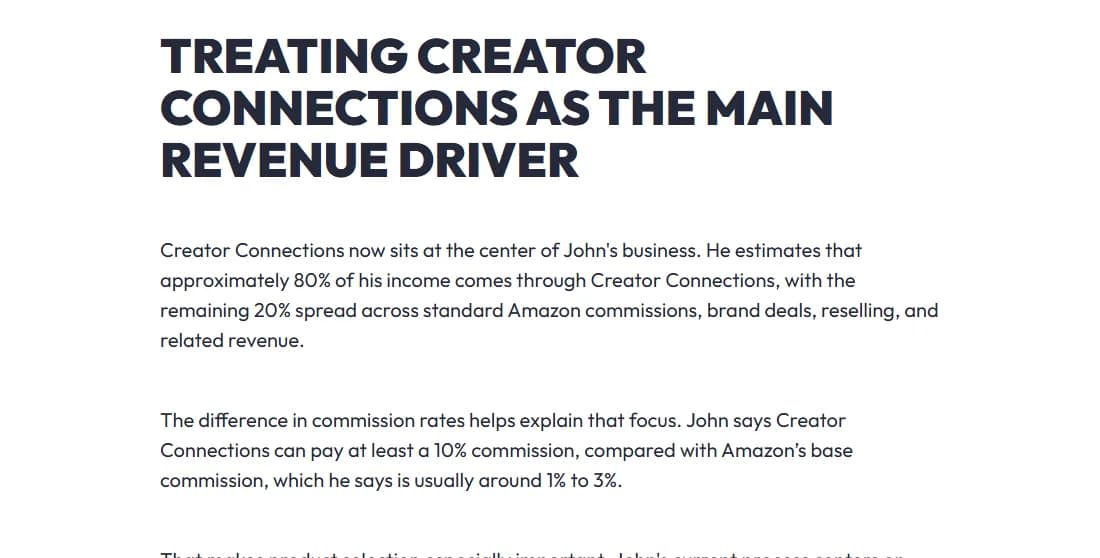
Our math: in a July video John gave June to the dollar: offsite $439, onsite $4,585, Creator Connections $22,670. That's $27,694, and Creator Connections is 81.9% of it, onsite 16.6%, offsite 1.6%. So the "80%" is right, but of Amazon commissions only. In his October video he calls the July and August totals "commissions only, not Facebook, not brand deals." Brand deals and reselling come on top, unquantified, and the interview's 80/20 split mixes the 2.
The April 2026 cut: why Creator Connections took over
"Amazon back in April, I think, cut commissions in half for their side of things, not for Creator Connections... That was kind of a turning point for my business. I decided to double down." And the rule he works by now: "If it's not on Creator Connections, it's not worth making a video."
Amazon's onsite rate page now shows 2 tables: current rates for content without Creator Ads, and a table for Creator Ads with exactly the rates Amazon published for onsite in 2021 and 2023. Side by side:
- Luxury Beauty — old: 5%. now: 4%
- Furniture, Home, Lawn and Garden, Pets — old: 4%. now: 3%
- Health, Sports, Kitchen, Automotive — old: 2.25%. now: 1.25%
- Apparel, Watches, Jewelry, Shoes — old: 2%. now: 1%
- Headphones — old: 3%. now: 1%
- Outdoors — old: 2.75%. now: 0.75%
- Toys — old: 1.5%. now: 0.5%
- Physical Books, Baby — old: 2.25%. now: 0.5%
- All other categories — old: 2%. now: 1%
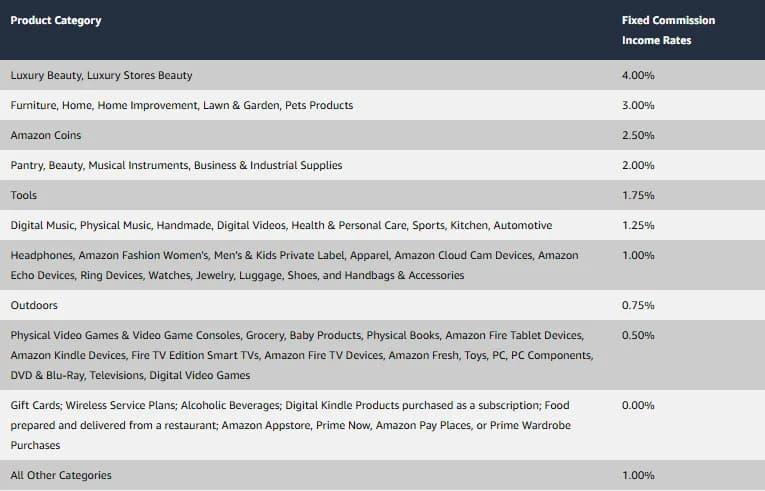
Our math: "cut in half" is the typical case; some categories lost 67% to 78%. On a $30 kitchen item, the base onsite commission is now $0.38. With a 10% Creator Connections bonus on top, the same sale pays $3.38, about 9 times more. That's the whole strategy in 1 line.
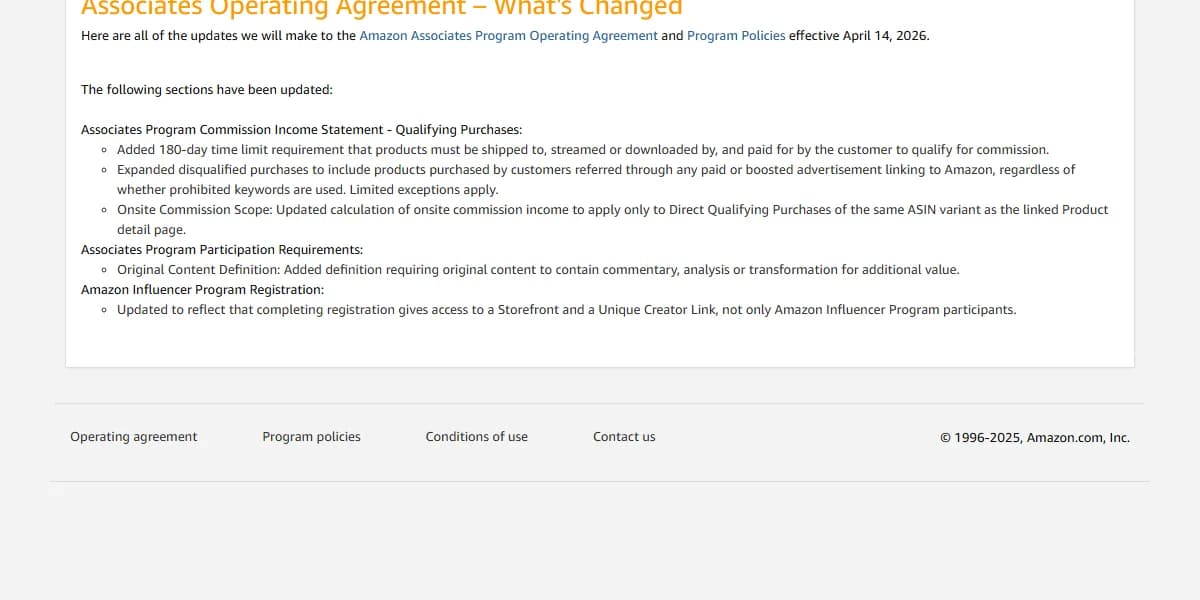
Amazon also changed the rules on April 14, 2026: onsite commission now counts only purchases of "the same ASIN variant as the linked Product detail page," purchases must be shipped and paid within 180 days, and purchases from paid or boosted ads linking to Amazon are disqualified.
Our take: Amazon cut what it pays for the same video and pushed creators toward commissions that brands fund. That makes Creator Connections income a function of how many brands keep funding campaigns, which John himself says may not last: "Creator Connections could be kind of finished unless Amazon steps up."
The method: volume first, then selection, then buying products
The early years were volume. "I said I was going to make 500 videos... the day I made my first 27 cents, I was like, okay, this is interesting." Products came from "everything in my house, everything in my parents' house... Airbnbs." He's now "just under 5,000" videos and makes "like 150 a month."
Now it's selection. A product should sell "at least 500 to a thousand per month," and "I need to be able to make a better video than was on that carousel." He checks Creator Connections campaigns that run long enough, price history in Keepa and sales estimates in browser extensions.
And now he buys. "One of my main strategies is investing in products... I'm literally buying it." Free samples dropped from "300 to 400 products a month" to buying "call it like 70 to 100." His break-even rule: "you have to sell about 6 to 10 to recoup your money."
Our math: the break-even rule is simple arithmetic. At a 10% commission, a product pays back its price after 10 sales; at 14%, after about 7. "6" works only at about 17% or with resale. At 70 to 100 bought products a month and an assumed average of $20 to $80 each, that's $1,400 to $8,000 a month in product spend. That range is ours; he doesn't give one. Per video, June's $27,694 over about 5,000 videos is $5.50 a video, and he admits most videos do nothing: you don't know "which of your 500 videos did anything."
Our take: the method is real and well described: pick products with demand, a campaign and a weak existing video, then make a better one. The cost side changed it from "anyone can do this without risking a penny," as his guide puts it, to inventory buying with a payback threshold. That's a business, and its profit isn't in the interview.
The trend: a 3-month peak
Put John's own videos in order and the "$25-30K a month" has a shape. Amazon commissions only:
- 2025 average: about $10K a month, all income included
- early 2026: about $8K a month
- May 2026: about $13K
- June 2026: $27,694
- July 2026: $35,000
- August 2026: about $31,000
- September 2026: $20,900 at filming, forecast $23-25K
In his October 2 video: "for September... I just passed 20,900... anywhere from like 23 to 25,000... it is going down."
Our math: from March to July his commissions grew about 4.4 times in 4 months, after the April cut, by switching to bought, high-volume Creator Connections products. From July to September they fell about 31%; from August, about 23%. June and July include Prime Day. And all of these are earned commissions, paid about 60 days after the month ends, according to John.
Our take: the interview was recorded at the top of the curve and published as the curve turned. That's nobody's fault, but the headline "$25-30K a month" describes 3 months, not a business, and the guest knew it was falling by October.
What the write-up got wrong
The written summary of the episode says his "monthly earnings moved through approximately $500, $1,000, $1,500, and $3,000." In the interview those numbers are video counts: "I did 500 the first 30 days, and then I went to a thousand, then it was 1,500, then it was 3,000." The summary turned a production log into an income ladder.
John's own origin story varies too: the first 500 videos took 30 days in the interview, 60 days in a June video and "the first month" in his guide; the first commission was 27 cents in the interview and 76 cents in the guide; 1,000 videos took 6 months in the guide and "about a year" in the interview. None of it changes the 2026 numbers. It's a reminder that income stories get rounded in the telling.
Fact-check: what the author showed and what they hid
We rate every case on 10 points: what an outsider needs to judge the result and repeat it. For a creator income case, the traffic source is Amazon's carousel and campaigns, creatives are the videos, and consumables are the products bought for them. Like most case studies, this one is selectively true.
- Setup: period, market, model — Partial. Amazon US, June to September 2026, onsite, offsite and Creator Connections explained. No breakdown by category or product.
- Author and independence — Partial. Public, findable and candid about bad months. His free guide ends in a paid call, and tool discount codes go undisclosed in the interview.
- Finances — Hid. Gross commissions by month, with June split by type. No product spend, no profit, no taxes, and the 80/20 split mixes commissions with total income.
- Proof — Hid. No dashboard on screen in the interview; the numbers are spoken. They match across his own videos.
- Source and selection — Showed. The carousel, Creator Connections, sales thresholds, campaign length and the "better video" rule.
- Tools — Showed. Keepa, Oink, Viral Vue and others are named. No prices.
- Creatives — Partial. Short single-take reviews that answer open questions. No results per video.
- Funnel — Showed. It's Amazon's own page; nothing to hide there.
- Consumables — Partial. 70 to 100 bought products a month and a 6-to-10-sale break-even. No spend in dollars.
- Repeatability today — Partial. The method is clear, but onsite rates were cut, Creator Connections may saturate, and his own income fell in September. A 5,000-video library isn't copyable.
Score: 3/5. John explains the mechanism, the selection rules and the economics of buying products better than most income claims ever do, and his numbers agree across 6 of his own videos. It stops at 3 because nothing is shown on screen, costs and profit are missing, the headline describes a 3-month peak that was already fading, and the free guide leads to a paid call. Solid, with key parts hidden: a 3.
Checklist: what to do
Questions and answers
How much do Amazon influencers make in 2026?
It varies widely. John Muscarello reports $27,694 in June 2026 and $35,000 in July from about 5,000 videos, most of it Creator Connections bonuses, after earning about $8,000 to $13,000 a month in spring and before falling to an expected $23,000 to $25,000 in September. Those are gross commissions, before product costs.
Did Amazon cut Influencer onsite commissions in 2026?
Yes. Amazon's current onsite table pays 1% to 4% in most categories, down from 2% to 5% in the table it published in 2021 and 2023. Several categories fell by 67% to 78%, including Outdoors, Toys, Books and Baby.
What is Amazon Creator Connections?
A program where brands fund extra commission for creators who make content for their products, usually at least 10% on top of the base rate, and up to 50% according to John. It's where most of his income now comes from, and it depends on brands continuing to fund campaigns.
Is the Amazon Influencer Program still worth it?
It can be, with selection and a budget. The volume-only approach of filming everything you own now pays much less after the rate cuts. What works in this case is filming bought products that sell well and carry a brand-funded bonus, with a clear payback rule.
Author’s conclusion
This is one of the clearer explanations of how Amazon Influencer money works in 2026: why base onsite rates stopped mattering, why Creator Connections became the business, how to pick products and when buying them pays back. John's numbers also hang together across his own videos, which is more than most income claims manage. What the interview doesn't give is proof on screen, costs or profit, and the context that matters most: the "$25-30K a month" was a 3-month peak built on brand-funded campaigns, and by October he was saying it's going down.
My advice: if you start, start with the math, not the headline. Check current rates for your categories, film only products with an active Creator Connections campaign and real sales, set a payback rule before you buy anything, and track commissions per video. Plan for the 60-day payment delay and for campaigns drying up, because the income in this case depends on brands deciding to keep paying the bonus.
Lu Discover, Editor-in-chief
Our verdict on this case
John explains the mechanism, the selection rules and the economics of buying products better than most income claims ever do, and his numbers agree across 6 of his own videos. It stops at 3 because nothing is shown on screen, costs and profit are missing, the headline describes a 3-month peak that was already fading, and the free guide leads to a paid call. Solid, with key parts hidden: a 3.
Our fact-check of the public case: what the numbers show, what is missing. Scores are never for sale.
Sources for this article
- nichepursuits.com — John Muscarello: interview on building a $25-30K-a-month Amazon Influencer business, written summary (September 2, 2026)
- youtube.com — John Muscarello: the same interview on video (September 2, 2026)
- youtube.com — John Muscarello: June 2026 income breakdown: offsite, onsite and Creator Connections (July 17, 2026)
- youtube.com — John Muscarello: July, August and September 2026 numbers: "it is going down" (October 2, 2026)
- youtube.com — John Muscarello: on Amazon's April 2026 commission cuts (April 14, 2026)
- reviewandearnsystem.com — John Muscarello: the free guide that ends with an assessment call
- affiliate-program.amazon.com — Operating Agreement, what's changed, effective April 14, 2026
- affiliate-program.amazon.com — Onsite commission income statement and rate tables
- affiliate-program.amazon.com — the 2021 and 2023 onsite rates
Related stories
 Case fact-check
Raketech's Q2 2026: Revenue -17.6% Under an 'EBITDA Improvement' Headline, Fact-Checked
 Case fact-check
59% of Installs Were Bots: An Indie Developer's Google App Campaign, Fact-Checked
 Case fact-check
Comments
0 commentsNo comments yet.
Add a comment