

Why Some Affiliate Sites Grow Without Massive Traffic


Contents 9
Affiliate site growth without massive traffic isn't a paradox. It's arithmetic. Revenue equals clicks to offers times earnings per click (EPC), not pageviews times hope. With average affiliate conversion around 1–3% and search clicks shrinking for everyone, the sites that grow are the ones that stopped optimizing for visitors and started optimizing for the right visitors.
Traffic was never the business model, it was a proxy
For fifteen years affiliate SEO ran on one assumption: more traffic means more money. Build pages, rank pages, collect visitors, convert a fraction. The fraction was small, so the answer was always more traffic.
Pew Research Center published the numbers that end that assumption. In a study of real browsing behavior released on July 22, 2025, Google users who saw an AI summary clicked a traditional search result in 8% of visits, versus 15% when no summary appeared. Links inside the summaries were clicked in 1% of visits. About 18% of the searches in Pew's March 2025 sample produced an AI summary, and users were more likely to end their browsing session on those pages (26% versus 16%).
From a publisher's chair: the click pool is shrinking, and hardest for the informational queries that built the "publish 500 articles and pray" model. And yet some small affiliate sites, with traffic that would embarrass a mid-tier blog, keep growing revenue. They run different math.
Key numbers before we go deep:
- 8% vs 15%: click rate on search results with and without an AI summary (Pew Research Center, July 2025).
- 1–3%: average affiliate conversion rate across niches; top performers reach 5–10% (wecantrack).
- Email converts at around 5.3%, and the same offer can earn 6x more per click from email than from social.
- A DR 15 specialist site outranks Amazon (DR 96) on competitive commercial keywords through topical authority (Ahrefs).
- Published 2026 EPC benchmarks: $3.80–$6.50 in personal finance, $2.10–$4.50 in hosting (AffiliateBooster).
The math nobody runs: revenue per visitor
Affiliate revenue comes down to three numbers: how many people reach your money pages, what share of them click out, and what each click earns. wecantrack's compilation puts the average affiliate conversion rate between 1% and 3%, with top affiliates at 5–10% and email at about 5.3%. Finance affiliates typically land at 2–5%, general retail at 1–3%.
EPC is where niches separate. AffiliateBooster's 2026 benchmarks:
- Personal finance, loans, credit: EPC $3.80–$6.50
- Cybersecurity and VPN: $2.90–$5.20
- SaaS and business software: $2.40–$4.80
- Web hosting: $2.10–$4.50
- AI tools and software: $1.60–$3.40
Now run two hypothetical sites through that table.
Site A gets 50,000 visitors a month on broad informational content: "what is a VPN", listicles, trend posts. Maybe 2% touch a money page and click out: 1,000 clicks. On low-intent traffic, a realistic EPC sits at the bottom of the range or below; call it $0.50. Revenue: $500.
Site B gets 2,000 visitors, but every page targets a decision-stage query in cybersecurity: comparisons, setup-specific reviews, "X vs Y for remote teams". A third of the visitors click out, because the page exists to settle a purchase decision: 660 clicks at $3.50 EPC. Revenue: $2,310.
Site B fails every traffic dashboard and out-earns Site A more than four to one. Neither site is real; the math is.
One honesty check before you fall in love with the table: network-displayed EPC is inflated by super-affiliates. AffiliateBooster itself warns that the median publisher EPC on the same program may be 40–60% lower, and in finance, rejected leads can cut another 20–40%. Halve every number for planning. The conclusion survives: per-visitor economics, not visitor totals, decide whether an affiliate site is a business or a hobby with a dashboard.
Intent beats volume
If revenue per visitor is the metric, intent is what moves it. The same wecantrack data shows organic traffic converting 10–15% better than paid depending on the niche, and email far above the average. AffiliateBooster's traffic-source breakdown gives the sharpest example: the same SaaS offer earned $1.63 EPC from email and $0.27 from Instagram. Same product, same commission, six times the value, decided by who was clicking and why.
A visitor who searched "best password manager for a 10-person agency" arrives with a problem, a budget and a deadline. A visitor from a meme page arrives curious at best. Both count as one visit in Google Analytics.
Intent-first publishers build around that asymmetry:
- Decision-stage queries over awareness queries. "Is X worth it", "X vs Y", "X for [use case]": small volumes, a large share of revenue.
- Specificity as a filter. A page for "CRM for solo real-estate agents" repels 95% of generic CRM traffic. The 5% who stay convert like email subscribers.
- Volume metrics as diagnostics. Impressions and visits are tracked to spot ranking problems, not celebrated as KPIs.
The uncomfortable corollary: most of the traffic big affiliate sites brag about is economically dead weight. It costs money to produce, inflates dashboards and converts at rates that round to zero.
Topical authority: how small sites outrank giants
None of this matters if a small site can't rank for high-intent queries. Five years ago that objection was fair. The record since says otherwise.
Ahrefs defines topical authority as search engines recognizing a site as the expert source on a subject, "not just for individual keywords, but for the full range of related queries within a topic." Its example: Bicycle Motor Works, a DR 15 specialist e-bike site, outranks Amazon (DR 96) for competitive e-bike keywords, and according to Ahrefs it also earns regular AI Overview appearances because it owns the topic better than brands with a diluted focus.
A DR 15 site beating the largest retailer on the internet isn't a backlink story. It's a coverage story: the specialist answers the whole question graph around its topic (choosing, installing, troubleshooting, comparing), while the giant has one thin category page per query.
The pattern repeats in documented practitioner work. Matt Diggity's topical authority case study tracked a US health-supplements site through a pillar-and-cluster rebuild: organic users grew 60.99%, from 4,202 to 6,765, in just over six months, and top-100 keyword rankings rose 62.8% (from 1,405 to 2,288). Note the absolute numbers: a site most traffic-obsessed marketers would call tiny.
Two practical lessons:
- Clusters beat lottery tickets. Twenty interlinked pages covering one buying decision from every angle build authority. Twenty disconnected posts chasing keyword-tool suggestions build nothing.
- Authority compounds into AI distribution. As AI Overviews absorb informational clicks, the citations that remain go to sources that own their topic.
A caveat: for every Bicycle Motor Works there are specialist sites that built good clusters and still lost to brands in a core update. Topical authority raises your odds; it doesn't remove volatility.
Conversion-first content: what Google actually rewards
"Conversion-first" is often misread as "more affiliate buttons above the fold". That version dies at the first core update. The durable version is almost boring: pages built to serve a purchase decision, which is exactly what Google's review guidance asks for. It tells reviewers to:
- "Provide evidence such as visuals, audio, or other links of your own experience with what you are reviewing."
- "Share quantitative measurements about how something measures up in various categories of performance."
- "When recommending something as the best overall or the best for a certain purpose, include why you consider it the best, with first-hand supporting evidence."
Every line does double duty: first-hand evidence ranks better and converts better, and quantitative comparisons answer the objections that stall a purchase.
On a working low-traffic site that looks like:
- money pages as decision tools: comparisons with real measurements, verdicts by use case, an honest "who should not buy this";
- disclosure at the top, not buried: it's required, and it reads as confidence;
- a real person attached: bylines, a testing methodology, an author page that survives a skeptical visitor;
- no scaled filler: a hundred AI-drafted listicles don't just fail to rank, they drag down the whole domain.
When small sites win, and when the model breaks
The affiliate industry isn't shrinking: DemandSage puts spending at about $20 billion in 2026. But the publisher side is brutally top-heavy: in the same data, only the top 9% of affiliates clear $50,000 a year. A low-traffic strategy doesn't change that distribution; it changes which side of it a focused operator can reach.
- Niche economics. Works with high EPC ($2+): finance, VPN, SaaS, hosting. Breaks below $0.50 EPC: mass-market gadgets, fashion, display-ad reliance.
- Query type. Works for decision-stage, comparison and use-case queries. Breaks on pure informational, news and entertainment.
- Monetization. Works with per-action and recurring commissions. Breaks on RPM and display ads, where the game is volume by definition.
- Focus. Works when one topic is owned completely. Breaks with broad, shallow coverage.
- Traffic mix. Works with organic plus an owned email list. Breaks on a single rented, low-intent channel.
Three risks stay no matter how clean the execution:
Concentration. A 2,000-visitor site earning $2,000 usually earns it from two or three programs and one traffic source. One commission cut or one core update can halve it. The hedge is an owned audience: an email list is both your best channel and your insurance.
Program risk. High-EPC niches are exactly where networks scrutinize, hold and claw back hardest. Read payout terms before you build the cluster.
Distribution shift. AI search is still repricing every click.
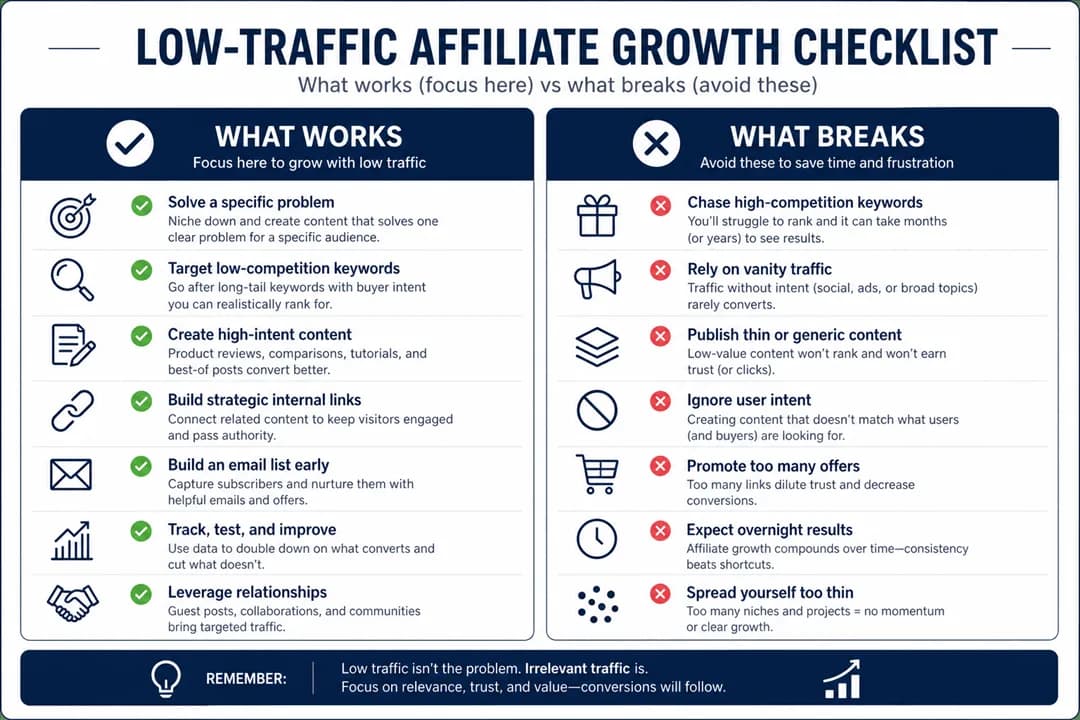
Checklist: what to do
Questions and answers
Can an affiliate site make money with fewer than 10,000 visitors a month?
Yes, if the niche's EPC and the traffic's intent support it. A few hundred decision-stage clicks in finance or VPN can out-earn tens of thousands of informational visits monetized with display ads. Low-EPC offers plus low-intent traffic is the combination that needs volume you don't have.
Is traffic still a useful metric?
As a diagnostic, yes; as a goal, no. Visits tell you whether rankings moved and whether a cluster gains coverage. Revenue per visitor, click-out rate and EPC by page tell you whether the business works.
How long does it take a small site to build topical authority?
In Matt Diggity's documented case, a supplements site grew organic users by 60.99% and top-100 rankings by 62.8% in just over six months after a pillar-and-cluster rebuild. Treat that as a realistic pace for momentum, not a guarantee; competitive niches move slower.
Do AI Overviews kill small affiliate sites?
They hurt the informational-traffic model: results get clicked much less when a summary appears, and links inside the summary get clicked in about 1% of visits. Specialists that own a topic are the ones cited on commercial queries, so focused sites are, so far, the relative winners.
Which conversion rate should a small affiliate site aim for?
The 1–3% industry average blends everything. Decision-stage pages of top affiliates reach 5–10%, and email converts around 5.3%. A practical target: money pages above 5% click-to-offer. If your best comparison page converts under 2%, the problem is usually intent, not button color.
Author’s conclusion
Some affiliate sites grow without massive traffic because revenue was never a function of traffic. It's a function of intent times economics, and traffic was the crude proxy we used while clicks were abundant. They aren't anymore: Pew measured the decline, Ahrefs documented who wins the rest, and the EPC tables explain why a 2,000-visitor specialist can out-earn a 50,000-visitor generalist.
My take: this isn't a promise that small equals profitable. Most affiliates still earn little. It's a narrower claim with data behind it: pick a niche where each click is worth dollars, own one topic completely, build money pages that meet Google's review standards, and treat your email list as the only traffic you truly own.
Lu Discover, Editor-in-chief
Sources for this article
- aliencpa.com — Original article (July 2026), rewritten
- pewresearch.org — Pew Research Center: clicks with and without AI summaries (July 22, 2025)
- wecantrack.com — wecantrack: affiliate conversion rate statistics
- affiliatebooster.com — AffiliateBooster: niches ranked by EPC (2026)
- ahrefs.com — Ahrefs: topical authority (Bicycle Motor Works vs Amazon example)
- diggitymarketing.com — Diggity Marketing: topical authority case study (+60.99% organic users)
- developers.google.com — Google Search Central: write high quality reviews
- demandsage.com — DemandSage: affiliate marketing statistics (spend, income distribution)
Related stories
 Guide
GuideHow Much Budget Do You Need to Test an Offer? What $100 Can and Can't Tell You
 Analysis
Why Most Affiliates Never Scale Past $10K a Month: The Ceiling Is Cash, Caps and Accounts, Not Talent
 Guide
Guide
Comments
0 commentsNo comments yet.
Add a comment