


"Compliance" Is the Most Useful Word in an Affiliate T&C — For the Platform
You log in. The dashboard is gone. The email is two sentences long. Your account was deactivated for "compliance reasons." No specific clause cited, no flagged link, no traffic source named. The balance is frozen or reversed.
Your first reaction is to ask which rule you broke. That is the wrong question, because in modern affiliate agreements compliance is not a single rule. It is a shorthand that covers everything from a missing FTC disclosure to a fraud-team review of your IP fingerprint to a brand partner deciding you no longer fit their image. The platform's lawyers wrote it that way on purpose.
We open the word "compliance" and show you the six things it actually means in 2026, how networks detect each one, and where the appeal door is closed before you knock. The clauses we cite are from public agreements. The complaint shapes come from Trustpilot, Reddit, AffiliateFix, and Affiliate Guard Dog. One story is noise. Dozens of unconnected stories with the same plot is a structural feature of the industry.
What Affiliate T&Cs Actually Mean by "Compliance"
The first move when you get a compliance email is to read the actual contract. Almost no one does that before they sign up. Here is what the major programs reserve for themselves under that one word.
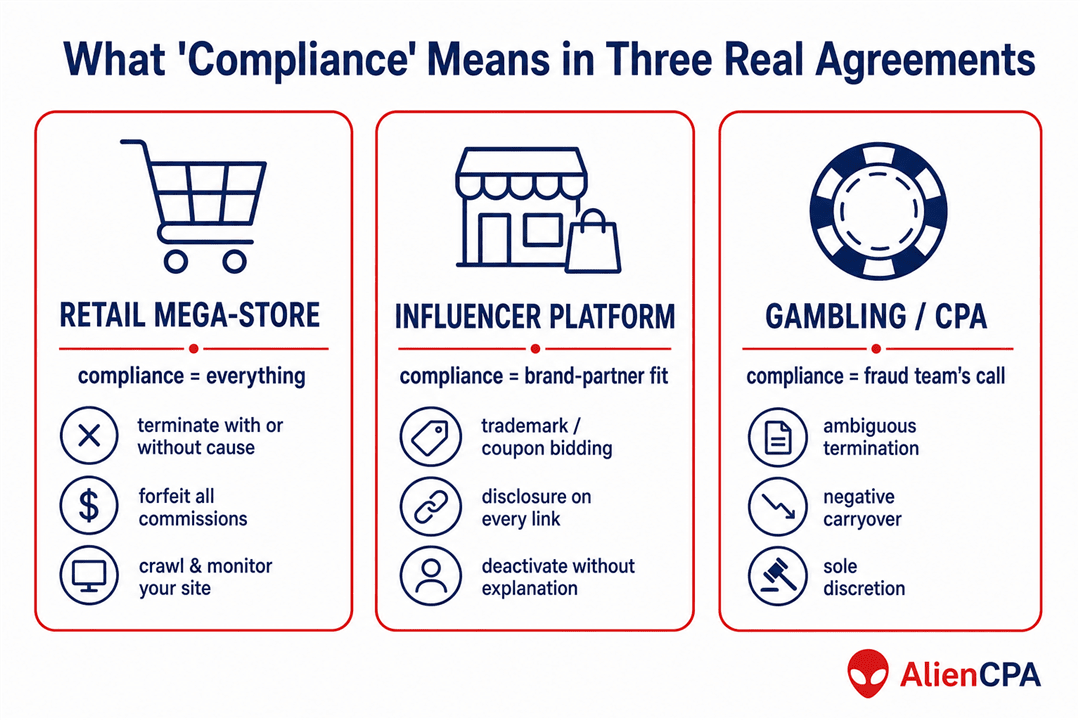
Amazon Associates: compliance = everything
Amazon's Associates Program Operating Agreement gives Amazon the broadest discretion in the industry. Section 6 states that "Either you or we may terminate this Agreement at any time, with or without cause," and that "any violation of Section 5 and as specified in the Program Policies will be deemed a material breach." Section 2 layers on the financial consequence: "If you violate this Agreement… we reserve the right to permanently cease payment of (and you agree you will not be eligible to receive) any and all commission income otherwise payable to you under this Agreement, whether or not directly related to such violation without notice."
Amazon also embeds a standing compliance-verification right — "You must promptly provide us with any information that we request to verify your compliance with this Agreement" — and Section 12 grants Amazon the right to "review, monitor, crawl, and otherwise investigate your Site."
The October 2025 agreement update tightened intellectual property usage and disclosure language. The December 20, 2024 update before that formalized the no-double-dipping rule.
Nothing in any of that defines a single thing called "compliance." It defines a perimeter. Anything inside is grounds.
Mavely: compliance = brand-partner fit
Mavely's compliance documentation is unusually explicit by influencer-platform standards. The published creator policy bans four categories: trademark bidding, coupon bidding, glitch promotions, and misleading audiences. Mavely's help center adds operational rules — VOIP phone numbers stopped being accepted on March 1, 2025, certain promotional words like "glitch," "error," "free," and "mistake" are off limits in creatives, and link-sharing in private paid channels is prohibited because the platform cannot verify usage there.
Then comes the clause that matters: "If an account is found to be out of compliance or no longer aligning with brand partners' expectations for affiliate marketers, Mavely reserves the right to deactivate the account without further explanation." "No longer aligning with brand partners' expectations" is not a rule you can read and follow. It is a discretion shaped by Mavely's conversations with the merchants that pay them. You can be FTC compliant, disclosure compliant, link-channel compliant, and still be deactivated under that one sentence.
Gambling and CPA networks: compliance = whatever the fraud team decides
Affiliate Guard Dog audits gambling affiliate programs against nine criteria, including predatory T&Cs, retroactive T&C changes, negative carryover, ambiguous termination clauses, and T&C update notifications. The "ambiguous termination clause" criterion exists precisely because some programs reserve termination with no defined cause, no evidence obligation, and no fixed final-payment window. For most CPA networks, "compliance" reduces to whatever the fraud team's review concludes.
The Six Real Categories Behind "Account Closed for Compliance"
When you read enough deactivation emails and dispute threads, the same six categories keep appearing under that one word.
1. FTC and disclosure failures
Missing or non-prominent affiliate disclosures. Mavely requires its disclosure on every shared link. Amazon requires a substantially similar version of "As an Amazon Associate I earn from qualifying purchases." This is the cleanest one-line route to a compliance termination, and the one violation where the platform's evidence is trivial to gather: a screenshot of your page.
2. Trademark, coupon, and brand-bidding violations
Buying paid search ads on the merchant's brand name, on "[Brand] coupon" terms, or on "[Brand] discount" keywords. Mavely lists trademark and coupon bidding as standalone violation categories. Most retail and SaaS programs treat brand bidding as immediate termination grounds because it inflates the brand's own paid-search costs. Affiliates often discover the rule after the ban.
3. Fraud-detection triggers
The broadest bucket. Suspicious IP origin, data-center traffic, identical device fingerprints across leads, conversion velocity outside human ranges, geographic mismatch between click and conversion. The 24metrics 2026 detection guide cites thresholds like time-to-conversion under five seconds, identical device fingerprints generating 10+ conversions in 24 hours, residential proxy share above 8%, and click-to-install ratios above 5,000:1 (versus a legitimate 50:1 to 500:1 range). Hit several and a fraud team files a compliance report on you.
4. KYC and identity verification gaps
Many networks have shifted to bank-grade KYC at first payout or above a threshold amount. AffLift's own community guide frames it as standard practice that "reduces fraud and crime." Translation: at the point you ask for money, you may be asked for ID, proof of address, business documents, or a tax form. Decline, fail, or trip a sanctions check, and the platform records that as a compliance failure.
5. Duplicate accounts and double-attribution detection
Amazon's December 2024 update explicitly prohibits earning commissions from both Amazon Associates and another monetization program on the same qualifying traffic. CrakRevenue publicly bans affiliates for multi-account creation: in one AffiliateFix dispute from May 2024, the network told an affiliate, "You created multiple accounts with us under different emails, and all of your affiliate accounts were banned for the same reason." Whether the duplication was deliberate or a side effect of an old test account, the compliance label is the same.
6. "Sole discretion" and brand-fit deactivations
The hardest to defend against. Mavely's "no longer aligning with brand partners' expectations" clause is the textbook example. Amazon's "with or without cause" termination right is the broader version. Anything that does not fit cleanly into the first five categories falls here. There is rarely a stated reason because the contract does not require one.
These six categories are not mutually exclusive. A real deactivation often touches several at once — and the email cites none of them.
How Networks Actually Detect "Non-Compliance"
If you understand the detection stack, the timing makes sense.
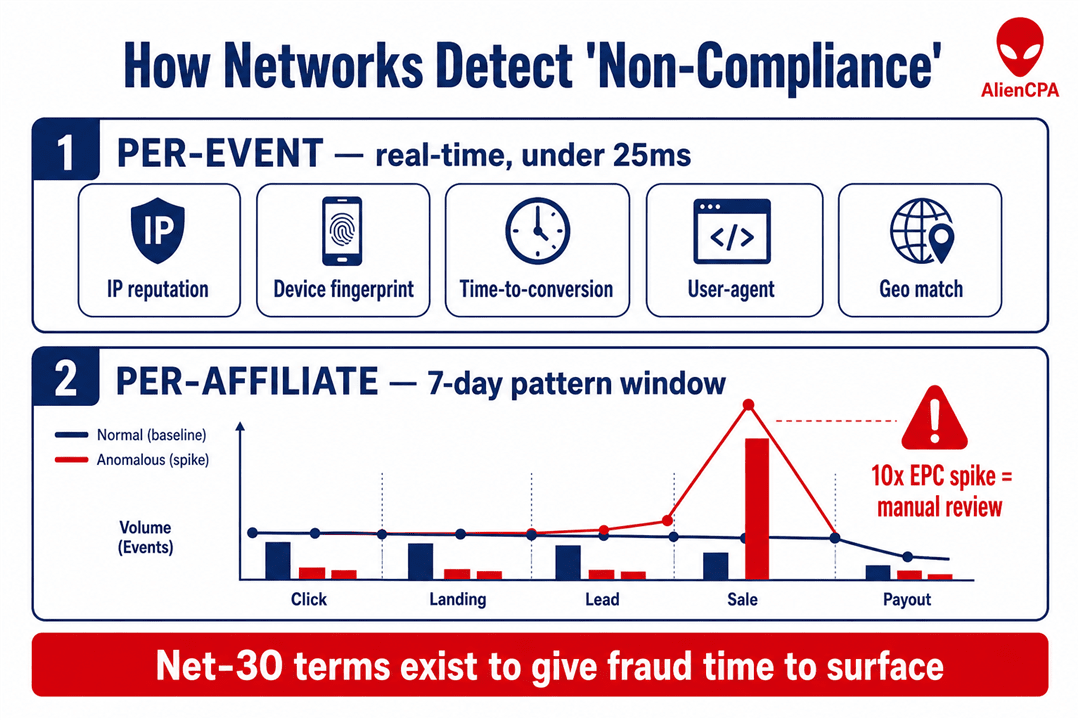
Industry data from the 24metrics 2026 guide pegs ad fraud losses at around $84 billion in 2023 and estimates that for most CPA programs, 15% to 25% of affiliate spend is fraudulent or invalid traffic. Detection runs in two layers.
Per-event detection is the real-time layer. Every click and conversion is scored against IP reputation, device fingerprint, time-to-conversion, user-agent consistency, and geo alignment, with bad events rejected in under 25 milliseconds. This is what quietly nulls out a portion of your traffic before it ever appears in your dashboard.
Per-affiliate detection is the pattern layer. Conversions aggregate over typically seven-day windows, and your account is compared against itself and benchmark distributions. A solo affiliate generating a normal-shaped funnel rarely triggers it. A campaign that suddenly 10x's your usual EPC, or a payout request after months of quiet activity, almost always triggers a manual review. The 24metrics guidance is blunt: "sophisticated fraud reveals itself within 30 days if someone is actually looking," and Net 30+ payment terms exist explicitly to "provide time for fraud to surface."
That is the entire reason compliance terminations cluster around payout day. AffiliateFix's community framing matches: an Adflex representative summarised it as "every ads network already have some program to check all traffic details like IP, device type, imei, time downloading, time open the game/app, etc." Standing infrastructure, not an exception applied to your account.
The table below maps each compliance category to its typical detection mechanism and realistic recovery odds.
- FTC / disclosure failures: How networks detect it - Manual crawl, automated page scan, screenshot; Evidence you usually get - The flagged page or link; Realistic recovery odds - Moderate — fix and reapply often works
- Trademark / coupon bidding: How networks detect it - Brand-protection scanners, manual SERP checks; Evidence you usually get - Screenshot of paid search ad; Realistic recovery odds - Low — usually treated as material breach
- Fraud-detection triggers: How networks detect it - Real-time signal stack + 7-day pattern review; Evidence you usually get - Vague: "suspicious traffic," "invalid conversions"; Realistic recovery odds - Low to moderate — depends on documentation
- KYC / identity gaps: How networks detect it - Identity-verification vendor (Onfido, Persona-style); Evidence you usually get - Document request emails; Realistic recovery odds - High if you actually pass KYC
- Duplicate / double attribution: How networks detect it - Account-link graphs, tag deduplication; Evidence you usually get - Email naming the linked accounts; Realistic recovery odds - Low — networks rarely reverse
- "Sole discretion" / brand fit: How networks detect it - Brand-partner request or internal review; Evidence you usually get - "No further explanation"; Realistic recovery odds - Near zero — there is no rule to disprove


Fraud vs Policy Violation — Different Words, Different Recovery Odds
Two affiliates can get the same deactivation email and have radically different recovery odds depending on whether the platform calls it fraud or policy violation. The words are not interchangeable.
Fraud in T&C language usually means deliberate manipulation — bots, cookie stuffing, fake leads, incentivized traffic disguised as organic, identity theft on lead forms. Once the network alleges fraud, consequences are maximum: forfeit balance, permanent ban, no practical appeal. CrakRevenue's response to the AffiliateFix $400 dispute was a textbook example: "Our actions were based on a thorough review, and we stand by our findings and decision." Public fraud disputes against established networks rarely succeed because the network's confidence signals that they have data the affiliate cannot see.
Policy violation is broader and softer. Disclosure missing, traffic source disallowed, attribution tag duplicated, KYC document missing. The bar to allege one is low, but so is the punishment ceiling. A first offense can be a warning. Many programs run a graduated path — warning, commission hold, termination — when they want the relationship to continue.
The dangerous variant is the policy-relabel-as-fraud sequence: approved traffic later flagged as "fraudulent" at payout.
When you read your deactivation email, the first thing to notice is which word the platform chose. The second is whether they offered any evidence beyond that word.
What Public Complaints Actually Show
Three platforms, three different shapes of the same problem.
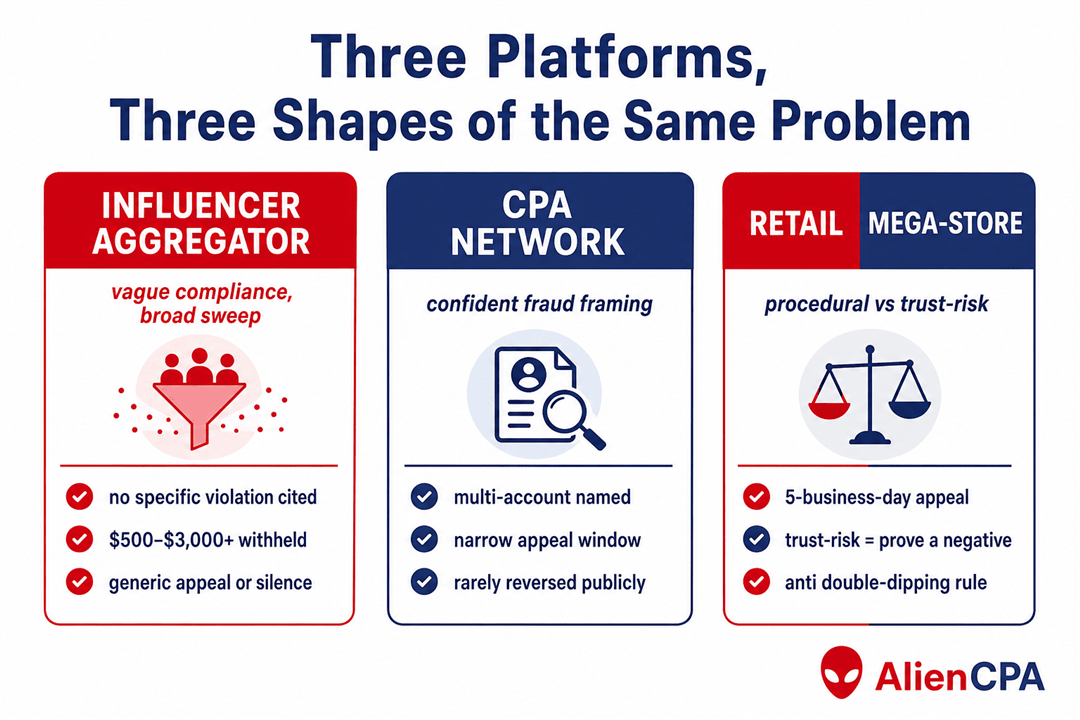
Mavely: vague compliance, broad sweep
Mavely's complaint pattern on Trustpilot and Reddit is the most documented version of compliance-driven deactivation in the influencer aggregator space. Recurring elements: months of link-sharing, balance approaching payout range, deactivation with no specific violation cited, generic appeal responses or silence. Public dollar amounts range from roughly $500 to over $3,000.
One widely cited Reddit complaint describes an account closed for "279 non-compliant links" with no examples provided, despite the affiliate's claim of full FTC disclosure on storefronts also actively running on Walmart, Target, and Amazon. Same creative, same disclosures, three programs approving and one deactivating — that is what an opaque "brand-fit" compliance call looks like from the outside. Our Mavely Review 2026 covers the platform-specific picture.
CrakRevenue: confident fraud framing, narrow appeal window
CrakRevenue runs the opposite playbook. Compliance closures are explicit, named, and confidently defended. The AffiliateFix $400 dispute on May 27, 2024 is representative — the network identified multi-account creation, named the linked emails, and refused refund. A separate post from January 23, 2025 in the same forum indicates some reinstatements after detailed appeals with documentation, but the default position is closed. When the network confidently cites specific compliance grounds with named accounts or IDs, public forum pressure rarely moves the decision.
Amazon: procedural vs trust-risk closure
Amazon's compliance terminations split into two buckets. The Closed Account Appeals page is explicit: "If your account was closed for something that we consider to be a violation that is not a customer trust risk (for example, you failed to respond to a request for more information), you may correct the violation and appeal." For customer-trust risk violations like redirecting traffic from an Amazon Site, "we will review only an appeal that provides detailed evidence that our facts were wrong in our violation analysis."
Three platforms. Three completely different doors. Same one-word label.
What to Document Before You Appeal
Most compliance appeals fail because the affiliate writes a tone-first email instead of an evidence-first packet. Reverse the order.
Snapshot the dashboard the moment you read the email
Earnings by month, balance, last conversion. The moment you lose dashboard access — sometimes within minutes — your only evidence is what you already exported. Step zero, not step one.
Identify which of the six categories the email targets
Read the email twice. Underline the specific noun — fraud, disclosure, traffic source, attribution, duplicate account, brand fit. If no noun is named, treat it as the "sole discretion" category and adjust expectations accordingly.
Gather category-matched evidence
For disclosure: page screenshots with timestamps. For traffic source: reports from your ad platform or tracker. For fraud claims: granular conversion logs, GEO breakdowns, click-time distributions, your own pre-existing fraud-filter results. For KYC: clean ID, proof of address, tax form, business registration. For double attribution: a clear technical statement of how your links were tagged. For "brand fit": there is no evidence path — focus on documenting the relationship and skip to escalation.
Cite the exact policy section in your appeal
Amazon's appeal form, AffiliateFix dispute threads, and AGD complaint posts all reward affiliates who reference Section numbers. Vague indignation reads as a rule-breaker bargaining. The language of the contract is the language of the appeal.
Respect the appeal window
Amazon allows five business days. Most CPA networks close formal appeal channels within 30 days of termination. Forum pressure and demand letters remain available after that, but the platform's internal review path closes early. If the email cites brand-partner discretion or a sole-discretion clause, the contract has already foreclosed the appeal; redirect energy to diversification.
Red Flags Before You Sign Up With a Network
Compliance deactivations are easier to avoid than to undo. The signals are visible in T&Cs and in public reviews before you send the first click.
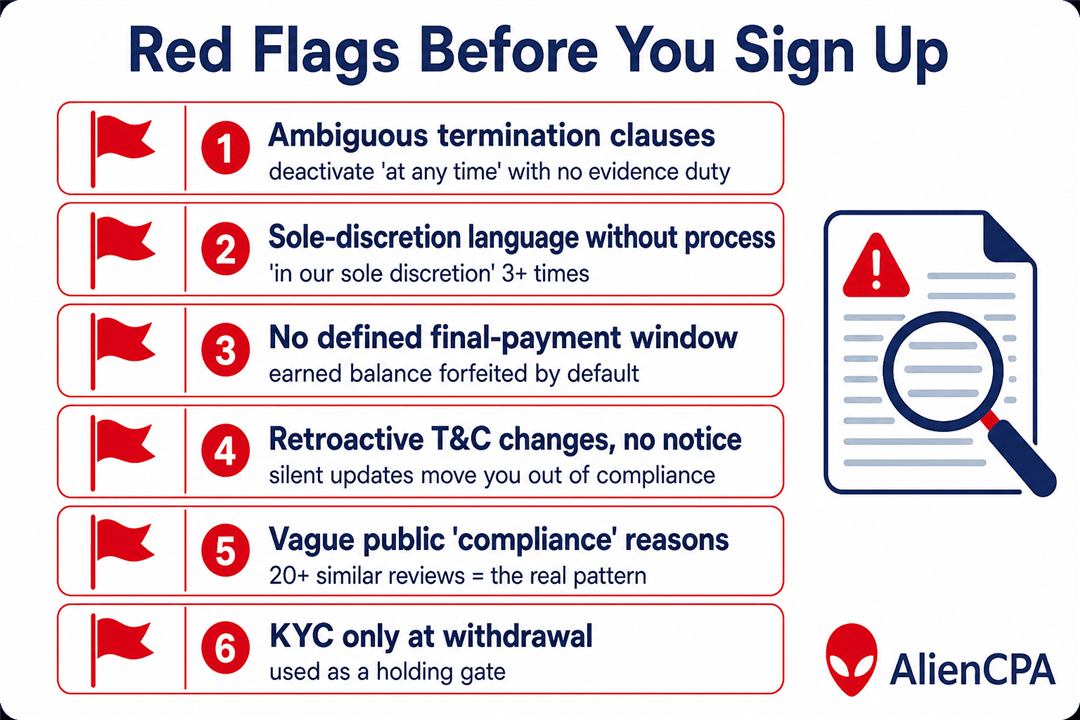
Ambiguous termination clauses. AGD flags this in its predatory audit for a reason. A termination clause that allows the platform to deactivate "at any time" or "in its sole discretion" without a defined evidence obligation is a compliance landmine. Presence alone is not unusual — Amazon, PIN-UP, and Mavely all have it. The warning is the absence of counterbalancing language (notice period, evidence on request, final-payment window).
Sole-discretion language without process. If the agreement uses "in our sole discretion" three or more times in the termination, payment, and fraud sections, assume that is the operating model. The clauses will be invoked.
No defined final-payment window. AGD's framework explicitly recommends programs "need a better reason for termination and pay final fees within 90 days." If the contract does not specify what happens to your earned balance on closure, the default in practice is forfeiture.
Retroactive T&C changes without email notice. Programs that update terms quietly and require continued participation as "acceptance" can move you into a compliance violation without ever telling you.
Vague public language for "compliance" reasons. Cross-reference Trustpilot, Reddit, and Affiliate Guard Dog. Twenty unconnected reviews describing vague compliance emails before payout is the network's actual operating pattern.
KYC only at withdrawal. Networks that delay KYC until the first payout request rather than at onboarding have chosen to use it as a holding gate.
Frequently Asked Questions
Is "compliance" the same thing as fraud in an affiliate T&C?
No, and the distinction matters for your appeal. Fraud in affiliate language usually means deliberate manipulation (bots, cookie stuffing, fake leads) and carries the maximum penalty: balance forfeit, permanent ban, almost no recovery.
Compliance is broader and includes everything from FTC disclosure to KYC to brand fit. A compliance violation that is not labeled fraud often has a real appeal path. A fraud allegation almost never does. Read your deactivation email for which word the platform used.
Can a platform close my account if I followed every published rule?
Often, yes — usually legal under the T&Cs you accepted. "Sole discretion" and "with or without cause" clauses, present in Amazon's Operating Agreement and most influencer-platform terms, allow termination without rule-breaking on your side. Mavely's published policy explicitly allows deactivation when your account "no longer aligning with brand partners' expectations." This does not make every such closure fair, but it usually makes it enforceable.
How do I know if my compliance issue is a KYC problem or a fraud problem?
Look at the requested next step. KYC issues come with document requests — ID, proof of address, tax form, business registration. The platform wants paperwork from you. Fraud issues come with no document request and often no specific question — the platform's review is internal and your participation is not asked for. If you are being asked for documents, that is good news: KYC failures often resolve when the paperwork is clean.
Can my Amazon Associates account get closed for inactivity or low sales?
Yes. Amazon requires accounts to generate qualifying sales within defined windows; failing to do so is a procedural closure, not a customer-trust violation. The non-customer-trust path allows correction and reapplication. This is the easiest compliance category to recover from, because the standard of proof is "you fixed it."
Is being deactivated for "compliance" recorded in some kind of industry blacklist?
There is no universal blacklist for affiliates. There are network-level lists and shared fraud-flag exchanges between some CPA networks (especially in iGaming and finance verticals), which means a compliance termination in one place can affect approval at related programs. There is no public registry you can query. Influencer-platform terminations rarely cross over to retail affiliate networks because the tracking and disclosure stacks are different.
Should I publicly post about my compliance termination?
Sometimes — but read your agreement first. Many T&Cs include confidentiality clauses. Affiliate Guard Dog and AffiliateFix dispute sections are the appropriate venues if you have documentation. Twitter rants rarely move the platform and can complicate future re-applications elsewhere. The forum route preserves your evidence and your relationship with other networks reading those threads.
The Bottom Line
"Account closed due to compliance" is the affiliate-industry version of a black-box rejection. The phrase exists because it has to cover six different operating realities — disclosure, traffic source, fraud detection, KYC, attribution, and brand fit — and the platforms benefit from the ambiguity at every touchpoint. The contract is built around it. The support reply repeats it. The appeal form rarely defines it.
This analysis does not claim every platform that closes accounts on compliance grounds is acting in bad faith. Some compliance terminations are textbook deserved enforcement: brand bidding, multi-accounting, undisclosed paid promotion, real fraud. Others are policy violations relabeled as fraud when the balance becomes inconvenient. Most live in the middle, where the contract gives the platform broad discretion and the affiliate spends the energy chasing a definition that does not exist in writing.
The defensive posture is the same in every case. Read the termination, compliance, and fraud sections of the agreement before you send traffic. Treat KYC readiness as a precondition, not a hurdle. Document disclosures, traffic sources, and conversion patterns in real time, not after the email. Cash out early so that "compliance review" never has six months of earnings to evaluate. Diversify so that no single platform's discretion is your entire P&L.